The Complete SDR Playbook for 2026: Your End-to-End Guide
The definitive SDR playbook for 2026: ICP definition, list building, multichannel cadences, cold email, LinkedIn, call scripts, handoff, metrics, and AI tools.

Key takeaways
- A modern SDR playbook must integrate multichannel sequences (phone, email, LinkedIn, video) with 12-16 touches over 3-4 weeks, adapting cadence intensity based on ICP tier and deal size to maximize conversion without burning leads.
- Effective ICP definition goes beyond firmographics to include behavioral signals—recent funding, tech stack changes, hiring patterns, and intent data—that indicate active buying cycles and dramatically improve connect rates.
- Outcome metrics (conversation rate, meeting-held rate, qualified opportunity rate, pipeline generated) predict revenue impact far better than activity metrics (dials, emails sent), yet most SDR playbooks still over-index on volume.
- AI tools should handle research automation, personalized messaging at scale, and role-play practice, freeing SDRs to spend 70%+ of their time in live conversations rather than administrative tasks.
- The SDR-to-AE handoff is the highest-leverage moment in the funnel: a structured live sync with documented discovery findings, stakeholder maps, and qualification scores increases demo-to-close rates by 30-40% compared to email-only handoffs.
What is an SDR playbook and why you need one
An SDR playbook is the complete operating system for your sales development team—the documented processes, frameworks, scripts, and standards that turn prospecting from an art into a repeatable science. It answers every tactical question an SDR faces: which accounts to target, how to research them, what to say in the first 10 seconds of a cold call, when to follow up, how to navigate gatekeepers, what qualifies as a good meeting, and how to hand off to account executives.
Without a playbook, every SDR invents their own approach. Your top performer books 15 meetings a month using a specific LinkedIn-then-call sequence, but that knowledge lives only in their head. Your newest hire flails through generic cold emails because no one showed them the messaging framework that actually works for your buyer. Onboarding takes 90 days instead of 45. Ramp time stretches. Pipeline becomes unpredictable.
A well-built SDR playbook solves this. It captures what works, scales best practices across the team, and creates a foundation for coaching. When every rep follows the same core process, managers can spot exactly where individuals struggle—is it tonality on cold calls, qualification rigor, or follow-up persistence?—and coach to the gap.
In 2026, the best SDR playbooks also integrate AI tools strategically. They specify when to use conversation intelligence for call review, how to leverage AI role-play for objection handling practice, and which parts of research or email personalization to automate. The playbook becomes a living system that compounds team performance over time.
This guide is that playbook. We'll walk through every component—ICP definition, list building, multichannel cadence design, cold calling, cold email, LinkedIn strategy, qualification, handoff protocols, metrics, and AI integration—with the tactical depth you need to implement immediately.
Define your ideal customer profile with surgical precision

Your ICP is not "B2B SaaS companies with 50-500 employees." That's a starting point, but it's far too broad to drive real prospecting efficiency. In our AI role-play sessions at QUOTA, we see SDRs waste 40-50% of their outreach on accounts that look right on paper but will never close, because the ICP lacks behavioral and contextual filters.
Start with firmographics, but go three layers deeper:
Firmographic foundation: Company size (employee count and revenue band), industry/vertical, geography, and funding stage. For enterprise deals, add "Fortune 1000" or "publicly traded" as a filter. For product-led growth motions, layer in "uses [complementary tool]" as a signal of tech-forward buying behavior.
Technographic signals: What tech stack does your ideal customer already use? If you sell sales enablement software, look for companies using Salesforce, Outreach, or Gong—they've already invested in the category and understand the value. If you sell to engineering teams, filter for companies using your integration partners' tools. Technographics predict need and shorten sales cycles.
Behavioral triggers: This is where most playbooks fail. Layer in signals that indicate active buying intent: recent funding rounds, new executive hires (especially in your champion role), office expansions, product launches, tech stack changes visible on job postings, or spikes in hiring for roles your product supports. These triggers move accounts from "fits our ICP" to "probably in-market right now."
Negative filters: Equally important—document who you don't target. If your product requires a minimum team size to deliver ROI, exclude smaller companies. If you've learned that companies using a specific competitor never switch, exclude them. If certain industries have compliance blockers, note it. Negative filters save reps from wasting time on unwinnable deals.
Build three ICP tiers:
- Tier 1: Perfect-fit accounts with active buying signals. These get your most intensive cadence (16+ touches, senior rep assignment, video messages, handwritten notes).
- Tier 2: Strong-fit accounts without immediate signals. Standard cadence, still high priority.
- Tier 3: Acceptable fit, lower priority. Lighter-touch nurture cadence or marketing automation until a trigger event occurs.
Document your ICP in a one-page reference sheet every SDR can access. Include example companies in each tier, the "why" behind each filter, and where to source the data (LinkedIn Sales Navigator, ZoomInfo, Clearbit, 6sense, Bombora). Review and update quarterly as you learn which signals actually predict closed deals.
Build your target account list with intent and intelligence
Once your ICP is defined, list building becomes a data operation, not a guessing game. The goal is a prioritized, enriched list of accounts that your SDRs can work top-to-bottom with confidence that every account is worth the effort.
Step 1: Source your accounts
Use a combination of tools:
- LinkedIn Sales Navigator: Filter by company size, industry, geography, and keywords in company descriptions. Save searches for each ICP tier.
- Intent data platforms (6sense, Bombora, ZoomInfo Intent): Identify accounts actively researching keywords related to your solution.
- Data enrichment tools (ZoomInfo, Clearbit, Apollo, Cognism): Pull firmographic and contact data at scale.
- Your own CRM and website analytics: Mine closed-lost deals from 12+ months ago (circumstances change), inbound leads that didn't convert, and companies that visited your pricing page but didn't fill a form.
Step 2: Enrich with contact data
For each target account, you need 2-4 contacts depending on deal complexity:
- Primary champion: The person with the pain (e.g., Sales Manager, VP Sales, RevOps Director). This is who your SDRs call first.
- Economic buyer: The budget holder (often one level up—VP, CRO).
- Technical evaluator: If your product requires implementation or integration (e.g., Sales Engineer, IT Director).
- End user influencer: Someone who will use the product daily and can advocate internally.
Pull direct dials and mobile numbers where possible—email-only contacts convert at a fraction of the rate. Verify contact data accuracy (tools like Neverbounce or ZeroBounce for emails; manual spot-checks for phone numbers).
Step 3: Layer in research triggers
For Tier 1 accounts, add a "trigger" column to your list: why now? Did they just hire a new VP Sales? Raise a Series B? Post a job listing for roles your product supports? Mention a relevant pain point in an earnings call or blog post?
This research step is where AI saves massive time. Use tools like Clay or Bardeen to automate the scraping of LinkedIn posts, company news, job listings, and funding announcements. Feed this into your CRM as a custom field so SDRs see the context before they dial.
Step 4: Score and prioritize
Assign a score (1-10 or A-F) to each account based on:
- ICP fit (firmographics + technographics)
- Intent signals (active research, website visits, content downloads)
- Trigger events (funding, hiring, tech changes)
- Relationship proximity (do you have a mutual connection, existing customer in the same industry, or warm intro path?)
Your SDRs work the list from highest to lowest score. Re-score monthly as new data comes in.
Step 5: Assign territories
Divide the list by rep, balancing account quality and volume. Avoid giving one rep all the Tier 1 accounts—spread opportunity evenly. Common territory models:
- Geographic: North America, EMEA, APAC.
- Vertical: SaaS, Financial Services, Healthcare.
- Account size: Enterprise (1000+ employees), Mid-Market (200-1000), SMB (<200).
- Named accounts: For ABM motions, assign specific high-value accounts to senior SDRs.
Document territory assignments in your CRM and playbook. Reps should own their territory for at least one quarter to build pipeline continuity.
Design your multichannel cadence architecture
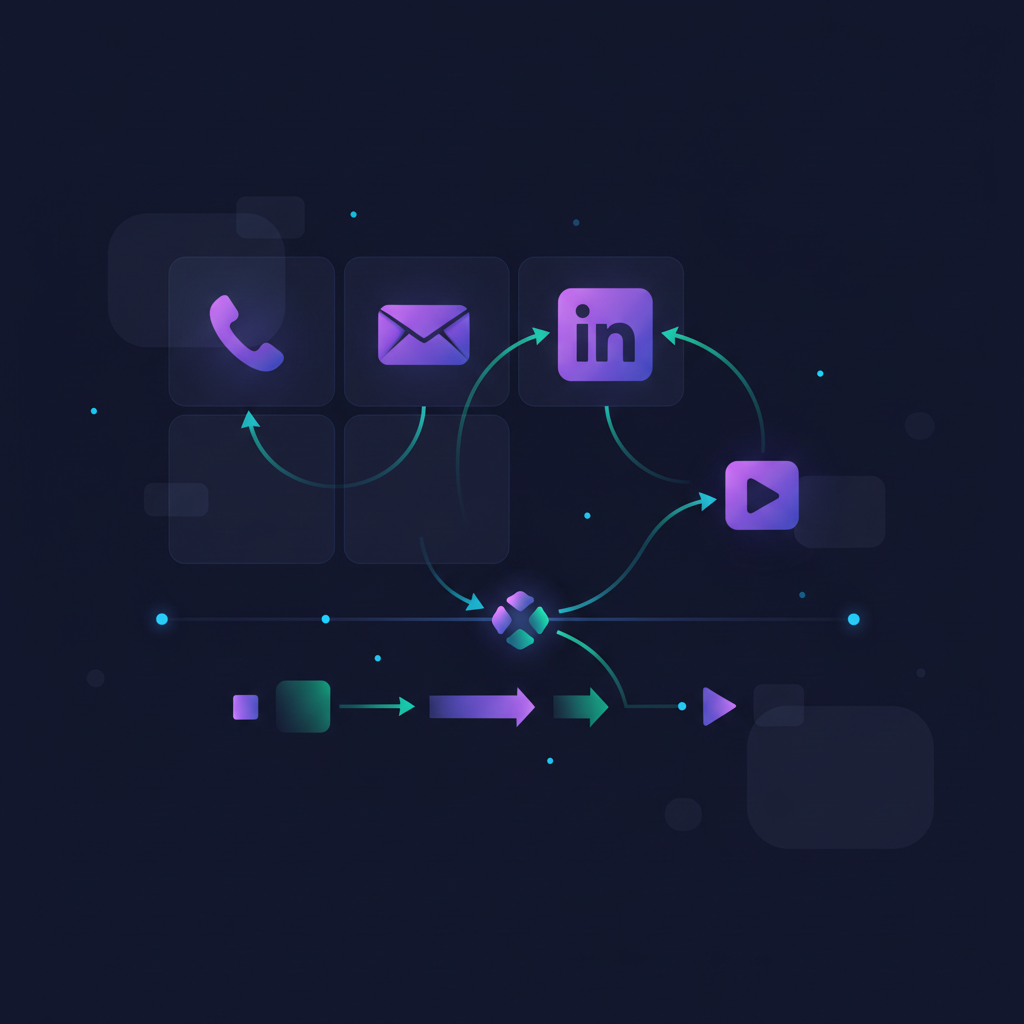
A cadence is the sequence of touches—calls, emails, LinkedIn messages, videos, direct mail—that an SDR uses to engage a prospect over time. The best SDR playbooks in 2026 are ruthlessly multichannel, because no single channel works for every buyer.
According to Salesforce on sales prospecting best practices, it takes an average of 8-12 touches to generate a conversation with a cold prospect, but most SDRs give up after 2-3. Your cadence must be long enough to break through noise, varied enough to respect channel preference, and personalized enough to feel human.
Here's the architecture we see working in QUOTA's AI role-play sessions:
Standard Tier 2/3 cadence (12 touches over 21 days):
- Day 1: Cold call + voicemail, followed by short email referencing the call ("Just tried to reach you...").
- Day 2: LinkedIn connection request with personalized note (reference a recent post or shared interest).
- Day 4: Cold call (no voicemail this time).
- Day 6: Value-add email (share a relevant case study, article, or insight—no ask).
- Day 8: Cold call + voicemail.
- Day 10: LinkedIn message (if they accepted your connection—ask a question or share a resource).
- Day 12: Email with a specific ask ("Would a 15-minute call on [date] work to discuss [pain point]?").
- Day 14: Cold call.
- Day 16: Video message (Loom or Vidyard—personalized, 60 seconds, reference something specific about their company).
- Day 18: Cold call + voicemail.
- Day 21: Breakup email ("I'll assume this isn't a priority right now—should I close your file or circle back in Q2?").
Tier 1 high-priority cadence (16 touches over 28 days): Add 4 extra touches—another call, a handwritten note or direct mail piece, a second video, and a multi-threaded email (CC another stakeholder at the company). Increase personalization at every step: reference their LinkedIn activity, recent company news, or a mutual connection.
For detailed templates and timing, see our guide on how to build SDR prospecting sequences that book meetings.
Channel-specific best practices:
Cold calling: Always the highest-value activity. Aim for 60-80 dials per day. Use a strong opening statement (company name, your name, reason for the call in 10 seconds). For tonality, pacing, and objection handling, follow our complete cold calling guide and cold call preparation checklist.
Cold email: Keep it under 100 words. Personalize the first line (reference a trigger, mutual connection, or pain point). One clear ask. No attachments. Subject lines should be curiosity-driven or question-based, not salesy. A/B test everything—subject lines, CTAs, send times.
LinkedIn: Connection requests should feel human, not templated. Once connected, engage with their content (like, comment thoughtfully) before you pitch. LinkedIn messages should be conversational, not a copy-paste of your email. Use LinkedIn voice messages for high-priority accounts—they stand out.
Video messages: Record a 45-60 second personalized video using Loom or Vidyard. Show your face, reference something specific about their company (their website, a LinkedIn post, a recent hire), explain the value you bring in one sentence, and end with a soft CTA. Videos convert 2-3x better than text-only emails for cold outreach.
Voicemail: Leave a voicemail on touches 1, 3, and 5. Keep it under 20 seconds. State your name, company, and one specific reason they should call back. For exact scripts, see our SDR voicemail scripts guide.
Automation and AI integration:
Automate email sends using your sales engagement platform (Outreach, Salesloft, Apollo). Use AI to generate personalized first lines at scale (tools like Lavender, Regie.ai, or Clay). But never automate calls or LinkedIn messages in a way that feels robotic—those must remain human-led.
Use AI conversation intelligence to analyze which messaging variants perform best, then update your cadence templates monthly based on data.
Master cold calling: the highest-leverage SDR activity
Cold calling is still the fastest path to a live conversation and the highest predictor of SDR success. Email open rates hover around 20-30%; cold call connect rates are 5-10%, but when you connect, you're in a real-time conversation where objections can be handled, pain can be uncovered, and meetings can be booked on the spot.
The problem: most SDRs are undertrained and under-practiced on the phone. They rely on scripts that sound robotic, fail to navigate gatekeepers, and give up after one or two objections.
Your playbook must include:
Pre-call preparation: Before every dial, the SDR should know: the prospect's name and title, one specific reason for the call (a trigger, pain point, or value hypothesis), and one question to ask if they get through. This takes 30-60 seconds per call. For a full pre-call checklist, see our cold call preparation checklist.
Opening statement structure: The first 10 seconds determine whether the prospect hangs up or listens. Use this structure:
- Your name and company (clear and confident).
- Reason for the call (specific and relevant—"I'm calling because you just hired a new sales team and I work with companies scaling their SDR org...").
- Permission-based transition ("Did I catch you at a bad time?" or "Do you have 30 seconds?").
For 8 proven opening frameworks, see our guide on SDR talk tracks that sound natural.
Tonality and pacing: Confidence matters more than the words you use. Slow down—nervous reps talk too fast. Use a downward inflection at the end of statements (upward inflection sounds uncertain). Smile while you talk; it changes your vocal tone. Practice this in AI role-play until it becomes muscle memory.
Handling objections in real time: The most common cold-call objections are "I'm busy," "Send me an email," and "We're all set." Your playbook should include 3-5 scripted responses for each. For example:
- "I'm busy": "Totally understand—this will take 30 seconds. I work with [similar company] to solve [pain point]. Does that sound relevant, or should I let you go?"
- "Send me an email": "Happy to—what's the best email? And just so I send the right info, are you currently [doing X process] in-house, or using a tool?"
The key is acknowledging the objection, then asking a qualifying question that keeps the conversation alive. For deeper objection handling frameworks, see our SDR talk tracks resource.
Gatekeepers: Enterprise deals require navigating executive assistants. The best approach: treat them as allies, not obstacles. Use their name, be direct about who you're trying to reach and why, and ask for their help. "Hi [Gatekeeper name], this is [Your name] from [Company]. I'm trying to reach [Executive] about [specific topic]. What's the best way to get 10 minutes on their calendar?" For 9 proven gatekeeper strategies, see our guide on cold call gatekeepers.
Call volume targets: Top-performing SDRs make 60-80 dials per day, resulting in 8-12 conversations and 1-3 meetings booked. Block 2-hour power-dial sessions (9-11am and 2-4pm are highest-connect windows). Remove distractions—no Slack, no email. Just dial, log, dial.
Role-play and coaching: Cold calling is a skill that degrades without practice. Weekly role-play sessions (live with managers or AI-powered) keep reps sharp. Record calls, review them with conversation intelligence tools, and coach to specific behaviors—tonality, objection handling, question quality. For more on building a coaching system, see our sales coaching frameworks.
Write cold emails that get replies, not deleted
Cold email is your second-highest-leverage channel, but only if you avoid the mistakes that plague 90% of SDR outreach: generic messaging, no personalization, weak subject lines, and unclear CTAs.
Subject line principles:
- Curiosity over clarity: "Quick question" or "Thoughts on [specific topic]?" outperforms "Introduction from [Your Company]."
- Personalization: Include their company name, a mutual connection, or a specific reference ("Saw your post on [topic]").
- A/B test ruthlessly: Test 3-5 variants per campaign. Track open rates and iterate weekly.
Email body structure (under 100 words):
-
Personalized first line (1 sentence): Reference a trigger event, LinkedIn post, mutual connection, or pain point specific to their company. This proves you did research and aren't blasting 1,000 identical emails.
Example: "I noticed you just expanded your SDR team from 5 to 12 reps—congrats on the growth."
-
Value statement (1-2 sentences): Explain what you do and why it matters to them. Focus on the outcome, not your product features.
Example: "We help sales leaders cut SDR ramp time in half by giving reps unlimited AI role-play practice on cold calls and objection handling."
-
Social proof (1 sentence, optional): Name a similar company or result.
Example: "We've helped teams at [Company A] and [Company B] boost meeting-booked rates by 30%+."
-
Clear, low-friction CTA (1 sentence): Ask for a specific next step—15-minute call, quick question answered, or permission to send more info.
Example: "Would a 15-minute call next Tuesday or Wednesday work to explore if this makes sense for your team?"
What to avoid:
- Attachments: They trigger spam filters and feel presumptuous.
- Multiple CTAs: One ask per email. "Can we chat? Or if not, here's a link to a case study, and also check out our blog..." is confusing.
- Feature dumping: No one cares about your product's features. They care about their problems.
- Fake personalization: "I loved your recent LinkedIn post" when you clearly didn't read it. Prospects see through this instantly.
Follow-up cadence: Most replies come on touches 3-6, not touch 1. Your playbook should script 4-5 follow-up emails:
- Touch 2 (2 days later): "Just bumping this up—did you get a chance to look?"
- Touch 3 (4 days later): Value-add email (share a case study, article, or insight with no ask).
- Touch 4 (7 days later): Different angle—new pain point or use case.
- Touch 5 (10 days later): Breakup email ("Should I close your file, or is this worth revisiting in Q2?").
Breakup emails often get the highest reply rates because they create urgency and give the prospect an easy out, which paradoxically makes them more likely to engage.
AI and automation: Use AI tools (Lavender, Regie.ai, Clay) to generate personalized first lines at scale by scraping LinkedIn activity, company news, and job postings. But always review and edit—AI-generated emails can feel generic if you don't add a human touch.
Track metrics: open rate (aim for 30%+), reply rate (aim for 5%+), and positive reply rate (aim for 2%+). If your open rates are low, test subject lines. If reply rates are low, test personalization and value propositions.
Leverage LinkedIn as a relationship channel, not a spam tool
LinkedIn is the most powerful channel for relationship-building and warm outreach, but most SDRs treat it like another email blast platform—sending 50 copy-paste connection requests a day with a pitch in the first message.
Your playbook should position LinkedIn as a relationship-first channel:
Connection requests: Send 20-30 per day to target accounts. Personalize every request with a 2-3 sentence note:
- Reference a mutual connection, shared group, or recent post.
- Mention why you're reaching out (e.g., "I work with sales leaders in SaaS and noticed you're scaling your SDR team—would love to connect and share ideas").
- No pitch. Just a reason to connect.
Acceptance rates for personalized requests are 30-40%, vs. 10-15% for generic requests.
Engage before you pitch: Once connected, don't immediately send a pitch message. Instead:
- Like and comment on their posts (thoughtful comments, not "Great post!").
- Share relevant content they might find useful.
- Wait 3-5 days, then send a conversational message.
This builds familiarity and reciprocity. When you do pitch, they're far more likely to respond.
LinkedIn messaging frameworks:
For warm connections (accepted your request): "Hey [Name], thanks for connecting! I saw your post about [topic] and it resonated—we're seeing a lot of sales leaders struggle with [related pain point]. If you're open to it, I'd love to share how we're helping teams like [similar company] solve that. Worth a quick call?"
For cold outreach via InMail (if you have Sales Navigator): Keep it even shorter—InMail is expensive (credits) and feels more intrusive. Lead with a strong hook (trigger event, mutual connection, or specific pain point), one sentence of value, and a question.
LinkedIn voice messages: Sales Navigator allows 1-minute voice messages. These are gold for high-priority accounts—record a personalized message referencing something specific about their profile or company. Voice messages have a 40%+ response rate because almost no one uses them, so they stand out.
Content sharing and thought leadership: Encourage your SDRs to post content 1-2x per week—insights from customer calls, lessons learned, industry trends. This builds their personal brand and makes cold outreach warmer (prospects see you're active and knowledgeable, not just a robot sending messages).
Automation boundaries: Tools like Phantombuster or Waalaxy can automate connection requests and follow-ups, but use them carefully. Over-automation leads to account restrictions and feels spammy. Automate connection requests, but keep messaging and engagement manual.
Qualify relentlessly: not every conversation is a meeting
One of the biggest mistakes in SDR playbooks: treating every connect as a win and booking meetings with unqualified prospects. This floods your AE calendar with junk, tanks demo-to-close rates, and erodes trust between SDR and AE teams.
Your playbook must define what qualifies as a meeting-worthy opportunity and train SDRs to disqualify fast.
Qualification framework: Use BANT (Budget, Authority, Need, Timing) or a modern variant like MEDDIC as your baseline. At the SDR stage, you're doing light qualification—enough to know the prospect is worth an AE's time, but not a full discovery.
Minimum bar for booking a meeting:
- Need/Pain: The prospect has acknowledged a problem your product solves. They're not just "interested in learning more"—they have a specific pain point.
- Timing: They're exploring solutions now or within the next 3-6 months (not "maybe next year").
- Authority: You're speaking with someone who has influence over the decision, or you've identified the decision-maker and have a path to them.
- Fit: They match your ICP (company size, industry, use case).
Disqualification triggers: Train SDRs to disqualify and move on when:
- The prospect has no budget or no authority to allocate budget.
- They're locked into a long-term contract with a competitor (12+ months remaining).
- The pain point doesn't align with your product's core value prop.
- They're "just researching" with no active project or timeline.
Disqualifying bad fits is a good thing—it frees up time to work better accounts and keeps your pipeline clean.
Qualification questions: Your playbook should script 5-8 questions SDRs ask during cold calls or email exchanges to qualify:
- "What's driving you to look at [category] solutions right now?"
- "What are you currently using to solve [pain point]?"
- "Who else is involved in evaluating tools like this?"
- "What does your timeline look like—are you hoping to have something in place by [date]?"
- "Do you have budget allocated for this, or is that something you'd need to secure?"
For a deeper dive into qualification methodology, see our guide on discovery call qualification questions.
When to book the meeting: If the prospect answers 3+ qualification questions positively and expresses genuine interest, book the meeting. Use a scheduling link (Calendly, Chili Piper) to reduce friction—don't play email tag over availability.
When to nurture instead: If the prospect is interested but not ready (e.g., "We're looking at this for Q3"), add them to a nurture sequence—monthly check-ins, value-add content, trigger-based follow-ups (when their contract is up for renewal, when they hire a new decision-maker). Don't force a premature meeting.
Execute a clean SDR-to-AE handoff that wins deals
The handoff is where most pipeline leaks. SDRs book meetings, but the context doesn't transfer. AEs show up to discovery calls without knowing what pain points were discussed, which stakeholders are involved, or what the prospect is expecting. The call starts cold, trust erodes, and deals stall.
Your playbook must standardize the handoff process:
Live sync call (15 minutes, required for all Tier 1 opps and recommended for Tier 2): The SDR and AE meet before the prospect call to brief. The SDR shares:
- Why the prospect took the meeting: What pain point did they mention? What trigger event happened?
- Stakeholders identified: Who are you meeting with? Who else is involved in the decision?
- Qualification notes: Budget signals, timeline, authority, competitive landscape.
- Objections or concerns surfaced: Did they mention pricing, implementation time, or integration requirements?
- Next steps agreed: What is the prospect expecting from this call?
This 15-minute sync doubles the AE's effectiveness on the discovery call because they can tailor the conversation instead of starting from scratch.
Documentation in CRM (required for all opps): The SDR logs:
- Meeting notes: Summary of the initial conversation, pain points discussed, and qualification answers.
- Contact details: Full name, title, email, phone, LinkedIn URL for all stakeholders identified.
- Opportunity score: BANT or MEDDIC score (1-10 or A-F) so the AE knows how qualified the opp is.
- Attachments: Any emails exchanged, LinkedIn messages, or research documents.
Use a standard CRM template (Opportunity object in Salesforce, Deal object in HubSpot) so every handoff looks the same.
Intro email (optional but recommended): The SDR sends a 3-way email introduction connecting the AE and the prospect, recapping what was discussed and confirming the meeting time. This reinforces the relationship and sets a professional tone.
Example: "Hi [Prospect], thanks again for the great conversation earlier! I'm looping in [AE name], our [title], who works with sales leaders like you to [solve pain point]. [AE] will lead our call on [date/time] and dive deeper into [specific topic]. Looking forward to it!"
Post-meeting feedback loop: After the AE's discovery call, they should update the SDR on the outcome: Did the prospect show? Was the qualification accurate? What's the next step? This feedback loop helps SDRs improve their qualification over time and keeps them invested in the deal.
For more on handoff best practices, see Gartner research on sales development effectiveness.
Track the metrics that predict revenue, not just activity
Most SDR playbooks over-index on activity metrics—dials made, emails sent, LinkedIn messages—because they're easy to measure. But activity doesn't predict revenue. Outcome metrics do.
Your playbook should define two tiers of metrics:
Activity metrics (leading indicators, tracked daily):
- Dials per day: Target 60-80 for full-time SDRs.
- Emails sent per day: Target 40-60 (personalized, not mass blasts).
- LinkedIn touches per week: Connection requests, messages, and content engagement.
- Accounts worked per week: How many unique target accounts did the rep touch?
These metrics ensure reps are putting in the volume required to hit outcomes. But they don't tell you if the activity is effective.
Outcome metrics (lagging indicators, tracked weekly/monthly):
- Connect rate: Conversations per dial (target 8-12%).
- Conversation-to-meeting rate: Meetings booked per conversation (target 20-30%).
- Meeting-booked rate: Meetings booked per account worked (target 3-5%).
- Meeting-held rate: Percentage of booked meetings that actually happen (target 70%+). Low held rates indicate poor qualification or no-show follow-up issues.
- Qualified opportunity rate: Percentage of held meetings that convert to qualified pipeline (target 40-60%). This is the ultimate measure of qualification rigor.
- Pipeline generated: Dollar value of opportunities sourced by SDRs (tracked monthly/quarterly).
- Average deal size: Are SDRs sourcing the right-sized deals, or booking meetings with SMB accounts when you target enterprise?
Diagnostic metrics (for coaching):
- Objection handling success rate: When a prospect says "I'm busy" or "Send me an email," how often does the SDR keep the conversation alive?
- Qualification question adherence: Are reps asking the qualification questions in the playbook, or skipping them?
- Tonality and pacing scores: Use conversation intelligence tools to score vocal delivery (tools like Gong, Chorus, or QUOTA's AI role-play platform).
Dashboard and reporting: Build a weekly SDR scorecard that every rep and manager reviews. Include activity, outcomes, and one coaching focus area. Celebrate wins (highest meeting-booked rate, best qualification score) and identify coaching opportunities (low connect rate = tonality issue? Low meeting-held rate = qualification issue?).
Use your CRM and sales engagement platform (Outreach, Salesloft) to automate data collection. Manual tracking doesn't scale.
For a deeper dive into what to measure and why, see our guide on sales coaching frameworks.
Integrate AI tools strategically to 10x SDR efficiency
AI is transforming the SDR role, but not by replacing reps—by automating the low-value tasks (research, data entry, email personalization) and augmenting the high-value skills (conversation, qualification, objection handling).
Your playbook should specify how and when to use AI:
Research automation: Tools like Clay, Bardeen, or Phantombuster can scrape LinkedIn profiles, company websites, funding announcements, and job postings to populate your CRM with trigger events and personalization data. This cuts research time from 5 minutes per account to 30 seconds.
Email personalization at scale: AI tools (Lavender, Regie.ai, Copy.ai) generate personalized first lines for cold emails by analyzing LinkedIn activity, company news, and job titles. The SDR reviews and edits, but the heavy lifting is automated.
Conversation intelligence: Tools like Gong, Chorus, Clari, or AI sales conversation intelligence platforms analyze recorded calls to surface patterns—which talk tracks work, which objections kill deals, where reps talk too much or ask too few questions. Managers use this data to coach at scale without listening to every call.
AI role-play for skill development: This is where QUOTA specializes. SDRs practice cold calls, objection handling, and qualification questions against AI personas that simulate real buyer behavior—skeptical gatekeepers, budget-conscious CFOs, fast-talking prospects. Reps get unlimited reps (pun intended) without burning real leads or taking up manager time. The AI scores tonality, pacing, objection handling, and question quality, then provides instant feedback.
In our role-play sessions, we see reps improve connect rates by 15-20% and objection-handling success by 30%+ after 10-15 practice sessions, because they've built muscle memory for high-pressure moments.
Lead scoring and prioritization: AI can analyze historical data (which accounts closed, which stalled, which ghosted) to score your target list and predict which accounts are most likely to convert. This helps SDRs prioritize their time.
Automated follow-up sequences: Sales engagement platforms (Outreach, Salesloft, Apollo) use AI to optimize send times, suggest next-best actions, and auto-pause sequences when a prospect replies. This ensures no lead falls through the cracks.
What NOT to automate: Live conversations. Cold calls, discovery calls, and real-time objection handling must remain human-led. AI can prepare the rep and analyze the call afterward, but the conversation itself is where trust and rapport are built—and that can't be faked.
Implementation in your playbook: Document which tools your team uses, what each tool does, and when reps should use it. For example:
- "Use Clay to research accounts and pull trigger events before adding them to a cadence."
- "Use Lavender to score your emails for readability and personalization before sending."
- "Record all cold calls and review 3 per week in Gong with your manager."
- "Complete 5 AI role-play sessions per week in QUOTA on objection handling."
Train reps on each tool during onboarding and build AI usage into your weekly activity targets (e.g., "Complete 5 role-play sessions" is a line item on the scorecard).
For more on choosing and implementing AI tools, explore our AI sales conversation intelligence resource.
Build a living playbook that evolves with your team
Your SDR playbook is not a static document you write once and forget. The best playbooks are living systems that evolve as you learn what works, as your market changes, and as your team grows.
Quarterly playbook reviews: Every 90 days, gather your SDR leadership team and review:
- What's working: Which talk tracks, email templates, and cadences are driving the highest conversion rates? Double down on these.
- What's not working: Which messaging angles fall flat? Which objections are we losing to most often? Update scripts and add coaching.
- Market changes: Has your ICP shifted? Are new competitors entering the space? Are buyers raising new objections? Adjust your playbook accordingly.
- New tools or processes: Have you adopted a new AI tool, changed your CRM, or restructured territories? Document it.
Version control: Treat your playbook like software. Use version numbers (v1.0, v1.1, v2.0) and track changes in a changelog so reps know what's new. Store the playbook in a shared workspace (Notion, Confluence, Google Drive) where everyone can access the latest version.
Rep feedback loop: Your SDRs are in the field every day. They hear objections you don't, they discover messaging that works, they find gaps in the playbook. Create a feedback channel (Slack channel, monthly feedback session, or anonymous form) where reps can suggest improvements. The best playbooks are co-created by the team, not dictated from above.
Onboarding integration: Every new SDR should go through the playbook as part of onboarding—not just read it, but practice it. Role-play the cold call scripts, send test emails, run through the qualification questions. The playbook becomes the foundation of your onboarding program.
Coaching tie-in: Use the playbook as your coaching framework. When a rep struggles with cold calls, point them to the cold calling section and run a role-play. When qualification is weak, review the BANT questions together and listen to a call. The playbook becomes the shared language of coaching.
Celebrate wins: When a rep books a big meeting or closes a tough deal using a playbook tactic, share it with the team. "Sarah used the breakup email template and got a reply from a prospect who'd gone dark for 3 weeks—here's what she wrote." This reinforces the playbook's value and encourages adoption.
Your playbook should feel like a competitive advantage, not a compliance document. If reps see it as a tool that makes their job easier and their results better, they'll use it. If it feels like bureaucracy, it will gather dust.
FAQ
What should be included in an SDR playbook?
A complete SDR playbook includes ICP definition, list building methodology, multichannel cadence design (email, phone, LinkedIn, video), messaging frameworks, objection handling scripts, qualification criteria, handoff protocols, activity and outcome metrics, tech stack documentation, and onboarding materials.
How many touches should an SDR cadence include?
Modern SDR cadences typically span 12-16 touches over 3-4 weeks, mixing cold calls, emails, LinkedIn touches, and video messages. The exact number depends on deal size, industry, and buyer seniority—enterprise targets warrant longer sequences than SMB.
What metrics should SDRs track beyond activity?
Beyond dials and emails sent, SDRs should track conversation rate, meeting-booked rate, meeting-held rate, qualified opportunity rate, pipeline generated, average deal size from SDR-sourced opps, and time-to-first-meeting. These outcome metrics predict revenue impact better than activity volume.
How should SDRs use AI in their workflow?
SDRs should use AI for research automation, personalized email generation at scale, conversation intelligence to review calls, role-play practice for objection handling, and lead scoring to prioritize accounts. The key is using AI to handle repetitive tasks while spending human time on high-value conversations.
What's the best way to hand off leads from SDR to AE?
A clean handoff includes a live sync call where the SDR briefs the AE on discovery findings, pain points, stakeholders identified, budget signals, and next steps agreed with the prospect. Documentation should capture meeting notes, qualification scores, and any objections surfaced during prospecting.
How often should an SDR playbook be updated?
Review and update your SDR playbook quarterly (every 90 days) to incorporate new learnings, market changes, messaging that's working, and feedback from the team. Treat it as a living document with version control, not a static PDF.
What's the difference between Tier 1, Tier 2, and Tier 3 accounts in an SDR playbook?
Tier 1 accounts are perfect-fit prospects with active buying signals (recent funding, new hires, intent data) and receive the most intensive outreach—16+ touches, personalized videos, and senior rep assignment. Tier 2 accounts are strong fits without immediate signals and get a standard 12-touch cadence. Tier 3 accounts are acceptable fits that receive lighter-touch nurture sequences until a trigger event occurs.
Should SDRs leave voicemails on every cold call?
No. Leave voicemails on touches 1, 3, and 5 of your cadence—enough to build familiarity without becoming annoying. Keep voicemails under 20 seconds, state your name and company clearly, and give one specific reason to call back. For exact scripts, see our SDR voicemail scripts guide.

Stefano Sechi
Co-founder, QUOTA Training
Stefano Sechi is co-founder of QUOTA Training. He works hands-on with B2B sales teams on cold calling, discovery and objection handling, and shaped much of the methodology behind QUOTA’s AI role-play scenarios.
Turn this into reps, not just reading
QUOTA Training lets your team practise these exact scenarios with an AI buyer that reacts like the real thing — then scores every call.
See it in actionArticles in this guide
The full SDR Playbook cluster — deep dives that build on this guide.
- Mastering Multi-Channel Follow-Up for SDRs with AI Training9 min
- Mastering SDR to AE Handoff with AI Training: Elevate B2B Sales Transitions10 min
- AI Training for SDR Personalization at Scale: Ditch Generic Outreach9 min
- AI Training for SDRs: Mastering Ideal Customer Profile Alignment11 min
- Mastering A/B Testing for SDR Outreach Sequences with AI Training10 min
- Mastering Internal Champion Building for SDRs with AI Training10 min
- Mastering Active Listening for SDRs with AI Training: Unlock Deeper Prospect Insights9 min
- Mastering SDR Time Management with AI Training for B2B Sales10 min
- Mastering AI for Strategic SDR List Building & Prioritization9 min
- AI Training for SDRs: Mastering Business Acumen to Drive Strategic Impact9 min
- Mastering SDR Call Flow Optimization with AI Training11 min
- AI for Intent-Driven SDR Prospecting: Unlocking Buyer Readiness10 min