SDR Coaching Programs: Build a System That Scales Revenue
Part of the SDR Playbook guide: The Complete SDR Playbook for 2026: Your End-to-End GuideDesign SDR coaching programs that cut ramp time, lift quota attainment, and scale without burning out managers. Framework, cadence, and metrics inside.

Key takeaways
- SDR coaching programs must separate onboarding (knowledge transfer) from ongoing coaching (skill development) — conflating the two extends ramp time and dilutes both.
- The highest-performing SDR teams run weekly 1:1 coaching sessions that follow a three-part structure: call review (20 min), skill practice (15 min), and metric accountability (10 min).
- Managers who coach more than 10 SDRs without a structured program see 34% lower quota attainment because coaching becomes reactive firefighting instead of proactive skill-building.
- AI role-play platforms cut manager coaching time by 60% by handling repetitive skill practice, freeing managers to focus on strategic feedback and deal progression.
- SDR coaching ROI should be measured in four metrics: days to first meeting, ramp-to-quota percentage, conversion rate improvement, and 90-day retention rate.
Why most SDR coaching programs fail before they start
The average SDR team operates without a coaching program at all. Instead, managers run what we call "chaos coaching" — reactive, inconsistent feedback triggered by missed numbers or escalated complaints. New SDRs get a week of onboarding, then they're turned loose with a daily activity target and a prayer.
According to The Bridge Group's SDR benchmarking, the median SDR ramp time sits at 3.2 months, and only 58% of SDRs hit quota in any given quarter. When we analyze role-play sessions on the QUOTA platform, the pattern is clear: reps aren't failing because they don't know the product or the process. They're failing because no one is systematically coaching the skills that convert dials into meetings.
Here's what breaks:
Onboarding is mistaken for coaching. You teach product knowledge, CRM workflows, and ICP definitions in week one. That's training. Coaching is the ongoing practice, observation, and feedback loop that turns knowledge into revenue-generating behavior. Most organizations stop after training and wonder why reps plateau at 40% of quota.
Coaching happens only when numbers slip. Managers wait until a rep misses their weekly meeting target, then schedule a "coaching session" that's really a performance intervention. By then, bad habits are entrenched and confidence is shattered.
There's no structure or cadence. One manager reviews calls on Mondays. Another does monthly check-ins. A third coaches "whenever I have time." Reps experience coaching as random and punitive, not developmental.
Skill practice is non-existent. Managers give feedback ("You need to handle price objections better"), but reps never practice the new behavior in a safe environment before their next live call. Feedback without practice is just noise.
If you're building or rebuilding an SDR coaching program, your job is to design a system that solves all four failure modes. That system needs structure, cadence, accountability, and scalable practice mechanisms — which is exactly what this guide delivers.
The Four Pillars of High-Performance SDR Coaching Programs

Every SDR coaching program that consistently lifts quota attainment and cuts ramp time is built on four pillars. Miss one, and the system collapses under scale.
Pillar 1: Structured onboarding that separates knowledge from skill
Your 30-day SDR onboarding plan should front-load knowledge transfer in week one (product, personas, tech stack, process), then shift immediately to skill development in weeks two through four. Week two is tonality, pacing, and opening lines. Week three is objection handling and discovery question frameworks. Week four is live shadowing and reverse shadowing with daily feedback.
Onboarding ends when the rep can execute the core skills at minimum viable competence. Coaching begins on day 31 and never stops.
Pillar 2: Weekly 1:1 coaching sessions with a repeatable structure
The highest-performing SDR managers we work with run 30-45 minute 1:1s every week, following this three-part structure:
-
Call review (20 minutes): Listen to 2-3 recorded calls together. The rep self-assesses first ("What did I do well? What would I change?"), then the manager adds observations tied to specific moments in the call. Focus on one skill per session — tonality, objection response, discovery depth, or close technique — not a laundry list of feedback.
-
Skill practice (15 minutes): Role-play the exact scenario the rep struggled with. If they fumbled a pricing objection, run that objection three times with different variations until the response is smooth. This is where behavior change happens.
-
Metric accountability (10 minutes): Review the rep's weekly scorecard (dials, connects, meetings set, show rate, SQL conversion). Identify the one metric that's blocking quota attainment and set a specific improvement target for next week.
This structure works because it combines observation, practice, and accountability in a single session. Reps leave with clarity on what to improve and confidence they can execute it.
Pillar 3: Peer role-play and group skill workshops
Managers can't be the only source of practice. High-performing SDR coaching programs include weekly or bi-weekly peer role-play sessions where reps practice objection handling, discovery, and closing scenarios in pairs. One rep plays the prospect, the other executes, then they swap and debrief.
Monthly group workshops tackle one skill theme — gatekeepers, multi-threading, or executive-level discovery — with live role-play, manager facilitation, and shared feedback. This builds team learning and normalizes practice as part of the culture.
Pillar 4: AI-powered skill practice that scales without burning out managers
Here's the math problem every SDR leader faces: if you manage 10 reps and each needs three role-play reps per week to build fluency, that's 30 practice sessions. At 10 minutes each, you've just burned five hours — and you haven't coached pipeline, reviewed forecasts, or handled escalations.
This is where AI sales roleplay scenarios become non-negotiable. Reps practice objection handling, discovery, and tonality against an AI buyer that adapts in real time, delivers instant feedback, and logs every session. Managers review the data, identify patterns, and focus their live coaching time on the 20% of skills that drive 80% of revenue.
In our observation, SDR teams that layer AI practice into their coaching programs cut manager coaching hours by 60% while lifting rep skill scores by 40%. The AI handles repetitive practice; managers handle strategic feedback and accountability.
For a full breakdown of how to implement this, see our guide to scaling sales coaching without burnout.
Weekly Coaching Cadence: What to Do When
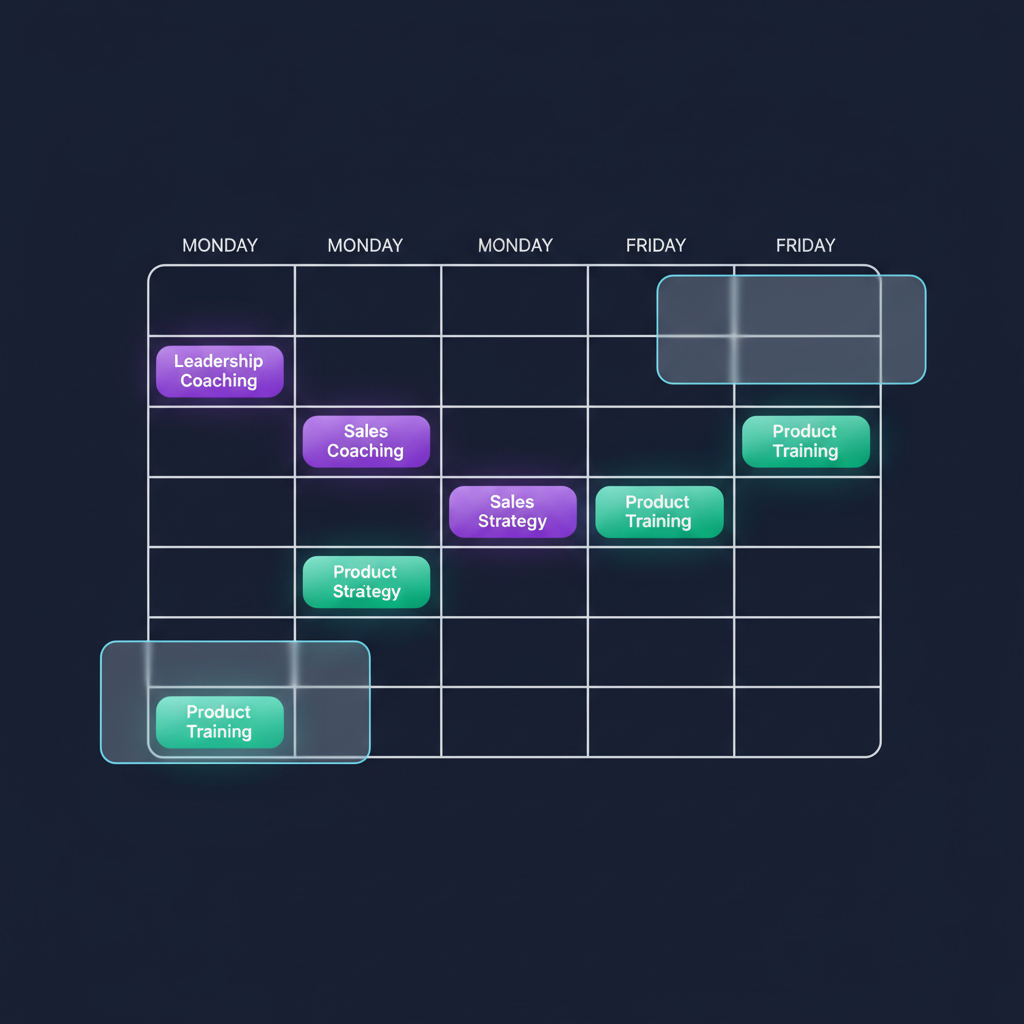
A coaching program without a calendar is just good intentions. Here's the weekly rhythm that works for SDR teams of 5-15 reps per manager:
Monday morning (30 minutes): Team huddle. Review last week's team metrics, celebrate wins, preview this week's focus skill (e.g., "This week we're all tightening our discovery questions to uncover budget authority").
Monday–Friday (2-3 observations per rep per week): Live call monitoring or recorded call reviews. Managers listen to calls asynchronously, flag coaching moments, and drop brief Slack or email feedback ("Great tonality on that gatekeeper — your pacing built trust. Next time, try [specific tweak].").
Tuesday–Thursday (scheduled 1:1s): Run your 30-45 minute structured 1:1s with each rep. Rotate through your team so every rep gets one session per week.
Wednesday or Thursday (60 minutes): Peer role-play session. Pair up reps, assign scenarios (gatekeeper, pricing objection, discovery with a skeptical buyer), facilitate practice, debrief as a group.
Friday afternoon (15 minutes per rep): Async review of AI role-play practice logs. Check which reps completed their assigned scenarios, review their scores, and note patterns to address in next week's 1:1.
Monthly (90 minutes): Group skill workshop on one theme. Bring in top performers to demonstrate, run live role-plays, and build shared language around what "good" looks like.
This cadence ensures every rep gets live coaching, peer practice, and AI-powered reps every single week. It's predictable, scalable, and tied directly to skill development and quota attainment.
What to coach: The skill hierarchy for SDRs
Not all skills matter equally. In our analysis of thousands of SDR role-play sessions, we've identified a clear skill hierarchy that predicts meeting conversion and SQL rates:
Tier 1 (highest impact): Tonality and pacing. If your voice sounds hesitant, rushed, or scripted, nothing else matters. Prospects disengage in the first 10 seconds.
Tier 2: Objection handling under pressure. Every SDR will hear "Send me some information" or "We're all set" dozens of times per day. Reps who convert objections into curiosity book 3x more meetings than reps who accept the brush-off.
Tier 3: Discovery depth. Reps who ask one surface-level question ("What are your biggest challenges?") and jump to pitching lose deals in the pipeline. Reps who layer follow-up questions and uncover pain, urgency, and authority close at 2x the rate.
Tier 4: Product knowledge and process adherence. Important, but these are table stakes. If a rep has flawless product knowledge but can't handle objections, they're still at 30% of quota.
Your coaching program should allocate time accordingly. Spend 50% of your coaching energy on tonality, pacing, and objection handling in the first 60 days. Layer in discovery depth once reps are confidently booking meetings. Product knowledge gets covered in onboarding and reinforced through async resources, not live coaching time.
How to measure SDR coaching program effectiveness
If you're not tracking coaching ROI, you're flying blind. Here are the four metrics that matter:
1. Ramp time to first meeting and first SQL
Track how many days it takes a new SDR to book their first qualified meeting and generate their first SQL. High-performing programs hit first meeting by day 21 and first SQL by day 45. If your reps are taking 60+ days to first meeting, your coaching program isn't accelerating skill development. For tactics to compress this timeline, see our guide to cutting SDR ramp time.
2. Quota attainment distribution
What percentage of your SDR team hits quota each month? In strong coaching programs, 70-80% of reps hit or exceed quota. If fewer than 60% are hitting their number, coaching is either inconsistent or focused on the wrong skills.
3. Conversion rate improvement over time
Track each rep's connect-to-meeting rate and meeting-to-SQL rate month over month. Coaching should lift these metrics steadily. If a rep's conversion rates are flat after 90 days of coaching, the feedback loop is broken.
4. Retention and promotion rates
SDRs who receive consistent, high-quality coaching stay longer and promote faster. Track 90-day and 12-month retention, and measure time-to-promotion for reps who move into AE or specialized SDR roles. High turnover or long promotion cycles signal a coaching problem, not a hiring problem.
Gartner research on sales development shows that organizations with structured coaching programs see 19% higher win rates and 25% faster ramp times than those without. Your metrics should reflect that lift — or you need to redesign the program.
Common SDR coaching mistakes that kill performance
Even well-intentioned coaching programs fail when managers make these mistakes:
Coaching too many skills at once. Giving a rep feedback on tonality, objection handling, discovery questions, and CRM hygiene in one session guarantees nothing sticks. Pick one skill per session, practice it, and move on only when the rep demonstrates competence.
Skipping the practice step. Feedback without practice is wasted breath. If you tell a rep to "slow down and pause after your value prop," but they never rehearse it before their next call, they'll revert to old habits under pressure.
Treating all reps the same. A rep at day 15 needs coaching on tonality and opening lines. A rep at day 90 needs coaching on multi-threading and executive discovery. One-size-fits-all coaching programs slow down top performers and overwhelm new hires.
Coaching only when numbers drop. If your 1:1s only happen when a rep misses quota, coaching feels punitive. Schedule weekly sessions regardless of performance. Top performers need coaching to stay sharp and accelerate promotion readiness.
Ignoring the data. If your conversation intelligence tool flags that a rep talks 80% of the time on discovery calls, and you're coaching them on objection scripts, you're solving the wrong problem. Let the data guide your coaching focus.
For more on how to structure feedback that drives behavior change, see our article on sales leadership feedback.
How AI role-play fits into your SDR coaching program
AI role-play isn't a replacement for manager coaching — it's a force multiplier. Here's how to integrate it:
Onboarding (days 8-30): New SDRs complete 3-5 AI role-play scenarios per week on core skills (tonality, opening lines, common objections). They practice until they hit a target score (e.g., 80% on objection handling) before moving to live calls. This compresses ramp time and builds confidence.
Ongoing skill development: Every SDR completes 2-3 AI role-play reps per week on their current coaching focus. If you're coaching discovery depth in this week's 1:1, assign discovery scenarios in the AI platform. Reps practice, review their own recordings, and come to the 1:1 ready to discuss what they learned.
Pre-call prep: Before a high-stakes call (executive discovery, pricing conversation, multi-threading attempt), reps run a quick AI role-play of that exact scenario. It's the sales equivalent of a dress rehearsal.
Manager leverage: Managers review AI role-play data weekly to identify patterns. If three reps are all struggling with the same objection, run a group workshop. If one rep's tonality scores are spiking, celebrate it in the team huddle and have them demo their technique.
The result: reps practice 10x more than they would with manager-only coaching, and managers focus their time on high-leverage feedback and strategic deal coaching instead of running basic objection drills.
For a full implementation guide, see our complete SDR playbook, which includes AI coaching integration timelines and benchmarks.
Building your SDR coaching program: 30-day implementation plan
Here's how to go from chaos coaching to a structured program in one month:
Week 1: Audit and design
- Document your current coaching reality (frequency, structure, who gets coached, what skills are covered)
- Interview your SDRs: what coaching do they want more of?
- Define your coaching structure (1:1 cadence, peer role-play schedule, AI practice requirements)
- Choose your focus skills for the first 90 days (recommend: tonality, objection handling, discovery depth)
Week 2: Build your coaching toolkit
- Create your 1:1 session template (call review, practice, metrics)
- Write 10-15 role-play scenarios for peer practice and AI role-play (gatekeeper, objections, discovery)
- Set up your conversation intelligence tool to flag coachable moments
- If using AI role-play, configure your scenarios and assign baseline practice
Week 3: Launch and train
- Announce the new coaching program to your team (the why, the what, the cadence)
- Run your first round of structured 1:1s with every rep
- Facilitate your first peer role-play session
- Assign first week of AI role-play practice
Week 4: Iterate and reinforce
- Gather feedback from reps on the new structure
- Adjust cadence or session length based on what's working
- Celebrate early wins (share a role-play recording where a rep nailed a skill)
- Lock in your ongoing weekly rhythm
By day 30, every rep should have experienced at least two structured 1:1s, one peer role-play session, and multiple AI practice reps. You've established the cadence and the culture. Now you execute and refine.
FAQ
What should an SDR coaching program include?
An effective SDR coaching program includes structured onboarding, weekly 1:1s with call reviews, monthly skill assessments, peer role-play sessions, and clear progression milestones tied to activity, conversion, and revenue metrics.
How often should SDR managers coach their reps?
SDR managers should conduct formal 1:1 coaching sessions weekly (30-45 minutes), plus 2-3 live call observations per rep per week, and at least one group role-play or skill workshop per month.
How do you measure the ROI of SDR coaching?
Measure SDR coaching ROI by tracking ramp time reduction, quota attainment improvement, conversion rate lift (connect-to-meeting, meeting-to-SQL), rep retention, and time-to-first-deal for new hires.
What's the difference between SDR training and SDR coaching?
SDR training is one-time knowledge transfer (product, process, tools). SDR coaching is ongoing, personalized skill development through observation, feedback, practice, and accountability that drives behavior change and performance improvement.
Sources

Stefano Breglia
Co-founder, QUOTA Training
Stefano Breglia is co-founder of QUOTA Training. He focuses on sales methodology, deal progression and how AI simulation accelerates rep ramp time across the SDR, BDR, AE and AM roles.
Turn this into reps, not just reading
QUOTA Training lets your team practise these exact scenarios with an AI buyer that reacts like the real thing — then scores every call.
See it in action