SDR Messaging Framework: Write Outreach That Gets Replies
Part of the SDR Playbook guide: The Complete SDR Playbook for 2026: Your End-to-End GuideBuild a repeatable SDR messaging framework that drives reply rates. Learn the exact structure, personalization tactics, and testing approach top teams use.

Key takeaways
- A repeatable SDR messaging framework includes five core components: a pattern-interrupt subject line, a personalized opening hook (3-15 seconds of research), a single-sentence value statement tied to buyer pain, a micro-commitment CTA, and a testing protocol that isolates one variable per experiment.
- Tier your personalization by account value: Tier 1 accounts (top 20% of pipeline potential) receive 5-10 minutes of manual research per contact; Tier 2 accounts get trigger-based personalization from tools; Tier 3 accounts receive segment-level messaging based on industry or role.
- The most common SDR messaging mistake is burying the ask—messages that require more than 15 seconds to understand the next step see reply rates drop by 40-60% compared to those with a clear, single CTA in the first three sentences.
- Test messaging systematically by running A/B experiments on one variable at a time with minimum sample sizes of 100 sends per variant, and refresh your entire framework quarterly or when reply rates decline 20% below your rolling 30-day average.
- Multi-channel sequences that align messaging across email, LinkedIn, and phone outreach generate 3-5x more meetings than single-channel campaigns, but only when each touchpoint reinforces the same core value statement rather than repeating identical copy.
Why most SDR messaging fails (and what to do instead)
Your SDRs send hundreds of emails every week. Most get ignored.
The problem isn't effort—it's the absence of a systematic SDR messaging framework. Without a repeatable structure, every message becomes a creative writing exercise. Quality varies wildly. What works gets lost. What fails gets repeated.
According to Gong's cold email research, the average cold email reply rate hovers between 1-3%. Top-performing teams consistently hit 10-15%. The difference isn't talent—it's framework.
A messaging framework is not a single template. It's a system that defines:
- Structure: The anatomy every message follows
- Personalization rules: What to research, where to place it, and how deep to go
- Value articulation: How you connect your solution to buyer pain in one sentence
- Testing protocols: How you improve systematically rather than guessing
When you build this framework and train reps to execute it, you transform messaging from art into repeatable science. This is foundational to The Complete SDR Playbook for 2026, where consistent outbound execution drives predictable pipeline.
The anatomy of a high-converting SDR message
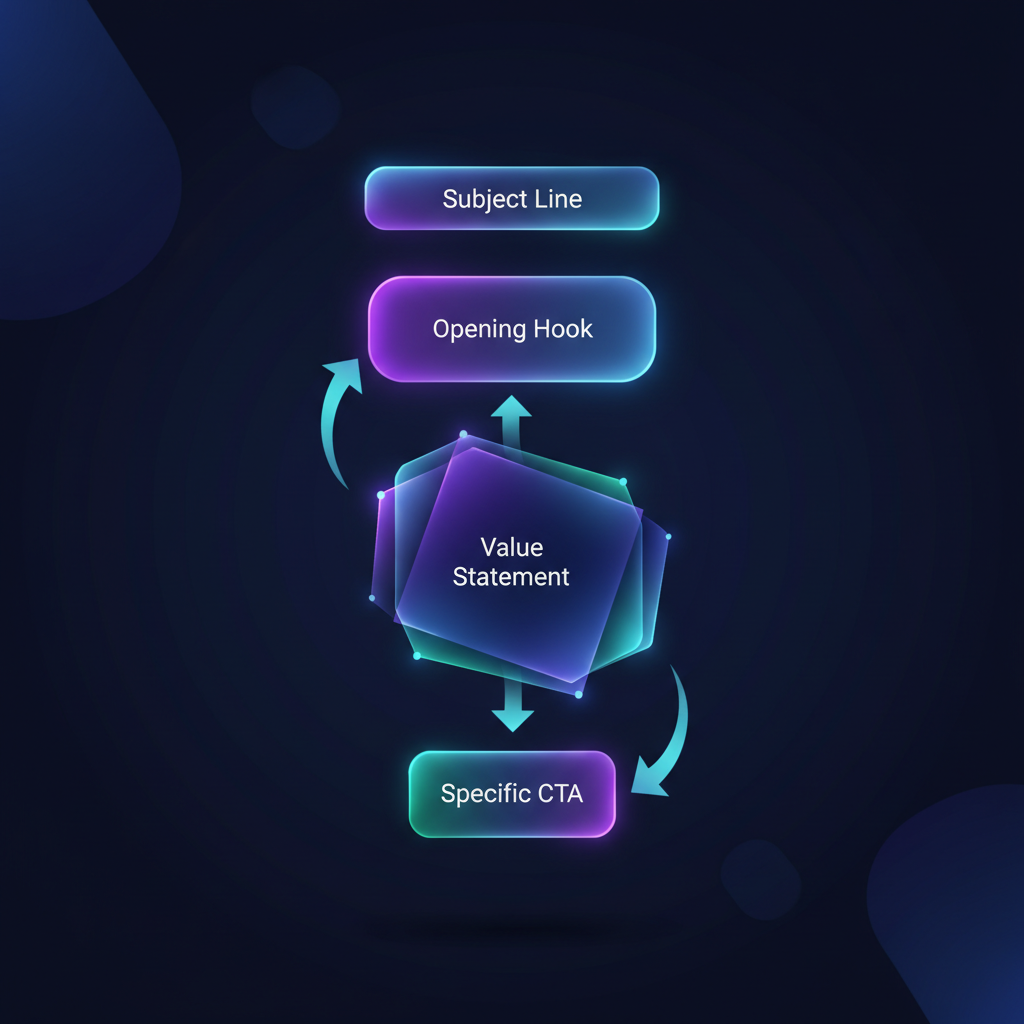
Every high-performing SDR message follows the same five-part structure. Deviate, and reply rates collapse.
1. Pattern-interrupt subject line (4-8 words)
Your subject line has one job: get the open. It succeeds when it creates curiosity without triggering spam filters or sounding like a sales pitch.
What works:
- "Quick question, [First Name]"
- "[Mutual connection] suggested I reach out"
- "Thoughts on [specific company initiative]?"
- "[Competitor name] + [your category]"
What fails:
- Generic benefit claims ("Increase your revenue by 40%")
- All caps or excessive punctuation
- Misleading urgency ("URGENT: Your account")
- Company name alone ("[Your Company] + [Their Company]")
In QUOTA role-play sessions, reps who test subject lines systematically see open rates improve 15-25% within 30 days. The key is testing one variable at a time with statistically meaningful sample sizes.
2. Personalized opening hook (1-2 sentences)
This is where most SDRs fail. They either skip personalization entirely or waste it on shallow observations ("I saw you're hiring").
Your opening hook must prove you've done real research and tie that research to a business outcome the buyer cares about.
Strong hooks:
- "I noticed [Company] just launched [specific product feature]—congrats. Most teams launching similar capabilities hit a wall around user adoption in month 3-4."
- "Saw your post on [specific topic] last week. The point about [specific detail] resonated—we're seeing the same challenge with [similar companies]."
- "Your Q3 earnings call mentioned [specific initiative]. Based on what [similar company] ran into when they rolled out something similar, curious how you're thinking about [specific challenge]."
Weak hooks:
- "I noticed you're in [industry]." (Too generic)
- "Congrats on the new role!" (Irrelevant unless tied to pain)
- "I saw you're hiring SDRs." (Observational, not valuable)
The research should take 30 seconds to 3 minutes depending on account tier (more on tiering below). If you can't connect the research to buyer pain, skip it—generic is worse than none.
3. Single-sentence value statement
After the hook, you have one sentence to articulate why this matters to them. Not what your product does—what outcome it drives for companies like theirs.
Formula: "[Companies like yours] use [our solution] to [specific outcome] without [common obstacle]."
Examples:
- "Revenue teams at companies like [Similar Company A] and [Similar Company B] use QUOTA to cut SDR ramp time by 40% without adding headcount to their enablement team."
- "Sales leaders in [industry] use our platform to get their AEs to discovery-level qualification in 3 weeks instead of 3 months, even with fully remote teams."
Notice what's missing: feature lists, jargon, vague benefits. Salesforce research on email effectiveness shows that messages with a single, concrete value statement outperform multi-benefit emails by 2-3x.
Your value statement should align with your SDR battlecards so reps can handle objections that arise from the initial outreach.
4. Micro-commitment CTA
Never ask for a 30-minute meeting in the first email. It's too big a commitment for someone who doesn't know you.
Instead, ask for a micro-commitment: a two-sentence reply, a 10-minute conversation, or permission to send a specific resource.
High-converting CTAs:
- "Worth a 10-minute conversation?"
- "Curious if this is on your radar—yes or no is totally fine."
- "If this resonates, I can send over a 2-minute breakdown of how [Similar Company] approached this. Interested?"
- "Does [Date/Time] or [Date/Time] work for a quick call?"
Low-converting CTAs:
- "Let me know if you'd like to learn more." (Too passive)
- "I'd love to show you our platform." (Seller-focused)
- "Do you have time for a demo?" (Too big an ask)
The CTA should appear within the first three sentences of the email body. If a prospect has to scroll to understand what you want, reply rates drop 40-60%.
5. Professional close
Keep it simple. Sign off with your name, title, and one line of social proof or credibility.
Example:
"[Your Name]
SDR, QUOTA Training
Trusted by 200+ B2B sales teams"
Avoid long signatures with multiple CTAs, social icons, or legal disclaimers in the first email. They distract from your primary ask.
Build your personalization tier system

You cannot deeply personalize every message. You also cannot send completely generic outreach and expect results.
The solution is a tiered personalization system based on account value.
Tier 1: High-value accounts (top 20% of pipeline potential)
Research time: 5-10 minutes per contact
Personalization depth: 3-5 specific data points
For your highest-value accounts—enterprise deals, strategic logos, or accounts with 6+ figure potential—invest real research time.
What to research:
- Recent company news (funding, acquisitions, leadership changes)
- Specific initiatives mentioned in earnings calls or press releases
- LinkedIn activity from your contact (posts, comments, shares)
- Technology stack changes (new tools adopted, old tools removed)
- Competitive intelligence (who they're replacing, what they're evaluating)
Example Tier 1 message: "Hi [Name],
Saw [Company] announced the Series B last week—congrats. I also noticed you're expanding into EMEA based on the 15 new sales roles posted.
Most companies scaling into new regions hit a wall around rep ramp time—it typically takes 4-6 months to get new hires productive, which kills momentum.
Revenue teams at [Similar Company A] and [Similar Company B] use QUOTA to cut that ramp time to 6-8 weeks using AI role-play that works in 12 languages.
Worth a 10-minute conversation? If so, does [Date/Time] or [Date/Time] work?"
Tier 2: Mid-value accounts (next 30%)
Research time: 1-2 minutes per contact
Personalization depth: 1-2 trigger-based data points
For mid-tier accounts, use triggers—events that signal buying intent or pain.
Common triggers:
- New funding round
- Executive hire (new CRO, VP Sales, Head of Sales Enablement)
- Technology adoption (they just bought a tool in your ecosystem)
- Expansion (new office, new market entry)
- Competitive displacement (they're moving away from a competitor)
Use tools like LinkedIn Sales Navigator, ZoomInfo, or 6sense to automate trigger detection.
Example Tier 2 message: "Hi [Name],
Congrats on the new VP Sales role at [Company].
Most new sales leaders inherit inconsistent coaching processes—some reps get great feedback, others get none.
Sales teams at [Similar Company] use QUOTA to standardize coaching using AI role-play, so every rep gets the same quality input without burning out managers.
Worth a quick conversation? I can walk you through how they rolled it out in under 60 days."
Tier 3: Volume accounts (remaining 50%)
Research time: 0 minutes (segment-level personalization)
Personalization depth: Industry or role-based pain points
For volume accounts, personalize at the segment level—write messages that speak to common pain points for specific industries or roles.
Example Tier 3 message (SaaS sales leaders): "Hi [Name],
Most SaaS sales teams struggle with inconsistent discovery calls—some AEs uncover real pain, others jump straight to demo.
Sales leaders at [Similar Company A] and [Similar Company B] use QUOTA's AI role-play to train reps on discovery frameworks like MEDDIC in 2-3 weeks instead of 2-3 months.
Worth a 10-minute call to see if this fits your team?"
Segment-level messaging won't win awards, but it's infinitely better than generic spray-and-pray. And it scales.
This tiered approach directly supports reducing SDR ramp time by giving new hires a clear playbook for how much research to invest based on account value.
Multi-channel messaging: email, LinkedIn, phone
Your SDR messaging framework must work across channels. But here's the mistake most teams make: they copy-paste the same message everywhere.
Multi-channel outreach works when each channel reinforces the same core value statement but adapts to the medium.
Email: Lead with value
Email is your most detailed channel. Use the full five-part structure above. Keep total length to 75-125 words.
LinkedIn: Lead with curiosity
LinkedIn messages feel more personal and less "salesy." Lead with a question or observation, not a pitch.
Example: "Hi [Name]—saw your post on [topic] last week. The point about [specific detail] hit home. Curious: how are you thinking about [related challenge] as you scale the team?"
If they reply, your second message introduces the value statement and CTA.
Phone: Lead with permission
If you're leaving a voicemail or getting a live pickup, your opening must earn permission to continue.
Live pickup script: "Hi [Name], this is [Your Name] from QUOTA Training—did I catch you at a bad time?"
(Pause for response)
"Quick reason for the call: I work with sales leaders at companies like [Similar Company], and one challenge that keeps coming up is [specific pain]. Thought it was worth a quick conversation to see if that's on your radar. Do you have two minutes?"
For detailed voicemail tactics, see existing coverage in the cold calling cluster—but the core principle remains: align the value statement across all channels.
When you align messaging this way, prospects who see your email, then your LinkedIn message, then hear your voicemail recognize the consistency and are 3-5x more likely to respond than if each touchpoint pitches something different.
Test, measure, and iterate your SDR messaging framework
A framework is only as good as your commitment to improving it. Top-performing SDR teams treat messaging like a product: they ship, measure, and iterate.
What to test
Run A/B tests on one variable at a time:
- Subject lines: Test curiosity vs. relevance vs. mutual connection
- Opening hooks: Test depth of personalization (1 data point vs. 3)
- Value statements: Test outcome-focused vs. feature-focused language
- CTAs: Test meeting ask vs. micro-commitment vs. resource offer
- Length: Test 50-word emails vs. 100-word emails
Never test multiple variables simultaneously—you won't know what drove the result.
Minimum sample sizes
Each variant needs at least 100 sends to produce statistically meaningful results. Anything less is noise.
Track:
- Open rate: Subject line effectiveness
- Reply rate: Overall message quality
- Positive reply rate: Replies that express interest (exclude "not interested" and "remove me")
- Meeting conversion rate: Positive replies that turn into booked meetings
When to refresh
Refresh your entire messaging framework when:
- Reply rates drop 20% below your rolling 30-day average
- You enter a new market or vertical
- Your product positioning changes significantly
- Quarterly, as a forcing function to stay sharp
In QUOTA's AI role-play platform, we see SDRs who practice delivering their messaging framework out loud—not just writing it—improve reply rates 20-30% faster than those who only write. Why? Because practicing delivery forces you to hear where your message sounds awkward, generic, or unclear.
This is the same principle behind effective cold call opening lines—if it doesn't sound natural when you say it, it won't read naturally either.
You can also apply AI sales prompt engineering principles to train AI tools to generate first-draft messaging that follows your framework, then have reps refine and personalize.
Common SDR messaging mistakes (and how to fix them)
Mistake 1: Burying the ask
If your CTA appears after the third sentence, reply rates drop 40-60%. Prospects skim. If they don't immediately understand what you want, they move on.
Fix: Put your CTA in sentence 2 or 3, right after your value statement.
Mistake 2: Writing about your product, not their outcome
Nobody cares about your features. They care about their problems.
Fix: Rewrite every message to lead with the buyer's pain, not your solution. Your product is the "how," not the "why."
Mistake 3: Over-personalizing low-value accounts
Spending 10 minutes researching a $5K deal is poor ROI. Your reps burn out, and volume collapses.
Fix: Use the tier system. Save deep research for high-value accounts.
Mistake 4: Sending the same message to every persona
A CFO cares about cost and risk. A VP Sales cares about quota attainment and team performance. An SDR manager cares about ramp time and activity metrics.
Fix: Build persona-specific messaging that speaks to role-specific pain. Maintain the same framework structure, but swap in different value statements and CTAs.
Mistake 5: Ignoring negative replies
"Not interested" emails are gold. They tell you what's not working.
Fix: Track negative reply themes weekly. If 40% of your "no" responses say "we already have a solution," your differentiation is weak. If they say "not a priority," your pain articulation missed. Adjust accordingly.
How to train your SDR team on the framework
A framework is useless if reps don't adopt it. Here's how to roll it out:
Step 1: Build the framework with your top performers
Don't create the framework in a vacuum. Pull your top 2-3 SDRs into a working session. Analyze their highest-performing messages. Extract the common patterns. Codify them.
This ensures the framework reflects what actually works, and it gives you internal champions who'll advocate for adoption.
Step 2: Create templates and examples
Give reps templates for each tier and persona. Include:
- Annotated examples that explain why each sentence works
- Fill-in-the-blank templates for common scenarios
- A research checklist for each tier
Step 3: Role-play the framework
Have reps practice writing and delivering messages in live role-play sessions. Use AI role-play tools to simulate buyer responses and objections.
Reps who practice their messaging out loud catch awkward phrasing, over-complicated value statements, and weak CTAs before they hit send.
Step 4: Review and coach weekly
In your 1:1s, review a sample of each rep's outbound messages. Look for:
- Are they following the structure?
- Is personalization appropriate for the account tier?
- Is the value statement clear and outcome-focused?
- Is the CTA a micro-commitment?
Coach deviations immediately. Consistency compounds.
Step 5: Celebrate wins and share learnings
When a rep books a meeting from a great message, share it with the team. When a test produces a clear winner, roll it out to everyone.
Make messaging improvement a team sport, not an individual grind.
FAQ
What is an SDR messaging framework?
An SDR messaging framework is a repeatable structure that guides how sales development reps craft outbound messages across channels—email, LinkedIn, phone—to consistently drive replies and meetings. It includes templates, personalization rules, value propositions, and testing protocols.
How do you personalize SDR messages at scale?
Personalize SDR messages at scale by using a tiered approach: high-value accounts get deep, manual research (3-5 data points); mid-tier accounts get trigger-based personalization (funding, hiring, tech stack); volume accounts get segment-level personalization (industry pain, role challenges). Use research tools and CRM data to automate data collection.
What is a good reply rate for SDR cold emails?
A good reply rate for SDR cold emails ranges from 5-15% depending on ICP fit, message quality, and list hygiene. Highly targeted campaigns with strong personalization can exceed 20%, while broad, generic outreach often falls below 3%. Track positive reply rate (interested responses) separately from total replies.
How often should SDRs test messaging?
SDRs should test messaging continuously using a structured cadence: run A/B tests on one variable at a time (subject line, opening, CTA) with at least 100 sends per variant. Review results weekly and implement winners. Refresh entire frameworks quarterly or when reply rates drop 20% below baseline.

Stefano Breglia
Co-founder, QUOTA Training
Stefano Breglia is co-founder of QUOTA Training. He focuses on sales methodology, deal progression and how AI simulation accelerates rep ramp time across the SDR, BDR, AE and AM roles.
Turn this into reps, not just reading
QUOTA Training lets your team practise these exact scenarios with an AI buyer that reacts like the real thing — then scores every call.
See it in action