The Complete Sales Coaching Guide: Build a Program That Delivers
Master the definitive sales coaching guide: cadence, call reviews, scorecards, role-play, skill gaps, 1:1s, metrics, and building a coaching culture that drives results.

Key takeaways
- The coaching cadence that works is "little and often": weekly 30-45 minute 1:1s, bi-weekly call reviews covering 2-3 calls, monthly skill-gap assessments, and daily 5-10 minute micro-coaching moments consistently outperform monthly marathon sessions.
- Effective sales coaching scorecards track 5-8 observable behaviors tied to revenue: discovery question quality, objection response effectiveness, tonality, talk-to-listen ratio, next-step commitment rate, and process adherence—each scored 1-5 with specific behavioral anchors at each level.
- Role-play is the highest-leverage coaching activity most managers skip: reps who practice objection handling, discovery, and cold calling in low-stakes simulation before live calls convert 23-31% more opportunities than those who learn exclusively on prospects.
- Call reviews fail without a structured observation framework: effective reviews isolate 1-2 specific behaviors per session, use timestamped examples, separate observation from evaluation, and end with a concrete practice plan—not vague feedback like "be more confident."
- Coaching culture scales when you document everything: repeatable scorecards, call-review templates, skill-gap libraries, and role-play scenarios allow multiple managers to deliver consistent coaching and let new managers ramp 40% faster.
What Is Sales Coaching (and Why Most Programs Fail)
Sales coaching is the ongoing, personalized process of observing rep performance, diagnosing skill gaps, providing targeted feedback, and facilitating deliberate practice to improve specific selling behaviors that drive revenue outcomes.
It is not training. Training is one-to-many knowledge transfer—teaching product features, explaining your methodology, or walking through a new tool. Coaching is one-to-one skill development focused on application: how this rep handles this objection in this deal right now.
Most sales coaching programs fail for three reasons:
First, they lack cadence. Managers coach when they "have time" or when a deal is at risk. Reps receive intense feedback once a month, then nothing for weeks. Behavioral change requires consistent reinforcement—little and often beats sporadic and intense every time.
Second, they focus on outcomes instead of behaviors. "You need to close more deals" or "your pipeline is light" describes a problem but doesn't build a skill. Effective coaching isolates the observable behavior that predicts the outcome: "You're accepting 'I need to think about it' without surfacing the real objection—let's practice three ways to dig deeper."
Third, they have no documentation or system. Coaching lives in managers' heads, feedback is inconsistent across reps, and when a manager leaves, the entire coaching culture evaporates. Programs that scale have frameworks, scorecards, templates, and shared language that any manager can pick up and execute.
This guide gives you the complete system: the cadence, the frameworks, the scorecards, the role-play structure, the call-review process, the 1:1 format, the metrics that matter, and the documentation that makes it all repeatable.
Building Your Sales Coaching Cadence
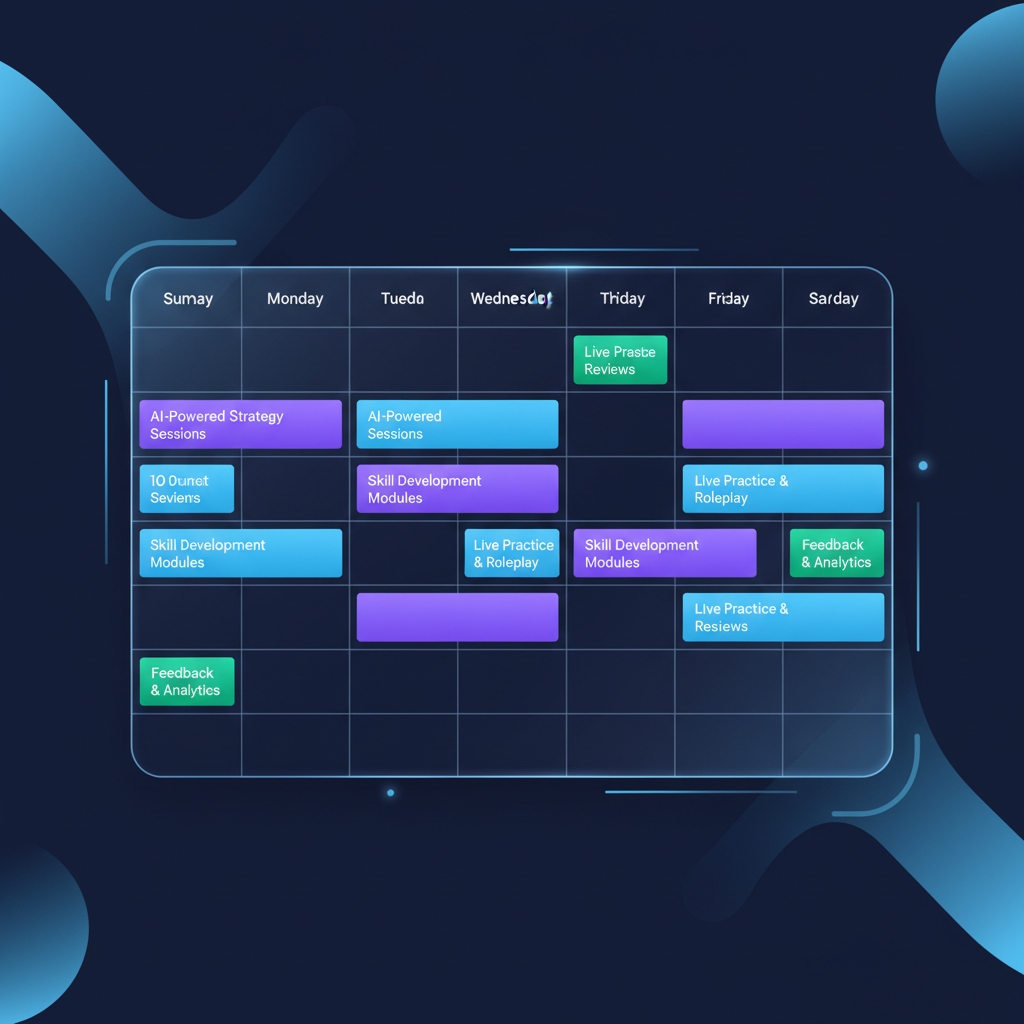
The question isn't whether to coach—it's when, how often, and in what format. High-performing sales organizations coach on a predictable rhythm that combines formal sessions with informal moments.
The Weekly Coaching Rhythm
Your baseline cadence should include:
- One formal 1:1 meeting per rep per week (30-45 minutes). This is sacred time for skill development, not pipeline review or deal strategy. Use a structured 1:1 format that covers performance review, skill-gap diagnosis, and practice.
- One call review session every two weeks (30 minutes, covering 2-3 calls). More frequent than bi-weekly and you'll spend all your time reviewing; less frequent and reps forget the context. Focus on isolating 1-2 coachable moments per call.
- Daily micro-coaching moments (5-10 minutes). Catch reps immediately after a call that went well or poorly. "I heard you handle that pricing objection—walk me through your thinking. Here's what I would have done differently." These brief, in-the-moment corrections are often more powerful than formal sessions.
- Monthly skill-gap assessment (60 minutes). Step back and evaluate: which skills have improved, which remain weak, and where should we focus next month? Update your coaching plan accordingly.
Coaching Cadence by Rep Tenure
Adjust frequency based on experience:
New reps (0-90 days): Daily coaching touchpoints, two formal 1:1s per week, call reviews after every 3-5 dials. They're building foundational habits—frequent correction prevents bad patterns from calcifying.
Ramping reps (90 days-1 year): Weekly 1:1s, bi-weekly call reviews, 2-3 micro-coaching moments per week. Focus shifts from "what to say" to "how to adapt in the moment."
Tenured reps (1+ years): Weekly 1:1s remain non-negotiable, but call reviews can drop to monthly unless performance dips. Coaching focuses on advanced skills—multi-threading, executive conversations, complex objections—and peer coaching opportunities.
The Coaching Calendar Template
Block your calendar in advance. If coaching time isn't scheduled, it won't happen. Create recurring blocks:
- Monday mornings: Review last week's metrics, identify reps who need extra attention
- Tuesday/Wednesday: Formal 1:1s with each rep (stagger throughout the week)
- Thursday: Call review sessions
- Friday: Skill-gap assessments and coaching plan updates
Treat these blocks as client meetings—they don't move for internal requests or "quick syncs."
Conducting Effective Sales Call Reviews
Call reviews are where theory meets reality. You're watching your rep execute (or fail to execute) the skills you've been coaching, and you're diagnosing exactly where the gap exists.
Most managers waste call reviews by trying to coach everything at once. The rep leaves overwhelmed, remembers nothing, and changes nothing.
The Call Review Framework That Works
Step 1: Let the rep self-assess first. Before you say a word, ask: "What went well? What would you do differently?" This surfaces their self-awareness (or lack of it) and ensures they're mentally engaged, not just receiving a lecture.
Step 2: Isolate 1-2 coachable moments. Pick the highest-leverage behavior to improve. If they botched the opener, nailed discovery, but fumbled the close, focus on the opener. You'll get to the close next session.
Step 3: Use timestamped examples. "At 4:32, the prospect said 'we're happy with our current vendor,' and you moved on. Let's replay that moment. What was the real objection underneath that statement?" Specificity makes feedback actionable.
Step 4: Separate observation from evaluation. Describe what you heard: "You asked three discovery questions in a row without acknowledging their answers." Then interpret: "That made it feel like an interrogation rather than a conversation." Finally, prescribe: "Next time, summarize what you heard before moving to the next question."
Step 5: Role-play the correction immediately. Don't just tell them what to do differently—have them practice it right now, in the call review. "Let's rewind to that objection. I'll play the prospect. Show me how you'd handle it using the technique we just discussed."
Step 6: Assign one concrete practice task. End every call review with a single, specific action: "Before our next session, I want you to role-play this objection response five times using our role-play tool and send me a recording of your best take."
For a deeper dive into what to watch during call reviews, see our guide on sales coaching observation.
What to Review: Live Calls vs. Recorded Calls
Both have value:
Recorded calls let you pause, rewind, and isolate exact moments. You can review multiple calls in one session and compare how a rep handles the same situation across prospects. Tools like Gong, Chorus, or AI sales call analysis platforms surface coachable moments automatically.
Live call shadowing gives you real-time context: the rep's body language, their pre-call preparation, how they recover from mistakes in the moment. You can provide immediate feedback right after the call while it's fresh.
Best practice: Alternate. Review recorded calls bi-weekly for deep skill diagnosis, and shadow live calls monthly to observe in-situ performance.
The Call Review Scorecard
Use a consistent scorecard for every review so reps know what you're evaluating and can track improvement over time. Score each dimension 1-5:
- Opener effectiveness: Did they earn the right to continue the conversation in the first 20 seconds?
- Discovery depth: Did they uncover pain, quantify impact, and identify decision criteria?
- Objection handling: Did they welcome pushback, isolate the real concern, and respond with evidence?
- Tonality and confidence: Did they sound like a peer, not a vendor?
- Talk-to-listen ratio: Did they speak less than 40% of the call?
- Next-step commitment: Did they secure a concrete next action with a date and time?
Document every score in your sales coaching documentation system so you can track trends over time.
Creating Effective Sales Coaching Scorecards

A coaching scorecard translates abstract advice ("be more consultative") into observable, measurable behaviors ("ask at least three 'why' or 'how' questions before pitching a solution").
What Makes a Scorecard Effective
It measures behaviors, not outcomes. "Closed the deal" is an outcome. "Identified three stakeholders and mapped their individual pain points" is a behavior that predicts closing the deal.
It has 5-8 dimensions, not 20. More than eight and managers cherry-pick what to score, making the data inconsistent. Fewer than five and you miss critical skills.
Each dimension has a 1-5 rubric with specific behavioral anchors. A "3" isn't "average"—it's "asked discovery questions but didn't quantify impact or connect pain to business outcomes." This removes subjectivity.
It's tied to your sales process. If your methodology emphasizes MEDDIC, your scorecard should include "Identified economic buyer" and "Quantified decision criteria." If you lead with insight, score "Taught the prospect something new about their business."
Sample Sales Coaching Scorecard
Here's a framework you can adapt:
| Behavior | 1 (Needs Work) | 3 (Proficient) | 5 (Excellent) |
|---|---|---|---|
| Discovery Quality | Asked surface questions; didn't uncover pain | Asked pain questions but didn't quantify impact | Uncovered pain, quantified impact, connected to business outcomes |
| Objection Response | Became defensive or gave up | Acknowledged objection but didn't isolate root cause | Welcomed pushback, isolated real concern, responded with relevant proof |
| Tonality/Confidence | Sounded scripted or uncertain | Conversational but occasionally hesitant | Sounded like a trusted peer throughout |
| Talk-to-Listen Ratio | Spoke >60% of the call | Spoke 40-50% of the call | Spoke <40%; let prospect do most talking |
| Next-Step Commitment | Ended with vague follow-up | Proposed next step but didn't confirm date | Secured concrete next action with date/time/agenda |
Use this scorecard in every call review and 1:1. Over time, you'll see which behaviors are improving and which remain stuck.
For more on choosing the right coaching framework, explore our breakdown of sales coaching models.
Mastering Sales Role-Play and Simulation
Role-play is the single highest-leverage coaching activity most managers avoid. Why? Because it feels awkward, reps resist it, and managers don't know how to structure it effectively.
But here's the reality: Harvard Business Review research shows that reps who engage in regular role-play practice convert 23-31% more opportunities than those who learn exclusively on live prospects. You wouldn't send a pilot into a storm without simulator hours—why do we send reps into six-figure deals without practice?
Why Role-Play Fails (and How to Fix It)
Problem 1: It's sporadic. Managers role-play once during onboarding, then never again. Reps don't build muscle memory from a single session.
Fix: Build role-play into your weekly cadence. Every 1:1 includes 10 minutes of scenario practice. Make it routine, not an event.
Problem 2: Scenarios are too vague. "Let's practice discovery" gives the rep no context. They improvise, the manager critiques, and nothing sticks.
Fix: Create a library of specific scenarios tied to real deals: "You're calling a VP of Sales at a 200-person SaaS company. They just missed quarter for the second time. Their CEO is pressuring them to fix the pipeline. You have 30 seconds before they say 'send me some information.' Go."
Problem 3: Feedback is delayed. The rep finishes the role-play, the manager takes notes, and five minutes later they debrief. By then, the rep has forgotten their internal thought process.
Fix: Pause mid-role-play. "Stop—right there. You just accepted 'we're all set.' What was the real objection you missed? Let's rewind and try that moment again."
The Role-Play Structure That Works
1. Set the scene (30 seconds). Give the rep the context: persona, company size, pain point, where they are in the buying process, and the goal of this conversation.
2. Run the scenario (3-5 minutes). You play the prospect. Make it realistic—don't be artificially easy or impossibly difficult. Throw one curveball (an objection, a tough question) to see how they adapt.
3. Pause and correct in real time. When the rep makes a mistake, stop immediately. "Hold on—you just pitched before asking a single discovery question. What should you have done?" Have them rewind and try again.
4. Debrief (2 minutes). What went well? What would they do differently? What's the one thing they'll focus on in the next live call?
5. Repeat the same scenario. Don't move to a new scenario every time. Repetition builds mastery. Have them practice the same objection response five times until it's automatic.
For advanced objection practice, see our guide on objection handling role-play.
AI Role-Play: Scaling Practice Without Burning Manager Time
The bottleneck with traditional role-play is manager availability. You can't give every rep 30 minutes of practice per day—there aren't enough hours.
AI-powered role-play solves this. Platforms like QUOTA Training let reps practice discovery, objection handling, cold calling, and closing scenarios on-demand, with realistic voice simulation and instant feedback on tonality, pacing, and response quality.
Reps can drill the same scenario ten times before lunch. The AI adapts difficulty based on performance, surfaces specific improvement areas, and tracks progress over time—freeing managers to focus on high-touch coaching moments the AI can't replicate.
According to Gartner research on sales coaching, organizations that combine AI-driven practice with human coaching see 40% faster ramp times and 18% higher quota attainment than those relying on manager-led role-play alone.
Diagnosing and Closing Skill Gaps
Effective coaching starts with accurate diagnosis. You can't fix a skill gap you haven't identified, and you can't prioritize development if you're trying to improve everything at once.
The Skill-Gap Assessment Framework
Step 1: Map your sales process to required skills. Break your sales process into stages (prospecting, discovery, demo, objection handling, closing) and list the 3-5 critical skills for each stage.
Example for discovery:
- Ask open-ended questions that uncover pain
- Quantify the cost of the problem
- Identify decision criteria and process
- Map stakeholders and influence
- Secure agreement on next steps
Step 2: Evaluate each rep against each skill. Use your coaching scorecard data from call reviews. Where are they consistently scoring 1-2? Where are they already at 4-5?
Step 3: Prioritize the highest-leverage gap. Don't try to fix five things at once. Ask: "Which single skill, if improved, would have the biggest impact on this rep's results?" Often it's the skill that's blocking them earliest in the funnel.
Step 4: Build a 30-day skill development plan. Focus on one skill for a month:
- Week 1: Diagnose (call reviews, self-assessment)
- Week 2: Learn (share examples, review best-in-class calls, study frameworks)
- Week 3: Practice (role-play daily, apply on low-stakes calls)
- Week 4: Evaluate (review progress, adjust approach, move to next skill or go deeper)
Common Skill Gaps and How to Coach Them
Gap: Weak discovery. Reps jump to pitching before understanding the problem.
Coaching approach: Role-play discovery scenarios where you (as the prospect) don't volunteer information—make them dig. Teach question sequencing: pain → impact → decision criteria → process. Review calls and count discovery questions asked before the first pitch.
Gap: Poor objection handling. Reps freeze, get defensive, or give discounts.
Coaching approach: Build an objection library of the ten most common pushbacks your team hears. Create scripted responses and drill them in role-play until they're automatic. Use the framework: acknowledge → isolate → respond → confirm. See our objection handling role-play guide for detailed drills.
Gap: Low tonality and confidence. Reps sound nervous, scripted, or like they're reading.
Coaching approach: Record reps reading the same script five times, with feedback between takes on pacing, inflection, and energy. Have them listen to top performers and identify vocal patterns. Practice the first 30 seconds of a call obsessively—confidence at the start carries through the entire conversation.
Gap: No next-step commitment. Calls end with "I'll send you some info" instead of a booked meeting.
Coaching approach: Role-play call endings exclusively. Make it a rule: no call ends without proposing a specific next step and securing a date/time. Practice handling "I need to think about it" and "send me something first" deflections.
Gap: Talk-to-listen ratio is inverted. Reps dominate the conversation.
Coaching approach: Set a timer in role-play—they can only speak for 90 seconds in a 5-minute scenario. Force them to ask questions and listen. Review call recordings and calculate actual talk time; share the data.
Structuring High-Impact 1:1 Coaching Sessions
The weekly 1:1 is your most important coaching lever. It's where you diagnose, prioritize, practice, and hold reps accountable for skill development.
Most 1:1s devolve into pipeline reviews or deal strategy. Those are valuable, but they're not coaching. Coaching 1:1s are about building the rep, not just managing their deals.
The 1:1 Coaching Agenda
Use this structure for every session (30-45 minutes total):
1. Performance review (5 minutes): Review key metrics from the past week: calls made, meetings booked, conversion rates, stage progression. Celebrate wins, flag concerns. This is data, not coaching—keep it brief.
2. Call review deep-dive (10 minutes): Pick one call from the past week (ideally one the rep flagged as challenging). Listen to a 2-3 minute segment. Apply the call review framework from earlier: observe, interpret, prescribe.
3. Skill practice (15 minutes): Role-play the specific skill you're developing this month. Use a real scenario from their pipeline. Give real-time feedback, have them repeat until it's clean.
4. Coaching plan review (5 minutes): What's the one skill we're focusing on this month? What's your practice plan for this week? What support do you need from me?
5. Accountability check (5 minutes): Review the action items from last week's 1:1. Did you complete them? If not, what got in the way? What's your commitment for this week?
For a complete breakdown of how to structure these sessions, see our guide on sales leadership 1:1 meetings.
1:1 Coaching Documentation
Document every 1:1 in a shared system (Notion, Google Docs, your CRM). Include:
- Date and rep name
- Metrics reviewed
- Call reviewed and key takeaways
- Skill practiced and performance assessment
- Action items and commitments
- Progress on current skill development plan
This documentation serves three purposes:
- Accountability: The rep can't claim "we never talked about that."
- Continuity: If you're out sick or leave the company, another manager can pick up exactly where you left off.
- Trend analysis: Over six months, you can see which skills improved, which plateaued, and whether your coaching is actually driving results.
Learn more about building a scalable documentation system in our sales coaching documentation guide.
Sales Coaching Metrics: What to Measure Beyond Quota
You can't improve what you don't measure. But most sales organizations measure only lag indicators—quota attainment, win rate, deal size—that tell you whether coaching worked three months ago, not whether it's working today.
Effective coaching programs track both leading and lagging indicators.
Leading Indicators: Behavioral Metrics
These predict future performance and tell you whether reps are improving now:
Skill adoption rate: What percentage of calls include the behavior you're coaching? If you're teaching reps to ask budget questions earlier in discovery, track how many discovery calls include a budget question in the first ten minutes.
Call-to-meeting conversion improvement: Are reps booking more meetings per dial after you coached cold-calling tonality? Track weekly conversion rates and correlate them with coaching sessions.
Objection-handling win rate: When a prospect raises a pricing objection, how often does the rep successfully move the deal forward vs. losing it? Track this by objection type.
Discovery question depth: Count the average number of "why" and "how" questions per discovery call. Surface-level reps ask 1-2; strong reps ask 5-7.
Talk-to-listen ratio: Use conversation intelligence tools to measure this automatically. Target: reps speak less than 40% of the call.
Next-step commitment rate: What percentage of calls end with a concrete next action (date, time, agenda) vs. vague follow-up?
Ramp time: How many days does it take a new rep to hit 50% of quota? 100%? Effective coaching should reduce this by 20-30%.
Lagging Indicators: Outcome Metrics
These confirm long-term coaching impact:
- Quota attainment: Are coached reps hitting quota at higher rates?
- Win rate: Are they closing a higher percentage of qualified opportunities?
- Average deal size: Are they selling more seats, bigger packages, or premium tiers?
- Sales cycle length: Are they moving deals through the pipeline faster?
- Retention and promotion: Are coached reps staying longer and advancing into leadership?
The Coaching Dashboard
Build a simple dashboard (spreadsheet or BI tool) that tracks these metrics per rep, per month. Review it in your monthly skill-gap assessment to answer:
- Which reps are improving fastest?
- Which skills are we successfully coaching vs. which remain stuck?
- Is our coaching cadence frequent enough?
- Are we focusing on the right skill gaps?
According to Salesforce research on sales coaching, organizations that track leading behavioral metrics alongside outcomes see 2.3x higher coaching ROI than those tracking only quota attainment.
Building a Sustainable Sales Coaching Culture
Individual coaching sessions improve individual reps. A coaching culture improves the entire team, compounds over time, and survives manager turnover.
A coaching culture is one where:
- Feedback is continuous, not episodic
- Reps proactively seek coaching, not avoid it
- Peer coaching happens without manager prompting
- Skill development is celebrated as much as closed deals
- Documentation and systems make coaching repeatable
How to Build a Coaching Culture
1. Model it from the top. If your VP of Sales doesn't coach their directors, directors won't coach their managers, and managers won't coach their reps. Leadership must visibly prioritize coaching: block time for it, talk about it in team meetings, celebrate coaching wins.
2. Make coaching a performance metric for managers. Don't just measure whether managers hit their team quota—measure whether they're coaching. Track: number of 1:1s completed, call reviews conducted, role-play sessions logged. Tie 20-30% of manager comp to coaching activity and rep development outcomes (ramp time, skill improvement).
3. Celebrate skill improvement, not just closed deals. In team meetings, spotlight reps who've made the biggest skill leap: "Sarah's objection-handling score went from a 2 to a 4 in six weeks—let's hear how she did it." This signals that development matters.
4. Create peer coaching opportunities. Pair top performers with struggling reps for monthly peer role-play sessions. Have reps present "call breakdowns" in team meetings where they analyze their own performance. Build a Slack channel where reps share wins, challenges, and coaching requests.
5. Invest in coaching infrastructure. Buy conversation intelligence tools. Implement AI role-play platforms. Build shared libraries of scorecards, scenarios, and best-practice recordings. Make it easy for any manager to deliver consistent coaching without reinventing the wheel.
6. Hire for coachability. In interviews, assess whether candidates seek feedback, admit mistakes, and demonstrate growth mindset. A rep with 80% of the skills who's highly coachable will outperform a rep with 100% of the skills who resists coaching.
For a deeper dive into building this culture, read our guide on sales leadership feedback culture.
Scaling Sales Coaching with AI and Technology
The traditional coaching model doesn't scale. A manager with eight reps can deliver maybe 5-6 hours of coaching per week—40 minutes per rep. That's not enough to drive meaningful skill development.
Technology doesn't replace human coaching, but it multiplies its impact.
Conversation Intelligence Platforms
Tools like Gong, Chorus, and Clari record, transcribe, and analyze every sales call. They surface:
- Moments when reps miss objections or buying signals
- Talk-to-listen ratios and question counts
- Competitor mentions and pricing discussions
- Successful patterns from top performers
Managers can review five calls in the time it used to take to review one. Reps can self-coach by reviewing their own calls and comparing them to top performers.
Learn more in our guide on AI sales call analysis.
AI Role-Play and Simulation
AI role-play platforms let reps practice on-demand, without waiting for manager availability. The AI plays realistic buyer personas, adapts difficulty based on performance, and provides instant feedback on tonality, pacing, objection handling, and question quality.
At QUOTA Training, we've seen reps who complete 20+ AI role-play sessions per month ramp 35% faster than those who rely solely on manager-led practice. The AI doesn't replace the manager's coaching—it handles the repetition and drills, freeing managers to focus on nuanced feedback and strategic development.
Building Your Coaching Tech Stack
A modern coaching stack includes:
1. Conversation intelligence (Gong, Chorus, Clari) for call recording and analysis
2. AI role-play (QUOTA, Quantified, Second Nature) for on-demand practice
3. Coaching documentation (Notion, Confluence, Lessonly) for scorecards, frameworks, and session notes
4. CRM integration (Salesforce, HubSpot) to tie coaching activity to deal outcomes
5. Video messaging (Loom, Vidyard) for asynchronous feedback on recorded pitches or demos
The key is integration. Your coaching data should flow into your CRM so you can correlate coaching sessions with pipeline progression and closed deals.
For help choosing the right tools, see our guide on AI sales coaching tools.
Training Sales Managers to Coach Effectively
Most sales managers were promoted because they were great reps, not because they were great coaches. Closing deals and developing people require entirely different skill sets.
If you want a coaching culture, you must invest in training your managers to coach.
The Core Coaching Skills Every Manager Needs
1. Active listening: Most managers listen to respond, not to understand. Train them to pause, reflect back what they heard, and ask clarifying questions before jumping to advice.
2. Asking powerful questions: Instead of "You should have done X," ask "What do you think you could have done differently in that moment?" Questions create ownership; directives create compliance.
3. Giving specific, behavioral feedback: "You need to be more confident" is useless. "At 3:15 in the call, your voice went up at the end of the sentence, which made it sound like a question instead of a statement—let's practice making declarative statements" is actionable.
4. Separating observation from interpretation: Describe what you saw ("You asked three questions in a row without pausing") before interpreting ("That made it feel like an interrogation"). This reduces defensiveness.
5. Facilitating practice, not just explaining: Managers who tell reps what to do create dependence. Managers who facilitate practice create mastery.
For a complete training program, see our guide on sales leadership coaching skills.
The Manager Coaching Certification Path
Consider building an internal coaching certification for new managers:
Month 1: Shadow senior managers conducting 1:1s, call reviews, and role-play sessions. Observe how they structure feedback, facilitate practice, and document progress.
Month 2: Co-coach with a senior manager. Run sessions together. The senior manager observes and provides feedback on your coaching technique.
Month 3: Solo coaching with observation. Run your own sessions while a senior manager shadows you and provides feedback.
Month 4: Certification assessment. Conduct a full coaching cycle (call review, skill diagnosis, role-play, 1:1) with a senior manager observing. Pass/fail based on a rubric.
This ensures every manager meets a minimum coaching standard before they're let loose on reps.
Common Sales Coaching Mistakes (and How to Avoid Them)
Even experienced managers fall into predictable coaching traps. Here are the most common—and how to fix them.
Mistake 1: Coaching outcomes instead of behaviors
The trap: "You need to close more deals" or "Your pipeline is too light."
Why it fails: The rep already knows the outcome is bad. Telling them doesn't build a skill.
The fix: Isolate the behavior that drives the outcome. "Your pipeline is light because you're only booking one meeting per ten dials. Let's review five calls and figure out where you're losing them."
Mistake 2: Trying to coach everything at once
The trap: After a call review, you give the rep feedback on their opener, discovery questions, objection handling, tonality, and close. They leave overwhelmed and improve nothing.
Why it fails: Behavioral change requires focus. Trying to fix five things dilutes effort.
The fix: Pick the one highest-leverage behavior to improve this week. Master that, then move to the next.
Mistake 3: Coaching in the moment when emotions are high
The trap: A rep just lost a big deal. You immediately launch into "here's what you did wrong."
Why it fails: When reps are emotional (frustrated, disappointed, defensive), they can't absorb feedback.
The fix: Let them vent. Acknowledge the disappointment. Schedule a debrief for the next day when they're calmer and more receptive.
Mistake 4: Giving feedback without facilitating practice
The trap: You tell the rep what to do differently, they nod, and the session ends. They don't actually practice the new behavior.
Why it fails: Knowing what to do and being able to do it are different. Practice builds muscle memory.
The fix: Every coaching session ends with role-play. "Show me how you'd handle that objection using the framework we just discussed."
Mistake 5: Inconsistent coaching cadence
The trap: You coach intensely for two weeks, then get busy with deals and don't coach for a month.
Why it fails: Skill development requires consistency. Sporadic coaching doesn't create lasting change.
The fix: Block coaching time on your calendar and treat it as non-negotiable. If you're too busy to coach, you're too busy—delegate or reprioritize.
Mistake 6: No documentation or follow-through
The trap: You give great feedback in the moment, but there's no record of it. Next week, the rep hasn't changed anything, and you can't remember what you told them to work on.
Why it fails: Without documentation and accountability, coaching evaporates.
The fix: Document every coaching session. Assign specific action items. Review those action items in the next 1:1.
FAQ
What is the ideal sales coaching cadence?
The ideal cadence combines weekly 1:1s (30-45 minutes), bi-weekly call reviews (2-3 calls per session), monthly skill-gap assessments, and daily micro-coaching moments (5-10 minutes). High-performing teams coach little and often rather than in infrequent marathon sessions.
How do you measure sales coaching effectiveness?
Measure coaching impact through leading indicators: skill adoption rate, call-to-meeting conversion improvement, objection-handling win rate, ramp time reduction, and rep confidence scores. Lag indicators like quota attainment and win rate confirm long-term impact but don't reveal what's working in real time.
What should a sales coaching scorecard include?
An effective scorecard tracks 5-8 observable behaviors tied to revenue outcomes: discovery question quality, objection response effectiveness, tonality and confidence, talk-to-listen ratio, next-step commitment rate, and adherence to your sales process. Score each behavior on a 1-5 scale with specific criteria for each level.
How often should sales managers coach their reps?
Sales managers should engage in coaching touchpoints 3-5 times per week per rep: one formal 1:1 weekly, one call review session, and 2-3 informal coaching moments. The goal is consistent, bite-sized development rather than sporadic intensive sessions.
What's the difference between sales coaching and sales training?
Sales training is one-to-many knowledge transfer—teaching concepts, frameworks, and product information. Sales coaching is personalized, ongoing development focused on applying skills in real selling situations, identifying individual gaps, and building behavioral change through practice and feedback.
How long does it take to see results from sales coaching?
Behavioral changes typically appear within 2-4 weeks of focused coaching on a specific skill. Measurable improvements in conversion rates and meeting-booking rates emerge within 4-6 weeks. Significant impact on quota attainment and win rates becomes visible after 90 days of consistent coaching.
Should sales coaching be mandatory or optional?
Sales coaching should be mandatory and built into the role expectations. Optional coaching programs suffer from adverse selection—the reps who need it most avoid it. Make coaching a non-negotiable part of your sales culture, with participation tracked and tied to performance reviews.
How do you coach remote sales teams effectively?
Remote coaching requires more structure and documentation. Use video for all 1:1s and call reviews so you can read body language. Leverage conversation intelligence tools to review calls asynchronously. Implement AI role-play for on-demand practice. Over-communicate and document everything in shared systems so remote reps have clarity on expectations and progress.
Sources

Stefano Breglia
Co-founder, QUOTA Training
Stefano Breglia is co-founder of QUOTA Training. He focuses on sales methodology, deal progression and how AI simulation accelerates rep ramp time across the SDR, BDR, AE and AM roles.
Turn this into reps, not just reading
QUOTA Training lets your team practise these exact scenarios with an AI buyer that reacts like the real thing — then scores every call.
See it in actionArticles in this guide
The full Sales Coaching cluster — deep dives that build on this guide.
- Building Executive Presence for Sales with AI Coaching9 min
- Mastering Sales Habit Formation with AI Training for B2B Reps9 min
- Mastering Post-Mortem Sales Analysis with AI Training for B2B Teams9 min
- AI Coaching for Strategic Deal Progression: Master B2B Deals9 min
- Empower Sales Reps: AI Training for Self-Coaching & Critical Reflection10 min
- Mastering B2B Sales-to-CS Handoffs with AI Training11 min
- Mastering Proactive Sales Coaching with AI for Early Intervention9 min
- Mastering Authentic Trust-Building in B2B Sales with AI Training9 min
- AI Coaching for Rapid Sales Rep Onboarding & Ramp-Up9 min
- Mastering Sales Performance Anxiety with AI Training9 min
- Mastering Cognitive Empathy in B2B Sales with AI Training10 min
- Mastering Dynamic Sales Conversation Pivots with AI Training10 min