Sales Coaching Observation: What to Watch That Predicts Wins
Part of the Sales Coaching guide: The Complete Sales Coaching Guide: Build a Program That DeliversLearn what elite sales coaches observe during live calls and role-plays to spot winning behaviors early. Master sales coaching observation techniques that drive results.
Key takeaways
- Vocal pacing and silence management predict buyer engagement better than talk-time ratios. Reps who pause 2-3 seconds after asking a question close 23% more often than those who fill silence immediately.
- Objection response latency under 1.5 seconds signals scripted thinking, not active listening. Elite reps wait 2-4 seconds before responding to pushback, demonstrating they've processed the concern.
- Question-to-statement ratio shifts throughout the call lifecycle. Discovery should run 3:1 (questions:statements), but closing conversations flip to 1:2 as reps guide decision-making.
- Stakeholder mapping behavior during calls separates top performers from the middle. Reps who verbally confirm "Who else will be involved in this decision?" within the first 12 minutes book second meetings 34% more often.
- Next-step clarity at call end is the single strongest predictor of deal velocity. Calls that end with mutual calendar commitment advance 4.2× faster than those ending with "I'll send you something."
Why most sales coaching observation fails
Most sales managers observe the wrong things.
They listen for energy. Confidence. Whether the rep "sounds good." They count talk time, track whether the pitch was delivered, and note if objections were handled.
None of that predicts whether the deal will close.
In thousands of AI role-play sessions on the QUOTA platform, we've identified a consistent gap: managers focus on what reps say when they should be watching how reps think in real time. The behaviors that correlate with won deals are subtle, sequential, and often invisible unless you know exactly where to look.
Sales coaching observation isn't about catching mistakes. It's about spotting the micro-behaviors that separate reps who close from reps who sound like they should close but don't.
According to Harvard Business Review's study on sales coaching effectiveness, the best coaches spend 60% of observation time on behavioral patterns and only 40% on content delivery. Yet most managers do the opposite.
This article will show you exactly what to observe, when to observe it, and how to turn those observations into coaching interventions that move metrics.
The five behaviors that predict deal outcomes

1. Vocal pacing and silence management
Elite reps control the space between words.
When a rep asks a discovery question and immediately follows up with clarification, explanation, or a second question, they signal anxiety. Buyers interpret that as lack of confidence or—worse—lack of genuine curiosity.
In our role-play data, reps who pause for 2-3 seconds after asking a question receive longer, more detailed buyer responses. Those longer responses contain the intel that closes deals.
What to observe:
- Does the rep allow 2+ seconds of silence after asking a question?
- Do they resist the urge to fill dead air with "Does that make sense?" or "What I mean is…"?
- When a buyer pauses mid-answer, does the rep stay silent or interrupt?
Coaching intervention:
Record a role-play, play it back, and count silence duration. Show the rep the difference between a 0.5-second pause (anxious) and a 3-second pause (confident). Practice until it feels natural.
2. Question-to-statement ratio by call stage
The best reps shift their communication style as the conversation progresses.
Early in discovery, questions should dominate. A 3:1 or 4:1 question-to-statement ratio signals curiosity and builds trust. But as the call moves toward next steps, that ratio should invert. Closing requires declarative guidance: "Here's what we'll do next."
Reps who maintain a 3:1 ratio all the way through sound collaborative but indecisive. Reps who pitch early (1:3 in the first ten minutes) lose trust.
What to observe:
- In the first third of the call, are questions outnumbering statements by at least 3:1?
- Does the rep transition to more statements as the call nears close?
- Are they guiding the buyer toward a decision, or waiting for the buyer to suggest next steps?
This is where sales coaching metrics become essential. Track question-to-statement ratio across call stages and correlate it with conversion rates.
3. Objection response latency
When a buyer says, "We're already working with [competitor]" or "I don't think we have budget," how fast does your rep respond?
If the answer comes in under 1.5 seconds, it's scripted. The rep isn't listening—they're waiting for their turn to deploy a memorized rebuttal.
Top performers wait 2-4 seconds. That pause accomplishes three things:
- It signals they've absorbed the objection
- It gives them time to tailor the response to the buyer's specific concern
- It prevents the conversation from feeling combative
What to observe:
- How many seconds elapse between the buyer's objection and the rep's first word?
- Does the rep restate or paraphrase the objection before responding?
- Is the response customized to what the buyer just said, or does it sound pre-packaged?
If your reps need work here, point them to our guide on objection handling role-play to build this skill in a safe environment.
4. Stakeholder mapping behavior
Deals stall when reps sell to one person in a multi-stakeholder decision.
The best reps surface the full buying committee early. They don't wait for discovery question #8 to ask, "Who else is involved?" They weave it into the conversation naturally within the first 12 minutes.
What to observe:
- Does the rep ask about other stakeholders before presenting any solution?
- Do they confirm decision-making process, not just decision-makers?
- When the buyer mentions another person ("I'll need to run this by Jane"), does the rep dig deeper or move on?
In QUOTA's AI role-play sessions, reps who verbally map stakeholders in the first quarter of the call book second meetings at a 34% higher rate. It's one of the most predictive behaviors we track.
5. Next-step clarity and mutual commitment
Calls that end with "I'll send you some information" die in email.
Elite reps end every call with a concrete, mutually agreed next step that involves both parties taking action. Not "Let me know what you think," but "I'll send the proposal by Thursday at 2 PM, and you'll review it with Jane by Monday. Let's schedule 20 minutes Tuesday at 10 to discuss—does that work?"
What to observe:
- Is there a specific date and time for the next interaction?
- Did both parties commit to an action before that next meeting?
- Did the rep secure calendar time during the call, or leave it to email?
This is the single strongest predictor of deal velocity. Calls with mutual calendar commitment advance 4.2× faster than those without.
How to structure your observation sessions
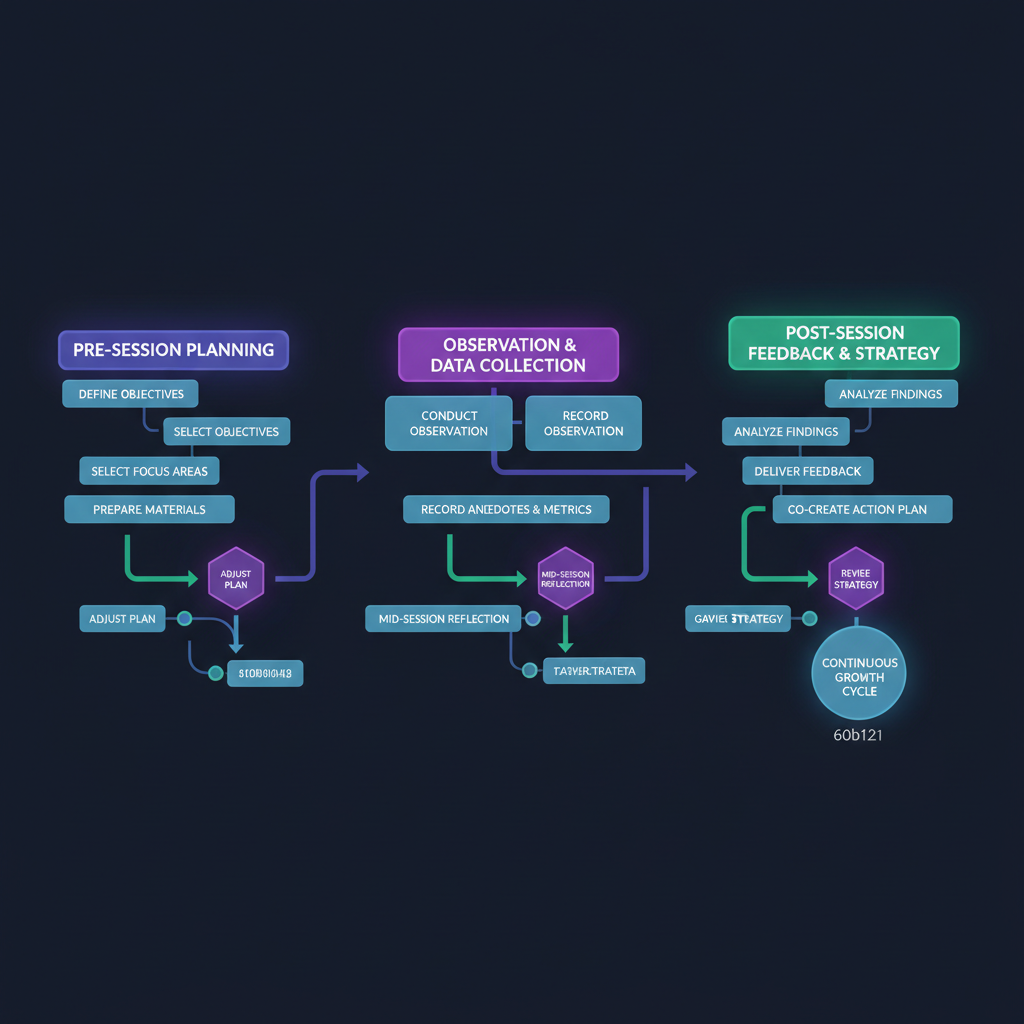
Effective sales coaching observation requires a repeatable system. Ad hoc "I'll listen to a call when I have time" doesn't work.
Pre-observation: Set the focus
Before you observe, decide what you're looking for. Observing everything yields generic feedback ("Great job, maybe slow down a bit"). Observing one behavior yields change.
Choose one of the five behaviors above. Tell the rep in advance: "Today I'm listening specifically for how you manage silence after questions. Everything else is secondary."
This focus reduces rep anxiety and makes feedback actionable.
During observation: Use a behavior checklist
Create a simple tally sheet:
| Behavior | Tally | Notes |
|---|---|---|
| Pauses 2+ seconds after question | III | Strong in discovery, rushed in closing |
| Objection response latency >2 sec | II | Faster on price, slower on timing |
| Stakeholder mapping question | I | Asked once at 18-min mark—too late |
| Next-step with calendar commitment | ✓ | Nailed it—booked follow-up live |
Tally in real time. This creates a factual record and prevents recency bias (remembering only the last five minutes).
Post-observation: One behavior, one action
Don't dump ten observations on a rep. Pick the one behavior that will move their numbers most, and build a 7-day practice plan around it.
Example:
Behavior: Objection response latency too fast (avg 0.8 seconds)
Action: Three role-plays this week focused solely on pausing before responding. Use a timer. Aim for 3 seconds.
Follow-up: Re-observe Friday to measure improvement.
This is the structure recommended in our comprehensive sales coaching framework, and it's how top teams build skill progressively rather than overwhelming reps with feedback.
Live observation vs. AI-assisted observation
You can't scale live observation across a team of 15 reps. You can scale AI-assisted observation.
AI sales call analysis tracks the five behaviors above automatically. It flags when a rep's question-to-statement ratio is off, when silence duration drops below threshold, or when a call ends without next-step commitment.
But AI doesn't replace your observation—it triages it. Use AI to identify which calls to observe and which behaviors need attention. Then bring human coaching to the specific moment.
At QUOTA, we combine AI role-play with behavioral tracking so reps can practice the exact behaviors you're observing for, and you can measure improvement without sitting through 40 discovery calls a week.
Gong's research on sales coaching found that managers who combine AI-flagged moments with live observation improve rep quota attainment by 19% compared to those who rely solely on manual call review.
Common observation mistakes that waste time
Mistake 1: Observing only struggling reps
Your top performers are your best training data. Observe them as often as you observe struggling reps. Capture what they do differently, then teach it to the rest of the team.
Mistake 2: Giving feedback days later
Feedback loses impact after 48 hours. Observe Monday, coach Tuesday. If you're using recorded calls, review and debrief within 24 hours.
Mistake 3: Observing without a hypothesis
"I'll just listen and see what I notice" leads to vague feedback. Enter every observation with a hypothesis: "I think this rep is rushing through discovery. I'm going to count question depth and silence duration to confirm."
Mistake 4: Confusing activity with behavior
Activity: "You made 50 dials."
Behavior: "You paused 3 seconds after asking about budget, and the buyer opened up about constraints."
Activity metrics matter for volume. Behavioral observation matters for conversion.
How to train managers to observe effectively
Most sales managers were promoted because they could sell, not because they could coach. Observation is a learned skill.
Start with calibration sessions. Have three managers observe the same call independently, then compare notes. You'll find they noticed completely different things. Calibration teaches them to see the same behaviors and apply the same standards.
Then build a shared observation rubric. What does "good" silence management look like? What does "poor" stakeholder mapping sound like? Concrete examples prevent subjective feedback.
Finally, invest in sales leadership coaching skills training. Managers who learn to observe, diagnose, and intervene systematically produce teams that hit quota 1.4× more consistently than managers who coach from intuition alone.
Building observation into your coaching cadence
Observation isn't a one-time event. It's a rhythm.
For new reps (first 90 days):
- Observe live or in role-play twice per week
- Focus on one behavior per session
- Use AI role-play between live observations to build reps
For established reps:
- Observe one live call per week
- Monthly deep-dive: review three calls, identify patterns
- Quarterly: observe a top performer, extract best practices
For high performers:
- Monthly observation to prevent skill drift
- Use them as observation subjects for newer reps
- Capture and document their micro-behaviors for team training
This cadence comes from our work with hundreds of sales teams on the QUOTA platform. It balances manager capacity with rep development needs, and it ensures observation drives continuous improvement rather than one-off feedback.
For more on how often to coach, see our guide on optimal coaching frequency.
FAQ
What should sales coaches observe during live calls?
Sales coaches should observe vocal pacing and silence management, question-to-statement ratio, objection response latency, stakeholder mapping behavior, and next-step clarity. These five behaviors predict deal outcomes more reliably than talk time or pitch delivery alone.
How do you observe sales reps without making them nervous?
Use AI role-play for initial observation so reps practice without pressure, establish a regular cadence so observation becomes routine, focus feedback on one behavior at a time, and share what you're observing in real-time to build transparency and trust.
What is the difference between sales coaching observation and call review?
Sales coaching observation happens live or in role-play and focuses on behavioral patterns that predict success. Call review is retrospective analysis of recorded conversations. Observation allows real-time intervention; review identifies trends over time. Both are essential.
How often should sales managers observe their reps?
New reps need observation at least twice weekly during their first 90 days. Established reps benefit from weekly observation of one call plus monthly deep-dive sessions. High performers should be observed monthly to capture best practices and prevent skill drift.
Ready to scale observation across your team? QUOTA Training uses AI role-play and behavioral tracking to help managers observe what matters, coach what moves metrics, and build reps who close. See how it works.
Sources

Stefano Breglia
Co-founder, QUOTA Training
Stefano Breglia is co-founder of QUOTA Training. He focuses on sales methodology, deal progression and how AI simulation accelerates rep ramp time across the SDR, BDR, AE and AM roles.
Turn this into reps, not just reading
QUOTA Training lets your team practise these exact scenarios with an AI buyer that reacts like the real thing — then scores every call.
See it in action