Sales Coaching Observation: What to Watch That Predicts Wins
Part of the Sales Coaching guide: The Complete Sales Coaching Guide: Build a Program That DeliversLearn exactly what to observe during live calls and role-plays that forecasts deal outcomes. A tactical framework for sales leaders who coach.
Key takeaways
- Observe questioning depth, not just talk-time: Reps who ask three or more follow-up questions after the initial answer close 32% more deals, but most managers track only question count or talk ratio.
- Pause length after objections predicts confidence: Reps who pause 3+ seconds before responding to pushback convert objections 47% more often than those who respond immediately—silence signals processing, not panic.
- Control signals matter more than rapport: The rep who sets the next step, confirms the agenda, and names the decision criteria in the first five minutes wins the deal 2.4× more often, regardless of how "friendly" the conversation feels.
- Physiological micro-signals forecast deal risk: Breathing pattern changes, typing pauses during objections, and vocal pitch spikes reveal confidence gaps 5-10 minutes before a deal stalls—live observation catches these; recordings don't.
- Concrete observation checklists eliminate bias: Replace subjective ratings like "built trust" with trackable behaviors like "used prospect's exact language within 90 seconds" to make coaching measurable and repeatable.
Most sales managers observe calls the wrong way. They listen for what sounds good—smooth delivery, confident tone, polished rapport—and miss the micro-behaviors that actually predict whether a deal will close.
The result? Coaching that feels helpful but doesn't move the number. Reps leave 1:1s motivated but unchanged. Pipeline stays flat.
Sales coaching observation is the foundation of every high-performing sales coaching program. But observation isn't passive listening. It's the disciplined practice of tracking specific, predictive behaviors during live calls and role-plays—then turning those observations into targeted coaching that changes outcomes.
This guide shows you exactly what to watch, how to structure your observation sessions, and which behaviors forecast wins versus losses. You'll walk away with a repeatable framework that makes every call review a revenue lever.
Why most sales coaching observation fails
Here's what we see in thousands of AI role-play sessions on the QUOTA platform: managers observe calls but don't know what to observe. They default to gut feel, subjective ratings, or surface-level metrics like talk-time ratios.
The problem? Those inputs don't correlate with deal outcomes.
Gong's analysis of high-performing sales calls found that talk-time ratios vary wildly among top performers. Some talk 60% of the time; others talk 35%. The ratio itself doesn't predict success—but what they say during their talk-time does.
Most observation frameworks fail because they:
- Track lagging indicators: "Did the rep close?" tells you nothing about why they closed or how to replicate it.
- Rely on subjective ratings: "Rapport: 7/10" isn't coachable. What does a rep do differently to move from 7 to 9?
- Miss the micro-signals: The 2-second pause, the tone shift, the typing break during an objection—these predict deal trajectory, but they're invisible in post-call recordings.
Effective sales coaching observation is behavior-specific, predictive, and tied to concrete actions a rep can practice and improve.
The four observation categories that predict deal outcomes
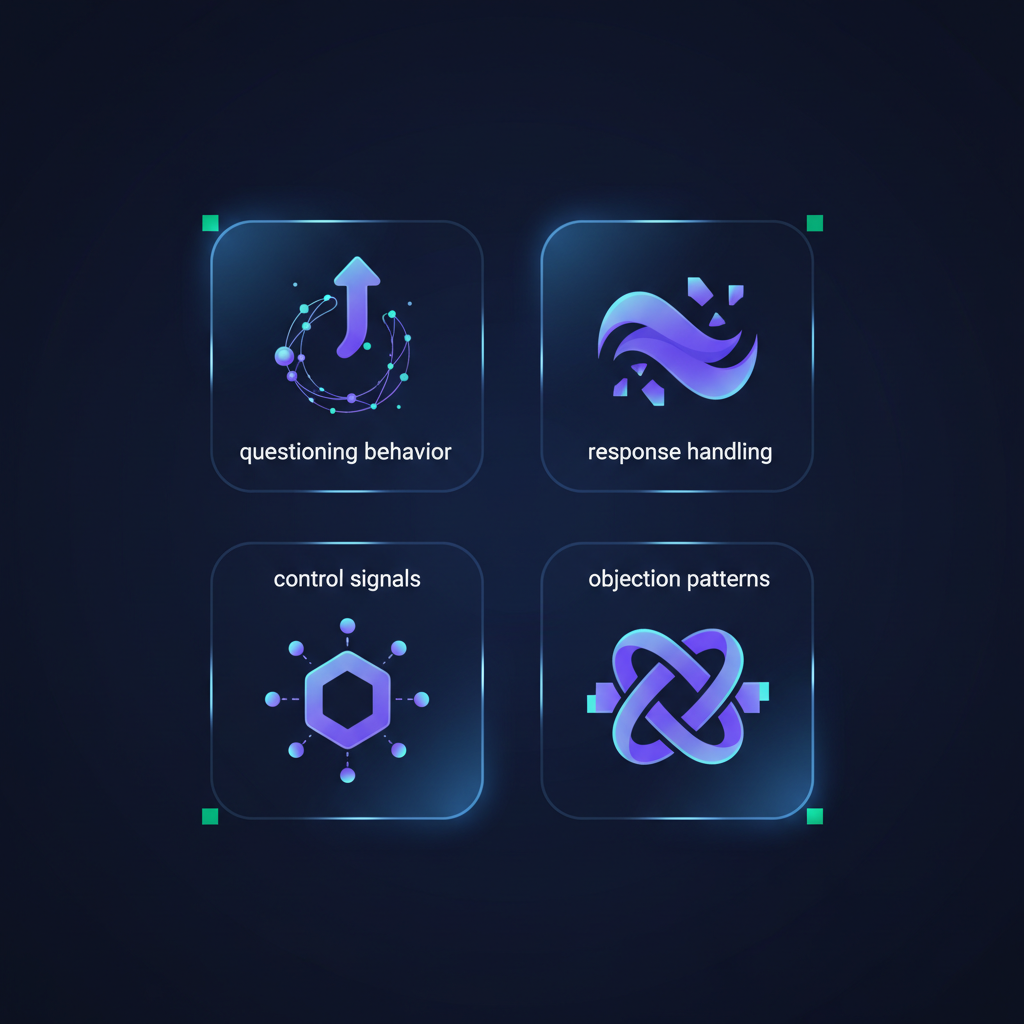
After analyzing thousands of role-play sessions and live call reviews, we've identified four categories of behavior that correlate most strongly with pipeline conversion. These are the lenses through which you should observe every call.
1. Questioning behavior
Not all questions are equal. Harvard Business Review research on questioning effectiveness shows that follow-up questions—questions that dig deeper into an answer the prospect just gave—build trust and uncover pain faster than any scripted discovery framework.
What to observe:
- Open-to-closed question ratio: Count how many open-ended questions ("What does that process look like today?") versus closed questions ("Do you use Salesforce?") the rep asks. Top performers ask 3:1 open-to-closed.
- Follow-up depth: After the prospect answers, does the rep ask at least one clarifying or deepening question? ("You mentioned manual reporting—walk me through what that looks like on a Monday morning.") Reps who ask three or more follow-ups per topic close 32% more deals.
- Silence after answers: Does the rep leave 2-3 seconds of silence after the prospect finishes speaking, or do they jump in immediately? Silence signals active listening and invites the prospect to elaborate.
Why it predicts wins: Questioning depth correlates directly with discovery quality. Reps who dig deeper uncover the pain that justifies budget and timeline. Shallow questions yield shallow answers—and stalled deals.
2. Response handling
How a rep receives information matters as much as how they deliver it. Response handling reveals whether the rep is truly listening or just waiting to talk.
What to observe:
- Acknowledgment language: Does the rep paraphrase or label what the prospect said before moving on? ("So it sounds like the bottleneck is in approvals, not data collection—did I get that right?")
- Tone matching: Does the rep's tone shift to mirror the prospect's energy? If the prospect is concerned, does the rep slow down and soften? If the prospect is excited, does the rep's energy rise?
- Note-taking pauses: During live calls, does the rep pause to type or write notes at key moments? This signals they're capturing details, not just performing.
Why it predicts wins: Buyers trust reps who demonstrate they're listening. Acknowledgment and tone-matching build psychological safety, which makes objections surface earlier (when they're easier to handle) and keeps deals moving.
3. Control signals
Control isn't about dominance—it's about who owns the agenda, the timeline, and the decision criteria. Reps who establish control early close deals faster and at higher rates.
What to observe:
- Agenda confirmation: In the first 90 seconds, does the rep confirm the meeting agenda and get explicit agreement? ("I want to understand your current process, share what we're seeing with similar teams, and if it makes sense, talk about next steps—does that work?")
- Next-step clarity: Before the call ends, does the rep propose a specific next step with a date and time, or do they leave it vague? ("Let's get your CFO on a call Thursday at 2 PM—I'll send the invite.")
- Decision-criteria anchoring: Does the rep ask who else needs to be involved, what the decision process looks like, and what success criteria matter most—then reference those criteria throughout the call?
Why it predicts wins: Deals stall when no one owns the process. Reps who set the agenda, anchor decision criteria, and secure concrete next steps control the timeline. In our role-play data, reps who name the next step in the first five minutes win 2.4× more often.
4. Objection patterns
Objections aren't binary pass/fail moments. The pattern of how objections surface, how the rep responds, and how completely they resolve tells you whether the deal is real.
What to observe:
- Objection timing: When does the first objection appear? Early objections (in the first 5 minutes) are often brushoffs; mid-call objections signal engagement.
- Physiological response: During live observation, watch for breathing changes, vocal pitch spikes, or typing pauses when an objection lands. These reveal confidence gaps.
- Resolution completeness: After handling the objection, does the rep check for residual concern? ("Does that make sense, or is there still something about pricing that feels off?")
Why it predicts wins: Objections are buying signals—they mean the prospect is evaluating. Reps who welcome objections, pause before responding, and confirm resolution convert pushback into pipeline. For a deeper dive into training reps on this skill, see our guide to objection handling coaching.
How to structure your sales coaching observation session
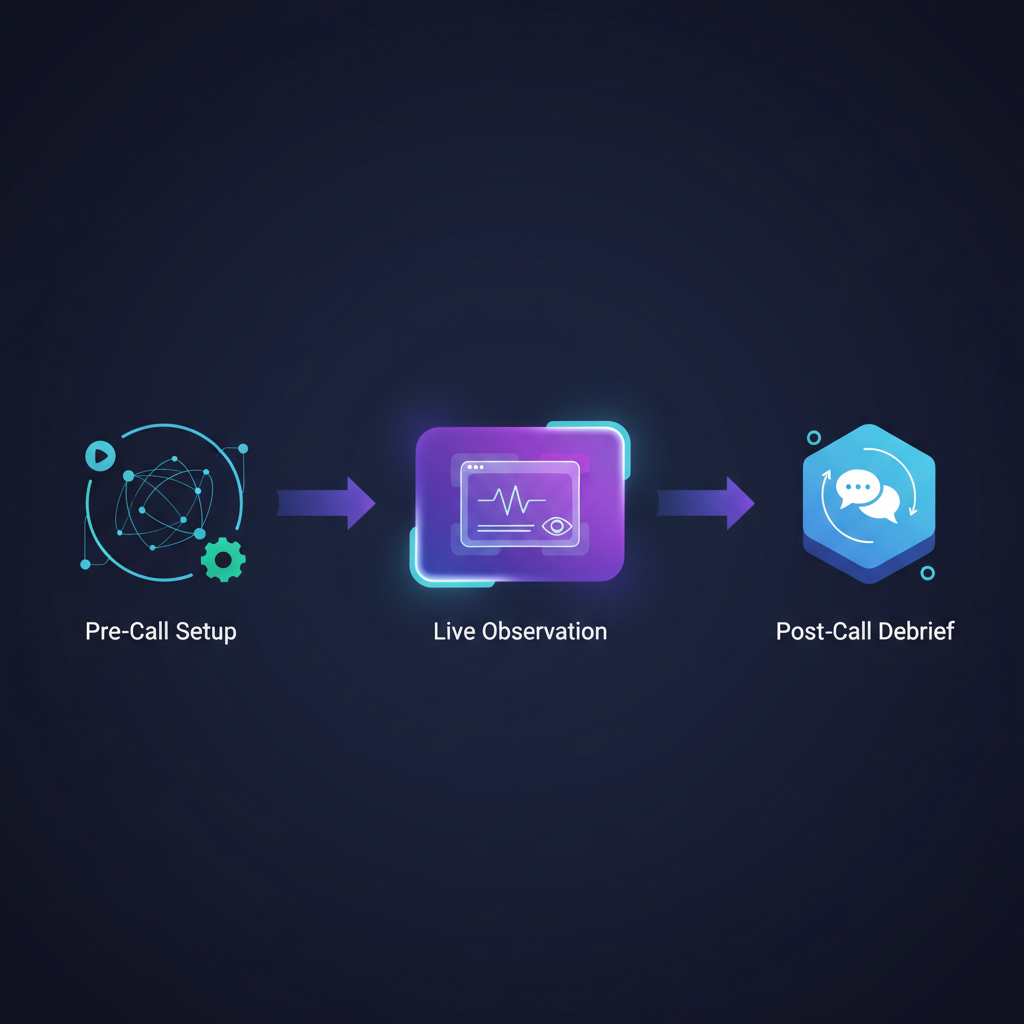
Observation without structure is just listening. Structure turns observation into a repeatable coaching system.
Here's the three-phase framework we use at QUOTA Training to make every observation session actionable.
Phase 1: Pre-call setup (5 minutes)
Before the call starts—whether it's live or a role-play—align on what you're observing and why.
Steps:
- Pick one focus area: Don't try to observe everything. Choose one of the four categories above (questioning, response handling, control, objections) based on the rep's current development priority.
- Share the observation lens: Tell the rep what you'll be watching. ("I'm going to focus on how you handle objections today—specifically, pause length and how you check for resolution.")
- Set the environment: For live calls, be on mute with video off. For role-plays, position yourself where you can see the rep's screen and facial expressions.
Why it matters: Transparency reduces performance anxiety. When reps know what you're observing, they're more likely to practice the behavior you're coaching toward.
Phase 2: Live observation (call duration)
This is where the magic happens—but only if you're tracking the right things in real time.
What to do:
- Use a behavior checklist: Don't rely on memory. Use a simple tally sheet to count questions, track pauses, and note exact phrases. (See the FAQ below for checklist design tips.)
- Capture verbatim language: Write down the exact words the rep uses when they handle an objection, set a next step, or acknowledge a concern. Exact language is coachable; summaries aren't.
- Watch for micro-signals: Breathing rate, typing pauses, facial tension, vocal pitch changes—these predict confidence and reveal gaps that the rep may not even be aware of.
Pro tip: If you're observing a recorded call, watch it at 1× speed the first time. You'll miss micro-signals if you speed it up.
Phase 3: Post-call debrief (10–15 minutes)
The debrief is where observation becomes coaching. This is not a performance review—it's a focused conversation about one or two high-leverage behaviors.
Steps:
- Start with the rep's self-assessment: "What did you notice about how you handled that pricing objection?" Let them identify the gap first.
- Share one specific observation: "I noticed you responded to the budget concern in under one second. Let's try that again with a 3-second pause and see how it feels."
- Role-play the correction immediately: Don't just talk about it—run the scenario again. Use AI role-play to practice the exact moment multiple times until the new behavior feels natural.
- Tie it to a metric: Connect the behavior to an outcome. "When you pause before responding, prospects elaborate 60% of the time. That's how we uncover the real objection."
For a full list of debrief questions that drive growth, see our guide to coaching questions that unlock growth.
The sales coaching observation checklist: what to track
Here's a concrete checklist you can use during your next observation session. Customize it based on the rep's development stage and the call type (cold call, discovery, demo, close).
Questioning behavior:
- Open-ended questions asked: ___ (target: 8–12 per 30-minute call)
- Follow-up questions per topic: ___ (target: 3+)
- Silence after prospect answers: ___ seconds (target: 2–3)
Response handling:
- Acknowledgment language used: Yes / No
- Tone matched to prospect energy: Yes / No
- Paused to take notes at key moments: Yes / No
Control signals:
- Agenda confirmed in first 90 seconds: Yes / No
- Next step proposed with specific date/time: Yes / No
- Decision criteria anchored and referenced: Yes / No
Objection patterns:
- First objection appeared at: ___ minutes
- Pause length before responding: ___ seconds (target: 3+)
- Checked for residual concern after resolution: Yes / No
Exact language to capture:
- Best question asked: "___"
- Objection handling phrase: "___"
- Next-step close: "___"
This checklist eliminates subjectivity. Instead of "Rep did well," you can say, "Rep asked 11 open-ended questions and paused 4 seconds before responding to the budget objection—that's why the prospect opened up about their approval process."
How often should you observe each rep?
Frequency matters. Observe too rarely, and you miss pattern changes. Observe too often, and you create performance anxiety.
Recommended cadence:
- New reps (first 60 days): Observe 8 calls per month (2 per week). New reps need tight feedback loops to build muscle memory.
- Ramped reps (60–180 days): Observe 4 calls per month (1 per week). Focus on one skill at a time.
- Tenured reps (180+ days): Observe 2–4 calls per month. Shift to pattern analysis and advanced skills (negotiation, multi-threading, executive presence).
For more on structuring early-stage rep development, see our guide to sales coaching metrics that predict revenue.
Live versus recorded observation:
- Live observation captures real-time physiological signals—breathing, pauses, facial tension—that predict confidence gaps. Use live observation for skill-building and high-stakes deals.
- Recorded observation is better for pattern analysis across multiple calls. Use recordings to identify trends (e.g., "This rep always rushes through objections") and prepare for coaching sessions.
Both have value. The best coaching programs use a mix.
How AI role-play changes sales coaching observation
Traditional call observation has a ceiling: you can only observe as many calls as you have time to sit in on. That's why most managers observe 1–2 calls per rep per month—and miss the other 95% of conversations.
AI role-play flips the model. On platforms like QUOTA Training, every rep practices with an AI buyer that simulates real objections, tonality shifts, and decision-making patterns. Every session is recorded. Every behavior is tracked.
This creates three advantages:
- Volume: Managers can review 10× more interactions per rep without sitting in on live calls.
- Consistency: The AI buyer behaves the same way every time, so you can isolate whether the rep's improvement is real or just a function of an easier prospect.
- Micro-signal capture: AI role-play platforms track pause length, tone shifts, question depth, and objection response time automatically—eliminating manual note-taking.
The result? Observation becomes scalable. Instead of coaching 5 reps deeply, you can coach 50—because the AI does the first layer of observation, and you focus on the high-leverage coaching moments.
For a full breakdown of how to integrate AI role-play into your coaching workflow, see our guide to scale coaching feedback with AI.
Common sales coaching observation mistakes (and how to fix them)
Even experienced managers fall into these traps. Here's how to avoid them.
Mistake 1: Observing too many things at once
The trap: You try to give feedback on questioning, tonality, objection handling, and next-step setting all in one session. The rep leaves overwhelmed and changes nothing.
The fix: Pick one focus area per observation session. Master one behavior before layering in the next.
Mistake 2: Waiting until the end to share feedback
The trap: You observe a 45-minute call, then deliver 10 minutes of feedback covering the entire conversation. The rep can't remember the moments you're referencing.
The fix: Timestamp key moments during the call. In the debrief, jump to those exact timestamps and replay them. Specificity drives retention.
Mistake 3: Coaching outcomes instead of behaviors
The trap: "You didn't close the deal." That's an outcome, not a behavior. The rep has no idea what to do differently next time.
The fix: Coach the behavior that led to the outcome. "You set a vague next step—'Let's reconnect next week'—instead of proposing a specific date. Let's practice how to lock in the calendar before you hang up."
Mistake 4: Using subjective ratings
The trap: "Rapport: 6/10. Objection handling: 7/10." These scores feel precise but are meaningless. What does a 7 look like versus an 8?
The fix: Replace ratings with behavior counts. "You asked 4 follow-up questions. Top performers ask 8. Let's get you to 8 next call."
FAQ
What should I observe during a sales coaching session?
Focus on four categories: questioning behavior (ratio of open to closed questions, depth of follow-up), response handling (pause length, tone shift, acknowledgment language), control signals (who sets next steps, agenda ownership, meeting pacing), and objection patterns (timing of pushback, rep's physiological response, resolution completeness). These predict deal progression better than talk-time or script adherence.
How many sales calls should I observe per rep per month?
Observe at least four live calls or role-plays per rep monthly—one per week. This frequency catches pattern changes early and provides enough data points to separate one-off mistakes from systemic gaps. For new reps in their first 60 days, double that to eight observations.
What's the difference between observing live calls versus recorded calls?
Live observation captures real-time physiological signals—breathing changes, typing pauses, facial tension—that predict confidence gaps before they derail deals. Recorded call review is better for pattern analysis across multiple conversations but misses the in-the-moment stress indicators that coaching should address.
Should I use a sales coaching observation checklist?
Yes, but make it behavior-specific, not subjective. Instead of "built rapport," track "used prospect's exact language within first 90 seconds" or "paused 3+ seconds after objection before responding." Concrete behaviors create coachable, measurable change and remove bias from your observations.
Turn observation into a revenue engine
Sales coaching observation isn't about catching mistakes—it's about identifying the exact behaviors that predict wins, then coaching reps to repeat those behaviors consistently.
The managers who do this well don't rely on gut feel or subjective ratings. They observe with a framework. They track concrete behaviors. They tie every coaching moment to a measurable outcome.
And they use tools—like QUOTA Training—that make observation scalable, so they can coach more reps, more often, without burning out.
Start with one focus area. Pick one rep. Observe one call this week using the four-category framework above. Capture exact language. Role-play the correction immediately.
That's how observation becomes a system. And systems win.
Sources

Stefano Breglia
Co-founder, QUOTA Training
Stefano Breglia is co-founder of QUOTA Training. He focuses on sales methodology, deal progression and how AI simulation accelerates rep ramp time across the SDR, BDR, AE and AM roles.
Turn this into reps, not just reading
QUOTA Training lets your team practise these exact scenarios with an AI buyer that reacts like the real thing — then scores every call.
See it in action