SDR Email Prospecting: 9 Tactics That Get Replies in 2025
Part of the SDR Playbook guide: The Complete SDR Playbook for 2026: Your End-to-End GuideMaster SDR email prospecting with 9 proven tactics that boost reply rates. Learn subject lines, personalization, timing, and follow-up strategies that book meetings.

Key takeaways
- Personalized subject lines that reference a specific trigger (company news, role change, or shared connection) generate 2-3x higher open rates than generic "quick question" lines—but personalization must extend beyond the subject into the first sentence to maintain engagement.
- The majority of email replies come from touches 3-5 in a sequence, not the first email—SDRs who stop after one or two attempts leave 60-70% of potential meetings on the table, yet each follow-up must add new value or a different angle.
- Emails under 75 words with a single, specific call-to-action (like "Are you free Tuesday at 2 PM?") convert 30-40% better than longer emails with multiple asks—decision-makers skim on mobile and need friction-free next steps.
- Tuesday-Thursday sends between 8-10 AM in the prospect's timezone consistently outperform Monday and Friday emails—timing matters as much as copy, because even perfect emails get buried in crowded inboxes.
- Value-first emails that lead with a relevant insight, benchmark, or question about the prospect's business earn replies even from cold lists—pitching your product in the first email kills curiosity and triggers immediate deletion.
SDR email prospecting is the backbone of predictable outbound pipeline. While cold calling grabs attention in the moment, email gives you the space to research, personalize, and build sequences that compound over time. Yet most SDR emails fail—not because the product is wrong, but because the tactics are generic, the timing is off, or the follow-up dies after one attempt.
At QUOTA Training, we analyze thousands of SDR role-play sessions where reps practice email scenarios alongside cold calling scripts and objection responses. The patterns are clear: top-performing SDRs treat email prospecting as a strategic system, not a volume game. They personalize with intent, sequence with discipline, and test relentlessly.
This guide breaks down nine SDR email prospecting tactics that consistently drive replies and book meetings—from subject lines and personalization to timing, follow-up cadences, and A/B testing. These aren't theoretical best practices; they're the exact techniques that separate SDRs who hit quota from those who spam and hope.
For a comprehensive view of how email fits into the broader SDR motion, see The Complete SDR Playbook for 2026.
Why most SDR prospecting emails fail
Before diving into what works, let's name the failure modes we see every day in training sessions:
Generic spray-and-pray templates. "Hi [First Name], I noticed your company and thought we could help..." tells the prospect nothing. It screams automation and gets deleted in two seconds.
No clear reason to reply. Emails that pitch features without context or ask vague questions like "Would you be open to a conversation?" give the prospect no incentive to respond. Busy people need a reason—a insight, a question, a specific value hook.
Weak or missing follow-up. Most SDRs send one email and move on. But research from HubSpot shows that 80% of sales require five or more follow-ups, yet 44% of reps give up after one attempt.
Poor timing and send hygiene. Blasting emails at 6 AM on a Monday or 5 PM on a Friday means your message lands when inboxes are chaos. Timing is a tactical lever, not an afterthought.
No testing or iteration. SDRs who don't track open rates, reply rates, and meeting-booked rates by template, subject line, and send time are flying blind. What you don't measure, you can't improve.
The antidote is a disciplined, multi-touch approach where every email has a job, every follow-up adds value, and every element—from subject line to CTA—is tested and refined.
Subject lines that get opened
Your subject line is the gatekeeper. If it doesn't earn the open, nothing else matters. Here's what works:
Keep it short and specific
Aim for 3-5 words. Long subject lines get truncated on mobile, and vague lines ("Touching base") signal spam. Examples that perform:
- "Quick question, [First Name]"
- "[Company name] + [Your company]"
- "Thoughts on [specific initiative]?"
- "[Mutual connection] recommended I reach out"
Reference a trigger or shared context
Personalized subject lines that tie to a real event—funding round, new hire, product launch, conference attendance—signal that you've done your homework. According to Salesforce, emails with personalized subject lines are 26% more likely to be opened.
Examples:
- "Congrats on the Series B"
- "Saw your post on LinkedIn re: [topic]"
- "Following up from [event name]"
Avoid spam triggers
Words like "free," "urgent," "limited time," excessive punctuation (!!!), and ALL CAPS tank deliverability and credibility. Keep it conversational and genuine.
Personalization beyond first name: research triggers that matter

Real personalization starts before you write a word. Top SDRs spend 5-10 minutes researching each prospect to find a hook—something specific that makes the email relevant right now. Here's where to look:
Company triggers
- Funding announcements (scaling teams, new budget)
- Product launches or feature releases (new pain points, competitive shifts)
- Hiring sprees (specific roles = specific challenges)
- Earnings calls or press releases (strategic priorities)
Individual triggers
- Role changes or promotions (new mandates, fresh eyes on vendors)
- LinkedIn posts or comments (shows what they care about)
- Conference speaking or attendance (shared interest, warm opener)
- Mutual connections (social proof, referral-style intro)
Use these triggers in the first sentence to prove you're not mass-blasting. Example:
"Hi Sarah, saw you just joined as VP of Sales at Acme—congrats. I work with a lot of VPs who inherit legacy tech stacks and need to ramp their teams fast..."
This beats "Hi Sarah, I help sales teams..." by a mile.
The value-first opening: lead with insight, not pitch
The first two sentences determine whether the prospect keeps reading or hits delete. Don't pitch your product. Instead, lead with value: a relevant insight, a question about their business, or a piece of intel they'll find useful.
Insight-led openers
Share a benchmark, trend, or observation that's relevant to their role or industry:
"Most SaaS sales teams we work with see a 6-8 week ramp time for new SDRs—but the top 10% cut that in half by using AI role-play instead of peer shadowing."
This positions you as a peer with useful knowledge, not a vendor begging for time.
Question-led openers
Ask a question that makes them think about a problem you solve:
"How are you currently ramping new SDRs without pulling your top reps off the phones for coaching?"
Good questions surface pain without being pushy. For more on crafting discovery-style questions, see our guide to objection handling frameworks.
Avoid the "I help companies like yours..." trap
This phrasing is vague, self-centered, and instantly forgettable. Flip it: make the first sentence about them, not you.
Keep it short: the 50-75 word rule
Busy prospects skim emails on their phones between meetings. Long blocks of text get skipped. Structure your email like this:
- Personalized opener (1 sentence)
- Value hook or insight (1-2 sentences)
- Soft qualifying question or CTA (1 sentence)
- Sign-off
Example:
Hi Mark,
Saw Acme just raised a Series B—congrats. Most companies scaling from 10 to 50 reps struggle to keep messaging consistent without slowing down hiring.
We help sales leaders like you use AI role-play to onboard reps 2x faster. Worth a 15-minute conversation?
Best,
Jamie
Total: 52 words. Clear, skimmable, and actionable.
The single, specific call-to-action
Don't give prospects multiple options ("Would you be open to a call, or should I send some resources, or...?"). Decision fatigue kills replies. Instead, propose one clear next step:
- Time-bound meeting ask: "Are you free Tuesday at 2 PM for a quick call?"
- Micro-commitment: "Should I send over a 2-minute demo video?"
- Qualifying question: "Are you currently using role-play to train your SDRs, or is it mostly peer shadowing?"
The best CTAs are easy to say yes to and low-friction. Avoid "Let me know if you'd like to chat"—it's vague and puts the burden on the prospect.
The follow-up sequence: persistence without pestering
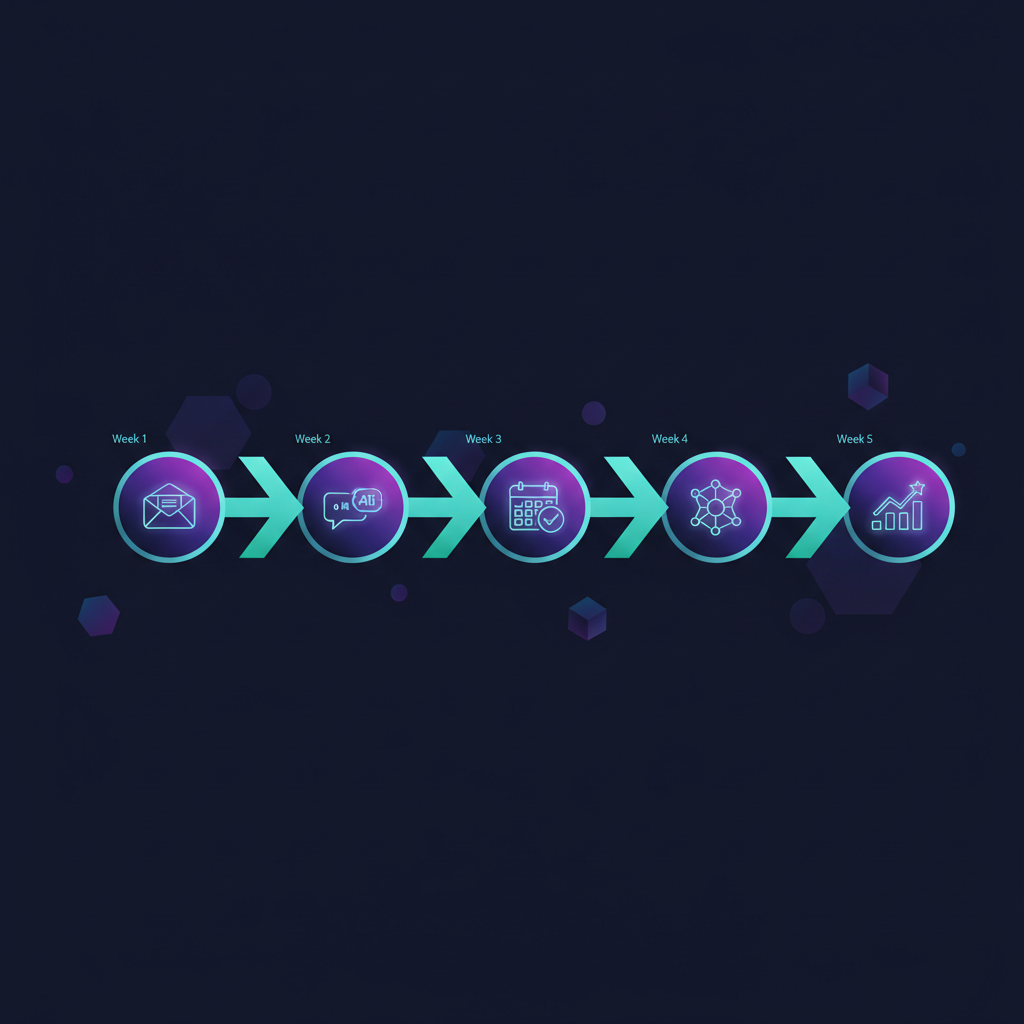
One email is not a sequence. Most replies come from touches 3-5, so your follow-up game matters more than your first email. Here's a proven cadence:
Email 1 (Day 1): Value-first intro
Lead with insight or question, as outlined above.
Email 2 (Day 3): Add a new angle
Don't just say "following up." Add new value—a case study, a relevant stat, a different pain point:
"Hi Mark, following up on my note from Tuesday. One thing I didn't mention: we recently helped a Series B SaaS company cut SDR ramp time from 8 weeks to 4 using AI role-play. Happy to share how—does Thursday work?"
Email 3 (Day 7): Social proof or urgency
Reference a customer in their industry or a relevant trigger:
"Hi Mark, just wrapped a call with another VP of Sales in your space who mentioned the same challenge around onboarding speed. Thought it might be worth connecting—are you free this week?"
Email 4 (Day 14): The break-up email
Use a polite "closing the loop" email to create urgency:
"Hi Mark, haven't heard back so I'm guessing this isn't a priority right now. Should I close your file, or is there a better time to revisit?"
Break-up emails often get the highest reply rates because they signal finality and respect the prospect's time.
For more on building multi-touch outreach, see our SDR onboarding plan, which includes email sequencing in the 30-60-90 ramp.
Timing: when to send for maximum opens and replies
Send time affects open rates and reply rates. Here's what we observe in training and what the data shows:
Best days: Tuesday, Wednesday, Thursday
Mondays are inbox chaos. Fridays are mentally checked out. Mid-week emails get more attention.
Best times: 8-10 AM and 3-4 PM (prospect's timezone)
Early morning catches decision-makers clearing their inbox before meetings start. Mid-afternoon catches them wrapping up their day. Avoid lunch (12-1 PM) and after 5 PM.
Always send in the prospect's timezone
If you're prospecting into the East Coast from the West Coast, schedule sends for 8 AM ET, not 8 AM PT. Tools like Outreach, SalesLoft, and HubSpot automate this.
A/B testing: the only way to improve
What works for one ICP or vertical might flop for another. The best SDRs treat email like a science experiment: test one variable at a time, measure results, and iterate.
What to test
- Subject lines: Personalized vs. generic, question vs. statement
- Opening lines: Insight-led vs. question-led
- Email length: 50 words vs. 100 words
- CTA style: Time-specific ask vs. open-ended question
- Send time: Morning vs. afternoon, Tuesday vs. Thursday
Metrics to track
Track these in your CRM or email tool:
- Open rate (subject line effectiveness)
- Reply rate (body copy and CTA effectiveness)
- Meeting-booked rate (overall sequence quality)
For a deeper dive into what to measure beyond activity, see SDR activity tracking.
Integrate email with multi-channel sequences
Email alone isn't enough. The highest-performing SDRs layer email with calls, LinkedIn touches, and video. A typical multi-touch sequence looks like:
- Day 1: Email (value-first intro)
- Day 2: LinkedIn connection request (no pitch)
- Day 3: Phone call (reference the email)
- Day 5: Email follow-up (add new value)
- Day 7: LinkedIn message (share a relevant article)
- Day 10: Phone call
- Day 14: Break-up email
This omnichannel approach increases touchpoints without overwhelming any single channel. According to Gong, deals that involve 6+ touches across multiple channels have 2x higher close rates than single-channel outreach.
Practice email scenarios with AI role-play
Writing great emails is a skill, and like any skill, it improves with deliberate practice. At QUOTA Training, SDRs use AI role-play training to simulate email scenarios: crafting openers, handling objections via email, and iterating on messaging in real time.
AI role-play lets reps test dozens of subject lines and body copy variations in minutes, get instant feedback on clarity and tone, and build confidence before hitting send to real prospects. It's faster and more scalable than peer review, and it integrates with the same gamification mechanics that drive consistent practice.
Common SDR email mistakes to avoid
Even experienced SDRs fall into these traps:
Mistake 1: Asking for too much too soon
"Can we schedule a 30-minute demo?" is a big ask for a cold prospect. Start smaller: "Worth a quick 10-minute call to see if this is relevant?"
Mistake 2: Overloading with features
Your prospect doesn't care about your product's features in the first email. They care about their problem. Lead with outcomes, not capabilities.
Mistake 3: No follow-up plan
Sending one email and moving on wastes your research and the relationship. Build a sequence before you send email one.
Mistake 4: Ignoring mobile optimization
Over 50% of emails are opened on mobile. Long paragraphs, tiny fonts, and complex formatting break the experience. Keep it simple.
How to train SDRs on email prospecting
Email prospecting is a trainable skill, but most onboarding programs treat it as an afterthought. Here's how to build it into your SDR development:
Week 1-2: Template library and personalization drills
Give new SDRs a library of proven templates (subject lines, openers, CTAs) and have them practice personalizing each one with real prospect research.
Week 3-4: Sequence design and A/B testing
Teach SDRs how to build multi-touch sequences and run small A/B tests on their own book of business. Review results in weekly 1:1s.
Ongoing: Role-play and review
Use AI role-play to simulate email writing under time pressure, and review real sent emails in team coaching sessions. For more on building a coaching cadence, see our sales coaching guide.
FAQ
What is the best time to send SDR prospecting emails?
Send prospecting emails Tuesday through Thursday between 8-10 AM or 3-4 PM in the prospect's timezone. These windows capture decision-makers when they're clearing their inbox or wrapping up their day, before meetings pile up or fatigue sets in.
How many follow-up emails should an SDR send?
SDRs should send 4-6 follow-up emails over 2-3 weeks as part of a multi-touch sequence. Space them 2-3 days apart initially, then extend to weekly. Most replies come from touches 3-5, so persistence is critical—but always provide value in each touch.
What makes a good SDR email subject line?
Effective SDR subject lines are 3-5 words, create curiosity without clickbait, reference something specific to the prospect (company news, role, challenge), and avoid spam triggers like 'free,' 'urgent,' or excessive punctuation. Personalized subject lines can double open rates.
How long should an SDR prospecting email be?
Keep SDR prospecting emails under 100 words—ideally 50-75. Busy prospects skim on mobile devices. Front-load the value proposition in the first sentence, use short paragraphs (1-2 lines each), and include a single, clear call-to-action.
Sources

Stefano Sechi
Co-founder, QUOTA Training
Stefano Sechi is co-founder of QUOTA Training. He works hands-on with B2B sales teams on cold calling, discovery and objection handling, and shaped much of the methodology behind QUOTA’s AI role-play scenarios.
Turn this into reps, not just reading
QUOTA Training lets your team practise these exact scenarios with an AI buyer that reacts like the real thing — then scores every call.
See it in action