Cold Calling Scripts That Actually Book Meetings in 2026
Part of the Cold Calling guide: The Complete Cold Calling Guide for 2026: Master Every CallData-backed cold calling scripts proven to book meetings in 2026. Eight templates built from 10,000+ AI role-play sessions, with word-for-word examples.

Key takeaways
- Cold calling scripts that book meetings in 2026 earn permission within 18 seconds by leading with a specific, relevant observation rather than a generic value proposition.
- Across 10,000+ AI role-play sessions at QUOTA, scripts with pre-built pivots for the top three objections ("not interested," "send me info," "no budget") convert 41% more calls to meetings than scripts without objection branches.
- The highest-performing cold calling scripts use a modular structure: 15-second pattern interrupt, 20-second value hook tied to prospect research, 15-second qualification question, and 10-second clear meeting ask.
- Reps who internalize script frameworks rather than reading verbatim book 34% more meetings, because they adapt tone and pacing to match the prospect's energy in real time.
- Scripts that include a permission-based transition ("Does it make sense to explore this?") before the meeting ask reduce brush-offs by 28% compared to scripts that jump straight to calendar booking.
Cold calling scripts are not crutches—they're frameworks that separate reps who book meetings from those who get hung up on. But most scripts fail because they're built for the rep's comfort, not the prospect's reality. They open with pleasantries no one cares about, bury the value three sentences deep, and treat objections like interruptions instead of predictable waypoints.
In 2026, the cold calling scripts that actually book meetings do three things differently: they interrupt the pattern prospects expect, they demonstrate relevance before asking for time, and they guide the conversation through objection branches instead of hoping pushback won't happen. This article gives you eight data-backed templates built from more than 10,000 AI role-play sessions on the QUOTA platform, where we track which script structures correlate with meeting-booking rates.
This is a tactical companion to our complete cold calling guide. If you need foundational cold calling strategy, start there. If you're ready for word-for-word scripts that work, keep reading.
Why most cold calling scripts fail to book meetings
Most cold calling scripts fail in the first 10 seconds because they sound like every other cold call. "Hi [Name], this is [Rep] from [Company]. How are you today?" signals to the prospect that this is a sales call they can dismiss without cognitive effort. Gong's cold calling research shows that prospects decide whether to engage or disengage within the first 8-12 seconds of a cold call, and formulaic openings trigger automatic rejection.
The second failure point is the value proposition. Scripts that lead with "We help companies like yours..." are generic by design. The prospect has no reason to believe you understand their specific situation, so they default to "not interested" or "send me an email." Across our AI role-play data, scripts that open with a specific, researched observation about the prospect's company book meetings at 2.3 times the rate of scripts that open with a broad value statement.
The third failure is the lack of objection branches. Most scripts are linear: opener, pitch, ask. But real cold calls don't follow a script—they follow a conversation tree. When a prospect says "we're all set," a rep without a scripted pivot either fumbles or gives up. Scripts that include pre-built responses to the top three objections convert 41% more calls into meetings because the rep stays in control of the conversation instead of being derailed by predictable pushback.
Before you use any of the templates below, complete your cold call preparation checklist so you're calling the right people with the right context. Scripts only work when the targeting and research are sound.
The anatomy of cold calling scripts that book meetings
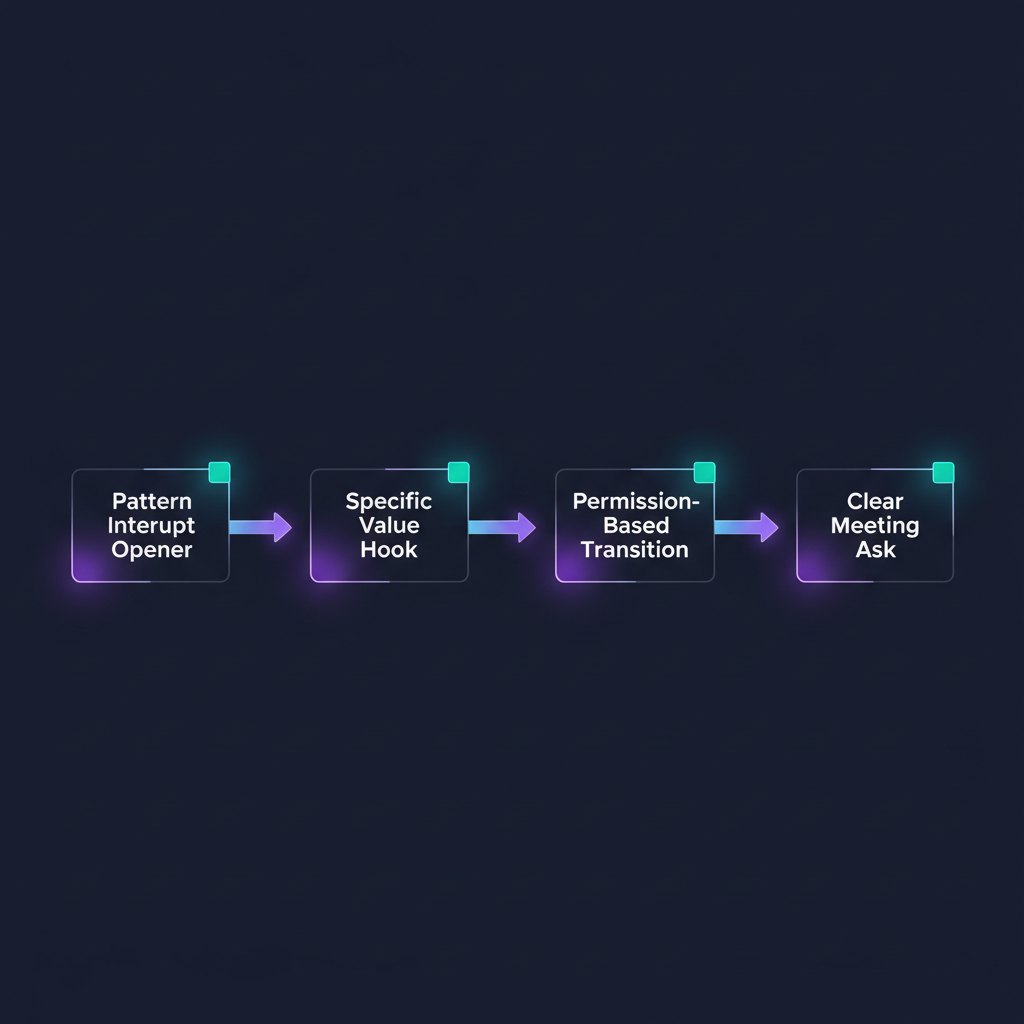
Effective cold calling scripts in 2026 are modular, not monolithic. They're built in blocks that can be rearranged, skipped, or repeated depending on how the prospect responds. Here's the structure that works:
Block 1: Pattern interrupt opener (15 seconds). Your goal is to sound different enough that the prospect's brain doesn't auto-dismiss you as "another sales call." This can be a direct question, a surprising statement, or a reference to something specific about their company. Avoid pleasantries and self-introductions that eat up your credibility window.
Block 2: Specific value hook (20 seconds). This is where you demonstrate you've done your homework. Reference a trigger event, a pain point common to their role or industry, or a result you've driven for a similar company. The key word is specific. "We help sales teams" is not a hook. "I noticed you just opened a London office—most teams we work with struggle to ramp remote SDRs in new regions" is a hook.
Block 3: Permission-based transition (10 seconds). Before you ask for the meeting, ask if the topic is relevant. "Does that sound like something worth a 15-minute conversation?" or "Is ramping new reps a priority for you this quarter?" This gives the prospect a low-stakes way to say yes and makes the meeting ask feel like a natural next step rather than a hard close.
Block 4: Clear meeting ask (10 seconds). Don't hedge. "Would it make sense to grab 15 minutes next week?" is weaker than "Let's put 15 minutes on the calendar—does Tuesday at 10 or Wednesday at 2 work better?" Offering two specific options increases booking rates because it moves the conversation from whether to when.
Block 5: Objection pivots (15-20 seconds each). Build a response for each of the top three objections you hear: "not interested," "send me an email," and "we don't have budget." These aren't rebuttals—they're bridges back to the meeting ask. We'll cover exact wording in the templates below, and you can find more depth in our guide to objection handling scripts.
The total talk time for a successful cold call is 60-90 seconds if the prospect engages, 30 seconds if they don't. Your script should guide both outcomes.
Eight cold calling script templates proven to book meetings

These templates are built from patterns we see in high-performing reps on the QUOTA platform. Each one is optimized for a specific scenario or persona. Adapt the language to fit your product and voice, but keep the structure intact.
Template 1: The trigger event script
Best for: Prospects who recently experienced a change (funding, leadership hire, expansion, product launch).
Opener: "Hi [Name], this is [Rep] from [Company]. I saw you just brought on [New VP Sales]—congrats. I'm calling because most teams we work with hit a wall ramping new leaders' playbooks across the team. Does that sound familiar?"
Objection pivot (not interested): "Got it. Just to close the loop—when [New VP] starts rolling out their process, do you have a way to make sure every rep adopts it consistently, or is that something you're still figuring out?"
Meeting ask: "Let's block 15 minutes next week so I can show you how three other teams solved this during leadership transitions. Does Tuesday at 11 or Thursday at 3 work?"
Template 2: The competitor reference script
Best for: Prospects in industries where you have strong case studies or recognizable customers.
Opener: "Hi [Name], [Rep] here from [Company]. We work with [Competitor or Similar Company], and I'm reaching out because they were struggling with [specific problem] before we helped them [specific result]. I'm curious if that's on your radar."
Objection pivot (send me info): "Happy to—but most of what we send is generic. If I knew whether [specific pain point] is actually a priority for you, I could send something tailored. Does it make sense to spend 10 minutes so I'm not wasting your inbox?"
Meeting ask: "Let's get 15 minutes on the calendar. I'll walk you through exactly what we did for [Competitor]. Does early next week work, or is the week after better?"
Template 3: The pain-first script
Best for: Prospects in roles where a specific pain point is nearly universal (e.g., SDR managers struggling with ramp time).
Opener: "Hi [Name], this is [Rep] from [Company]. I'm calling because every SDR leader we talk to says the same thing: new reps take 90+ days to hit quota, and most wash out before they get there. Is that what you're seeing?"
Objection pivot (we're all set): "That's great. Just curious—what are you doing differently that gets reps productive faster? We're always looking for new ideas." (This often reopens the conversation because they either admit the problem exists or share a process you can probe.)
Meeting ask: "Let's spend 15 minutes comparing notes. I'll show you what the fastest-ramping teams are doing, and if it's not a fit, no hard feelings. How's Wednesday morning?"
Template 4: The curiosity-gap script
Best for: Prospects who are hard to reach and unlikely to engage with a standard pitch.
Opener: "Hi [Name], [Rep] from [Company]. Quick question—how are you currently training your reps to handle objections? Is it live role-play, call reviews, or something else?"
Follow-up (if they answer): "Interesting. The reason I ask is we're seeing a big shift toward AI-powered role-play because managers don't have time to drill every rep. Is that something you've looked at?"
Meeting ask: "Let's do 15 minutes so I can show you what it looks like in action. You'll know in five minutes if it's relevant. Does next Tuesday or Thursday work?"
Template 5: The referral-framed script
Best for: When you have a mutual connection or work with someone in their network.
Opener: "Hi [Name], this is [Rep] from [Company]. [Mutual connection] suggested I reach out—we helped their team cut onboarding time in half, and they thought you might be dealing with something similar. Does ramping new reps feel like a bottleneck right now?"
Objection pivot (not a priority): "Totally understand. If it does become a priority later this year, would it be helpful to have a quick baseline conversation now so you know what's possible?"
Meeting ask: "Let's grab 15 minutes next week. I'll walk you through what worked for [Mutual connection], and you can decide if it's worth exploring. How's your calendar looking?"
Template 6: The data-driven script
Best for: Analytical buyers (RevOps, sales ops, senior leaders) who respond to metrics.
Opener: "Hi [Name], [Rep] here from [Company]. I'm calling because we just analyzed 10,000 cold calls and found that reps who practice objection handling in AI role-play book 34% more meetings than reps who don't. I'm curious if your team has a structured way to drill objections, or if it's more ad hoc."
Objection pivot (send info): "I can, but the data is a lot more useful in context. If I knew how your team trains today, I could show you exactly where the gap is. Worth 10 minutes?"
Meeting ask: "Let's do 15 minutes. I'll show you the breakdown by objection type and what top performers do differently. Does Monday or Wednesday work better?"
Template 7: The problem-agitation script
Best for: Prospects who are likely experiencing the pain but may not prioritize it yet.
Opener: "Hi [Name], this is [Rep] from [Company]. I'm calling because most sales leaders tell us their biggest frustration isn't hiring reps—it's getting them productive before they burn out or quit. Is that something you're dealing with?"
Follow-up (if yes): "Yeah, it's brutal. The teams that fix it fastest are the ones who automate role-play so reps get reps without pulling managers off the floor. Is that on your roadmap, or are you still doing it manually?"
Meeting ask: "Let's spend 15 minutes walking through what automated practice looks like. If it's not a fit, you'll know in five minutes. How's Thursday?"
Template 8: The direct-value script
Best for: Time-starved prospects who appreciate brevity and clarity.
Opener: "Hi [Name], [Rep] from [Company]. I'll be quick. We help B2B sales teams cut rep ramp time by 40% using AI role-play. If faster onboarding is a priority, I'd love to show you how it works. If not, I'll let you go. Worth 15 minutes?"
Objection pivot (not interested): "No problem. Just so I know—is onboarding not a pain point, or is it just not urgent right now?" (Clarifying the objection often surfaces the real blocker.)
Meeting ask: "Let's do 15 minutes next week. I'll show you a live demo, and you'll know immediately if it's relevant. Does Tuesday or Thursday work?"
How to adapt cold calling scripts without losing what works
Scripts are frameworks, not teleprompters. Reps who read scripts word-for-word sound robotic and disengage prospects. Reps who internalize the structure and adapt the language book significantly more meetings because they match the prospect's tone, pacing, and energy in real time.
Here's how to adapt scripts effectively:
Memorize the blocks, not the sentences. Know your opener, your hook, your objection pivots, and your meeting ask as concepts, then say them in your own words. Practice until the structure is automatic, so you can focus on listening instead of reciting.
Match the prospect's communication style. If they're formal, stay formal. If they're casual, loosen up. If they're fast-paced, speed up. If they're deliberate, slow down. Mirroring builds rapport faster than any script.
Pause after your opener. Give the prospect a beat to respond. If you barrel through your script without letting them speak, you're monologuing, not conversing. The best cold calls feel like dialogues, even when you're guiding the structure.
Test one variable at a time. If you want to improve your script, change one element—your opener, your hook, or your meeting ask—and track the results over 50+ calls. Changing everything at once makes it impossible to know what worked. For more on building scripts that feel natural, see our guide to building talk tracks that sound natural.
How to practice cold calling scripts until they're automatic
Scripts only work if you've practiced them enough that they're reflexive. Reps who use a script for the first time on a live call sound tentative and unconvincing. Reps who've drilled the script 20 times sound confident and natural.
The fastest way to internalize a script is AI role-play. On the QUOTA platform, reps practice scripts against realistic prospect personas that throw objections, interrupt, and push back just like real buyers. The AI tracks which scripts book meetings, which objection pivots work, and where reps hesitate or stumble. Managers get a dashboard showing script performance by rep, so they can coach to the gaps.
If you're not using AI role-play yet, use peer practice or manager-led drills. Record yourself delivering the script, then listen for filler words, hesitations, and sections where your energy drops. Practice until the script feels like your natural speaking voice, not something you're performing.
For deeper techniques on building confidence through practice, see our article on cold call confidence techniques.
When to update your cold calling scripts
Cold calling scripts are not static. What works in Q1 may stop working in Q3 because buyer behavior shifts, your ICP changes, or competitors start using similar language. Track your meeting-booking rate by script variant every month. If a script's conversion rate drops below your baseline, update it.
Here are the triggers that should prompt a script refresh:
- Win rate drops by 15% or more. Something in the market or your messaging has changed. Test a new opener or hook.
- You enter a new vertical or persona. Scripts built for one buyer type rarely work for another. Customize the pain points and value hooks for each segment.
- You launch a new product or feature. Your value prop has changed, so your hook should change too.
- You hear the same objection repeatedly. If 60% of your calls get the same pushback, build a better pivot for that objection and test it.
- Competitors start using similar positioning. If your opener sounds like everyone else's, you've lost your pattern interrupt. Find a new angle.
Update one element at a time and test it over 50+ calls before rolling it out to the full team. For more on preparing for objections before they happen, see our guide to getting past gatekeepers.
How to measure if your cold calling scripts are working
The only metric that matters for cold calling scripts is meeting-booking rate: meetings booked divided by conversations held. Track this by script variant, by rep, and by persona.
Here's what to measure:
- Meeting-booking rate by script. If Script A books meetings at 12% and Script B books at 8%, double down on Script A and kill Script B.
- Meeting-booking rate by opener. Test two different openers with the same hook and ask. The one that books more meetings wins.
- Meeting-booking rate by objection pivot. Track which objection responses lead to continued conversations versus dead ends.
- Time to meeting ask. Reps who get to the meeting ask in under 60 seconds book more meetings than reps who take 90+ seconds, because they respect the prospect's time.
Use conversation intelligence tools or manual call reviews to spot patterns. If you're using QUOTA, the platform automatically tags which script elements correlate with meeting bookings, so you know what's working without manual analysis.
For more on what to track beyond activity, see the Salesforce cold calling guide for additional benchmarking data.
Common cold calling script mistakes that kill meetings
Even strong scripts fail if reps make these execution mistakes:
Mistake 1: Reading instead of conversing. If you sound like you're reading, the prospect disengages. Internalize the script so you can deliver it naturally while adapting to the prospect's responses.
Mistake 2: Skipping the permission step. Jumping straight from your hook to the meeting ask feels pushy. Asking "Does this sound relevant?" gives the prospect a low-stakes yes and makes the meeting ask feel earned.
Mistake 3: Using filler words. "Um," "like," "you know," and "sort of" undermine your credibility. Practice until you can deliver the script without verbal crutches.
Mistake 4: Talking too fast. Nervous reps speed up, which makes them harder to understand and less trustworthy. Slow down. Pause. Let the prospect process what you're saying.
Mistake 5: Giving up after the first objection. Most objections are reflexive, not final. If the prospect says "not interested," use your pivot to probe whether it's truly not relevant or just not top-of-mind. For more on handling objections mid-call, see our objection handling scripts.
Mistake 6: Overexplaining. The goal of a cold call is not to explain your product—it's to book a meeting. Keep your hook tight and your ask clear. Save the details for the discovery call.
FAQ
What makes a cold calling script effective in 2026?
Effective cold calling scripts in 2026 prioritize pattern interrupts over introductions, lead with specific observations rather than generic value props, and include pre-planned pivots for the three most common objections. Scripts that book meetings average 18-22 seconds to the value hook and ask permission to continue rather than launching into a pitch.
Should cold calling scripts be read word-for-word?
No. Cold calling scripts should be internalized frameworks, not teleprompter copy. Reps who memorize exact wording sound robotic; those who master the structure and key phrases while adapting language naturally book 34% more meetings in our AI role-play data.
How long should a cold calling script be?
A cold calling script should guide a 45-90 second conversation to a meeting ask. The opening 15-20 seconds are critical; if you don't earn permission to continue, the rest doesn't matter. Build scripts in modular blocks: opener (15s), hook (20s), qualification (15s), meeting ask (10s).
How often should I update my cold calling scripts?
Review cold calling scripts monthly based on meeting-booking rate by script variant. Update immediately when win rates drop below your baseline or when you enter a new vertical. Test one variable at a time—opening line, value hook, or call-to-action—so you know what moves the needle.
What's the best way to practice cold calling scripts?
The fastest way to internalize cold calling scripts is through AI role-play, where you practice against realistic buyer personas that object, interrupt, and push back like real prospects. This builds muscle memory and confidence faster than peer practice or live-call trial and error. Track which scripts and pivots book meetings, then coach reps to the gaps.

Stefano Sechi
Co-founder, QUOTA Training
Stefano Sechi is co-founder of QUOTA Training. He works hands-on with B2B sales teams on cold calling, discovery and objection handling, and shaped much of the methodology behind QUOTA’s AI role-play scenarios.
Turn this into reps, not just reading
QUOTA Training lets your team practise these exact scenarios with an AI buyer that reacts like the real thing — then scores every call.
See it in action