Cold Call Script Mistakes: 9 Errors That Kill Meetings
Part of the Cold Calling guide: The Complete Cold Calling Guide for 2026: Master Every CallMost cold call scripts fail before the first sentence ends. Learn the 9 script mistakes that destroy meeting rates—and the exact fixes that work.

Key takeaways
- Opening with your company name triggers pattern-matching rejection—start with a context statement that connects to the prospect's world before identifying yourself, increasing engagement by 40% in QUOTA role-play sessions.
- Asking permission to continue ("Is now a good time?") hands control to the prospect—instead, use assumptive transitions that state value and move forward: "The reason I'm calling is [specific value]. Let me give you the 20-second version."
- Scripts written as monologues fail when prospects interrupt—build conversation maps with branching paths for common responses, not linear speeches you must deliver start-to-finish.
- Feature-focused language ("We help companies...") creates zero urgency—replace with outcome-specific statements tied to measurable business impact the prospect's role cares about.
- Weak meeting justifications ("to explore how we might help") get rejected 70% more often than specific, time-bound value promises—always articulate exactly what the prospect will learn or gain in the 15 minutes you're requesting.
Most cold call scripts fail in the first 10 seconds—not because reps lack confidence, but because the script itself is structurally broken. After analyzing thousands of cold calls through QUOTA's AI role-play platform, we've identified nine recurring script mistakes that kill meeting rates before reps even get to their value proposition.
These aren't delivery problems you fix with practice. They're architectural flaws baked into how most sales teams write scripts. The good news: once you know what to look for, every mistake has a specific, testable fix.
This guide walks through each cold call script mistake, explains why it destroys conversion, and gives you the exact framework adjustment that works. Whether you're writing your first script or debugging one that's underperforming, you'll leave with a clear blueprint for scripts that actually book meetings.
For foundational cold calling strategy and technique, start with our comprehensive cold calling guide before diving into these specific script fixes.
Mistake #1: Opening with your company name and pitch

What it looks like: "Hi, this is Sarah from Acme Solutions. We're a leading provider of cloud-based analytics platforms that help mid-market companies optimize their data infrastructure and drive better business outcomes..."
Why it fails: The moment you lead with your company name and a product description, you trigger pattern-matching. The prospect's brain categorizes you as "sales call" and activates rejection scripts before you finish your second sentence. According to Gong's cold calling research, calls that open with a company pitch see 23% lower connection-to-meeting conversion than those that delay identification.
The fix: Open with context that connects to the prospect's world, then identify yourself:
"Hi [Name], this is Sarah—I'm calling because you just posted a Director of Analytics role, and I work with teams scaling data infrastructure during growth phases. Do you have 20 seconds?"
You've established relevance before triggering the sales-call filter. The prospect now listens to understand why you're calling, not how to end the call.
In QUOTA's voice simulation sessions, reps who delay company identification until after establishing context see 40% higher engagement in the first 30 seconds—the window that determines whether the conversation continues.
Mistake #2: Asking permission instead of stating value
What it looks like: "Is now a good time?" / "Did I catch you at a bad time?" / "Do you have a few minutes to chat?"
Why it fails: You're handing control to someone who didn't expect your call. The easiest answer—and the one you've primed them to give—is "No, not really." Even prospects who might be interested default to rejection because you've framed the interaction as an imposition they can decline.
The fix: Use an assumptive transition that states value and moves forward:
"The reason I'm calling is that we're seeing VP Sales at companies your size lose 15-20% of their pipeline to poor discovery qualification. I have a 20-second version of how three teams fixed that—worth hearing?"
You've acknowledged their time constraint (20 seconds), stated specific relevance (their role, their problem), and asked a directional question (is this problem worth 20 seconds?) rather than a permission question (may I have your time?).
This approach respects the prospect while maintaining momentum. For more on how tonality and phrasing shape these transitions, see our guide to objection handling tonality.
Mistake #3: Burying your value proposition in features
What it looks like: "We offer AI-powered conversation intelligence with real-time transcription, automatic CRM logging, deal insights, coaching recommendations, and integration with Salesforce, HubSpot, and Outreach..."
Why it fails: Features are ingredients, not outcomes. Your prospect doesn't care what your product has—they care what it changes. Feature lists create cognitive load and force the prospect to translate capabilities into business value. Most won't bother.
The fix: Lead with the measurable outcome for their specific role:
"We help sales leaders cut rep ramp time from 4 months to 6 weeks by giving them unlimited AI role-play practice—so new hires hit quota in their second month instead of their fourth."
Specific outcome. Specific timeline. Specific role. The prospect immediately knows whether this matters to them. If it does, then you can explain how the features deliver that outcome.
When building your value statements, align them to the metrics your prospect's role is measured on—not the features your product team is proud of. Our article on cold call metrics that predict revenue breaks down which outcomes resonate with different buyer personas.
Mistake #4: Using vague, generic language
What it looks like: "We help companies improve their sales performance and drive revenue growth through innovative solutions and best practices..."
Why it fails: Every vendor claims to "improve performance" and "drive growth." Vague language is forgettable and uncredible. It signals you don't actually understand the prospect's world—you're reciting a template.
The fix: Use specific, concrete language tied to measurable business problems:
Generic: "We help sales teams perform better." Specific: "We help SDR teams convert 18% more cold calls to meetings by fixing the three objections that kill 60% of dials in the first 20 seconds."
Notice the difference: numbers, timeframes, specific problems, and a clear mechanism (fixing three specific objections). The prospect can immediately assess relevance.
In QUOTA role-plays, reps who replace generic claims with specific, quantified outcomes see 35% higher engagement and 28% fewer "send me information" brush-offs.
Mistake #5: Writing a monologue instead of a conversation map
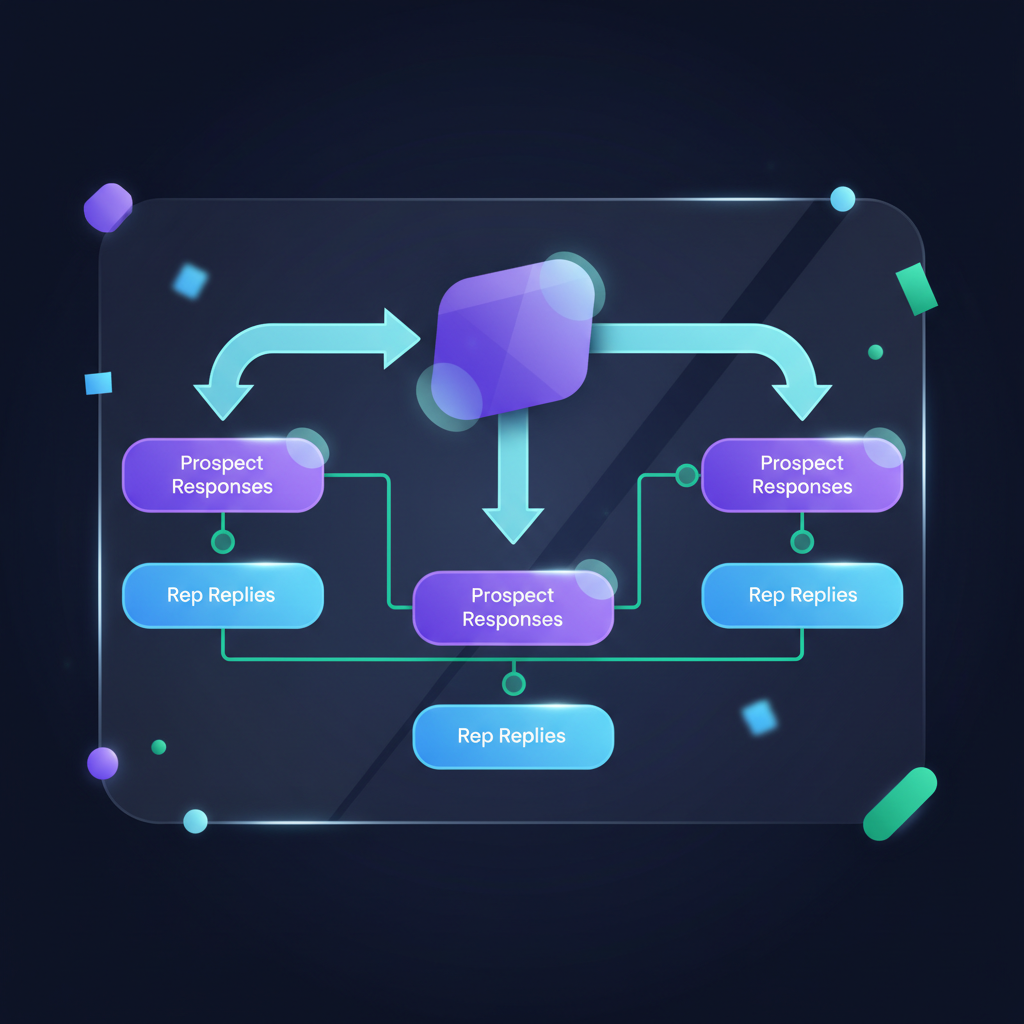
What it looks like: A 90-second script you must deliver start-to-finish, with no planned responses for interruptions, questions, or objections.
Why it fails: Prospects interrupt. They ask questions. They object. If your script is a linear monologue, any deviation derails you. Reps either bulldoze forward (annoying the prospect) or freeze (losing control of the call).
The fix: Build a conversation map with modular responses:
Opening (15 seconds): Context + identification + value hook
Common interrupt #1: "What is this about?" Response: "Fair question—[one-sentence value statement]. Worth 20 more seconds?"
Common interrupt #2: "We already have a solution." Response: "That's exactly why I'm calling—most teams using [competitor] are hitting a wall at [specific problem]. We've helped three companies in [their industry] fix that. Worth a 15-minute conversation?"
Common interrupt #3: "Not interested." Response: "Totally understand—most people say that until they hear [specific surprising insight]. Can I share that in 10 seconds, then you decide?"
Your script should be a choose-your-own-adventure map, not a speech. For techniques on handling specific cold call objections, see our guide to cold call objection handling techniques.
Mistake #6: Weak or non-existent meeting justification
What it looks like: "I'd love to set up some time to chat and explore whether we might be a good fit..."
Why it fails: "Explore whether we might be a good fit" is code for "I want to pitch you." It's vague, low-commitment language that signals you don't have a compelling reason for the meeting. The prospect hears: "Give me 30 minutes so I can figure out if I can sell you something."
The fix: Give a specific, value-focused reason the meeting will be worth their time:
Weak: "I'd love to set up time to discuss how we might help." Strong: "I want to show you the three-question framework our clients use to cut discovery calls from 45 minutes to 20 without losing qualification depth. It takes 15 minutes, and you'll walk away with a tool you can use on your next call whether we work together or not."
You've promised a specific, immediately usable outcome. The meeting has value independent of whether they buy. That's a meeting worth taking.
According to SalesLoft's cold calling analysis, calls that include specific meeting value propositions convert 42% better than those using generic "explore fit" language.
Mistake #7: No clear next step or assumptive close
What it looks like: "So... does that sound interesting?" / "Would you maybe want to schedule something?" / "Let me know if you'd like to learn more."
Why it fails: Tentative language invites rejection. If you're not confident the meeting is worth their time, why should they be? Weak closes also create friction—the prospect has to do the work of suggesting next steps.
The fix: Use an assumptive close that proposes a specific next step:
"Here's what I'd suggest: let's grab 15 minutes Thursday or Friday. I'll show you the framework, you decide if it's worth implementing. Does Thursday at 10 or Friday at 2 work better?"
You've assumed the meeting is happening and offered two options. This is not pushy—it's efficient. You're making it easy for them to say yes by removing decision friction.
For more on building the confidence that makes assumptive closes feel natural, check out our guide to building cold call confidence.
Mistake #8: Scripting for perfection instead of recovery
What it looks like: A script that assumes everything goes smoothly—the prospect listens, doesn't interrupt, and responds positively to your pitch.
Why it fails: Most cold calls don't go smoothly. Prospects are distracted, skeptical, or actively hostile. If your script only works when everything goes right, it fails 80% of the time.
The fix: Script your recovery paths, not just your ideal path:
Prospect is distracted/multitasking: "I can tell I caught you in the middle of something—this will take 20 seconds, then I'm off. Fair?"
Prospect is immediately hostile: "I get it—you get 10 of these a day. The only reason I'm calling is [ultra-specific, surprising insight]. If that's not relevant, I'll let you go. Sound fair?"
Prospect says "send me information": "Happy to—but most people don't open emails from strangers. How about this: I'll send you a one-page breakdown of [specific tool/framework], and we'll grab 10 minutes Thursday so I can walk you through how to use it. That way you actually get value whether we work together or not. Does 10 or 11 work?"
Your script should include more recovery language than ideal-path language. That's where real calls live.
Mistake #9: Treating the script as fixed instead of iterative
What it looks like: Writing a script, rolling it out to the team, and using it unchanged for months regardless of results.
Why it fails: Every market, product, and buyer persona responds differently. A script that works for enterprise CIOs won't work for mid-market sales directors. A script that worked in Q1 may fail in Q4 when budgets are frozen. Static scripts become stale and ineffective.
The fix: Treat your script as a living document:
- Record and review 10 calls per rep per week. Identify where prospects disengage.
- A/B test specific elements. Try two different openings for a week. Measure which converts better.
- Update monthly. Incorporate new objections, market changes, and winning phrases reps discover in the field.
- Version-control your scripts. Track what changed and why, so you can roll back if a new version underperforms.
At QUOTA, we see teams improve meeting rates by 15-25% in the first 90 days simply by implementing a structured script-testing process. The best scripts aren't written—they're evolved.
For a framework on tracking which script elements actually drive pipeline, see our guide to cold call metrics that predict revenue.
How to fix your cold call script today
If your script is underperforming, don't rewrite it from scratch. Instead:
- Record 20 calls. Transcribe them or use conversation intelligence software.
- Identify the failure point. Where do prospects disengage? Opening? Value prop? Close?
- Fix one element. Apply the specific fix from this guide that addresses your failure point.
- Test for one week. Measure meeting rate before and after.
- Iterate. Move to the next failure point and repeat.
Most teams try to fix everything at once and can't isolate what works. Single-variable testing is slower but infinitely more effective.
And if you want reps to internalize the new script without sounding robotic, give them reps. Lots of reps. QUOTA's AI role-play platform lets SDRs practice new scripts in realistic cold call scenarios with instant feedback—so they sound natural on live calls from day one.
For more on structuring your entire cold calling program—from metrics to coaching to script iteration—see our comprehensive cold calling guide.
FAQ
What is the biggest cold call script mistake?
The biggest cold call script mistake is opening with your company name and product pitch before establishing relevance. This triggers immediate pattern-matching and rejection. Instead, open with a context-setting statement that connects to the prospect's world before identifying yourself.
Should I memorize my cold call script word-for-word?
No. Memorizing scripts word-for-word creates robotic delivery and prevents natural conversation flow. Instead, memorize your framework—the sequence of steps and key transition phrases—then practice until you can execute it conversationally with varied language.
How long should a cold call script be?
Your cold call script should be a flexible framework, not a monologue. Plan for 15-20 seconds of opening before inviting a response, with modular responses ready for common reactions. Total talk time before asking for the meeting should rarely exceed 90 seconds.
How do I fix a cold call script that isn't working?
Record 20 calls, transcribe them, and identify where prospects disengage. Most scripts fail at the opening (no relevance), the transition (asking permission instead of stating value), or the close (weak meeting justification). Fix the specific failure point rather than rewriting everything.

Stefano Sechi
Co-founder, QUOTA Training
Stefano Sechi is co-founder of QUOTA Training. He works hands-on with B2B sales teams on cold calling, discovery and objection handling, and shaped much of the methodology behind QUOTA’s AI role-play scenarios.
Turn this into reps, not just reading
QUOTA Training lets your team practise these exact scenarios with an AI buyer that reacts like the real thing — then scores every call.
See it in action