The Complete SDR Playbook for 2026: Your End-to-End Guide
Part of the SDR Playbook guide: The Complete SDR Playbook for 2026: Your End-to-End GuideThe definitive SDR playbook for 2026. Master ICP definition, list building, multichannel sequences, cold email, LinkedIn, cadence design, handoff, metrics, and AI.

Key Takeaways
- A modern SDR playbook is a living system that documents your ICP, list-building process, multichannel sequences, messaging frameworks, cadence structure, qualification criteria, handoff protocols, and success metrics—all optimized for 2026's buyer behavior.
- Multichannel execution is non-negotiable: top-performing SDRs combine cold calls, personalized emails, LinkedIn engagement, and video messages in coordinated 8-15 touch cadences that reach prospects where they're most receptive.
- AI is reshaping every stage of the SDR workflow, from predictive account scoring and personalized message generation to real-time call coaching and automated activity logging—teams that integrate AI tools see 30-40% efficiency gains.
- Qualification rigor determines pipeline quality: clear SQL criteria, structured handoff processes, and alignment between SDRs and AEs prevent wasted cycles and ensure only sales-ready opportunities enter the pipeline.
- Metrics must go beyond activity volume: track conversion rates at every funnel stage, measure conversation quality with AI scoring, and tie SDR performance directly to pipeline value and closed-won revenue.
What Is an SDR Playbook and Why You Need One in 2026
An SDR playbook is your team's documented blueprint for prospecting success. It defines exactly how Sales Development Representatives identify target accounts, build lists, execute multichannel outreach, handle objections, qualify prospects, and hand off sales-ready opportunities to Account Executives.
Without a playbook, every SDR invents their own approach. With one, your entire team executes a proven, repeatable system that compounds results over time.
In 2026, the stakes are higher than ever. According to Gartner research on B2B buying, buyers complete 83% of their research independently before engaging sales. Your SDR playbook must intercept prospects earlier, deliver value in every touchpoint, and leverage AI to operate at a speed and scale that manual processes can't match.
This guide is the definitive SDR playbook for modern B2B teams. You'll learn how to build every component from scratch—or refine what you already have—so your SDRs consistently book high-quality meetings that convert to pipeline.
Define Your Ideal Customer Profile (ICP) with Precision

Your ICP is the foundation of your entire SDR playbook. Get this wrong, and every subsequent step wastes time on prospects who will never buy.
Firmographic Criteria
Start with the basics:
- Company size: Define employee count ranges (e.g., 50-500 for mid-market, 500+ for enterprise)
- Revenue band: Annual revenue thresholds that indicate budget capacity
- Industry verticals: The 3-5 industries where your solution delivers the most value
- Geography: Regions you serve, considering time zones, language, and regulatory fit
- Technology stack: Tools they already use that indicate need, maturity, or integration potential
Behavioral and Intent Signals
Layer in signals that indicate buying readiness:
- Hiring for roles related to your solution (e.g., hiring a Head of Sales Enablement if you sell training software)
- Funding events (Series A/B/C rounds that unlock budget)
- Leadership changes (new VP of Sales often means new vendor evaluation)
- Content engagement (downloaded a relevant whitepaper, attended a webinar)
- Product usage triggers (if you have a freemium model, specific in-app behaviors)
Negative Signals (Disqualifiers)
Equally important—document who you don't target:
- Companies too small to afford your solution
- Industries with regulatory blockers
- Accounts already using a direct competitor with multi-year contracts
- Geographic regions where you lack legal entity or support infrastructure
Document your ICP in a single-page reference sheet every SDR can access. Update it quarterly based on win/loss analysis.
Build High-Quality Prospect Lists That Convert
List quality determines everything downstream. A great SDR executing against a mediocre list will always underperform a mediocre SDR working a great list.
List-Building Tools and Data Sources
Modern SDRs use a combination of:
- Prospecting platforms: ZoomInfo, Apollo, Cognism, Lusha for firmographic data and contact details
- Intent data providers: Bombora, 6sense, G2 Buyer Intent to identify accounts actively researching your category
- LinkedIn Sales Navigator: For building lists by title, seniority, company, and engagement signals
- CRM and enrichment tools: HubSpot, Salesforce, Clearbit to enrich existing records and prevent duplicates
The List-Building Process
- Define your list criteria using your ICP filters (company size, industry, geography, tech stack)
- Layer in intent signals to prioritize accounts showing buying behavior
- Identify decision-makers and influencers by title (VP Sales, Head of Enablement, Sales Ops Manager)
- Verify contact data quality: use email verification tools (NeverBounce, ZeroBounce) to minimize bounces
- Segment your list by persona, industry, or account tier so you can tailor messaging
List Hygiene and Refresh Cadence
Stale data kills conversion rates. Implement these habits:
- Weekly: Remove bounced emails and disconnected phone numbers
- Monthly: Re-verify contact data for high-priority accounts
- Quarterly: Refresh your entire database to catch job changes and company updates
Assign list-building ownership—whether that's each SDR maintaining their own territory or a dedicated ops role feeding the team.
Craft Messaging That Resonates Across Channels
Generic messaging gets ignored. Personalized, value-driven messaging gets replies.
The Messaging Hierarchy
Build your messaging in layers:
- Value proposition (company level): The single sentence that explains what you do and for whom
- Persona-specific value: How your solution solves the unique pain of a VP Sales vs. a Sales Ops Manager
- Industry-specific value: Tailored examples for SaaS, manufacturing, financial services, etc.
- Account-specific hooks: Custom research points (recent funding, a blog post, a hiring spree)
Email Messaging Framework
Your cold emails should follow this structure:
- Subject line: Curiosity-driven or value-led (avoid salesy language)
- Opening line: Personalized observation or compliment (1 sentence)
- Problem statement: The pain you solve, framed as a question or observation (2-3 sentences)
- Social proof: Brief example of a similar company you've helped (1 sentence)
- Call to action: Low-friction ask (15-minute call, not a demo) with 2-3 time options
Keep emails under 100 words. Every sentence must earn its place.
LinkedIn Messaging Strategy
LinkedIn messages should feel conversational, not transactional:
- Connection request note: Mention a mutual connection, shared group, or recent post (don't pitch)
- First message after connection: Thank them, share a relevant piece of content, ask a question
- Value-add touch: Comment on their post, share an article, introduce them to someone useful
- Soft ask: After 2-3 value touches, suggest a brief call to explore a specific challenge
Never copy-paste your email script into LinkedIn. The channel demands a different tone.
Cold Call Messaging
Your cold calling techniques require a different structure optimized for verbal delivery:
- Pattern interrupt: A question or statement that breaks their expectation of a sales call
- Permission-based opener: "Did I catch you at a bad time?" (gives them control)
- Reason for the call: One sentence on why you're calling, tied to their role or company
- Discovery question: Open-ended question that gets them talking about their challenges
For deeper guidance on call structure, see our complete guide to cold calling techniques.
Design Your Multichannel SDR Cadence
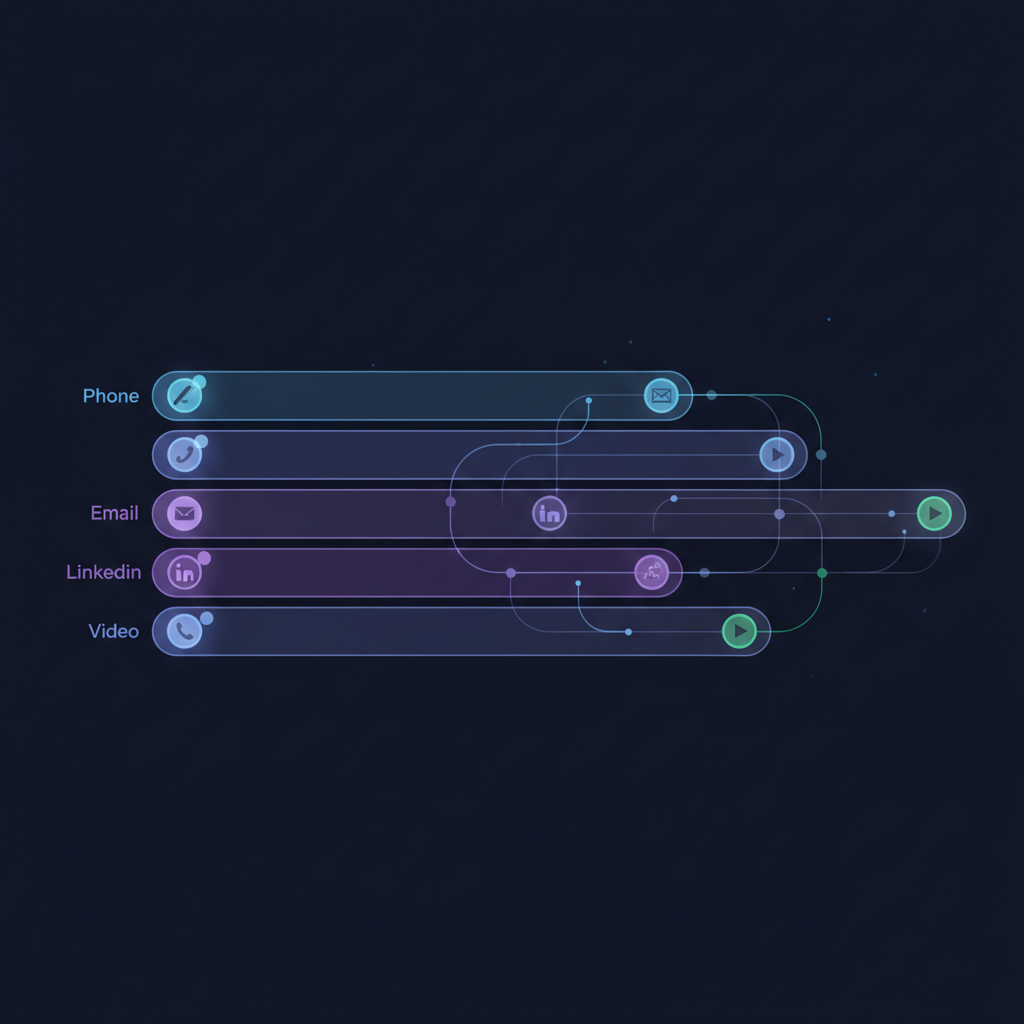
A cadence is the sequence and timing of touchpoints across channels. It's the engine of your SDR playbook.
Cadence Structure Principles
Modern cadences follow these rules:
- 8-15 touchpoints over 2-4 weeks: Enough persistence to break through noise, not so much you become spam
- Multi-channel by design: Combine calls, emails, LinkedIn, and video in every cadence
- Front-loaded intensity: More touches in week 1, then taper as you move to lower-intent prospects
- Strategic timing: Call mid-morning or mid-afternoon; send emails Tuesday-Thursday 8-10 AM in their time zone
Sample 10-Touch, 3-Week SDR Cadence
| Day | Touchpoint | Channel | Goal |
|---|---|---|---|
| 1 | Touch 1 | Introduce yourself, state reason for reaching out | |
| 1 | Touch 2 | LinkedIn connection request | Personalized note, no pitch |
| 2 | Touch 3 | Cold call | Pattern interrupt, discovery question |
| 3 | Touch 4 | Share relevant case study or content | |
| 5 | Touch 5 | Cold call | Reference previous email, ask discovery question |
| 7 | Touch 6 | LinkedIn message | Comment on their recent post or share insight |
| 9 | Touch 7 | Address a specific pain point with social proof | |
| 11 | Touch 8 | Video message (Vidyard/Loom) | Personalized 30-second video referencing their company |
| 14 | Touch 9 | Cold call | Final attempt to connect, offer specific value |
| 18 | Touch 10 | Breakup email | "Should I close your file?" with easy reply path |
Adjust touch frequency and channel mix based on your ICP and deal size. Enterprise accounts may warrant longer, more personalized cadences; SMB may require higher volume and faster cycles.
For a deeper dive into optimizing your sequences, read our guide on building high-converting outbound sales sequences and explore sales cadence best practices.
Channel-Specific Cadence Tactics
Cold calling: Always leave a voicemail on touches 3, 5, and 9. Use the frameworks in our sales voicemail script guide.
Email: A/B test subject lines, send times, and CTAs. Track open and reply rates by variant.
LinkedIn: Engage with their content between formal touches. A like or thoughtful comment keeps you top of mind without feeling pushy.
Video: Use personalized video on touch 8 or 9 as a pattern interrupt. Record a 20-30 second message mentioning something specific about their company.
Master Cold Calling in the SDR Role
Cold calling remains the highest-ROI activity for SDRs—when done well. The phone forces real-time conversation, reveals objections immediately, and builds rapport faster than any asynchronous channel.
Call Preparation Checklist
Before every call:
- Research the prospect: LinkedIn profile, recent company news, tech stack
- Review previous touchpoints: What emails have they received? Did they open or click?
- Define your call objective: Book a meeting, gather intel, or confirm fit
- Prepare 2-3 discovery questions: Specific to their role and industry
- Have your calendar open: Be ready to book the meeting on the spot
The Cold Call Structure
- Pattern interrupt (5 seconds): "Hey [Name], this is [You] from [Company]—did I catch you at a bad time?"
- Reason for the call (10 seconds): "I'm reaching out because [specific trigger or reason tied to their role]."
- Discovery question (5 seconds): "Quick question—how are you currently handling [specific challenge]?"
- Listen and adapt (60-90 seconds): Let them talk. Use their language. Identify pain.
- Transition to the ask (10 seconds): "Based on what you're sharing, it might make sense to explore this further. Do you have 15 minutes next Tuesday or Wednesday?"
For more on structuring your calls, see our cold calling guide.
Handling Common Objections on the Phone
You'll hear the same objections repeatedly. Prepare responses for:
- "Send me an email": "Happy to—what specifically should I include so it's relevant?" (Then pivot to booking time.)
- "We're all set": "That's great to hear. Out of curiosity, what are you using today?" (Gather intel, plant a seed.)
- "No budget": "Totally understand. When does your budget cycle reset?" (Book a future follow-up.)
- "Not interested": "No worries—can I ask what you're focused on right now?" (Uncover hidden pain.)
Our objection handling techniques guide offers frameworks for every scenario.
Leverage LinkedIn for Modern Prospecting
LinkedIn is the most underutilized channel in most SDR playbooks. When executed correctly, it warms cold prospects, builds credibility, and opens doors that email and phone alone cannot.
LinkedIn Profile Optimization for SDRs
Your profile is your landing page. Optimize it:
- Headline: Not "SDR at [Company]"—instead, "Helping [Persona] achieve [Outcome]"
- About section: 3-4 short paragraphs on what you do, who you help, and how to reach you
- Featured content: Pin case studies, testimonials, or helpful resources
- Activity: Post or comment 3-5 times per week to stay visible in your prospects' feeds
LinkedIn Outreach Sequence
Layer LinkedIn into your cadence:
- Day 1: Send personalized connection request (no pitch)
- Day 3-5: Like or comment on one of their recent posts
- Day 7: Send a message thanking them for connecting, share a relevant article or insight
- Day 10-12: Engage with another post or share a case study
- Day 14: Soft ask—suggest a brief call to discuss a specific challenge
LinkedIn Content Strategy for SDRs
Top SDRs don't just consume LinkedIn—they create:
- Share customer wins (with permission): "Congrats to [Customer] on achieving [Outcome]"
- Post insights from calls: "Three objections I heard this week and how I handled them"
- Curate industry news: Share a relevant article with your take in 2-3 sentences
- Engage authentically: Comment on prospects' and customers' posts with genuine insights
Consistency beats perfection. Two thoughtful posts per week will put you in the top 10% of SDRs.
Qualify Prospects with Rigor: From MQL to SQL
Not every conversation is a qualified opportunity. Your playbook must define exactly what separates a Marketing Qualified Lead (MQL) from a Sales Qualified Lead (SQL).
The BANT Framework (Updated for 2026)
BANT remains a useful starting point:
- Budget: Do they have budget allocated, or can they secure it within a reasonable timeframe?
- Authority: Are you speaking to a decision-maker, or can this person champion internally?
- Need: Do they have a pain point your solution directly addresses?
- Timeline: Is there urgency (a trigger event, deadline, or initiative driving action)?
In 2026, add Champion and Competition to create BANTCC:
- Champion: Is there an internal advocate who will sell on your behalf?
- Competition: What alternatives are they evaluating (competitors, build in-house, do nothing)?
SQL Criteria Checklist
A prospect becomes SQL when they meet all of these:
- Matches your ICP (firmographic fit)
- Confirmed pain point that your solution addresses
- Budget authority identified (or path to budget clear)
- Timeline within your sales cycle (typically 3-6 months)
- Agreed to a discovery call or demo with an AE
Document these criteria in your CRM. Use mandatory fields to prevent premature handoffs.
Disqualification Is a Skill
Knowing when to disqualify is as important as knowing when to advance. Disqualify if:
- They don't match ICP (too small, wrong industry, no budget)
- No pain point or urgency (just "exploring options")
- Competitor is deeply entrenched with no switching intent
- Timeline is 12+ months out with no near-term catalyst
Disqualifying fast frees you to focus on high-probability opportunities. Track disqualification reasons to refine your ICP and targeting over time.
Execute the AE Handoff Like a Relay Race
The handoff from SDR to Account Executive is where many deals die. A smooth handoff requires process, documentation, and communication.
Pre-Handoff: The Internal Brief
Before the AE takes the first call, the SDR provides:
- Company overview: Size, industry, tech stack, recent news
- Key contacts: Decision-maker, influencers, champion (if identified)
- Pain points discussed: Specific challenges the prospect mentioned
- Qualification notes: BANTCC scorecard with evidence
- Next steps: What the prospect expects from the call
Use a standard handoff template in your CRM or a shared Slack/Teams channel.
The Warm Introduction
The SDR should introduce the AE via email before the scheduled call:
Subject: Intro: [Prospect Name] <> [AE Name]
Hi [Prospect],
Thanks again for our conversation on [topic]. I'm excited to introduce you to [AE Name], our [title], who works with companies like yours on [specific outcome].
[AE Name] will lead our call on [date/time] and dive deeper into [specific challenge you discussed].
Looking forward to it!
[SDR Name]
This sets expectations and reinforces credibility.
Post-Handoff: Stay in the Loop
The SDR's job isn't done at handoff. Best practices:
- Attend the first AE call (optional but recommended for complex deals)
- Check in 24-48 hours post-call: Ask the AE for feedback on lead quality
- Track SQL → Opportunity conversion rate: If <50%, revisit qualification criteria
- Celebrate closed-won deals: When an SQL closes, recognize the SDR's contribution
For more on managing the entire pipeline process, see our guide on sales performance metrics.
Track the Right SDR Metrics in 2026
What gets measured gets managed. Your SDR playbook must define the metrics that matter—and the targets for each.
Activity Metrics (Leading Indicators)
These measure effort and volume:
- Calls per day: Target 50-80 for high-velocity teams
- Emails sent per day: Target 30-50 personalized emails
- LinkedIn touches per week: Target 20-30 (connection requests, messages, engagements)
- Accounts worked per week: Target 50-100 depending on market and deal size
Activity metrics ensure consistent effort but don't measure quality.
Conversion Metrics (Efficiency Indicators)
These measure effectiveness:
- Connect rate: % of calls that reach a human (target: 20-30%)
- Conversation rate: % of connects that turn into 2+ minute conversations (target: 40-60%)
- Email reply rate: % of emails that get a response (target: 5-15% for cold, 20-40% for warm)
- Meeting-booked rate: % of conversations that result in a scheduled AE call (target: 20-30%)
- SQL rate: % of meetings that become SQLs (target: 50-70%)
Track these weekly and identify underperforming areas for coaching.
Pipeline Metrics (Outcome Indicators)
These tie SDR work to revenue:
- SQLs created per month: Absolute number of qualified opportunities generated
- Pipeline value created: Total $ value of SQLs handed to AEs
- SQL → Opportunity conversion rate: % of SQLs that become real deals (target: 50%+)
- SQL → Closed-Won rate: % of SQLs that eventually close (track over 6-12 months)
Quality Metrics (Powered by AI)
In 2026, leading teams use AI conversation intelligence to measure:
- Talk-to-listen ratio: Target 40:60 (SDR talks 40%, prospect talks 60%)
- Discovery question count: Number of open-ended questions asked per call
- Objection handling effectiveness: AI scores how well reps navigate objections
- Sentiment analysis: Prospect engagement and positivity during calls
These metrics reveal how SDRs are performing, not just what they're producing.
For a complete framework on measuring what matters, explore our guide to sales performance metrics.
Integrate AI Into Your SDR Playbook
AI is no longer optional. In 2026, AI tools augment every stage of the SDR workflow—from list building to call coaching to follow-up.
AI for List Building and Prioritization
AI-powered tools analyze signals across the web to identify high-intent accounts:
- Predictive lead scoring: Algorithms rank prospects by likelihood to convert based on firmographic and behavioral data
- Intent data platforms: Tools like 6sense and Demandbase surface accounts actively researching your category
- Lookalike modeling: AI identifies new prospects that resemble your best customers
AI for Personalized Outreach at Scale
Generative AI helps SDRs personalize without sacrificing speed:
- Email generation: Tools like Lavender, Regie, or ChatGPT draft personalized emails based on prospect research
- Dynamic content insertion: Automatically pull company-specific details (funding, news, tech stack) into templates
- A/B test optimization: AI analyzes which subject lines, CTAs, and messaging variants perform best
Caution: Always review and edit AI-generated content. Generic AI output is easy to spot and damages credibility.
AI for Real-Time Call Coaching
AI conversation intelligence platforms (Gong, Chorus, Clari Copilot) provide:
- Live battle cards: Surface competitive objections, pricing info, or case studies during calls
- Real-time prompts: Suggest next-best questions based on what the prospect just said
- Automated call summaries: Generate notes, action items, and CRM updates post-call
- Coaching insights: Flag moments where the SDR talked over the prospect, missed a buying signal, or nailed a discovery question
AI for Skill Development
AI role-play platforms like QUOTA Training let SDRs practice prospecting scenarios against realistic AI prospects:
- Unlimited reps: Practice cold calls, objection handling, and discovery without bothering real prospects
- Instant feedback: AI scores every call on talk time, question quality, objection handling, and more
- Personalized coaching paths: Adaptive scenarios target each rep's weak spots
According to Salesforce sales statistics, teams using AI-powered coaching see 30-40% faster ramp times and higher quota attainment.
For more on how AI is reshaping training, see our guide to AI sales coaching strategies.
Build a Culture of Continuous Improvement
Your SDR playbook is never finished. The best teams treat it as a living document, updated based on data, feedback, and market shifts.
Weekly SDR Team Huddles
Hold 30-minute huddles every Monday to:
- Review last week's metrics (activity, conversion, pipeline)
- Share wins and lessons learned
- Role-play a common objection or new messaging
- Align on priorities for the week
Monthly Playbook Reviews
Once a month, gather the SDR team, sales leadership, and ops to:
- Analyze conversion rates at every funnel stage
- Review messaging performance (which emails, scripts, and sequences are working)
- Update ICP criteria based on win/loss data
- Identify process bottlenecks (handoff issues, data quality, tool gaps)
Quarterly Deep Dives
Every quarter, step back and assess:
- Are we targeting the right accounts? (ICP refinement)
- Are our sequences effective? (Cadence redesign based on data)
- Are our tools delivering ROI? (Evaluate your tech stack)
- Are our SDRs ramping fast enough? (Onboarding and training improvements)
Document every change in your playbook and communicate it clearly to the team.
Celebrate Wins and Learn from Losses
Recognition fuels motivation. Publicly celebrate:
- Most SQLs created this month
- Highest meeting-booked rate
- Best objection handling moment (share the call recording)
Also create a safe space to dissect losses. When a deal falls through, ask:
- What signals did we miss during qualification?
- Did we hand off too early or too late?
- What could we have done differently?
Use these insights to refine your playbook.
Onboard New SDRs with Your Playbook
Your playbook is your onboarding curriculum. New SDRs should master it in their first 30-60 days.
Week 1-2: Foundation
- Learn the product: What you sell, who you sell to, key differentiators
- Memorize the ICP: Firmographic criteria, personas, disqualifiers
- Study messaging: Value props, email templates, call scripts
- Shadow veteran SDRs: Listen to 20+ calls, review top-performing emails
Week 3-4: Practice
- Role-play cold calls with managers and peers (or use AI role-play)
- Write and send practice emails (reviewed by a mentor before sending to real prospects)
- Build your first lists using prospecting tools
- Make supervised calls: Manager listens live and provides feedback
Week 5-6: Go Live (with Training Wheels)
- Start your first cadences on lower-priority accounts
- Book your first meetings (celebrate the first one loudly)
- Receive daily coaching: 15-minute debriefs after key calls
- Track your metrics: Focus on activity volume and learning, not quota yet
Week 7-12: Ramp to Full Quota
- Increase activity targets progressively each week
- Refine your approach based on what's working
- Hit 50-70% of quota by end of month 3
- Achieve full quota by month 4-6
For a complete onboarding framework, see our SDR onboarding plan guide.
Common SDR Playbook Mistakes to Avoid
Even experienced teams make these errors:
Mistake 1: Prioritizing Activity Over Outcomes
Sending 100 emails per day means nothing if reply rate is 0.5%. Focus on conversion rates, not just volume.
Mistake 2: Weak Qualification Standards
Handing off unqualified leads frustrates AEs and damages trust. Be ruthless about SQL criteria.
Mistake 3: One-Size-Fits-All Messaging
A VP of Sales and a Sales Ops Manager have different pain points. Personalize by persona and industry.
Mistake 4: Ignoring Data
If email reply rates drop from 8% to 3%, investigate immediately. Your playbook should evolve based on metrics.
Mistake 5: Neglecting Skill Development
Prospecting is a skill that requires deliberate practice. Invest in coaching, role-play, and AI-powered training.
Mistake 6: Poor Handoff Process
A messy handoff kills deals. Document every SQL thoroughly and introduce the AE with context.
Mistake 7: Forgetting to Follow Up
80% of sales require 5+ touchpoints, but most SDRs give up after 2-3. Build persistence into your cadence.
The Future of the SDR Playbook: What's Next
As we move deeper into 2026 and beyond, several trends will reshape the SDR playbook:
Hyper-Personalization at Scale
AI will enable 1:1 personalization for every prospect without manual effort—dynamic emails, custom videos, and personalized landing pages generated in seconds.
Predictive Engagement Timing
AI will predict the optimal time to call or email each prospect based on their behavior patterns, not generic "best practices."
Conversational AI Assistants
AI co-pilots will join live calls, suggesting questions, surfacing objections, and automating CRM updates in real time.
Tighter Integration Between SDR and Marketing
Intent data, account-based marketing, and SDR outreach will merge into a single, orchestrated motion—no more silos.
The Rise of AI-Powered Skill Development
Platforms like QUOTA Training will replace traditional role-play, offering unlimited, realistic practice scenarios with instant feedback and personalized coaching paths.
The teams that adapt fastest—integrating AI, refining their playbooks with data, and investing in skill development—will dominate.
FAQ
What is an SDR playbook?
An SDR playbook is a documented framework that defines how Sales Development Representatives identify, research, engage, and qualify prospects. It includes ICP criteria, list-building processes, multichannel sequences, messaging templates, cadence structures, handoff protocols, and success metrics.
How many touchpoints should an SDR cadence include?
Modern SDR cadences typically include 8-15 touchpoints over 2-4 weeks, combining cold calls, emails, LinkedIn touches, and video messages. The exact number depends on your ICP, deal size, and channel performance data.
What metrics should SDRs track in 2026?
SDRs should track activity metrics (calls, emails, LinkedIn touches), conversion metrics (connect rate, reply rate, meeting-booked rate), pipeline metrics (SQLs created, pipeline value), and efficiency metrics (time to first meeting, cost per SQL). Leading teams also track conversation quality scores using AI conversation intelligence.
When should an SDR hand off a lead to an Account Executive?
An SDR should hand off a lead when it meets your defined SQL criteria: the prospect matches your ICP, has confirmed budget authority and timeline, acknowledges a pain point your solution addresses, and has agreed to a discovery call or demo with the AE.
How is AI changing the SDR playbook in 2026?
AI is transforming SDR workflows through conversation intelligence that analyzes calls in real time, generative tools that personalize outreach at scale, predictive scoring that prioritizes high-intent accounts, and AI role-play platforms that accelerate skill development without requiring manager time.
What's the difference between an MQL and an SQL?
An MQL (Marketing Qualified Lead) has shown interest through marketing activities (downloaded content, attended a webinar) but hasn't been vetted for fit or intent. An SQL (Sales Qualified Lead) has been qualified by an SDR against BANT or BANTCC criteria and is ready for an AE conversation.
How long should it take a new SDR to ramp to full quota?
With a strong playbook and onboarding program, new SDRs should hit 50-70% of quota by month 3 and achieve full quota by months 4-6. Teams using AI-powered training platforms often see 30-40% faster ramp times.
Should SDRs focus more on cold calling or email?
Both are essential. Cold calling has the highest connect rate and enables real-time discovery, while email scales better and allows prospects to respond on their schedule. The most effective SDR playbooks use multichannel cadences that combine calls, emails, LinkedIn, and video.

Stefano Sechi
Co-founder, QUOTA Training
Stefano Sechi is co-founder of QUOTA Training. He works hands-on with B2B sales teams on cold calling, discovery and objection handling, and shaped much of the methodology behind QUOTA’s AI role-play scenarios.
Turn this into reps, not just reading
QUOTA Training lets your team practise these exact scenarios with an AI buyer that reacts like the real thing — then scores every call.
See it in action