SDR Onboarding Plan: Your 30-60-90 Day Ramp Framework
Part of the SDR Playbook guide: The Complete SDR Playbook for 2026: Your End-to-End GuideBuild a winning SDR onboarding plan with this step-by-step 30-60-90 day framework. Reduce ramp time, boost quota attainment, and retain top talent.
Key takeaways
- A structured SDR onboarding plan reduces average ramp time from 4-5 months to 60-90 days while improving quota attainment by up to 30%.
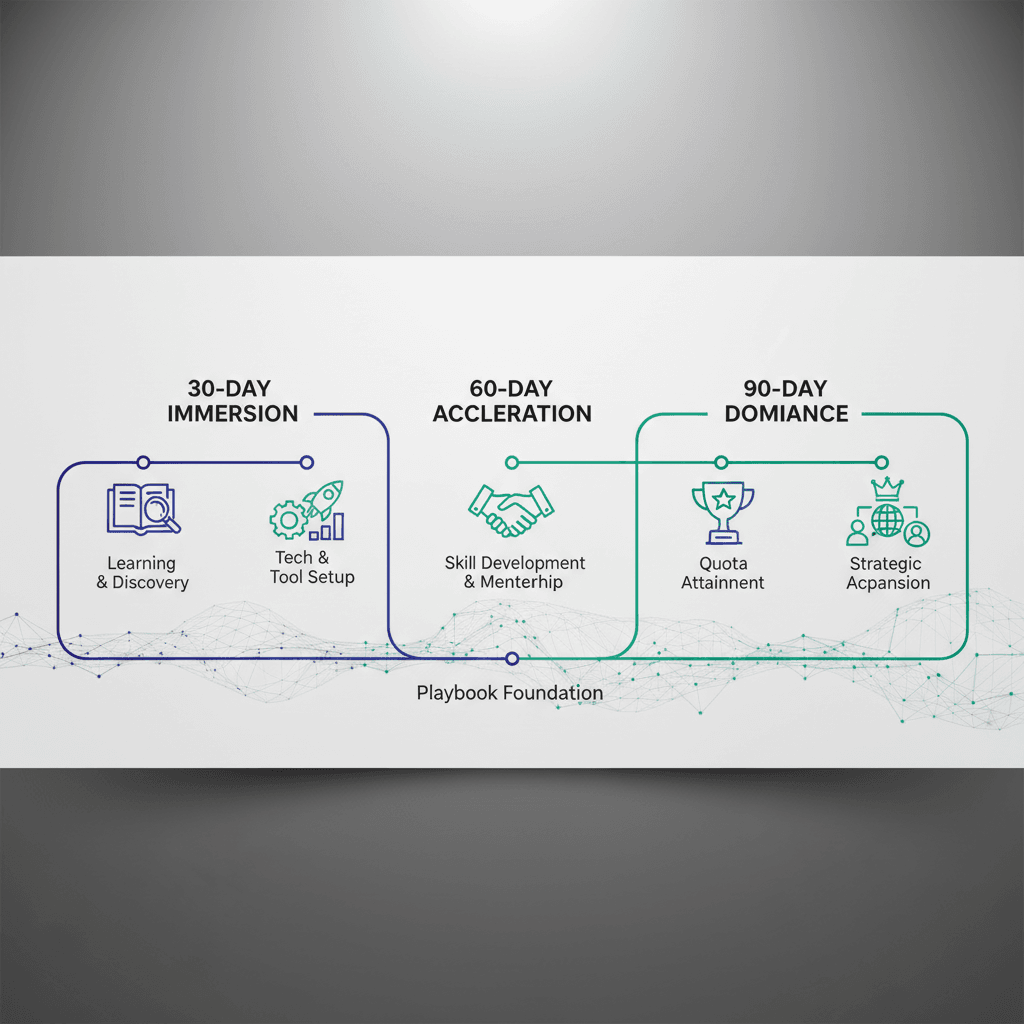
- The 30-60-90 day framework divides onboarding into three phases: foundation building (days 1-30), supervised execution (days 31-60), and independent performance (days 61-90).
- Days 1-30 should focus on product knowledge, ICP understanding, and tool proficiency, with new SDRs practicing pitch delivery through role-play before making real calls.
- Days 31-60 transition SDRs to live prospecting with reduced quotas (50-70% of full target) while managers provide daily call reviews and objection handling coaching.
- By days 61-90, SDRs should carry 100% quota, demonstrate consistent activity metrics, and begin mentoring newer team members to solidify their own learning.
Why your SDR onboarding plan matters more than you think

Your SDR onboarding plan is the single most important factor in determining whether new hires hit quota in their first year. According to research from the Bridge Group, the average SDR ramp time is 3.2 months, but top-performing teams consistently onboard new reps in under 60 days.
The cost of getting this wrong is staggering. When SDRs leave within their first six months, you've lost not just recruiting and salary costs, but also the opportunity cost of pipeline that should have been generated. A poor onboarding experience is the primary reason 40% of SDRs leave within their first year.
The solution? A systematic SDR onboarding plan that breaks the first 90 days into clear phases, each with specific learning objectives, activities, and success metrics. This framework gives new hires clarity, managers accountability, and your organization predictable results.
The 30-60-90 day SDR onboarding plan framework

This framework is designed to take a new SDR from zero knowledge to quota-carrying contributor in three months. Each phase builds on the previous one, with increasing autonomy and responsibility.
Days 1-30: Foundation and fundamentals
The first 30 days of your SDR onboarding plan should focus entirely on knowledge acquisition and skill development in a low-pressure environment. Your new hire should not be carrying quota yet.
Week 1: Company, product, and market immersion
Core activities:
- Complete company history, mission, and values training
- Shadow customer success calls to hear how customers describe their problems
- Review 10-15 recorded sales calls (both discovery and demos)
- Study your ICP documentation: industries, company sizes, titles, pain points
- Set up and learn your tech stack (CRM, sales engagement platform, conversation intelligence tools)
Deliverable: Have your new SDR write a one-page summary of "who we sell to and why they buy" in their own words. This forces them to synthesize what they've learned and reveals gaps in understanding.
Week 2: Product deep-dive and positioning
Core activities:
- Attend product training sessions with solutions engineers
- Get hands-on with your product (create a test account, click through key workflows)
- Learn your core value propositions and how they map to different personas
- Study competitive landscape and key differentiators
- Memorize your pricing structure and common package configurations
Deliverable: Have the SDR deliver a 5-minute product pitch to their manager, focusing on value rather than features. Provide detailed feedback.
Week 3: Messaging and conversation frameworks
Core activities:
- Learn your cold calling framework and email templates
- Practice your opening statement, discovery questions, and objection responses
- Role-play common scenarios with peers and managers
- Study your best-performing sequences and understand why they work
- Review call recordings of your top SDRs to identify patterns
This is where AI role-play training becomes invaluable. Instead of waiting for manager availability, new SDRs can practice hundreds of conversations against realistic buyer personas, building muscle memory and confidence before making real calls.
Deliverable: Pass a certification role-play where the SDR successfully navigates a cold call, handles two objections, and books a qualified meeting.
Week 4: Supervised practice and shadowing
Core activities:
- Shadow 3-5 live calls daily from experienced SDRs
- Begin making practice calls to low-priority accounts (with manager listening)
- Send practice emails and LinkedIn messages (manager reviews before sending)
- Start building your own target account list
- Attend team meetings and pipeline reviews to understand the full funnel
Success metrics for days 1-30:
- Passed product knowledge assessment (80% or higher)
- Completed 20+ practice role-plays
- Shadowed minimum 40 live prospecting calls
- Sent 10+ reviewed emails with improving quality scores
- Made 20+ practice calls to low-priority accounts
Days 31-60: Supervised execution
Month two is where your SDR onboarding plan shifts from learning to doing. Your new hire should now carry a reduced quota—typically 50-70% of your team's full number.
Week 5-6: Ramp to active prospecting
Core activities:
- Begin full-time prospecting with reduced daily activity targets
- Make 30-40 calls per day (vs. 60-80 for ramped reps)
- Send 20-25 personalized emails daily
- Book your first real meetings and hand them off to AEs
- Daily 15-minute call review sessions with your manager
Manager focus: Listen to every meeting your new SDR books. Are they qualifying properly? Are the meetings showing up? Provide immediate feedback.
Week 7-8: Increase volume and refine technique
Core activities:
- Increase to 70-80% of full activity targets
- Focus on one skill improvement area per week (e.g., objection handling, discovery questions)
- Start tracking your own conversion metrics (connect rate, meeting book rate)
- Practice handling common objections like budget concerns in live situations
- Participate in team role-play sessions
This is the critical period where bad habits form or good ones solidify. Managers should review 5-10 calls per week and provide specific, actionable feedback. Look for effective cold calling techniques in their delivery.
Success metrics for days 31-60:
- Achieving 50-70% of full quota (meetings booked or pipeline generated)
- Making 800-1,000 dials for the month
- Maintaining connect rate within 10% of team average
- Meeting-to-show rate above 60%
- Passing qualification criteria on 80%+ of booked meetings
Days 61-90: Independent performance
By month three, your SDR should be operating at or near full capacity. Your SDR onboarding plan now focuses on consistency, optimization, and early leadership development.
Week 9-10: Full quota responsibility
Core activities:
- Carry 100% quota and activity targets
- Manage your own daily schedule and prioritization
- Conduct your own call preparation and account research
- Experiment with messaging variations to improve conversion rates
- Begin tracking personal performance trends
Manager focus: Shift from daily coaching to weekly 1:1s. Let your SDR solve problems independently first, then guide them toward solutions.
Week 11-12: Optimization and knowledge sharing
Core activities:
- Identify your highest-converting messages and channels
- Document what's working in your prospecting approach
- Shadow an AE on discovery and demo calls to understand the full sales cycle
- Participate in a team training session (potentially as a co-facilitator)
- Begin mentoring SDRs who are in weeks 1-4 of their ramp
Having new SDRs teach others is one of the most effective ways to solidify their own learning. It also identifies your future team leads.
Success metrics for days 61-90:
- Achieving 90-100% of full quota
- Consistent daily activity (not feast-or-famine patterns)
- Meeting quality score of 8/10 or higher from AE feedback
- Connect rate and conversion rates at or above team average
- Demonstrating one area of excellence (e.g., email response rates, objection handling)
Accelerating your SDR onboarding plan with modern tools
Traditional SDR onboarding plans rely heavily on manager availability for role-play practice and call reviews. This creates a bottleneck—managers can only coach so many people at once, and new SDRs often wait days between practice sessions.
Modern sales training platforms solve this by providing on-demand practice environments. New SDRs can:
- Practice cold calls against AI buyers who respond realistically to different approaches
- Get instant feedback on talk time, filler words, and question quality
- Repeat difficult scenarios (like handling the "not interested" objection) dozens of times in a single day
- Build confidence before making their first real prospect call
This is particularly powerful during days 1-30, when new hires need high-volume, low-stakes practice. According to Salesforce research, sales reps who engage in regular role-play practice are 33% more likely to achieve quota.
Gamification elements like leaderboards, achievement badges, and team challenges can also increase engagement during the onboarding period, when new SDRs are most vulnerable to feeling overwhelmed.
Common SDR onboarding plan mistakes to avoid
Mistake #1: Throwing new hires on the phones too early
The pressure to generate pipeline often leads managers to assign quota before SDRs are ready. This creates anxiety, leads to poor prospect experiences, and teaches bad habits that are hard to break. Resist the urge—invest the full 30 days in foundation building.
Mistake #2: Inconsistent manager involvement
Your SDR onboarding plan is only as good as its execution. If managers are too busy to conduct daily call reviews in weeks 5-8, new hires will struggle. Block dedicated onboarding time on your calendar and protect it.
Mistake #3: No clear success criteria
New SDRs need to know exactly what "good" looks like at each stage. Create specific, measurable targets for every week of your 90-day plan. Ambiguity creates anxiety.
Mistake #4: One-size-fits-all timelines
Some SDRs will be ready for full quota at day 60; others need the full 90 days. Build flexibility into your plan and adjust based on individual performance. The goal is competence, not calendar compliance.
Mistake #5: Neglecting the emotional journey
Starting as an SDR is hard. New hires will experience rejection, confusion, and impostor syndrome. Regular check-ins about how they're feeling—not just what they're doing—improve retention significantly.
Measuring the success of your SDR onboarding plan
Track these metrics to evaluate and improve your onboarding process:
Leading indicators (during onboarding):
- Time to first meeting booked
- Time to first qualified meeting
- Activity completion rate (did they do what was assigned?)
- Role-play certification pass rate
- Manager 1:1 attendance and engagement
Lagging indicators (post-onboarding):
- Percentage of cohort achieving 90%+ quota in month 4
- Retention rate at 6 months and 12 months
- Average ramp time to full productivity
- Quality of meetings booked (AE feedback scores)
- Time to promotion or role advancement
Adapting your SDR onboarding plan for different scenarios
Remote SDRs
Remote onboarding requires more structure and over-communication. Schedule daily video check-ins, create recorded training modules they can reference anytime, and use collaboration tools to maintain visibility. Consider bringing remote hires to headquarters for week 1 if budget allows.
Experienced SDRs from other companies
They can skip some fundamentals but don't assume they know your market, product, or methodology. Accelerate the timeline (60 days instead of 90) but don't skip steps entirely. Bad habits from previous roles need to be identified and corrected early.
SDRs promoted from other departments
Internal promotions often have deep product knowledge but lack prospecting skills. Flip the emphasis: light on product training, heavy on cold calling practice, objection handling, and resilience building.
Building continuous improvement into your SDR onboarding plan
Your SDR onboarding plan should evolve based on results. After each cohort completes their 90 days:
- Survey the new SDRs: What was most valuable? What was confusing? What would they change?
- Interview their managers: Where did people struggle? What topics needed more time?
- Analyze performance data: Which activities correlated most strongly with success?
- Update your plan based on these insights
- Document changes and communicate them to the team
The best sales organizations treat onboarding as a product, iterating and improving it with each release.
FAQ
How long should an SDR onboarding plan take?
A comprehensive SDR onboarding plan should take 90 days to bring a new hire to full productivity. The first 30 days focus on learning fundamentals without quota pressure, days 31-60 involve supervised prospecting with reduced targets, and days 61-90 transition to full quota responsibility. Some experienced SDRs may ramp faster, but rushing the process typically leads to poor habits and lower long-term performance.
What should be included in the first 30 days of SDR onboarding?
The first 30 days should cover product knowledge, ICP and buyer persona training, sales methodology and messaging frameworks, CRM and sales tool setup, and extensive role-play practice. New SDRs should shadow experienced reps, study recorded calls, and practice their pitch in low-stakes environments before making real prospecting calls. This foundation prevents the common mistake of putting new hires on the phones before they're ready.
How do you measure if an SDR onboarding plan is working?
Measure your SDR onboarding plan success through time-to-first-meeting, percentage of new hires hitting 90%+ quota by month 4, retention rates at 6 and 12 months, meeting quality scores from AEs, and activity metric attainment during the ramp period. Compare these metrics across cohorts to identify which onboarding elements drive the best outcomes, then optimize accordingly.
Should new SDRs have quota during their first month?
No, new SDRs should not carry quota during their first 30 days. This period should focus entirely on learning—product knowledge, messaging, tools, and practice. Assigning quota too early creates pressure that leads to poor prospect experiences, bad habits, and increased anxiety. Begin with reduced quota (50-70% of full target) in month two once fundamentals are solid.
How can AI role-play improve SDR onboarding?
AI role-play platforms allow new SDRs to practice cold calls, objection handling, and discovery questions on-demand without requiring manager availability. New hires can complete dozens of practice conversations per day, receive instant feedback on their technique, and build confidence before making real calls. This accelerates skill development during the critical first 30 days when high-volume, low-stakes practice is most valuable.
Sources

Stefano Breglia
Co-founder, QUOTA Training
Stefano Breglia is co-founder of QUOTA Training. He focuses on sales methodology, deal progression and how AI simulation accelerates rep ramp time across the SDR, BDR, AE and AM roles.
Turn this into reps, not just reading
QUOTA Training lets your team practise these exact scenarios with an AI buyer that reacts like the real thing — then scores every call.
See it in action