AI Sales Coaching Strategies: Personalizing Growth at Scale
Part of the AI & Sales guide: The Complete Guide to AI in Sales: Transform Your Revenue EngineDiscover how AI sales coaching strategies can revolutionize your team's development, delivering hyper-personalized feedback and scalable growth for every rep.

In the competitive landscape of B2B sales, individual rep performance isn't just a metric—it's the bedrock of your team's success. Yet, providing truly personalized, impactful coaching at scale remains a monumental challenge for even the most dedicated sales managers. How do you give each SDR and AE the tailored guidance they need to excel without burning out your leadership team?
The answer lies in leveraging cutting-edge AI sales coaching strategies. Artificial intelligence is no longer a futuristic concept; it's a practical, powerful tool transforming how sales teams learn, adapt, and grow. By harnessing AI, you can move beyond generic advice to deliver precise, data-driven insights that address each rep's unique strengths and weaknesses, fostering unprecedented individual growth and ultimately, boosting your team's overall win rates.
This article will explore how AI empowers sales leaders to implement highly effective, personalized coaching programs that scale. We'll dive into the specific strategies, benefits, and practical steps to integrate AI into your coaching framework, ensuring every rep receives the attention and development they deserve.
Key takeaways
- Traditional sales coaching struggles with scalability and personalization, leading to inconsistent rep development and manager overload.
- AI sales coaching strategies provide hyper-personalized feedback by analyzing vast amounts of sales interaction data, identifying specific areas for improvement in tone, objection handling, discovery, and more.
- AI tools enable objective, data-driven performance analysis, moving beyond subjective assessments to offer clear, actionable insights for every sales rep.
- Implementing AI coaching involves defining KPIs, integrating AI platforms, training teams, and fostering a culture of continuous learning, often enhanced by gamification.
- QUOTA Training offers an AI-powered platform that delivers gamified, voice-simulated role-play, providing a safe, effective environment for reps to practice and refine their skills with personalized feedback.
The Challenge: Why Traditional Sales Coaching Falls Short for Growth
Sales managers are often caught in a bind. They know that effective coaching is critical for improving rep performance, reducing ramp-up time, and hitting revenue targets. However, the realities of managing a high-performing sales team often make deep, personalized coaching an elusive goal.
Time Constraints and Manager Overload
Sales leaders typically wear many hats: recruiting, forecasting, strategy, and closing deals themselves. This leaves precious little time for one-on-one coaching sessions, especially when you have a large team. The ideal scenario of spending hours reviewing calls and providing detailed feedback for each rep often gives way to quick check-ins or reactive problem-solving.
One-Size-Fits-All Limitations
Even when coaching happens, it can often be generic. A manager might identify a common team weakness, like handling the "no budget" objection, and provide blanket training. While valuable, this approach doesn't account for individual reps' specific communication styles, existing skill gaps, or learning preferences. What works for one rep might not resonate with another, leading to uneven development.
Inconsistent Feedback and Follow-Through
Without a structured, data-driven approach, coaching feedback can be inconsistent. One manager might focus on discovery questions, while another emphasizes closing techniques. Furthermore, tracking whether reps actually apply the feedback and improve can be difficult, making it hard to prove the ROI of coaching efforts. This is where a robust sales coaching framework becomes essential, but even the best framework can struggle with implementation at scale.
What Are AI Sales Coaching Strategies?
AI sales coaching strategies involve using artificial intelligence technologies to analyze sales interactions, identify performance patterns, and deliver personalized, actionable feedback to sales representatives. This goes beyond simple analytics; it's about intelligent systems acting as virtual coaches, helping reps refine their skills in a scalable and consistent manner.
At its core, AI coaching leverages capabilities like natural language processing (NLP), speech analytics, and machine learning to dissect every aspect of a sales call, email, or demo. It can detect sentiment, identify key phrases, track talk-to-listen ratios, and even gauge a rep's adherence to a script or battlecard. This deep analysis allows for a level of insight that a human coach simply cannot achieve manually for every single interaction.
Platforms like QUOTA Training utilize AI role-play for sales training to simulate real-world sales scenarios, providing a safe space for reps to practice and receive instant, objective feedback on their performance. This hands-on, iterative learning is a cornerstone of effective AI sales coaching.
How AI Transforms Sales Coaching for Individual Reps

AI doesn't replace human coaches; it augments their capabilities, allowing them to focus on high-level strategy and complex behavioral coaching, while AI handles the granular, repetitive analysis. Here’s how AI drives individual rep growth:
Hyper-Personalized Feedback and Skill Development
Imagine a system that reviews hundreds of a rep's calls and pinpoints precisely where they hesitate, use filler words, or miss opportunities to ask discovery call questions. AI does exactly that. It can identify specific areas for improvement, such as:
- Objection Handling: Recognizing common objections and suggesting optimal objection handling techniques based on successful past interactions.
- Discovery: Highlighting missed opportunities to dig deeper into a prospect's pain points or needs.
- Pitch Delivery: Analyzing clarity, confidence, and adherence to sales pitch examples or messaging guidelines.
- Active Listening: Monitoring talk-to-listen ratios and identifying instances where a rep might have interrupted or talked over a prospect.
This level of detail allows for truly individualized coaching plans, ensuring each rep focuses on the skills most critical to their personal development. For instance, if a rep struggles with sales call anxiety, AI can provide specific practice scenarios to build confidence.
Objective Performance Analysis with Data
Human biases can sometimes creep into coaching. AI, however, provides purely objective, data-driven insights. By analyzing recorded calls, emails, and CRM data, AI can offer an unbiased assessment of a rep's performance against predefined metrics. This data can inform your sales call review template and ensure consistency.
AI systems can track trends over time, showing a rep's progress in specific areas. This quantitative feedback is incredibly powerful for motivating reps and proving the effectiveness of coaching interventions. It also helps managers identify which sales performance metrics are most impacted by coaching efforts.
Scalability and Consistency Across Teams
One of the biggest advantages of AI is its ability to scale. Whether you have 10 reps or 1000, AI can provide consistent, high-quality feedback to everyone. This ensures that every member of your team, regardless of their manager or location, receives the same caliber of coaching and training.
This consistency is vital for maintaining a high standard across the organization and making sure that your sales coaching framework is uniformly applied. AI helps bridge the gap between aspirational coaching goals and the practical limitations of human bandwidth.
On-Demand Practice and Role-Play
AI-powered platforms offer reps the ability to practice their skills anytime, anywhere. Through voice-simulated role-play, reps can rehearse pitches, handle objections, and refine their discovery questions in a no-pressure environment. This is particularly valuable for sales call warm-up exercises before important meetings.
This continuous, self-directed practice accelerates skill acquisition and boosts confidence. Reps receive immediate feedback on their performance, allowing them to iterate and improve much faster than waiting for scheduled coaching sessions. This also complements traditional methods like sales call shadowing by providing a safe space for initial practice.
Implementing Effective AI Sales Coaching Strategies: A Step-by-Step Guide
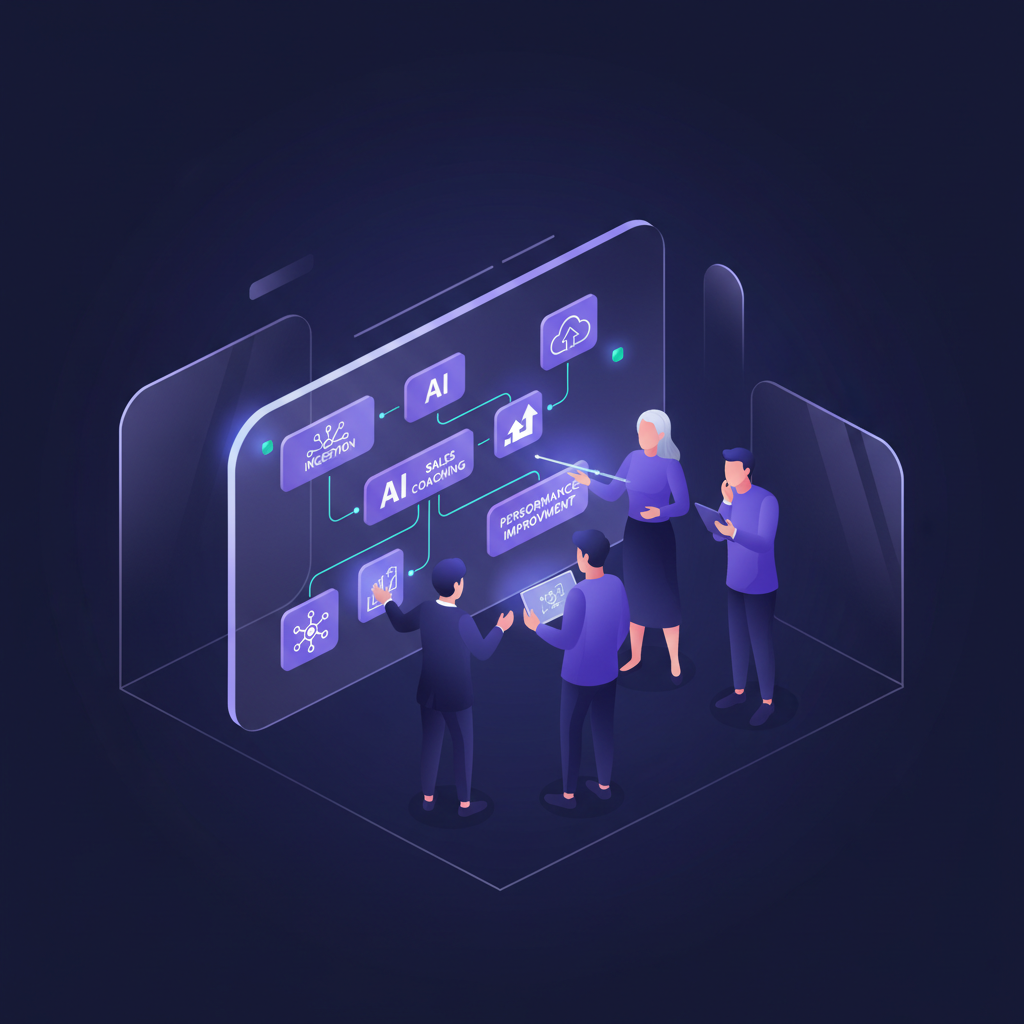
Integrating AI into your sales coaching isn't a flip of a switch; it's a strategic process. Here's a framework to guide your implementation:
Step 1: Define Coaching Objectives and KPIs
Before deploying any AI tool, clearly articulate what you want to achieve. Are you aiming to improve discovery calls, reduce ramp-up time for new SDRs, or boost conversion rates on specific objections? Define measurable Key Performance Indicators (KPIs) that AI can track and influence.
Examples:
- Increase talk-to-listen ratio by 10%.
- Reduce average time to first meeting booked by 15%.
- Improve discovery question coverage by 20%.
- Increase conversion rate on "no budget" objection by 5%.
These objectives will guide your AI platform's configuration and help measure its impact.
Step 2: Integrate AI Tools with Existing Workflows
Choose an AI sales coaching platform that integrates seamlessly with your CRM, communication tools, and call recording systems. Look for solutions like QUOTA Training, which provides a comprehensive platform for AI role-play and voice simulation. This ensures data flows smoothly and insights are readily accessible.
Explore QUOTA's product features to understand how AI can be embedded into your daily sales operations. The goal is to make AI a natural extension of your team's workflow, not an additional burden. Ensure compliance with sales call recording best practices when integrating voice analytics.
Step 3: Train Managers and Reps on AI Utilization
Successful adoption hinges on proper training. Managers need to understand how to interpret AI-generated insights, how to use them to inform their one-on-one coaching, and how to combine AI feedback with their human intuition. Reps need to understand how to engage with the AI platform, interpret their personalized feedback, and leverage practice opportunities.
Highlight the benefits for both parties: managers gain efficiency and deeper insights, while reps get more personalized and consistent development opportunities. Address any concerns about AI replacing human interaction by emphasizing its role as an enhancement.
Step 4: Foster a Culture of Continuous Improvement
AI coaching thrives in an environment that values learning and growth. Encourage reps to actively engage with the AI, review their performance data, and utilize the practice modules. Incorporate AI-generated insights into team meetings and individual coaching sessions. Consider adding elements of gamification in sales training to boost engagement and make learning more fun.
Regularly celebrate improvements based on AI feedback. Make it clear that AI is a tool for self-improvement, not just for evaluation. According to a recent survey by McKinsey & Company, companies that embed AI into their core workflows and culture are significantly more likely to see substantial business value from their AI investments.
Step 5: Regular Review and Adaptation
AI models learn and improve over time. Regularly review the effectiveness of your AI sales coaching strategies. Are the insights accurate? Are reps showing measurable improvement in the targeted KPIs? Gather feedback from both managers and reps.
Be prepared to adapt your coaching objectives and how you utilize the AI based on performance data and team input. This iterative process ensures your AI coaching program remains relevant and impactful as your team and market evolve.
Overcoming Common Hurdles in AI Sales Coaching Adoption
While the benefits are clear, some challenges can arise during AI adoption:
Data Privacy and Ethical Considerations
Ensure your chosen AI platform adheres to strict data privacy regulations (e.g., GDPR, CCPA). Clearly communicate to your team how their data is being used, anonymized where necessary, and secured. Transparency builds trust and encourages adoption. Always prioritize ethical AI use, focusing on development and support rather than surveillance.
Ensuring Human Touch Remains Central
AI is a powerful tool, but it cannot replace the empathy, motivational skills, and strategic guidance of a human sales manager. Position AI as a co-pilot, not a replacement. Managers should use AI insights to inform deeper, more meaningful conversations, focusing on behavioral coaching, motivation, and complex scenario planning that AI cannot yet fully replicate. The goal is to free up managers' time for higher-value human interactions.
Measuring ROI and Proving Value
Clearly link your AI coaching efforts to tangible business outcomes. Track metrics like reduced ramp-up time, increased conversion rates, larger deal sizes, and improved rep retention. Present these results to leadership to secure continued investment and demonstrate the value of your [AI sales coaching strategies]. Salesforce's "State of Sales" report often highlights the link between effective coaching and increased sales productivity, a trend only amplified by AI capabilities.
Conclusion
AI sales coaching strategies are no longer a luxury; they are a necessity for B2B sales organizations aiming for sustained growth and peak performance. By providing hyper-personalized feedback, objective data analysis, scalable training, and on-demand practice, AI empowers every rep to reach their full potential.
For sales managers, AI offers the ability to coach more effectively and efficiently, transforming the challenge of scaling personalized development into a tangible reality. Embrace AI not as a threat, but as your most powerful partner in building a high-performing, adaptable, and confident sales team.
Ready to revolutionize your sales coaching with cutting-powered AI? Explore how QUOTA Training's gamified AI role-play and voice simulation platform can deliver personalized growth for your B2B sales team. Visit quota.training today to learn more.
FAQ
Q: What is the primary benefit of AI sales coaching for individual reps?
A: The primary benefit is hyper-personalized feedback and development. AI analyzes individual performance data to pinpoint specific strengths and weaknesses, offering tailored guidance and practice opportunities that accelerate skill acquisition and address unique learning needs.
Q: How does AI sales coaching help sales managers?
A: AI sales coaching helps managers by providing objective, data-driven insights into rep performance, automating call reviews, and enabling scalable, consistent coaching across the entire team. This frees up managers' time to focus on higher-level strategy, motivation, and complex behavioral coaching.
Q: Can AI replace human sales coaches?
A: No, AI cannot replace human sales coaches. Instead, AI augments human coaches by handling granular data analysis, providing objective feedback, and offering on-demand practice. Human coaches remain essential for empathy, motivational guidance, strategic mentorship, and addressing complex interpersonal dynamics that AI cannot fully replicate.

Stefano Breglia
Co-founder, QUOTA Training
Stefano Breglia is co-founder of QUOTA Training. He focuses on sales methodology, deal progression and how AI simulation accelerates rep ramp time across the SDR, BDR, AE and AM roles.
Turn this into reps, not just reading
QUOTA Training lets your team practise these exact scenarios with an AI buyer that reacts like the real thing — then scores every call.
See it in action