Sales Call Review Template: How to Run Sessions That Improve Win Rates
Part of the Sales Coaching guide: The Complete Sales Coaching Guide: Build a Program That DeliversA proven sales call review template with step-by-step frameworks, scoring rubrics, and coaching questions to turn recorded calls into repeatable wins.

Key takeaways
- A structured sales call review template reduces coaching time by 40% while increasing feedback consistency across your team.
- Effective call reviews focus on three dimensions: discovery quality, objection response, and next-step clarity—not just talk time or feature mentions.
- The best call review sessions pair quantitative scorecards (1-5 ratings on specific skills) with qualitative coaching moments that address one behavioral change per call.
- AI-powered call analysis can pre-score calls and surface coaching moments, but human review remains essential for nuance, tone, and strategic judgment.
- Implementing a regular call review cadence (weekly 1:1s with 2-3 calls per rep) correlates with 23% faster ramp times and higher quota attainment in the first year.
If you're a sales manager drowning in recorded calls but struggling to deliver coaching that actually moves the needle, you need a sales call review template that's both rigorous and repeatable.
Most teams record every call thanks to tools like Gong, Chorus, or native CRM features—but recording isn't coaching. Without a structured framework, call reviews become meandering "nice job" sessions or, worse, nitpicky critiques that demoralize reps instead of developing them.
This guide gives you a proven sales call review template you can implement today, complete with scoring rubrics, coaching questions, and integration points for AI analysis. Whether you're coaching SDRs on cold calls, AEs on discovery, or the full team on demos, this framework scales.
Why most sales call reviews fail (and how to fix it)
The typical call review goes like this: a manager listens to a recording at 1.5x speed, jots down a few notes, then tells the rep "good energy, but ask more questions next time." The rep nods, nothing changes, and quota attainment stays flat.
Three failure modes dominate:
- No structure. Feedback is random and based on whatever the manager noticed first, leading to inconsistent coaching across reps.
- Too much feedback. Managers dump 12 pieces of advice after one call; the rep remembers none and improves at nothing.
- No follow-through. There's no tracking of whether the rep applied last week's coaching, so behavioral change never compounds.
A sales call review template fixes all three. It gives you a repeatable lens to evaluate calls, forces prioritization (one key improvement per session), and creates a paper trail that connects coaching to performance over time.
This is especially critical during onboarding—structured call reviews are a cornerstone of any effective SDR onboarding plan and directly accelerate time-to-quota.
The 3-phase sales call review template
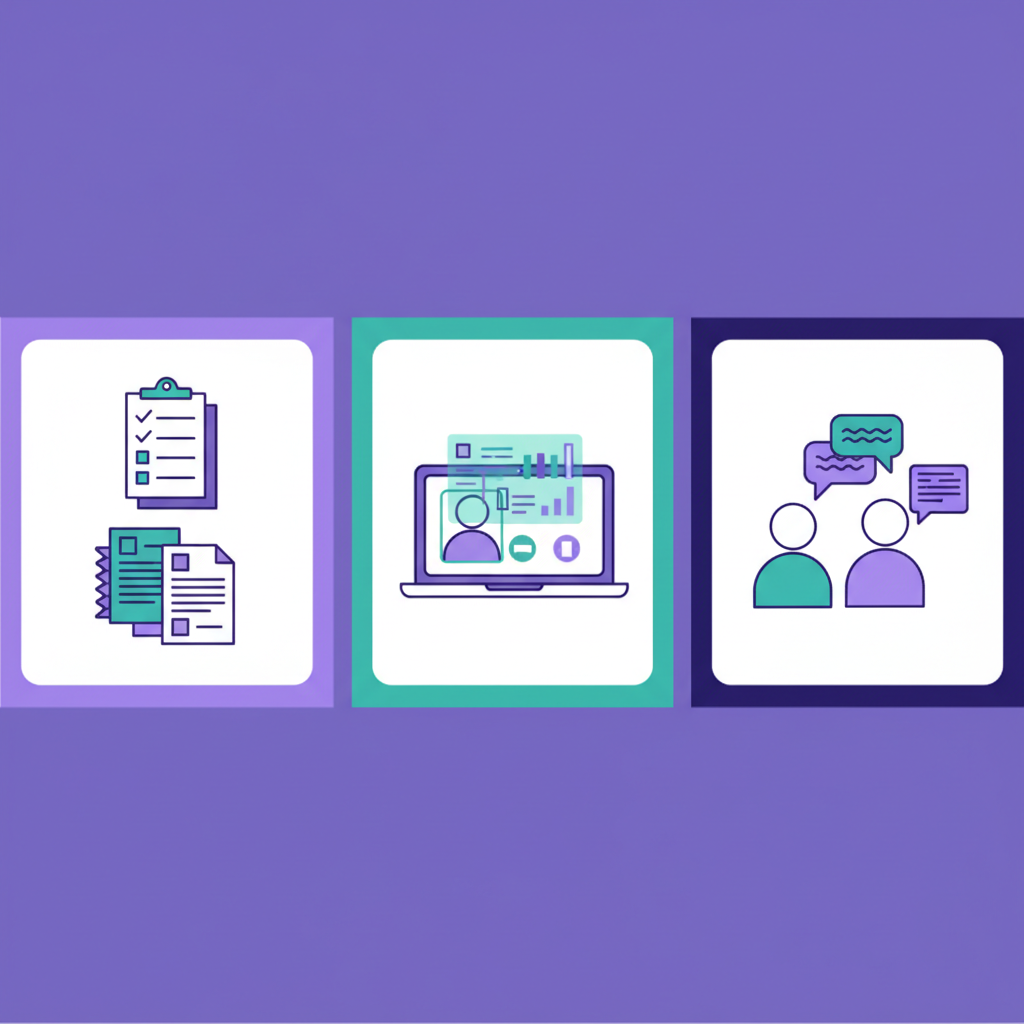
This template works for any call type (cold, discovery, demo, closing). Adapt the specific criteria to your sales motion, but keep the three-phase structure intact.
Phase 1: Pre-review preparation (5 minutes)
Before you hit play, gather context:
- Rep's goal for the call. What was the intended outcome? (Book meeting, qualify out, advance to demo, etc.)
- Account context. Deal size, stage, any relevant history or competitive intel from your sales battlecards.
- Previous coaching focus. What was the one thing this rep was working on last week? You're checking for application, not introducing new concepts every session.
If you use AI call analysis tools, review the auto-generated summary and sentiment score now. Flag any moments the AI highlighted (long monologues, competitor mentions, objections) but don't let the AI set your agenda—you're looking for coachable behaviors, not just keyword triggers.
Phase 2: Live review and scoring (15-20 minutes)
Listen to the call (or watch key clips) and score the rep across these five dimensions using a 1-5 scale:
| Dimension | What you're evaluating | 1 = Needs work | 5 = Excellent |
|---|---|---|---|
| Opening & rapport | Did the rep earn the right to continue? Personalization, permission-based language, tone match. | Generic pitch, no research, talked at prospect. | Tailored hook, built credibility in 30 seconds, prospect engaged. |
| Discovery depth | Quality and sequencing of questions; did they uncover real pain? | Surface-level questions, no follow-up, missed buying signals. | Multi-layered questions, probed implications, confirmed pain with prospect's own words. |
| Objection handling | How they responded to pushback or skepticism. | Defensive, ignored objection, or gave up. | Acknowledged, isolated, reframed with evidence, moved forward. |
| Value articulation | Clarity and relevance of the pitch or demo. | Feature dump, no tie to pain, jargon-heavy. | Tied features to discovered pain, used prospect's language, clear differentiation. |
| Next steps & control | Did they secure a clear, mutual next step? | Vague "follow up next week," no calendar invite, unclear owner. | Specific date/time booked, agenda agreed, mutual commitment confirmed. |
Don't score everything as a 3. Be honest. A "2" isn't a failure—it's a growth opportunity.
For discovery calls specifically, cross-reference your scoring with proven discovery call questions to see if the rep is using a structured methodology.
For objection moments, check if the rep applied any of the objection handling techniques you've trained them on—or if they froze.
Phase 3: Coaching conversation (10 minutes)
Now you debrief with the rep. Follow this exact sequence:
Step 1: Rep self-assessment (2 minutes)
"What's one thing you thought went really well, and one thing you'd do differently next time?"
Let them talk first. This builds self-awareness and often they'll identify the exact issue you spotted. If they do, your job is easier—you're reinforcing their insight, not imposing yours.
Step 2: Manager feedback using the "WWW" framework (5 minutes)
- What Worked: Name one specific behavior they did well. Be concrete: "Your transition from rapport to discovery at 3:15—'You mentioned X in your LinkedIn post; I'm curious how that's affecting your team today'—was smooth and earned you credibility."
- What to Work on: Pick one dimension from your scorecard where they scored lowest. Explain the gap with a specific timestamp: "At 8:40, when they said 'we're happy with our current vendor,' you moved on. That's a buying signal in disguise. Let's talk about how to probe that."
- What's Next: Agree on one micro-behavior to practice before your next review. "Next three calls, when you hear 'we're happy with X,' I want you to say, 'That's great—what would make you even happier?' and see what surfaces."
Step 3: Role-play the improvement (3 minutes)
Don't just tell them what to do differently—practice it. You play the prospect, they replay the moment with the new approach. This is where AI role-play sales training shines between live coaching sessions: reps can drill the exact scenario 10 times before their next real call.
Log the coaching focus in your CRM or a shared tracker. Next week, you'll review a call specifically listening for whether they applied this one change.
Advanced: Integrating AI call analysis into your template

AI tools like Gong, Chorus, or Clari Copilot can auto-score calls, track talk ratios, flag keywords, and even surface "coachable moments." Here's how to layer AI into your sales call review template without letting it replace human judgment:
Use AI to pre-filter and prioritize
If you manage 8 reps and each takes 20 calls a week, you can't review 160 calls. Use AI scorecards to:
- Identify the highest-stakes calls (late-stage deals, high ACV accounts).
- Flag calls with the biggest gaps (low question rate, high monologue time, objection without response).
- Surface winning behaviors to celebrate and replicate (strong next-step close rate, competitor mention handled well).
Review 2-3 calls per rep per week—one "struggle" call and one "win" call.
Validate AI scores with context
AI might flag a rep's talk time as too high (60% vs. the benchmark 40%), but if it's a demo call where they're screen-sharing a technical workflow, that's appropriate. Your template should include a "context override" note field where you document why you disagree with the AI.
Use AI-generated snippets in coaching
Most platforms let you clip and share 30-second moments. When you deliver feedback, send the rep the exact clip: "Here's the moment at 8:40 I mentioned—watch how the prospect's tone shifted when you didn't probe." This makes coaching concrete and reviewable.
For more on compliance and best practices when recording and reviewing calls, see our sales call recording best practices guide.
How to run a team call review session (group coaching)
Beyond 1:1 reviews, schedule a weekly 30-minute team call review where you dissect one anonymized call together. This scales your coaching and builds a shared language.
Format:
- Play a 3-5 minute call snippet (discovery opening, objection moment, closing sequence—rotate focus weekly).
- Pause and ask the team: "What did you notice? What would you do differently?"
- Facilitate discussion using your scoring rubric as the lens. Avoid letting it become a pile-on; frame it as collective learning.
- Role-play alternatives. Have 2-3 reps take turns replaying the moment with different approaches. Vote on what felt most natural and effective.
- Assign practice. Everyone drills the technique in their next two calls and reports back in Slack or your next team meeting.
This approach mirrors the principles behind a strong sales coaching framework—you're building a culture of continuous improvement, not one-off feedback.
Measuring the impact of structured call reviews
How do you know your sales call review template is working? Track these leading indicators:
- Coaching consistency: Are all managers using the same scorecard? Audit a sample of reviews quarterly.
- Behavior change velocity: How many coaching focuses does it take before a rep consistently applies a skill? (Target: 2-3 reviews.)
- Skill score trends: Is the average score on each dimension increasing month-over-month?
- Lagging performance metrics: Compare quota attainment, average deal size, and win rate for reps who receive structured reviews vs. those who don't.
According to a 2023 study by Gartner, organizations with formal call review processes see 19% higher win rates and 27% better forecast accuracy than those relying on ad-hoc feedback.
For a broader view of what to measure beyond quota, explore our guide on sales performance metrics.
Common mistakes to avoid in call reviews
Mistake 1: Reviewing only struggling reps
Your top performers need coaching too—often on advanced skills like multi-threading or executive presence. If you only review calls when someone's behind quota, coaching feels punitive.
Mistake 2: Changing focus every week
"Last week we worked on discovery. This week let's work on tonality. Next week, objection handling." The rep never masters anything. Pick one skill, drill it for 3-4 weeks, then move on.
Mistake 3: No rep input
If you dictate what to improve without asking the rep's perspective, they're less likely to own the change. Always start with their self-assessment.
Mistake 4: Skipping role-play
Telling someone what to do differently is 10% as effective as having them practice it in the moment. Budget 3 minutes per review for live role-play.
Sales call review template: Ready-to-use scorecard
Here's a downloadable-ready version you can adapt:
Call Details
- Rep name:
- Call date:
- Call type: (Cold / Discovery / Demo / Closing)
- Account:
- Call outcome:
- Previous coaching focus:
Scorecard (1-5 scale)
- Opening & rapport: ___
- Discovery depth: ___
- Objection handling: ___
- Value articulation: ___
- Next steps & control: ___
Coaching Notes
- What Worked (specific behavior + timestamp):
- What to Work on (one focus area + timestamp):
- What's Next (micro-behavior to practice):
Role-Play Summary
- Scenario practiced:
- Rep performance:
- Follow-up drill assigned: (Link to AI role-play scenario if applicable)
Next Review Date: ___
You can integrate this template into your existing sales cadence by scheduling call reviews at consistent intervals—weekly for new reps, bi-weekly for ramped reps, monthly for veterans.
Gamifying call reviews to boost engagement
Call reviews don't have to feel like performance evaluations. Many high-performing teams gamify the process:
- Skill badges: Award digital badges when a rep scores 5/5 on a dimension three reviews in a row.
- Leaderboards: Track improvement velocity (biggest month-over-month score gains) rather than absolute scores, so everyone can win.
- Peer recognition: Let reps nominate a teammate's call for "Call of the Week" and play it in the team session.
This aligns with broader trends in gamification in sales training, which research shows increases engagement by up to 60% when applied to coaching and skill development.
Platforms like QUOTA Training integrate AI role-play with gamified scorecards, letting reps practice the exact moments flagged in call reviews and compete on skill mastery—not just activity metrics.
FAQ
How often should I review calls with each rep?
For new hires in their first 90 days, review 2-3 calls per week during 1:1s. For ramped reps, 1-2 calls per week is sufficient. Top performers benefit from monthly deep-dives on advanced skills. Consistency matters more than volume—better to review two calls thoroughly every week than ten calls superficially once a month.
Should I review only lost deals or struggling calls?
No. Review a mix: one "struggle" call (missed objection, lost control) and one "win" call (great discovery, smooth close) per rep per week. Reviewing wins reinforces what's working and lets you extract best practices to share with the team. Focusing only on failures creates a negative coaching culture.
Can AI replace human call reviews?
AI can pre-score, flag moments, and save you time, but it can't assess strategic judgment, read subtext, or coach nuance. Use AI to prioritize which calls to review and surface coaching moments, but always pair it with human analysis. The best approach combines AI efficiency with manager expertise.
What's the one most important thing to include in a sales call review template?
A single, specific coaching focus per review. Reps can't improve on 10 things at once. Identify the one behavior that, if changed, would have the biggest impact on their results—then drill it for 2-3 weeks until it's automatic. Track whether they apply it in subsequent calls before moving to the next skill.
How do I get buy-in from reps who resist call reviews?
Frame reviews as development, not evaluation. Start every session by asking what they want to improve, not what you think is broken. Share data showing that reps who participate in structured reviews ramp faster and hit quota more consistently. Make reviews a two-way conversation, and always role-play the improvement so they leave with a new skill, not just criticism.
Turn call reviews into a competitive advantage
A sales call review template isn't just a coaching tool—it's a compounding advantage. Every review builds a library of what works in your market, with your buyers, in your reps' own words. Over time, you'll identify the exact discovery questions that uncover budget, the objection responses that flip skeptics, and the closing language that gets calendar invites.
That institutional knowledge becomes your playbook. New hires ramp faster because you're teaching them proven patterns, not generic theory. Veteran reps keep improving because you're pressure-testing their skills against real calls, not letting them coast on muscle memory.
If you're ready to scale this process with AI-powered role-play that lets reps drill the exact moments you flag in reviews, explore QUOTA Training's gamified simulation platform. Reps practice the scenarios you coach, you track skill progression in real time, and your call reviews become 10x more effective because the behavioral change happens between sessions—not just during them.
Sources

Stefano Breglia
Co-founder, QUOTA Training
Stefano Breglia is co-founder of QUOTA Training. He focuses on sales methodology, deal progression and how AI simulation accelerates rep ramp time across the SDR, BDR, AE and AM roles.
Turn this into reps, not just reading
QUOTA Training lets your team practise these exact scenarios with an AI buyer that reacts like the real thing — then scores every call.
See it in action