Sales Call Shadowing: How to Train Reps Without Slowing Deals
Part of the Sales Coaching guide: The Complete Sales Coaching Guide: Build a Program That DeliversSales call shadowing accelerates rep ramp time—when done right. Learn a framework for shadowing calls, giving feedback, and scaling training without bottlenecking your AEs.

Key takeaways
- Sales call shadowing is the practice of having new or developing reps observe live sales calls to learn messaging, objection handling, and deal progression in real time.
- Effective shadowing requires structure: pre-call briefs, live observation with a focus checklist, and post-call debriefs to reinforce learning and surface questions.
- Traditional 1:1 shadowing doesn't scale beyond 5-10 reps; recorded calls, AI role-play simulations, and group shadowing sessions help teams train faster without monopolising top performers' calendars.
- Shadowing works best when paired with active practice: reps should rehearse what they observe through mock calls or AI role-play before taking live conversations.
- Measuring shadowing effectiveness means tracking time-to-first-call, ramp velocity, and early-stage conversion rates—not just hours spent observing.
What is sales call shadowing?
Sales call shadowing is a training method in which a less experienced rep (the "shadow") listens to and observes a more experienced seller conduct live sales conversations—discovery calls, demos, negotiations, or closes. The goal is knowledge transfer: the shadow learns tone, structure, objection responses, and situational decision-making by watching a real deal unfold.
Unlike reading a script or watching a generic training video, shadowing exposes reps to the messy, unpredictable reality of buyer conversations. They hear how top performers pivot when a prospect goes off-script, how they build rapport in the first 60 seconds, and how they navigate silence or pushback.
Shadowing is a cornerstone of most SDR onboarding plans, especially in the first 30 days when new hires are still building confidence and learning your ICP's language. But it's also valuable for veteran reps moving upmarket, adopting new messaging, or cross-training on a different product line.
The challenge? Traditional shadowing is time-intensive, hard to standardise, and doesn't scale. A single AE can only have so many shadows on a call before it becomes awkward for the buyer—and if your best rep is constantly training others, they're not closing deals.
Why sales call shadowing works (and where it falls short)
The benefits of shadowing
Contextual learning. Reps don't just hear what to say—they hear when and why. They learn how a great discovery question lands differently depending on the buyer's tone, or how a pricing objection is defused with a story instead of a discount.
Faster ramp. According to research from the Bridge Group, top-performing SDR teams ramp new hires to full productivity 30% faster than average teams, and shadowing is one of the most cited accelerators. Reps who shadow 10+ calls in their first two weeks typically make fewer early mistakes and require less one-on-one coaching.
Culture transmission. Shadowing teaches more than tactics—it reinforces your team's selling philosophy, your approach to objections, and the way you treat buyers. New reps absorb your sales culture by osmosis.
The limits of traditional shadowing
It doesn't scale. If you hire five SDRs in a month, and each shadows your top rep for 15 calls, that's 75 calls where the rep is managing both the buyer and the audience. Most sellers find this exhausting and distracting.
Passive observation isn't practice. Watching someone else handle an objection is useful, but it doesn't build muscle memory. Reps need to rehearse what they've observed, ideally in a low-stakes environment, before they internalise it.
Inconsistent quality. Not every call is a teaching moment. If the shadow happens to observe three no-shows and a churlish gatekeeper, they've learned very little. And not every great seller is a great teacher—some struggle to articulate why they made a choice in the moment.
Buyer experience risk. Having multiple people on a call can feel invasive to prospects, especially if they weren't told in advance or if the shadow accidentally unmutes.
This is why modern sales teams are augmenting live shadowing with recorded calls, AI role-play training, and structured debrief frameworks.
How to structure an effective sales call shadowing program
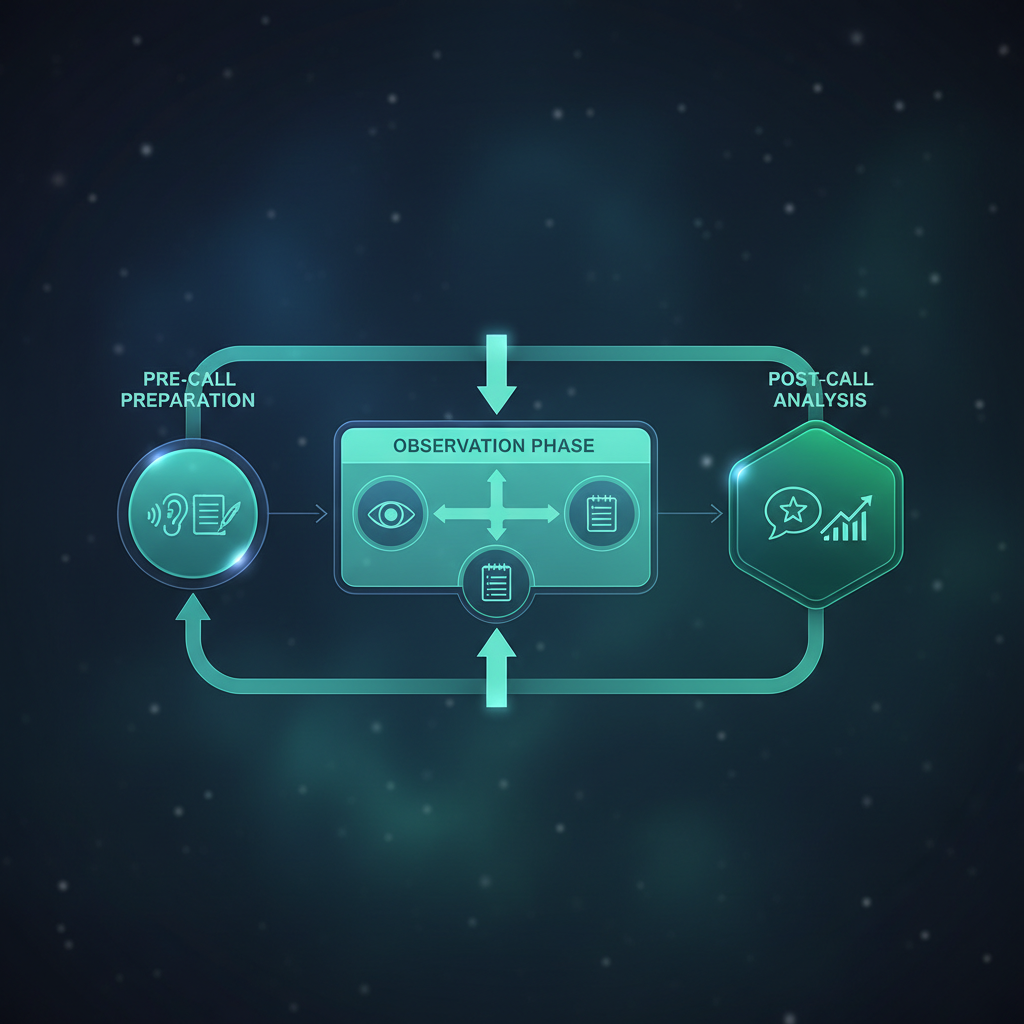
If you want shadowing to accelerate ramp without creating chaos, treat it as a deliberate process—not an ad hoc "just listen in" exercise.
1. Create a shadowing curriculum
Don't let reps shadow randomly. Map out which types of calls they should observe, in sequence:
- Week 1: Cold calls and outbound prospecting (5-10 calls)
- Week 2: Discovery calls with qualified leads (3-5 calls)
- Week 3: Demos or product walkthroughs (2-3 calls)
- Week 4: Objection-heavy calls or late-stage negotiations (2-3 calls)
This progression mirrors the buyer journey and ensures reps see the full sales motion, not just one slice. Pair this with your sales cadence best practices so reps understand how each call fits into a broader sequence.
2. Assign a pre-call brief
Before the shadow joins, the lead rep should share:
- Deal context: Where is this prospect in the pipeline? What's happened so far?
- Call objective: What does success look like? (e.g., "Confirm budget and decision process.")
- What to watch for: Specific skills or moments to observe (e.g., "Notice how I use silence after asking about pain.").
This primes the shadow to listen actively rather than passively. Give them a simple observation checklist:
- How did the rep open the call?
- What questions surfaced the biggest reaction?
- How did they handle interruptions or objections?
- What would I have done differently?
3. Set ground rules for shadows
- Muted and cameras off unless the lead rep invites them to introduce themselves.
- No side conversations in Slack or email during the call.
- Take notes, but don't try to transcribe everything—focus on moments that surprised you or patterns you notice.
Some teams introduce the shadow at the start of the call: "I have Sarah joining us today—she's new to the team and learning our process. She'll be muted, but I wanted you to know she's here." Most buyers don't mind, especially in B2B contexts where they expect sales teams to train.
4. Conduct a post-call debrief (within 30 minutes)
This is where the learning happens. The lead rep and shadow should spend 10-15 minutes immediately after the call discussing:
- What went well? Which moments felt smooth or effective?
- What was difficult? Where did the buyer push back or disengage?
- Why did you make that choice? (Lead rep explains their in-the-moment decisions.)
- What would you do next time? (Shadow reflects on how they'd approach a similar call.)
If you're using sales call recording tools, you can timestamp key moments and revisit them in the debrief. This is far more effective than trying to remember a 40-minute conversation from memory.
5. Follow shadowing with practice
Shadowing is input; practice is output. After a rep shadows three discovery calls, have them run a mock discovery call with a peer or manager using the same structure they observed. Better yet, use AI role-play simulations that let them rehearse the exact scenarios they shadowed—objection responses, tonality, pacing—until they're confident.
At QUOTA Training, teams pair shadowing with voice-simulation practice so reps can test what they've learned in a safe environment before taking a real call. This cuts ramp time and reduces the "I froze" moments that plague new hires.
Scaling sales call shadowing beyond 1:1 sessions
Once your team grows past 10 reps, traditional shadowing breaks down. Here's how to scale it.
Record and curate a call library
Build a library of your best calls, organised by stage and skill:
- Cold call openers (first 90 seconds)
- Discovery calls that uncovered deep pain
- Objection handling examples (budget, timing, competitor)
- Demo excellence (storytelling, not feature-dumping)
- Closes (negotiation and commitment)
New reps can watch these asynchronously, at 1.5x speed, with timestamps highlighting key moments. Pair each recording with a short commentary doc: "At 4:32, notice how she reframes the pricing question as an ROI conversation."
This approach respects your top reps' time and ensures every new hire sees great examples, not just whatever calls happen to be scheduled during their first week.
Run group shadowing sessions
Once a week, host a 30-minute "call breakdown" where the team listens to a recorded call together (live or recorded), pauses at key moments, and discusses what's happening. This works especially well for objection handling or competitive situations where multiple perspectives add value.
Format:
- Play a 3-5 minute clip.
- Pause and ask: "What just happened? What would you do next?"
- Play the next segment and debrief the actual outcome.
- Discuss alternatives and document takeaways in your sales battlecards or playbook.
This turns shadowing into a team learning ritual, not a solo activity.
Use AI role-play to simulate shadowed scenarios
After a rep shadows a tough objection or a tricky discovery call, they can immediately practice a similar scenario against an AI buyer that mimics the same persona, tone, and pushback. This closes the gap between observation and execution.
For example, if a rep shadows a call where the prospect says, "We're happy with our current vendor," they can then role-play that exact objection five times with an AI sim, testing different approaches until one feels natural. AI role-play platforms let you scale this practice infinitely, without requiring a manager or peer to play the buyer.
Common sales call shadowing mistakes (and how to avoid them)
Mistake 1: Shadowing without a feedback loop
Letting reps listen to 20 calls without structured reflection is like watching TV—it's passive consumption, not learning. Always pair shadowing with a debrief, a reflection doc, or a practice session.
Mistake 2: Only shadowing your best rep
Your top performer's style might not suit every new hire's personality. Let reps shadow 2-3 different sellers so they can pick and choose techniques that fit their voice. Diversity of style also prevents reps from becoming clones.
Mistake 3: Shadowing too long before practicing
If a rep shadows for three weeks straight before making their first call, they'll be paralysed by overthinking. Introduce live practice early—even if it's just leaving voicemails or running internal mock calls—so they build confidence in parallel.
Mistake 4: Ignoring the buyer's perspective
Always get consent (implicitly or explicitly) before adding shadows to a call. A surprise "We have three people joining today" can make a prospect uncomfortable, especially in enterprise deals. If you're recording, ensure you're compliant with call recording regulations.
Mistake 5: No measurable outcomes
Track whether shadowing actually works. Measure:
- Time to first call (days from hire to first live conversation)
- Ramp velocity (days to first meeting booked, first opp created, first deal closed)
- Early win rate (conversion rate on first 10 calls vs. team average)
If reps who shadow 15+ calls in their first month ramp 20% faster, you have a business case to formalise the program. If there's no difference, your shadowing process needs work—or you need to add practice and feedback loops.
How to give feedback after shadowing a call
Shadowing isn't just for new hires learning from veterans—it's also a coaching tool. When a manager or peer shadows a rep's call to give feedback, structure matters.
Use the SBI model (Situation-Behaviour-Impact)
Instead of vague praise ("Good job!") or criticism ("That was weak"), anchor feedback in specifics:
- Situation: "When the prospect said they were evaluating two other vendors..."
- Behaviour: "...you asked what criteria they were using to decide, which was great..."
- Impact: "...because it shifted the conversation from price to fit, and they opened up about their frustrations."
This makes feedback concrete and repeatable. Pair this approach with a sales coaching framework that tracks skill development over time.
Balance reinforcement and redirection
For every piece of corrective feedback, highlight two things the rep did well. This keeps morale high and ensures they know what to keep doing, not just what to fix.
Record feedback in a shared doc
Create a simple "shadowing log" for each rep:
| Date | Call Type | What Went Well | What to Work On | Practice Task |
|---|---|---|---|---|
| 3/12 | Discovery | Great open-ended questions | Talked over prospect twice | Practice active listening in next mock |
| 3/14 | Demo | Strong storytelling | Didn't confirm next steps | Add close plan to demo checklist |
This creates a longitudinal record of growth and makes it easy to spot patterns (e.g., "You've nailed discovery but struggle with closing—let's focus there").
Integrating shadowing into your broader sales training program
Shadowing is one tool in a larger training ecosystem. Here's how it fits:
- Weeks 1-2 (Onboarding): Heavy shadowing (10-15 calls) + product training + discovery call question frameworks.
- Weeks 3-4 (Practice): Reduced shadowing (3-5 calls) + daily mock calls or AI role-play + live dials with a safety net (manager on mute).
- Weeks 5-8 (Independence): Minimal shadowing (1-2 calls/week) + peer feedback + performance metric reviews.
- Ongoing (Skill refinement): Shadowing becomes opt-in—reps request to observe calls when they're learning a new skill (e.g., enterprise deals, technical demos) or preparing for a high-stakes conversation.
Shadowing should decrease as reps gain confidence, not stay constant. If a rep is still shadowing heavily after 60 days, something's wrong with your practice or feedback loop.
FAQ
What is sales call shadowing?
Sales call shadowing is a training method where a less experienced rep observes a more experienced seller conduct live sales calls to learn messaging, objection handling, and deal progression in real time.
How many calls should a new SDR shadow?
Most high-performing teams have new SDRs shadow 10-15 calls in their first two weeks, spread across cold calls, discovery, and demos. After that, shadowing should taper as reps begin practicing and taking live calls themselves.
How do you scale call shadowing for large teams?
Scale shadowing by recording and curating a library of top calls, running weekly group call breakdowns, and pairing shadowing with AI role-play practice so reps can rehearse what they observe without monopolising senior reps' time.
Should shadows introduce themselves on the call?
It depends on your team's philosophy and the buyer relationship. Many teams have the lead rep briefly introduce the shadow at the start of the call to maintain transparency. Always mute the shadow unless they're invited to speak.
How do you measure if shadowing is working?
Track time-to-first-call, ramp velocity (days to first meeting or opp), and early-stage conversion rates. Compare reps who shadowed extensively vs. those who didn't to quantify the impact on onboarding speed and performance.
What should a rep focus on when shadowing a call?
Reps should focus on the call's opening, the questions that surfaced the strongest reactions, how objections were handled, and moments where the seller made a surprising or effective choice. Use a simple observation checklist to guide active listening.
Can you shadow calls remotely?
Yes. Most modern sales teams shadow via Zoom, Gong, Chorus, or similar platforms. Remote shadowing is often easier to scale because reps can join from anywhere and recordings can be reviewed asynchronously.
Sources

Stefano Sechi
Co-founder, QUOTA Training
Stefano Sechi is co-founder of QUOTA Training. He works hands-on with B2B sales teams on cold calling, discovery and objection handling, and shaped much of the methodology behind QUOTA’s AI role-play scenarios.
Turn this into reps, not just reading
QUOTA Training lets your team practise these exact scenarios with an AI buyer that reacts like the real thing — then scores every call.
See it in action