Sales Call Preparation Checklist: 8 Steps to Winning Calls
Part of the SDR Playbook guide: The Complete SDR Playbook for 2026: Your End-to-End GuideA complete sales call preparation checklist used by top performers. Follow these 8 tactical steps to research, plan, and execute calls that convert.

Key takeaways
- A structured sales call preparation checklist reduces call anxiety and increases conversion rates by ensuring reps enter every conversation with context, confidence, and a clear objective.
- Effective pre-call research goes beyond LinkedIn stalking—it includes analysing recent company news, tech stack signals, competitive intel, and buyer role-specific pain points.
- The best-prepared reps build a one-page call plan that includes a primary objective, three discovery questions, two likely objections with responses, and a specific next-step ask.
- Vocal and mental warm-up routines—practised 10-15 minutes before calls—prime reps for peak performance and help them sound natural rather than scripted.
- Post-call reflection (even 60 seconds) compounds learning velocity and turns preparation into a feedback loop that continuously improves win rates.
Why sales call preparation separates top performers from the rest
The difference between a 15% and a 45% connect-to-meeting conversion rate often comes down to what happens before the call, not during it.
Top-performing SDRs and AEs don't wing it. They follow a repeatable sales call preparation checklist that ensures they show up informed, confident, and strategically aligned to the buyer's context. This preparation doesn't just improve outcomes—it also reduces sales call anxiety by replacing uncertainty with a clear plan.
Yet most sales teams lack a standardised pre-call planning process. Reps are left to figure it out themselves, leading to inconsistent research depth, missed context, and calls that feel generic to buyers. A checklist fixes that.
This guide breaks down the exact eight-step sales call preparation checklist used by high-performing teams, with tactical examples you can implement today.
Step 1: Define your call objective (and write it down)
Every sales call needs a single, specific objective. Not "build rapport" or "explore fit"—those are activities, not outcomes.
Your objective should answer: What does success look like when I hang up?
Examples of strong call objectives:
- Discovery call: Confirm they have budget authority and uncover at least two quantified pain points related to lead response time.
- Demo call: Get verbal agreement that our workflow automation solves their bottleneck and secure a technical validation call with their ops lead.
- Follow-up call: Address the pricing concern raised last week and get a signed mutual action plan with close date.
Write your objective at the top of your call notes. This becomes your North Star when the conversation veers off track.
Without a clear objective, you'll leave calls feeling busy but unproductive—and your pipeline will reflect it.
Step 2: Research the company (15 minutes max)

Deep research beats wide research. You don't need to read every press release from the past year—you need the signals that indicate timing and pain.
Here's where to focus your 15 minutes:
Recent company news and triggers
- Funding rounds, acquisitions, leadership changes, or new product launches (check Crunchbase, LinkedIn company page, Google News)
- Hiring spikes in relevant departments (e.g., if they're hiring 10 SDRs, they likely need better training infrastructure)
- Earnings calls or analyst reports for public companies
Tech stack and competitive intel
Use tools like BuiltWith, Clearbit, or LinkedIn Sales Navigator to identify:
- What sales tools they currently use
- Whether they use a competitor's product (and how long they've had it)
- Integration opportunities or gaps
This intel feeds directly into your positioning and helps you craft relevant discovery call questions.
Industry and market context
Understand the macro environment:
- Is their industry growing or contracting?
- What regulatory or economic pressures are they facing?
- What do analyst firms (Gartner, Forrester) say about their market?
This context lets you speak their language and position your solution as timely, not just useful.
Step 3: Research the individual buyer
Once you understand the company, zoom in on the human you're about to speak with.
LinkedIn deep-dive
- How long have they been in this role? (Newer = likely building their own processes; tenured = may be defending status quo)
- What did they do before? (Career path reveals priorities)
- Do they post content? If so, what themes? (This is gold for personalisation)
- Mutual connections or shared background (school, previous company, interests)
Role-specific pain points
Map their title to likely challenges:
- VP Sales: Pipeline predictability, rep ramp time, win rate improvement
- Sales Enablement Manager: Content adoption, training scalability, measuring impact
- SDR Manager: Activity volume, connect rates, meeting quality, attrition
When you reference a pain point they haven't explicitly mentioned yet, you demonstrate expertise and earn credibility fast.
Step 4: Build your one-page call plan
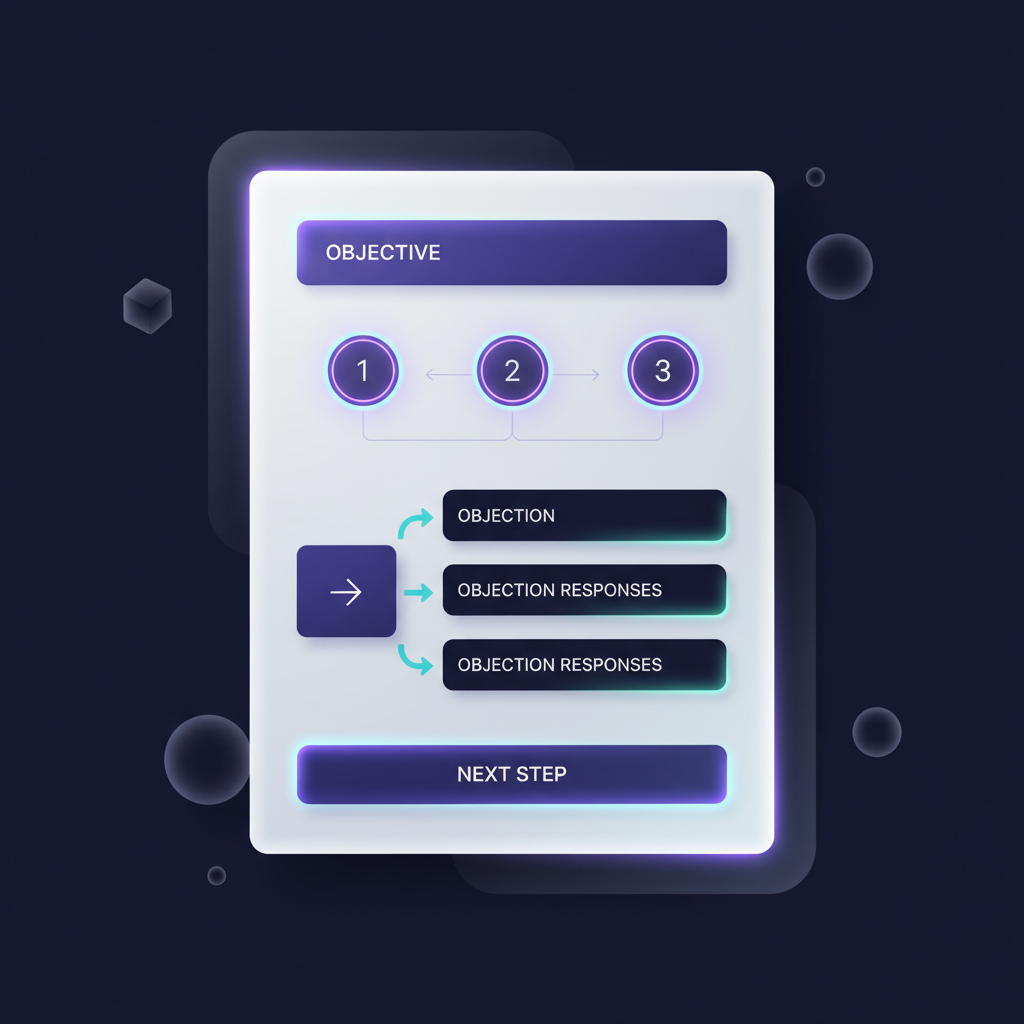
Now synthesise your research into a single-page document (or note) you'll have open during the call.
Your call plan should include:
Primary objective
(From Step 1)
Opening personalisation hook
One specific, non-generic reference that proves you did homework:
- "I saw you just brought on Sarah Chen as your new CRO—congrats. I'm curious how that's shifting priorities for your team this quarter."
- "You posted last week about the challenge of scaling coaching across remote teams—that's exactly what I wanted to explore with you."
Three core discovery questions
Pre-write your most important questions. These should be open-ended and designed to uncover pain, quantify impact, or reveal decision-making process. Don't script the entire call, but anchor yourself with these three.
Two likely objections + responses
Based on your research and deal stage, predict the objections you'll hear and prepare concise, confident responses. Reference our guide on objection handling techniques for frameworks.
Example:
- Objection: "We already have a training platform."
- Response: "That's great—most of our clients did too. What we found is that traditional LMS platforms handle content delivery well, but they don't give reps reps. Can I ask: how are your reps currently practising live conversations before they're on real calls?"
Specific next-step ask
Know exactly what you'll propose at the end:
- "Based on what you've shared, I'd love to set up a 30-minute working session where we map your current onboarding timeline against our ramp acceleration framework. Does Thursday at 2pm work?"
This level of preparation makes you sound like a consultant, not a vendor.
Step 5: Prepare your environment and tools
Logistics matter more than you think.
Technical setup
- Test your mic, camera, and internet connection 10 minutes early
- Close unnecessary browser tabs and apps (nothing kills credibility like "sorry, can you repeat that? Slack distracted me")
- Have your CRM, call plan, and demo environment open and ready
- If you're recording the call, confirm your sales call recording best practices are compliant
Physical environment
- Quiet space with good lighting
- Water nearby (dry mouth kills vocal quality)
- Stand if possible (it improves energy and vocal projection)
Reference materials at hand
- Sales battlecards for competitive scenarios
- Pricing sheet or ROI calculator
- Case studies or testimonials from similar companies
You won't need all of this, but having it ready means you never have to say "let me get back to you on that."
Step 6: Run a pre-call warm-up routine
Athletes don't walk onto the field cold. Neither should you.
Spend 10-15 minutes before your first call (or block of calls) running through sales call warm-up exercises that prime your voice, mind, and energy.
Vocal warm-up (3 minutes)
- Humming scales to loosen vocal cords
- Tongue twisters to improve articulation
- Practice your opening line out loud three times
Mental warm-up (5 minutes)
- Review your call objective and key questions
- Visualise a successful call outcome
- Recall a recent win to boost confidence
Energy check (2 minutes)
- Stand up, stretch, do 10 jumping jacks if needed
- Smile before you dial (it changes your tone)
- Take three deep breaths
This might feel silly, but it's the difference between sounding robotic and sounding human. According to research from the Harvard Business Review, vocal warm-ups improve perceived confidence and trustworthiness in professional conversations.
Step 7: Execute with flexibility
Your sales call preparation checklist gives you a strong foundation—but don't treat it like a script.
The best reps prepare thoroughly, then stay present and adaptable during the call itself. Use your call plan as a guide, not a straightjacket.
Listen more than you talk
Aim for a 40/60 talk-to-listen ratio on discovery calls. Your preparation should make you more curious, not less.
Follow the energy
If the buyer wants to dive deep on something you didn't anticipate, go there. Your research helps you recognise when a tangent is valuable versus a distraction.
Take live notes
Capture direct quotes, especially around pain points, metrics, and decision criteria. These become gold for follow-up emails and deal progression.
Confirm next steps before you hang up
Never end with "I'll send you some times." Get a specific commitment: day, time, attendees, and agenda.
Step 8: Conduct a post-call review (even if it's 60 seconds)
The final step in your sales call preparation checklist happens after the call—and it's what turns good reps into great ones.
Immediately after hanging up, spend 60-90 seconds answering:
- Did I achieve my objective? (Yes/No/Partial)
- What surprised me? (New pain point, unexpected objection, competitive intel)
- What would I do differently next time? (One specific improvement)
- What's my follow-up action? (Email, calendar invite, Slack to AE, etc.)
Log this in your CRM or a dedicated sales call review template. Over time, these micro-reflections compound into dramatically better pattern recognition and call performance.
If you're a manager, build this reflection step into your sales coaching framework—it's one of the highest-leverage coaching moments available.
How to scale sales call preparation across your team
Individual discipline is great. Team-wide consistency is transformational.
Here's how to operationalise this sales call preparation checklist:
Template everything
Create a shared one-page call plan template in Notion, Google Docs, or your CRM. Make it frictionless for reps to fill out.
Build it into your cadence
Incorporate prep time into your sales cadence design. If reps are expected to make 50 calls a day, they won't prepare. If they're making 12 high-quality calls, they will.
Use AI role-play to practise
Once reps have prepared, let them rehearse the call in a safe environment. AI role-play for sales training platforms like QUOTA allow reps to simulate the exact call they're about to make—with the buyer's context, likely objections, and your call plan baked in.
This bridges the gap between preparation and execution, so reps don't just know what to say—they've already said it.
Inspect and coach
During 1-on-1s, review a rep's call plan alongside the recording. Ask:
- What research informed this question?
- Why did you choose this objective?
- What would you change about your prep next time?
This teaches reps to self-coach and continuously improve their preparation process.
Common sales call preparation mistakes to avoid
Even with a checklist, reps fall into predictable traps:
Over-preparing and under-executing
Spending 45 minutes researching a 15-minute call is inefficient. Timebox your prep to 15-20 minutes max for most calls.
Researching without synthesising
Collecting facts isn't preparation. Preparation is turning facts into strategy: Because they just raised a Series B, they're likely hiring fast, which means onboarding speed is probably a pain point.
Preparing alone in a silo
If an AE on your team just closed a similar deal, ask them what mattered. If your manager has called this account before, get their intel. Preparation is faster and better when it's collaborative.
Skipping the warm-up
You wouldn't skip research, so don't skip the 10-minute vocal and mental warm-up. It's the difference between sounding sharp and sounding flat.
FAQ
How long should I spend on sales call preparation?
For most discovery and qualification calls, 15-20 minutes of focused preparation is optimal. For high-value enterprise deals or executive conversations, invest 30-45 minutes. The key is timeboxing—don't let research become procrastination.
What's the most important part of a sales call preparation checklist?
Defining a clear, specific call objective. Without it, all your research lacks direction. Your objective determines what you research, what questions you ask, and how you measure success.
Should I prepare differently for cold calls versus scheduled meetings?
Yes. Cold calls require lighter, faster prep focused on trigger events and a strong opening hook (3-5 minutes max). Scheduled discovery or demo calls warrant deeper research and a full one-page call plan (15-20 minutes).
How can I get my team to actually use a sales call preparation checklist?
Make it mandatory for onboarding, then inspect it during coaching sessions. Celebrate examples where thorough prep led to wins. Use tools like QUOTA's gamified training platform to make preparation feel less like homework and more like skill-building.
What tools should I use for pre-call research?
LinkedIn Sales Navigator, Crunchbase, BuiltWith, ZoomInfo, your CRM, and Google News cover 90% of needs. For competitive intel, maintain updated sales battlecards your team can reference quickly.
How do I prepare for a sales call when I have very little information about the prospect?
Focus on role-based and industry-based research. Even without individual intel, you can prepare relevant questions based on common pain points for their title and sector. Lead with curiosity: "I don't know your specific situation yet, but here's what I typically see with [role] at [company type]—does any of that resonate?"
Should I script my entire sales call during preparation?
No. Script your opening hook, your three core questions, and your closing ask. Everything else should be conversational and responsive. Over-scripting makes you sound robotic and prevents you from truly listening. Preparation creates confidence, not rigidity.

Stefano Sechi
Co-founder, QUOTA Training
Stefano Sechi is co-founder of QUOTA Training. He works hands-on with B2B sales teams on cold calling, discovery and objection handling, and shaped much of the methodology behind QUOTA’s AI role-play scenarios.
Turn this into reps, not just reading
QUOTA Training lets your team practise these exact scenarios with an AI buyer that reacts like the real thing — then scores every call.
See it in action