How to Run a Sales Pipeline Review That Drives Revenue
Part of the Sales Leadership guide: The Complete Sales Management Guide: Build a High-Performing TeamLearn how to run a sales pipeline review that uncovers stuck deals, improves forecast accuracy, and accelerates revenue with tactical frameworks and scripts.

Key takeaways
- A sales pipeline review is a structured meeting where sales leaders inspect individual deals, assess their health, and coach reps on next actions to move opportunities forward or disqualify them.
- Effective pipeline reviews happen weekly, last 30–45 minutes per rep, and follow a consistent framework that focuses on high-value deals, stalled opportunities, and forecast accuracy.
- The best pipeline reviews balance inspection (validating deal data and stage progression) with coaching (helping reps develop strategy and remove blockers).
- Use a tiered approach: inspect 100% of commit and best-case deals, then sample earlier-stage opportunities based on age, size, or risk factors.
- Document action items, next steps, and follow-up dates in your CRM immediately after each review to maintain accountability and track coaching impact over time.
What is a sales pipeline review?
A sales pipeline review is a recurring one-on-one or small-group meeting where sales managers systematically examine each rep's active opportunities, validate deal health, challenge assumptions, and coach reps on strategy and next steps. Unlike a forecast call—which focuses on what will close this quarter—a pipeline review zooms in on why deals are progressing (or stalling) and how to accelerate them.
The sales pipeline review is your earliest warning system for missed quota, your best lever for improving forecast accuracy, and your highest-leverage coaching moment. When done well, it transforms your CRM from a graveyard of wishful thinking into a living roadmap of winnable deals.
For a broader view of the metrics that matter beyond the pipeline itself, see our guide to sales performance metrics.
Why most pipeline reviews fail (and how to fix them)
Most pipeline reviews devolve into one of three failure modes:
- The data-entry audit: The manager reads fields from the CRM while the rep nods along. No strategy, no coaching, no value.
- The wishful-thinking parade: Reps defend every deal as "still alive," and managers lack the framework to challenge assumptions or force disqualification.
- The time sinkhole: Two-hour meetings that cover every deal in exhaustive detail, leaving no time for actual selling.
The fix is a structured process that balances speed with rigor, and inspection with development. The framework below gives you that balance.
The five-step sales pipeline review framework

Step 1: Set the cadence and scope
Frequency: Weekly for AEs carrying fewer than 30 active opportunities; biweekly if pipeline volume is higher. Monthly reviews lose urgency and let bad data compound.
Duration: 30–45 minutes per rep. If you're consistently running over, you're either covering too many deals or lacking a triage system.
Scope: Use a tiered approach based on deal stage and forecast category:
- Tier 1 (must review): All "commit" and "best case" deals for the current quarter, plus any deal over your threshold (e.g., >$50K ARR).
- Tier 2 (sample review): Qualified opportunities in earlier stages—focus on deals that have been in-stage longer than your average sales cycle, or deals that recently moved backward.
- Tier 3 (skip or spot-check): Early prospecting activity unless the rep is struggling with qualification.
This approach ensures you spend 80% of review time on the 20% of deals that drive revenue.
Step 2: Prepare with pre-work
Effective pipeline reviews start before the meeting. Require reps to update the CRM 24 hours in advance:
- Next step and date
- Close date (realistic, not aspirational)
- Stage (with exit criteria met)
- Key stakeholders and champions identified
- Competitive threats
- Risks or blockers
As the manager, scan the pipeline before the meeting and flag:
- Deals that haven't progressed in 2+ weeks
- Opportunities with close dates in the past
- Stage movements that skip steps (e.g., Discovery → Negotiation)
- Deals missing critical fields (decision criteria, budget, timeline)
This pre-work transforms the meeting from a status update into a strategic session.
Step 3: Inspect deal health with a standard set of questions
For each Tier 1 deal, use a consistent set of questions to validate health and surface risk. Here's a proven question set organized by deal element:
Stakeholder coverage:
- "Who is the economic buyer, and when did you last speak with them directly?"
- "Who can kill this deal? What's their current stance?"
- "Do we have a coach inside the account? How do you know they're a coach and not just friendly?"
Value and urgency:
- "What happens if they do nothing? What's the cost of inaction?"
- "Why now? What changed in their business to create urgency?"
- "Have they allocated budget, or are we hoping they'll find it?"
For deeper discovery coaching, link reps to our practical SPIN selling questions to sharpen their qualification.
Competitive position:
- "Who else are they evaluating? What's our differentiation?"
- "What's their decision criteria, and how do we stack up?"
- "Have they told us why they'd choose us, or are we assuming?"
Keep sales battlecards updated based on competitive intelligence surfaced in these reviews.
Next steps and momentum:
- "What's the next meeting, who's attending, and what's the agenda?"
- "What could cause this to slip? What's our mitigation plan?"
- "If this closes, what are the three things that have to happen first?"
These questions force specificity. Vague answers ("They're really interested," "We have a good relationship") are red flags.
Step 4: Coach, don't just audit
The pipeline review is a coaching session disguised as a forecast meeting. After you inspect, invest time in developing the rep's strategy and skills.
For stalled deals: Don't just ask "What's the holdup?" Help the rep diagnose why it stalled and craft a breakout play:
- "Let's role-play the call to the economic buyer. I'll be them—what's your opening?"
- "What if we proposed a scaled-down pilot to reduce their risk? How would you position that?"
For at-risk deals: Help reps face reality and decide whether to fight or fold:
- "On a scale of 1–10, how confident are you we'll win? What would move that number up two points?"
- "If you were advising a peer on this deal, would you tell them to keep investing time?"
If you're building a repeatable coaching motion, our sales coaching framework offers a scalable structure.
For winning deals: Reinforce what's working and extract best practices:
- "Walk me through how you built the business case with them. That's a technique the team should learn."
Step 5: Document and follow through
The pipeline review only creates value if it drives action. At the end of each deal discussion:
- Summarize the agreed next step (who does what by when).
- Update the CRM in real time or immediately after—close date changes, stage movements, risk flags.
- Log coaching actions: If you committed to intro the rep to a contact, schedule a role-play, or review their deck, put it in your task list.
- Set follow-up expectations: "I'll check in Thursday on how the exec call went."
This closes the accountability loop and signals that the review matters.
Advanced tactics for high-performing pipeline reviews
Use a deal-scoring rubric
Create a simple health score (e.g., Green/Yellow/Red) based on objective criteria:
- Green: Champion identified, budget confirmed, compelling event, multi-threaded, next step scheduled.
- Yellow: One or two elements missing or unvalidated.
- Red: Stalled >14 days, single-threaded, no budget discussion, or close date pushed twice.
This rubric speeds triage and removes subjectivity. Salesforce and HubSpot both support custom deal scores; use them.
Run "deal autopsies" on losses
Once per month, dedicate 15 minutes of a pipeline review to dissect a recent loss:
- Where did we lose control?
- What signal did we miss?
- How do we avoid this next time?
This turns losses into learning and improves the team's pattern recognition.
Leverage conversation intelligence
If your team records calls, pull snippets into the pipeline review. Instead of relying on the rep's summary, listen to 60 seconds of the prospect describing their decision process or objection. AI conversation intelligence platforms can surface these moments automatically, saving you hours of call review.
Rotate "deal defense" sessions
Once per quarter, run a group pipeline review where each rep presents their top three deals and the team pressure-tests them. This builds accountability, spreads best practices, and trains junior reps to think strategically.
Common pipeline review mistakes to avoid
Mistake 1: Accepting "I'm waiting on them" as a next step
Waiting is not a strategy. If the rep doesn't have a scheduled meeting or a reason to follow up, the deal is stalled. Coach them to create a reason (new insight, case study, intro to a specialist).
Mistake 2: Letting reps sandbag
Some reps hide deals in early stages to avoid scrutiny or create "surprise" wins. Make it clear that pipeline reviews reward transparency, not gamesmanship. Celebrate deals that were accurately forecasted, not just closed.
Mistake 3: Skipping the "why now" question
Deals without urgency slip. If the rep can't articulate the prospect's compelling event or cost of inaction, the deal belongs in a later quarter (or should be disqualified).
Mistake 4: Reviewing pipeline in a vacuum
Connect pipeline health to activity metrics. If a rep's pipeline is thin, look upstream: Are they booking enough meetings? Running enough discovery calls? Use insights from your sales cadence to diagnose the root cause.
Mistake 5: Talking more than the rep
Your job is to ask questions and listen. If you're doing more than 40% of the talking, you're lecturing, not coaching. For techniques to improve listening, see our guide on sales call listening skills.
How to structure the pipeline review meeting agenda
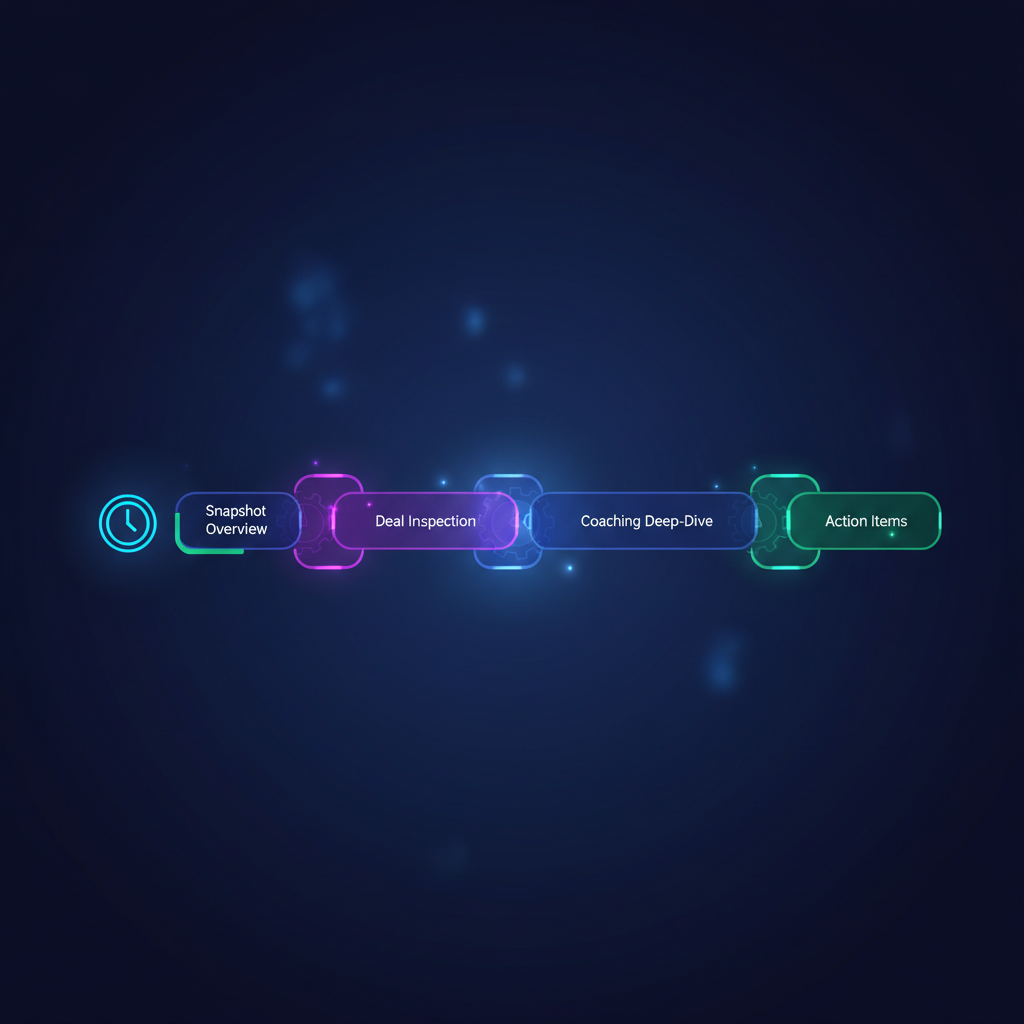
Here's a proven 45-minute agenda:
Minutes 0–5: Pipeline snapshot
- Total pipeline value
- Coverage ratio (pipeline ÷ quota)
- Number of deals by stage
- Week-over-week changes (new, moved, closed, lost)
Minutes 5–30: Deal-by-deal inspection
- Tier 1 deals: 3–5 minutes each
- Tier 2 deals: 1–2 minutes each (focus on "what's changed?")
Minutes 30–40: Coaching deep-dive
- Pick one deal or skill gap to workshop (e.g., role-play a stalled deal breakout call)
Minutes 40–45: Action items and close
- Recap next steps
- Confirm follow-up dates
- One piece of positive reinforcement
This structure ensures you balance breadth (covering the pipeline) with depth (developing the rep).
Measuring the impact of your pipeline reviews
Track these metrics to validate that your pipeline review process is working:
- Forecast accuracy: Measure commit vs. actual close rate. Effective reviews should tighten this gap to <10% variance.
- Average deal age by stage: If deals are moving faster after you implement structured reviews, your coaching is working.
- Win rate on reviewed deals: Compare close rates for deals that were reviewed vs. deals that weren't (if you have a large enough team).
- Pipeline quality score: Track the percentage of deals that meet your Green health criteria. Target 60%+.
For a comprehensive view of what to measure as a sales leader, explore our sales performance metrics framework.
Scaling pipeline reviews across a growing team
As your team grows beyond 8–10 reps, you can't personally review every deal. Here's how to scale:
Delegate to frontline managers: Train each manager on your pipeline review framework. Sit in on their first three reviews to calibrate.
Implement skip-level reviews: Once per month, review a sample of deals from each manager's team to ensure consistency and spot coaching gaps.
Use AI-powered deal insights: Modern revenue intelligence platforms can flag at-risk deals, suggest next actions, and summarize call insights—letting you focus manager time on strategy, not data gathering. For more on how AI can support coaching at scale, see our guide to AI sales coaching strategies.
Create a pipeline review playbook: Document your question sets, health score rubric, and meeting agenda so every manager runs reviews the same way. Include example coaching moments and call recordings (with permission) as training assets.
Integrating pipeline reviews into your broader coaching motion
Pipeline reviews are most effective when they're part of a continuous coaching system, not an isolated ritual. Connect them to:
- Call reviews: Surface specific calls from deals discussed in the pipeline review. If a rep says "the champion is on board," listen to that call together. Use a sales call review template to structure the feedback.
- Skills development: If pipeline reviews reveal a pattern (e.g., reps struggle to multi-thread), schedule role-play sessions or training on that skill. Platforms like QUOTA Training let reps practice these scenarios between reviews.
- One-on-ones: Use a portion of your weekly 1:1 to follow up on action items from the last pipeline review and celebrate progress on coached deals.
This integration turns pipeline reviews from a compliance exercise into a growth engine.
FAQ
How often should I run a sales pipeline review?
Run pipeline reviews weekly for individual contributors carrying active deals. Biweekly is acceptable for high-volume teams (30+ opportunities per rep), but monthly reviews lose effectiveness because deals can stall or derail without early intervention.
What's the difference between a pipeline review and a forecast call?
A forecast call focuses on what will close this period and rolling up commit numbers for leadership. A pipeline review is rep-focused and examines why deals are progressing, how to accelerate them, and where coaching is needed. Pipeline reviews feed forecast accuracy but serve a broader coaching and deal strategy purpose.
How many deals should I review in each pipeline review meeting?
Review 100% of commit and best-case deals for the current quarter, plus any deal above your materiality threshold (e.g., >$50K). For earlier-stage deals, sample based on age, size, or risk. Aim to cover 8–12 deals in a 45-minute session, spending more time on high-value or at-risk opportunities.
What should I do with deals that are clearly stuck?
First, diagnose why the deal stalled (lost champion, no urgency, budget evaporated, competitor ahead). Then decide: re-engage with a new angle (new value prop, executive sponsor, pilot offer), push to a future quarter with a clear trigger to revisit, or disqualify and reallocate the rep's time to higher-probability deals. Avoid letting zombie deals clog the pipeline.
How do I get reps to be honest in pipeline reviews instead of sandbagging?
Create psychological safety by rewarding transparency over optimism. Celebrate reps who accurately forecast (even if they miss quota) and coach those who consistently over-project. Make it clear that the pipeline review is a coaching session to help them win, not a performance evaluation to punish them. When reps see the review drives real support (introductions, deal strategy, removing blockers), honesty follows.
Should I run pipeline reviews one-on-one or as a group?
Default to one-on-one for weekly reviews—this allows candid conversation, personalized coaching, and faster pace. Run group "deal defense" sessions monthly or quarterly to spread best practices, build team accountability, and train junior reps by exposing them to how senior reps think about deals.

Stefano Breglia
Co-founder, QUOTA Training
Stefano Breglia is co-founder of QUOTA Training. He focuses on sales methodology, deal progression and how AI simulation accelerates rep ramp time across the SDR, BDR, AE and AM roles.
Turn this into reps, not just reading
QUOTA Training lets your team practise these exact scenarios with an AI buyer that reacts like the real thing — then scores every call.
See it in action