Sales Leadership Pipeline Reviews: Run Sessions That Drive Revenue
Part of the Sales Leadership guide: The Complete Sales Management Guide: Build a High-Performing TeamLearn how to run sales leadership pipeline reviews that uncover risk, coach reps in real time, and drive forecast accuracy—not just status updates.

Key takeaways
- Effective sales leadership pipeline reviews spend 60-70% of time on in-flight deals, 20% on pipeline generation, and 10% on closed-lost analysis—not equal time across all opportunities.
- The four-question framework (What changed? What's the risk? What's your next move? How can I help?) transforms status updates into coaching conversations that move deals forward.
- Pipeline reviews that improve forecast accuracy focus on deal age, stage velocity, and multi-threading coverage—not just total pipeline value or rep-reported close dates.
- Weekly pipeline reviews create the optimal cadence for catching deal slippage early while respecting selling time; monthly reviews miss critical inflection points, and daily reviews create administrative drag.
- The best pipeline reviews end with documented next actions, clear ownership, and follow-up accountability—turning insights into execution.
Most sales leadership pipeline reviews are glorified status updates. Your reps recite what's in Salesforce. You nod, ask when deals will close, and move on. Everyone leaves with the same information they brought—and your forecast accuracy stays mediocre.
Great pipeline reviews are different. They're coaching sessions that uncover hidden risk, sharpen deal strategy, and build reps who think like revenue leaders. They improve your forecast, accelerate deals, and create a culture of accountability—without becoming interrogations that kill morale.
This guide shows you how to run sales leadership pipeline reviews that actually drive revenue. You'll learn the exact framework, questions, and cadence that separate high-performing sales leaders from managers who just collect updates.
Why most pipeline reviews fail to drive results
The typical pipeline review follows a predictable pattern: the rep walks through their top deals, you ask a few surface-level questions, and the conversation stays tactical. "When will it close?" "Have you sent the proposal?" "What's the next step?"
These reviews fail for three reasons.
First, they're backward-looking. You're reviewing what already happened instead of shaping what happens next. The rep tells you about last week's demo. You don't discuss the strategy for next week's executive meeting.
Second, they lack structure. Without a framework, you bounce between deals randomly, miss critical risks, and run out of time before covering pipeline generation or closed-lost lessons. The loudest deals get attention; the quietly stalling ones slip through.
Third, they don't coach. You're auditing, not developing. The rep learns that pipeline reviews are about defending their forecast—not improving their deal execution. Over time, they game the system, inflating pipeline and pushing out close dates to avoid scrutiny.
According to Salesforce's pipeline best practices, only 47% of forecasted deals actually close in the predicted quarter. That gap isn't just a rep problem—it's a leadership problem. Your pipeline reviews should close that gap.
The pipeline review framework that uncovers real risk
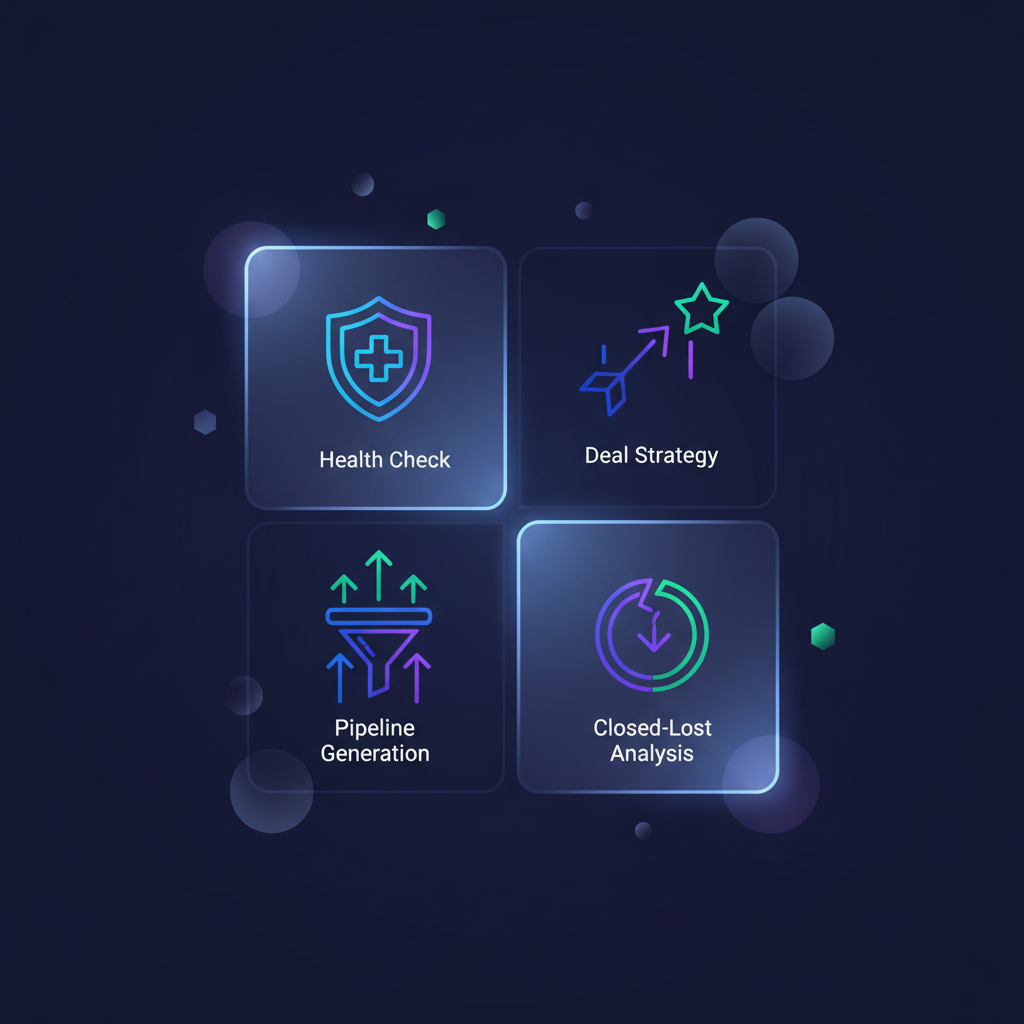
Effective sales leadership pipeline reviews follow a consistent structure that balances deal coaching, pipeline health, and rep development. Here's the framework that works.
Allocate time by impact, not by deal count
Spend your pipeline review time where it drives the most revenue:
- 60-70% on deals in flight (opportunities moving through active stages)
- 20% on pipeline generation (prospecting activity, new opportunities, top-of-funnel health)
- 10% on closed-lost analysis (what went wrong, what to apply forward)
This allocation ensures you're coaching the deals that will close this quarter while also building future pipeline and extracting lessons from losses. Most leaders do the opposite—they spend 90% of the time on current deals and wonder why next quarter's pipeline is thin.
The four-part deal review sequence
For each in-flight deal, move through this sequence:
1. Health check (2 minutes). Review the objective data: deal age, stage, last activity date, multi-threading score, and any velocity red flags. Don't ask the rep to report these—pull them from your CRM before the meeting. This is where your coaching metrics that predict revenue come into play.
2. What changed? (3 minutes). Ask the rep to highlight what's different since your last review. New stakeholders? Shifted timelines? Competitor intel? Budget reallocation? This surfaces momentum—or the lack of it.
3. Risk identification (5 minutes). This is where you coach. Ask: "What could kill this deal?" and "What don't we know yet?" Push the rep to articulate gaps in their qualification, missing stakeholders, or unclear decision criteria. Most reps overestimate deal health; your job is to stress-test their assumptions.
4. Strategy and next actions (5 minutes). Discuss the next 1-3 moves that will advance the deal or de-risk it. Be specific: "Schedule a technical validation call with their VP of Engineering by Friday" is actionable. "Move the deal forward" is not.
This sequence takes 15 minutes per deal. For a rep carrying 8-10 active opportunities, you'll review 3-4 in depth each week, rotating through the pipeline over a month.
Pipeline generation check-in
After deal reviews, spend 5 minutes on pipeline creation:
- How many new qualified opportunities did the rep add this week?
- What's their coverage ratio (pipeline value ÷ quota) for next quarter?
- Are they prospecting into the right accounts and personas?
This isn't about activity metrics (dials, emails sent). It's about qualified pipeline moving into early stages. If your reps are hitting this quarter's number but building nothing for next quarter, your sales leadership forecasting will show a cliff in 60 days.
Closed-lost review
End with a quick closed-lost analysis. Pick one recent loss and ask:
- Why did we lose?
- What signal did we miss?
- What would we do differently?
This isn't about blame—it's about extracting a lesson the rep (and team) can apply to future deals. Document the insight and share it in your next team meeting.
How to coach reps during pipeline reviews (not interrogate them)

The tone of your pipeline review determines whether reps show up prepared and honest—or defensive and evasive. Here's how to make the session feel like coaching, not an inquisition.
Ask open-ended questions that reveal thinking
Replace yes/no questions with prompts that expose the rep's deal understanding:
- Instead of: "Did you send the proposal?" Ask: "Walk me through how the proposal landed and what feedback you're hearing."
- Instead of: "Is the budget approved?" Ask: "What's the approval process for a deal this size, and where are we in it?"
- Instead of: "When will it close?" Ask: "What needs to happen between now and close, and who controls each step?"
These questions force the rep to demonstrate their grasp of the deal—or reveal the gaps you need to coach through.
Use the "tell me more" follow-up
When a rep gives a surface answer, don't move on. Say "Tell me more about that" or "Help me understand why you believe that." This follow-up uncovers the details that predict whether a deal is real or wishful thinking.
For example:
- Rep: "The champion is really excited."
- You: "Tell me more—what did they say that signals they're willing to fight for this internally?"
This technique, borrowed from discovery frameworks, surfaces whether the rep has evidence or assumptions. It's also how you model the delivering feedback that drives change approach—curious, not accusatory.
Separate deal health from rep performance
When you identify a deal risk, frame it as a problem to solve together—not a rep failure. Say "This deal has some red flags we should address" instead of "You missed this." The first invites collaboration; the second triggers defensiveness.
Your goal is to build reps who proactively surface risks because they trust you'll help them navigate, not punish them for honesty. That shift is what separates avoiding micromanagement from abdicating oversight.
End every deal discussion with clear next actions
Before moving to the next opportunity, confirm:
- What the rep will do next
- When they'll do it
- What outcome they're aiming for
Document these commitments. At the start of next week's review, check whether the actions happened. This accountability loop is what turns pipeline reviews into execution drivers, not just talk sessions.
Pipeline review questions that predict deal outcomes
Certain questions consistently reveal whether a deal will close—or stall. Here are the high-signal prompts to weave into your reviews.
Multi-threading and stakeholder coverage
- "Who else inside the account has a vote on this decision, and what's their current stance?"
- "If your champion leaves tomorrow, does this deal survive?"
Gong's research on pipeline management shows that deals with 4+ stakeholders engaged have a 70% higher win rate. If your rep can only name one contact, the deal is fragile.
Decision process and timeline
- "Walk me through the exact steps between now and a signed contract—who approves, in what order?"
- "What happens if we don't close by their stated timeline? Is there a consequence for them, or just for us?"
Reps often accept buyer timelines at face value. Your job is to pressure-test whether the urgency is real or fabricated.
Competitive positioning
- "Who else are they evaluating, and why haven't they picked them yet?"
- "If we're the incumbent or the challenger, what's our unique advantage in this deal?"
If the rep doesn't know the competitive landscape, they're flying blind. This is where deal strategy shifts from hopeful to intentional.
Value and ROI clarity
- "Can the buyer articulate the business problem we're solving and the cost of inaction?"
- "What's the quantified value they expect from our solution, and who owns that number internally?"
Deals without clear, agreed-upon value rarely close on time—or at all. This question exposes whether you're in a real buying cycle or an exploration conversation the rep has mislabeled as an opportunity.
How to structure your pipeline review cadence
The frequency and format of your pipeline reviews directly impact their effectiveness. Here's how to build a rhythm that works.
Weekly one-on-one pipeline reviews
Run a 30-minute pipeline review with each rep every week. This cadence is frequent enough to catch slippage early but not so often that it consumes selling time.
Weekly reviews also create a predictable coaching drumbeat. Reps know you'll ask about next actions from last week, so they're more likely to follow through. Monthly reviews lose this accountability—too much time passes for course correction.
Quarterly deep-dive sessions
Once per quarter, run a 60-minute deep-dive pipeline review. Go beyond the current quarter's deals and evaluate:
- Next quarter's pipeline coverage and quality
- Win/loss trends over the past 90 days
- Changes in buyer behavior, competition, or market conditions
This session is strategic, not tactical. You're zooming out to spot patterns the weekly reviews miss.
Team pipeline calibration
Every two weeks, run a 30-minute team pipeline calibration session. Pick 2-3 deals across the team and review them together. This serves three purposes:
- It levels up your entire team's deal intuition by exposing them to different scenarios
- It calibrates how reps assess deal health, so your forecast becomes more consistent
- It reinforces that pipeline reviews are about learning, not judgment
Team calibration also reduces the perception that pipeline reviews are punitive—everyone sees that you're coaching the same way across the board.
Common pipeline review mistakes that kill forecast accuracy
Even experienced sales leaders fall into traps that undermine their pipeline reviews. Here's what to avoid.
Mistake 1: Reviewing every deal equally
Not all deals deserve equal airtime. A $200K opportunity in late-stage negotiation with clear next steps needs less discussion than a $50K deal that's been stuck in "demo delivered" for six weeks.
Prioritize your review time based on deal risk and revenue impact, not alphabetical order or rep seniority.
Mistake 2: Accepting "waiting on the customer" as a status
"Waiting on the customer" is code for "I don't have a next action." Every deal should have a proactive next move the rep controls. If the buyer is slow to respond, the next action is a strategic follow-up, a multi-threaded outreach, or a re-qualification conversation—not waiting.
When you hear "waiting on the customer," ask: "What can you do to create urgency or clarity while they're deciding?"
Mistake 3: Skipping closed-lost analysis
Most pipeline reviews focus only on open and won deals. Losses get ignored because they're uncomfortable. But closed-lost deals are your richest source of coaching material—they reveal patterns in qualification gaps, competitive weaknesses, and messaging failures.
Make closed-lost analysis a non-negotiable part of your cadence. Extract the lesson, document it, and move on. Don't dwell, but don't skip.
Mistake 4: Failing to document and follow up
If you don't write down the commitments from each pipeline review, they evaporate. Reps forget, you forget, and the next week's review starts from scratch.
Use a simple shared doc or CRM task to capture:
- Deal-specific next actions and owners
- Coaching points or skill gaps to address
- Follow-up items for you (intros, deal support, escalations)
At the start of each review, check last week's commitments. This accountability is what separates high-performing teams from those with good intentions and poor execution.
How AI role-play reinforces pipeline review coaching
Pipeline reviews uncover skill gaps—reps who can't articulate value, struggle with multi-threading, or freeze when a deal stalls. The challenge is turning those insights into capability.
This is where AI role-play scenarios become a force multiplier. After a pipeline review, you can assign a rep a targeted scenario that mirrors the exact situation they're facing: handling a stalled deal, navigating a multi-stakeholder negotiation, or responding to a competitor objection.
The rep practices in a safe environment, gets instant feedback, and returns to the live deal with a refined approach. You've closed the loop between identification (pipeline review) and development (skill-building)—without scheduling another role-play session yourself.
For teams running weekly pipeline reviews across 10+ reps, this scalability is critical. You can't personally coach every gap in real time, but you can direct reps to the right practice scenarios and track whether they're improving. Learn more about how AI sales training metrics help you measure that progress.
Turning pipeline reviews into a competitive advantage
Sales leadership pipeline reviews are one of the highest-leverage activities you own. Done well, they improve forecast accuracy, accelerate deal velocity, and build reps who think strategically about every opportunity.
Done poorly, they become administrative theater—box-checking exercises that consume time without driving outcomes.
The difference comes down to structure, discipline, and coaching intent. Use the four-part framework. Ask questions that reveal thinking, not just status. Hold reps accountable for next actions. And treat every review as a chance to develop your team, not just audit their pipeline.
When you approach pipeline reviews this way, they stop feeling like overhead and start feeling like the engine that powers your forecast, your team's growth, and your quota attainment.
For more on building a high-performing sales organization, explore our complete sales management guide—it covers everything from hiring and onboarding to coaching systems that scale.
FAQ
How often should sales leaders run pipeline reviews?
Weekly pipeline reviews work best for most teams. They create a predictable cadence for coaching, allow you to catch deal slippage early, and keep reps accountable without micromanaging. Monthly reviews are too infrequent to course-correct; daily reviews create administrative overhead that kills selling time.
What's the difference between a pipeline review and a forecast call?
A pipeline review is a coaching session focused on deal strategy, risk identification, and rep development. A forecast call is a reporting exercise where you roll up numbers for leadership. Great pipeline reviews improve your forecast accuracy, but they serve fundamentally different purposes.
How long should a pipeline review take per rep?
Plan 20-30 minutes per rep for a thorough weekly review. Spend 60-70% of that time on deals in flight, 20% on pipeline generation, and 10% on closed-lost analysis. If you're running longer, you're either coaching too deeply on individual deals or letting reps ramble through status updates.
What pipeline metrics should sales leaders track in reviews?
Focus on velocity metrics that predict outcomes: average deal age by stage, stage conversion rates, days since last activity, and multi-threading coverage. Avoid vanity metrics like total pipeline value without context—a bloated pipeline full of stalled deals doesn't drive revenue.

Stefano Sechi
Co-founder, QUOTA Training
Stefano Sechi is co-founder of QUOTA Training. He works hands-on with B2B sales teams on cold calling, discovery and objection handling, and shaped much of the methodology behind QUOTA’s AI role-play scenarios.
Turn this into reps, not just reading
QUOTA Training lets your team practise these exact scenarios with an AI buyer that reacts like the real thing — then scores every call.
See it in action