The Complete Sales Management Guide: Build a High-Performing Team
Master every aspect of sales management: hiring, onboarding, forecasting, pipeline reviews, quotas, compensation, coaching, and retention strategies that drive revenue.

Key takeaways
- Sales management success requires mastery of eight interconnected disciplines: hiring the right talent, accelerating onboarding and ramp, accurate forecasting, effective pipeline reviews, fair quota setting, motivating compensation design, consistent coaching, and strategic retention—each discipline directly impacts revenue outcomes.
- Structured onboarding reduces ramp time by 30-40%: Top-performing teams use milestone-based 30-60-90 day plans with shadowing, AI role-play practice, and clear success criteria at each stage, getting new reps productive faster than ad-hoc training approaches.
- Pipeline reviews and forecasting serve different purposes: Pipeline reviews are coaching opportunities focused on deal-level health and rep development, while forecasts aggregate data to predict revenue for business planning—conflating the two creates inaccurate predictions and missed coaching moments.
- Quota attainment rates reveal plan health: When fewer than 60% of reps hit quota, the targets are likely unrealistic and demotivating; when more than 80% exceed quota consistently, you're leaving revenue on the table—the sweet spot is 60-75% attainment with clear accelerators for top performers.
- Retention of top performers requires intentional career pathing: High performers leave when they hit a growth ceiling—create clear progression frameworks, invest in skill development through coaching and training technology, and build a feedback-rich culture where reps see a future beyond their current role.
What Is Sales Management? (And Why Most Definitions Miss the Mark)
Sales management is the discipline of building, leading, and optimizing a team that consistently delivers revenue targets. It's not just "managing salespeople"—it's architecting a system where the right people, equipped with the right skills, follow the right process, motivated by the right incentives, to produce predictable outcomes.
Most sales management content focuses on tactics in isolation: how to run a pipeline review, how to set quotas, how to coach. But these elements are interconnected. Your hiring decisions determine who you'll coach. Your onboarding quality affects ramp time and quota attainment. Your compensation plan shapes behavior that shows up in your pipeline. Your coaching approach directly impacts retention.
This sales management guide treats these disciplines as an integrated system. We'll walk through each component—hiring, onboarding, forecasting, pipeline reviews, quota setting, compensation design, coaching, and retention—with frameworks you can implement immediately, informed by what we observe working with hundreds of sales teams through QUOTA Training.
According to Gartner research on sales performance, organizations with structured sales management practices see 15-20% higher quota attainment and significantly lower turnover. Yet most sales managers are promoted from individual contributor roles with minimal formal training in these disciplines. This guide fills that gap.
Building Your Sales Hiring Framework

Hiring is your highest-leverage activity as a sales manager. A great hire compounds value over years; a bad hire costs you 6-12 months of salary, opportunity cost, and team morale before you course-correct.
Define Role-Specific Success Profiles
Start by documenting what "good" actually looks like for each role. For SDRs, this might be resilience, coachability, pattern recognition, and communication clarity. For AEs, add deal orchestration, executive presence, and problem-solving under ambiguity.
Avoid generic "hungry hunter" descriptions. Get specific: What does resilience look like in your environment? If you sell into enterprise procurement, resilience means navigating 9-month cycles with multiple no-shows. If you sell transactional SaaS, it means bouncing back from 50 cold call rejections per day.
Document the specific skills each role requires:
- SDR: Cold calling tonality, objection handling, qualification questioning, CRM hygiene, meeting setting
- AE: Discovery depth, multi-threading, demo customization, negotiation, forecast accuracy
- Sales Manager: Pipeline inspection, coaching delivery, forecast modeling, hiring judgment, conflict resolution
Structure Your Interview Process to Predict Performance
Most interview processes test the wrong things. Charisma in an interview doesn't predict quota attainment. A polished resume doesn't predict coachability.
Build a multi-stage process that simulates real work:
Stage 1: Screening call (15 min)
Assess baseline communication, confirm role understanding, and gauge genuine interest. Listen for questions about the product, market, and team—candidates who ask thoughtful questions are doing their homework.
Stage 2: Skills assessment (async)
Give candidates a realistic task: "Research this prospect company and record a 60-second voicemail you'd leave for the VP of Sales." Or: "Review this discovery call transcript and identify three missed opportunities."
This reveals work quality, resourcefulness, and whether they can execute without hand-holding. In our experience at QUOTA, candidates who skip instructions or submit generic work rarely improve after hiring.
Stage 3: Role-play interview (30-45 min)
Simulate a real sales scenario. For SDRs, role-play a cold call with common objections. For AEs, run a discovery call where the interviewer plays a skeptical buyer.
Don't just evaluate the outcome—watch how they respond to coaching mid-role-play. Give them one piece of feedback and see if they adjust. Coachability is more predictive of success than initial performance.
Stage 4: Values and team fit (30 min)
Assess alignment with your culture and work style. Ask behavioral questions: "Tell me about a time you missed quota. What did you do?" or "Describe a situation where you disagreed with your manager's coaching. How did you handle it?"
Listen for ownership vs. blame, growth mindset vs. fixed mindset, and team orientation vs. lone wolf tendencies.
Red Flags That Predict Failure
Certain patterns consistently predict poor performance:
- Blaming external factors for past failures: "My leads were terrible" or "The product wasn't competitive"—this signals a victim mentality
- Lack of preparation: Not researching your company or asking generic questions suggests low engagement
- Inability to accept feedback in role-play: Defensiveness or repeating the same mistake after coaching indicates low coachability
- Job hopping without clear progression: Three roles in two years with no upward movement suggests performance issues
For a deeper framework on avoiding common hiring mistakes, see our guide on sales leadership coaching skills.
Designing Sales Onboarding That Accelerates Ramp Time
The gap between "hired" and "productive" is where most sales managers lose months of revenue. Industry benchmarks suggest 3-6 months for SDRs and 6-9 months for AEs, but top-performing teams cut this by 30-40% through structured onboarding.
The 30-60-90 Day Milestone Framework
Break onboarding into three phases with clear success criteria:
Days 1-30: Foundation
- Goal: Understand the product, market, buyer, and process
- Activities: Product training, competitor analysis, ICP documentation, process shadowing
- Success criteria: Can articulate value proposition in 30 seconds, identify ideal customer profile characteristics, explain the sales process stages
- Output: Pass product knowledge assessment, complete 10 hours of call shadowing with notes
Days 31-60: Supervised Practice
- Goal: Execute core activities with coaching and feedback
- Activities: First calls/meetings with manager listening, AI role-play practice, deal shadowing, CRM workflow training
- Success criteria: Book first meeting (SDR), advance first deal to next stage (AE), demonstrate proper objection handling
- Output: Complete 20 AI role-play scenarios, conduct 5 live calls with post-call debriefs, log all activities in CRM correctly
Days 61-90: Independent Execution with Accountability
- Goal: Hit ramped quota (typically 50-75% of full quota)
- Activities: Full activity load, weekly coaching sessions, pipeline building, deal progression
- Success criteria: Achieve ramp quota, demonstrate consistent process adherence, show improvement trajectory
- Output: Close first deal or hit meeting quota, maintain pipeline coverage ratio, show week-over-week improvement in key metrics
Leverage AI Role-Play to Compress Learning Curves
Traditional role-play happens in team meetings—maybe once a week, with 5 minutes per rep, with peer anxiety killing honest practice. This isn't enough repetition to build muscle memory.
AI-powered training personalization enables reps to practice objection handling, discovery questioning, and tonality control in private, unlimited sessions. At QUOTA, we see new reps who complete 30+ role-play scenarios in their first month ramp 40% faster than those who rely only on live call experience.
The advantage: AI gives instant feedback, tracks improvement over time, and lets reps fail privately without stakes. When they go live, they've already handled the objection ten times.
Create a Shadowing and Reverse-Shadowing System
Shadowing (weeks 1-4): New reps observe top performers on live calls. But passive listening isn't enough—require them to document:
- Opening statements used
- Questions asked and sequencing
- Objections encountered and responses
- Moments of friction or breakthrough
- What they'd do differently
Reverse-shadowing (weeks 5-8): The new rep takes the call while a senior rep or manager listens. Debrief immediately after:
- What went well?
- What would you change?
- What did you notice about the buyer's tone or language?
- How confident did you feel, and where did you hesitate?
This combination builds pattern recognition faster than either approach alone.
For a complete breakdown of SDR onboarding, see our complete SDR playbook.
Running Pipeline Reviews That Drive Deals Forward
Pipeline reviews are your highest-leverage coaching opportunity. Done well, they surface blockers, improve deal strategy, and teach reps to think critically about their pipeline. Done poorly, they become interrogations that waste time and erode trust.
Pipeline Review vs. Forecast Call: Know the Difference
These are not the same meeting:
Pipeline review = Deal health inspection + coaching
- Focus: Individual deal strategy, stage integrity, next steps, blockers
- Outcome: Rep leaves with clearer action plan, manager identifies coaching needs
- Frequency: Weekly or bi-weekly, 30-60 min per rep
- Tone: Collaborative, developmental
Forecast call = Revenue prediction + resource planning
- Focus: Aggregate numbers, commit/best-case/pipeline, risk assessment
- Outcome: Leadership has confidence in the forecast, knows where to allocate resources
- Frequency: Weekly or monthly, depending on sales cycle length
- Tone: Analytical, accountability-focused
Conflating these two creates bad outcomes: reps sandbag because they're afraid to be honest about deal risk, and you miss coaching opportunities because you're focused on the number.
The Four-Quadrant Pipeline Inspection Framework
For each deal in the pipeline, assess two dimensions: deal health (strong or weak) and rep understanding (clear or unclear).
Quadrant 1: Strong deal + clear understanding
- Action: Light touch, confirm next steps, move on
- Coaching: Minimal—rep has it under control
Quadrant 2: Strong deal + unclear understanding
- Action: Dig deeper with questions: "Who's the economic buyer? What happens if they do nothing? What's the decision process?"
- Coaching: Rep may be getting lucky or riding a champion—teach them to validate strength
Quadrant 3: Weak deal + clear understanding
- Action: Strategize together on how to strengthen or whether to disqualify
- Coaching: Rep knows the problem—help them solve it or make the tough call to move on
Quadrant 4: Weak deal + unclear understanding
- Action: Intensive coaching—this deal is at risk and the rep doesn't see it
- Coaching: Use this as a teaching moment: "What questions should you ask to validate this stage?"
This framework prevents you from spending equal time on every deal. Prioritize quadrants 3 and 4.
Key Questions to Ask in Every Pipeline Review
Don't just ask "What's the status?" Ask questions that reveal deal health and teach reps to think strategically:
- "Who's the economic buyer, and have you spoken to them directly?"
- "What happens if they do nothing? What's the cost of inaction?"
- "Who else is involved in the decision, and what does each person care about?"
- "What's the formal decision process, and where are we in it?"
- "What could cause this deal to slip or stall?"
- "On a scale of 1-10, how confident are you in the close date? Why that number?"
These questions train reps to qualify deeply and spot red flags before they become surprises. For more on sales coaching observation, see our dedicated guide.
Mastering Sales Forecasting: From Pipeline to Prediction
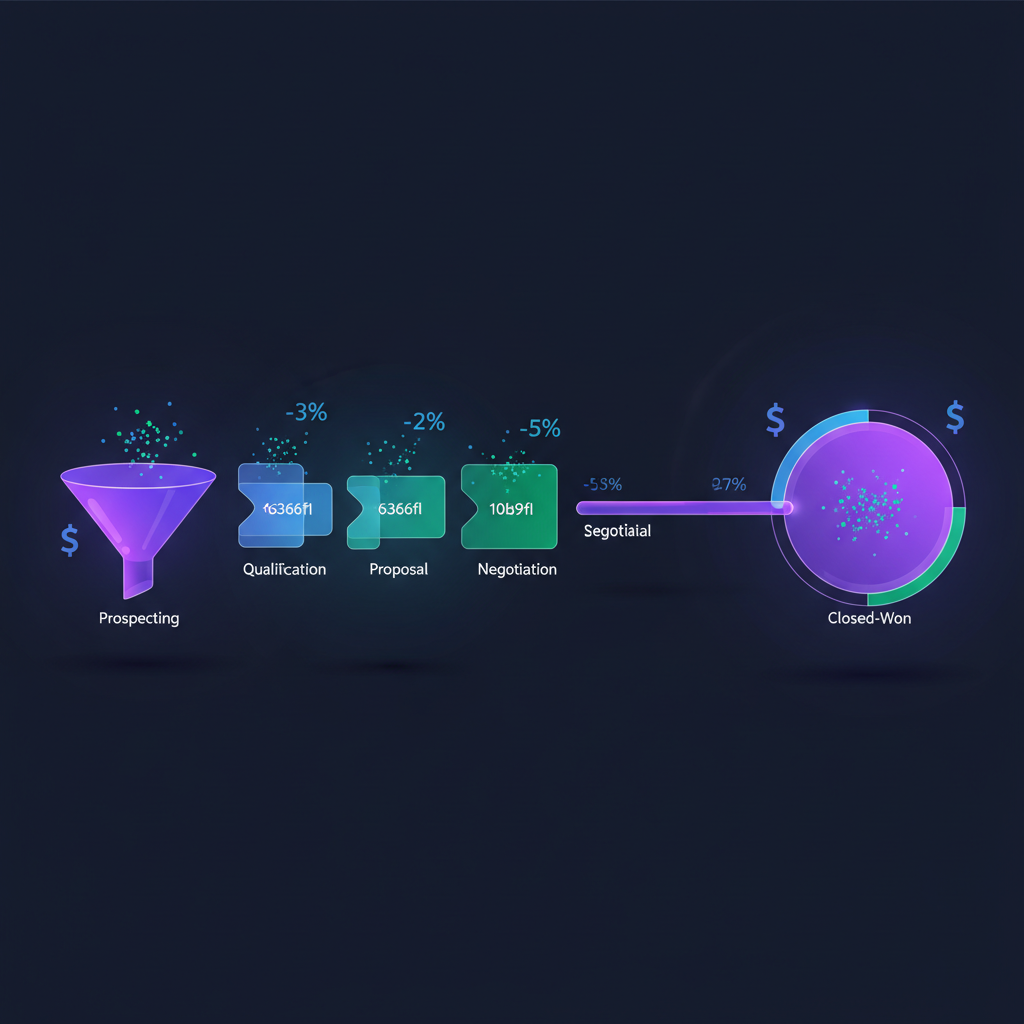
Forecasting is part science, part art. The science is data—stage conversion rates, historical win rates, sales cycle length. The art is judgment—knowing when a deal is real despite what the data says, or when it's at risk despite a rosy stage.
Build a Stage-Weighted Forecast Model
Start with a simple stage-based model:
| Stage | Probability | Example Deal Value | Weighted Value |
|---|---|---|---|
| Discovery | 20% | $50K | $10K |
| Demo | 40% | $50K | $20K |
| Proposal | 60% | $50K | $30K |
| Negotiation | 80% | $50K | $40K |
| Closed-Won | 100% | $50K | $50K |
Multiply each deal's value by its stage probability, then sum across all deals. This gives you a probability-weighted forecast.
Refine with historical data: If your "Proposal" stage converts at 50% historically, not 60%, adjust your model. Track stage conversion rates quarterly and update probabilities.
Adjust for deal age: Deals that sit in a stage longer than your average sales cycle are less likely to close. Apply a decay factor—if a deal has been in "Negotiation" for 90 days and your average cycle is 45 days, reduce its probability from 80% to 50%.
Use a Three-Category Forecast System
Break your forecast into three buckets:
Commit: Deals you're confident will close this period (typically 90%+ probability)
- Criteria: Verbal agreement, contract out, final approvals in flight, close date confirmed by buyer
Best Case: Deals that could close but have risk (typically 50-70% probability)
- Criteria: Strong engagement, budget confirmed, but timeline uncertain or final decision-maker not fully aligned
Pipeline: Everything else—early-stage deals and long-shots (weighted by stage probability)
Report all three to leadership. This gives them a range (Commit = floor, Best Case = likely, Pipeline = ceiling) and prevents the "surprised VP" scenario where your forecast misses by 40%.
Common Forecasting Mistakes and How to Fix Them
Mistake 1: Trusting rep optimism without validation
Reps are optimistic by nature. They'll say "90% chance to close" based on a friendly conversation.
Fix: Require evidence for high-probability deals. What specific actions has the buyer taken? Have they introduced you to the economic buyer? Have they shared a decision timeline?
Mistake 2: Ignoring historical patterns
If your team historically closes 25% of "Demo" stage deals, assuming 40% will close this quarter is wishful thinking.
Fix: Use trailing 12-month win rates by stage as your baseline. Adjust for seasonality or major changes (new product, new market), but default to data.
Mistake 3: Sandbagging to look good
Some managers under-forecast to beat expectations. This creates resource allocation problems—leadership can't hire, invest, or plan accurately.
Fix: Separate forecast accuracy from performance evaluation. Reward honest forecasting even when the number is lower than hoped.
For more on building a high-performing team culture, see our guide on building a feedback culture.
Setting Sales Quotas That Motivate Without Demoralizing
Quota setting is one of the most consequential—and most poorly executed—responsibilities of sales management. Set quotas too high, and you demotivate your team, increase turnover, and create a culture of sandbagging. Set them too low, and you leave revenue on the table and fail to push reps to grow.
The Top-Down + Bottom-Up Quota Formula
Start with two inputs:
Top-down (company revenue goal):
Your company needs to hit $10M ARR this year. You have 10 AEs. Simple math says each AE needs to close $1M.
Bottom-up (capacity and historical performance):
Your AEs historically close $750K/year on average. Your top performer did $1.2M. Your bottom performer did $400K.
If you set quota at $1M, you're asking for a 33% improvement across the board. Is that realistic? What's changed to enable it—better leads, new product features, improved training?
The formula:
- Start with historical average attainment
- Add a growth factor based on real improvements (better ICP targeting, expanded territory, new product line)
- Aim for 60-75% of reps hitting quota in a healthy plan
- Ensure top performers can exceed quota by 150-200% with accelerators
Example:
- Historical average: $750K
- New product line expected to add 20% opportunity: $750K × 1.20 = $900K
- Set quota at $900K
- Result: Realistic stretch without demoralization
Segment Quotas by Territory, Vertical, or Rep Experience
One-size-fits-all quotas ignore reality. A rep selling into SMB with a 30-day sales cycle should have a different quota than one selling into enterprise with a 9-month cycle.
Segment by:
- Territory: High-density markets (SF, NYC) may have higher quotas than rural territories
- Vertical: If you sell into healthcare and tech, and healthcare converts at half the rate, adjust quotas accordingly
- Experience: New reps on a ramp plan should have lower quotas in months 1-6
Document the logic behind each segment. Transparency prevents perceptions of favoritism.
Monitor Quota Attainment Rates as a Health Metric
Your quota attainment distribution reveals plan health:
- <60% hitting quota: Quotas are too high, or you have a systemic problem (bad leads, broken process, poor hiring)
- 60-75% hitting quota: Healthy—most reps can succeed, top performers are rewarded
- 75-85% hitting quota: Acceptable, but consider whether you're leaving money on the table
- >85% hitting quota: Quotas are too low—you're under-challenging your team
Track this quarterly and adjust annually. Don't change quotas mid-year unless something fundamental shifts (new market, major product change)—instability kills trust.
Designing Sales Compensation Plans That Drive the Right Behavior
Compensation is a behavior-shaping tool. Reps do what you pay them to do. If you pay for activity, you'll get activity without outcomes. If you pay only for closed deals, SDRs won't care about meeting quality. If you pay for revenue without profitability guardrails, reps will discount recklessly.
The Base-to-Variable Ratio by Role
SDR/BDR: 60/40 to 70/30 base-to-variable
- Why: SDRs don't control the close, so their variable is tied to meetings booked or SQLs generated
- Structure: Base salary + commission per qualified meeting + accelerator above quota
AE (transactional): 50/50 base-to-variable
- Why: AEs control deal outcomes and cycles are short enough for frequent commissions
- Structure: Base salary + commission on closed revenue + accelerator above 100% quota attainment
AE (enterprise): 60/40 base-to-variable
- Why: Longer sales cycles mean fewer commission events, so higher base provides stability
- Structure: Base salary + commission on closed revenue + quarterly or annual bonuses
Sales Manager: 70/30 to 80/20 base-to-variable
- Why: Managers should focus on team development, not just their own deals
- Structure: Base salary + team attainment bonus + individual performance component
Include Accelerators to Reward Top Performance
Accelerators are commission multipliers that kick in above 100% quota attainment. They reward top performers disproportionately and create healthy competition.
Example:
- 0-100% quota: 10% commission rate
- 101-120% quota: 15% commission rate (1.5× accelerator)
- 121%+ quota: 20% commission rate (2× accelerator)
A rep who closes $1M on a $1M quota earns $100K in commissions. A rep who closes $1.2M earns $145K ($100K on the first $1M + $30K on the next $200K at 15%). This rewards excellence without punishing those who hit quota.
Avoid Complexity That Kills Motivation
The best comp plans fit on one page. If a rep needs a spreadsheet to calculate their commission, your plan is too complex.
Common complexity traps:
- Multiple metrics with conflicting priorities (revenue + margin + customer satisfaction + activity)
- Clawbacks or complex holdbacks that delay payment
- Frequent plan changes mid-year
Keep it simple:
- 1-2 primary metrics (revenue for AEs, meetings for SDRs)
- Clear accelerators
- Monthly or quarterly payouts
- Transparent calculation
According to Salesforce sales management insights, sales teams with simple, transparent comp plans see 20% higher engagement and lower turnover.
When to Use SPIFs and Contests (and When Not To)
SPIFs (Sales Performance Incentive Funds) are short-term bonuses for specific behaviors—closing deals in a certain vertical, upselling a new product, or hitting a monthly stretch goal.
Use SPIFs when:
- You need to drive a specific behavior for a limited time (new product launch, end-of-quarter push)
- The behavior is clear and measurable
- The incentive is meaningful (at least $500-1K)
Avoid SPIFs when:
- You're compensating for a broken process (bad leads, poor product-market fit)
- They conflict with long-term incentives
- You run them constantly (they lose impact and become expected)
Run SPIFs sparingly—2-3 per year maximum. Overuse trains reps to wait for incentives before acting.
Building a Sales Coaching Program That Compounds Performance
Coaching is the highest-ROI activity a sales manager performs. One hour of effective coaching per week per rep can improve win rates by 10-15%, according to our observations at QUOTA. Yet most managers spend fewer than 30 minutes per rep per week on coaching, and much of it is reactive firefighting rather than proactive development.
The Weekly 1:1 Coaching Framework
Structure weekly 1:1s around three components:
1. Deal review (15 min)
Pick 1-2 deals to inspect deeply. Use the pipeline review questions from earlier. Focus on strategy and next steps, not just status updates.
2. Skill development (20 min)
Identify one skill to improve this week—objection handling, discovery questioning, negotiation, etc. Use call recordings, role-play, or live call shadowing.
Example: "I noticed you didn't ask about budget in your last three discovery calls. Let's role-play a budget question and practice handling pushback."
3. Metrics and accountability (10 min)
Review key metrics (activity, conversion rates, pipeline coverage). Celebrate wins. Identify gaps. Set clear goals for next week.
This structure balances coaching (skill development) with accountability (metrics) and strategic thinking (deal review).
For a complete framework, see our sales coaching guide.
Use Call Recording and AI Analysis to Scale Coaching Insights
You can't listen to every call. AI conversation intelligence tools analyze 100% of calls and flag coaching opportunities—reps who talk too much, miss buying signals, skip discovery questions, or fail to set next steps.
At QUOTA, we see managers who use AI call analysis identify coachable moments 3× faster than those who rely on random call sampling. The AI spots patterns: "This rep interrupts buyers 40% more than the team average" or "This rep never asks about decision process."
This doesn't replace human coaching—it makes it more targeted. Instead of "Let's listen to a random call," you coach on specific, data-backed opportunities: "I noticed you're not asking about budget. Let's work on that."
For more on how AI surfaces coaching insights, see our guide on AI sales conversation intelligence.
Create a Coaching Culture, Not a Coaching Event
Coaching shouldn't only happen in scheduled 1:1s. Build a culture where coaching is continuous:
- Post-call debriefs: After a rep takes a call with you listening, spend 5 minutes debriefing immediately—what went well, what to try next time
- Peer shadowing: Have reps shadow each other and share observations in team meetings
- Role-play Fridays: Dedicate 30 minutes every Friday to team role-play on a specific skill
- Coaching scorecards: Track coaching delivery—are you coaching every rep weekly? Are you focusing on skill development or just firefighting?
Consistency compounds. A rep who gets one piece of actionable feedback per week improves 52× per year. A rep who gets feedback once a month improves 12×.
Retaining Top Sales Talent: Why Reps Leave and How to Keep Them
Turnover is expensive. Replacing an AE costs 6-12 months of salary when you factor in recruiting, onboarding, ramp time, and lost revenue. Worse, top performers often leave first—they have options.
The Three Reasons Top Performers Leave
1. They hit a growth ceiling
Your best AE has been crushing quota for two years. They've mastered the product, the pitch, the process. Now what? If there's no path to enterprise accounts, team lead, or management, they'll find it elsewhere.
Fix: Create clear career paths. Document what it takes to progress from AE to Senior AE to Team Lead to Manager. Offer skill development opportunities—let them mentor new reps, lead a vertical, or pilot a new market.
2. Compensation doesn't reward excellence
If your top performer makes 20% more than your average performer despite closing 2× the revenue, your comp plan is broken. Top performers want to be paid like top performers.
Fix: Use accelerators (covered earlier). Ensure your top quartile earns 50-100% more in variable comp than the median. Recognize and celebrate top performance publicly.
3. They don't feel valued or heard
Reps leave managers, not companies. If they feel micromanaged, unappreciated, or like their input doesn't matter, they'll leave even if the comp is good.
Fix: Build a feedback-rich culture (see our guide on building a feedback culture). Ask for input on process changes. Recognize wins publicly. Show genuine interest in their career goals.
Conduct Stay Interviews, Not Just Exit Interviews
By the time a rep gives notice, it's too late. Conduct "stay interviews" quarterly with your top performers:
- "What do you enjoy most about your role?"
- "What frustrates you?"
- "What would make you more effective?"
- "Where do you see yourself in two years?"
- "What would cause you to consider leaving?"
These conversations surface issues before they become resignation letters. They also signal that you care about their experience, not just their quota attainment.
Invest in Development as a Retention Tool
Top performers are growth-oriented. They want to get better. Invest in their development:
- Advanced training: Send them to industry conferences, executive presence workshops, or negotiation training
- Stretch projects: Let them pilot a new vertical, mentor new reps, or lead a process improvement initiative
- AI-powered practice: Give them access to tools like QUOTA Training for unlimited role-play and skill refinement
Development signals investment. When reps feel like you're investing in their growth, they're more likely to stay and grow with you.
Putting It All Together: Your 90-Day Sales Management Action Plan
If you're a new sales manager or looking to level up your management practice, here's a 90-day roadmap:
Days 1-30: Audit and Baseline
- Week 1: Review current team performance—quota attainment, pipeline coverage, activity metrics, turnover rate
- Week 2: Conduct 1:1s with every rep—understand their goals, challenges, and perception of support
- Week 3: Audit your hiring, onboarding, coaching, and comp processes—document what exists and what's missing
- Week 4: Set 90-day goals for yourself and the team—be specific (e.g., "Reduce ramp time from 6 months to 4.5 months" or "Increase forecast accuracy from 70% to 85%")
Days 31-60: Build and Implement Systems
- Week 5-6: Implement a structured onboarding plan (30-60-90 framework) for the next new hire
- Week 7: Establish a weekly pipeline review cadence with clear format and questions
- Week 8: Launch weekly coaching 1:1s with every rep using the 3-part framework
Days 61-90: Measure, Iterate, and Scale
- Week 9-10: Review early results—are reps ramping faster? Is forecast accuracy improving? Is coaching happening consistently?
- Week 11: Gather feedback from reps—what's working, what's not? Adjust based on input
- Week 12: Document your systems (onboarding checklist, coaching framework, pipeline review questions) so they're repeatable as you scale
This isn't a one-time project—it's a continuous improvement cycle. Revisit and refine quarterly.
FAQ
What are the core responsibilities of a sales manager?
Sales managers are responsible for hiring the right talent, designing effective onboarding programs, setting achievable quotas, running pipeline reviews, coaching reps to improve performance, forecasting revenue accurately, designing compensation plans that motivate, and retaining top performers through career development and culture-building.
How long should sales rep ramp time be?
Industry benchmarks suggest 3-6 months for SDRs and 6-9 months for AEs, but top-performing teams reduce this by 30-40% through structured onboarding, AI-powered role-play practice, shadowing programs, and milestone-based progression with clear success criteria at 30, 60, and 90 days.
What's the difference between a sales forecast and a pipeline review?
A pipeline review examines individual deal health, stage progression, and blockers to coach reps on specific opportunities. A sales forecast aggregates pipeline data to predict revenue outcomes for a period, using stage-weighted probabilities and historical win rates to inform business planning and resource allocation.
How should sales quotas be set?
Effective quotas balance top-down revenue targets with bottom-up capacity planning. Start with company revenue goals, factor in historical attainment rates (aim for 60-80% of reps hitting quota), account for market conditions and territory differences, and ensure quotas are achievable with reasonable effort to maintain motivation without creating sandbagging.
What's the best sales compensation structure?
Most B2B sales roles use a 50/50 to 70/30 base-to-variable split. SDRs often earn 60/40 with accelerators for exceeding meeting quotas. AEs typically see 50/50 or 60/40 with commission on closed revenue. Include accelerators above 100% quota attainment, and keep plans simple—complexity kills motivation and creates disputes.
How often should I coach each sales rep?
Top-performing sales managers conduct weekly 1:1 coaching sessions of 45-60 minutes per rep, structured around deal strategy, skill development, and metrics review. Additionally, provide real-time coaching through call shadowing and immediate post-call debriefs. Consistency matters more than duration—one focused hour per week compounds better than sporadic longer sessions.
What metrics should I track as a sales manager?
Track both activity metrics (calls, meetings, emails) and outcome metrics (conversion rates by stage, average deal size, sales cycle length, quota attainment, forecast accuracy, pipeline coverage ratio). The ratio of pipeline value to quota should be 3-5× for healthy coverage. Also monitor leading indicators like meeting-to-opportunity conversion and opportunity-to-close rates to predict future performance.
How do I improve forecast accuracy?
Use a stage-weighted probability model based on historical conversion rates, not gut feel. Implement a three-category system (Commit, Best Case, Pipeline) with clear criteria for each. Require evidence for high-probability deals—verbal commitments, contract reviews, confirmed timelines. Track forecast-to-actual variance monthly and adjust your model based on patterns. Separate forecast accuracy from performance reviews to encourage honesty.

Stefano Sechi
Co-founder, QUOTA Training
Stefano Sechi is co-founder of QUOTA Training. He works hands-on with B2B sales teams on cold calling, discovery and objection handling, and shaped much of the methodology behind QUOTA’s AI role-play scenarios.
Turn this into reps, not just reading
QUOTA Training lets your team practise these exact scenarios with an AI buyer that reacts like the real thing — then scores every call.
See it in actionArticles in this guide
The full Sales Leadership cluster — deep dives that build on this guide.
- Mastering Sales Momentum: Sustaining B2B Performance with AI Leadership10 min
- Mastering Hybrid Sales Team Management with AI Training8 min
- Mastering Sales Team Adaptability with AI Training for B2B Leaders9 min
- Mastering Agile Sales Decision-Making with AI Training for B2B Leaders10 min
- Mastering Sales Team Accountability with AI Training for B2B Leaders10 min
- Mastering Sales Forecasting Accuracy with AI Training for B2B Leaders10 min
- Mastering Sales Talent Retention with AI Training for B2B Leaders8 min
- Fostering a Culture of High-Performance & Continuous Learning in B2B Sales with AI Training9 min
- Mastering Sales Experimentation with AI Training for B2B Leaders9 min
- Scalable Sales Coaching: AI for B2B Leaders to Empower Teams9 min
- Mastering Dynamic Sales Resource Allocation with AI for B2B Leaders10 min
- Mastering Continuous Sales Skill Development with AI Coaching9 min