Sales Leadership Hiring: Build a Team That Hits Quota
Part of the Sales Leadership guide: The Complete Sales Management Guide: Build a High-Performing TeamSales leadership hiring determines 80% of team performance. Learn the exact criteria, interview questions, and onboarding steps that separate quota-crushers from résumé writers.

Key takeaways
- Sales leadership hiring determines 80% of team performance: The reps you hire—and how you onboard them—predict quota attainment more than territory, product, or comp plan. Get hiring wrong and no amount of coaching fixes it.
- Coachability beats experience: A rep who role-plays objection handling three times in an interview and adapts each time will outperform a ten-year veteran who refuses feedback. Test willingness to learn, not résumé length.
- Live role-play is non-negotiable: Fifteen minutes of cold-call simulation reveals tonality, listening skills, objection handling, and process adherence—skills that predict 70% of quota attainment. Skipping role-play is the fastest way to mis-hire.
- Onboarding velocity separates winners from laggards: Reps who hit 50% quota by day 60 are 3x more likely to exceed annual targets. Compress ramp time with structured AI role-play that builds muscle memory before live calls.
- Structured scorecards eliminate bias: Hiring on "gut feel" introduces recency bias, halo effect, and culture fit theatre. A four-pillar scorecard (coachability, process, curiosity, resilience) produces consistent, repeatable results.
Sales leadership hiring is the highest-leverage decision you make. Hire the wrong rep and you burn six months of ramp time, quota capacity, and team morale. Hire the right one and they compound revenue for years.
Yet most sales leaders still hire on charm, résumé pedigree, and "culture fit"—a polite euphemism for "I liked them." The result? Sixty percent of new hires miss quota in year one, and half churn before year two.
This guide gives you the exact sales leadership hiring framework we see working across hundreds of teams using QUOTA's AI role-play platform: the traits that predict success, the interview structure that surfaces them, and the onboarding plan that compresses ramp time from 90 days to 60.
If you're building or rebuilding a sales team, this is your blueprint.
Why most sales hiring fails (and what actually predicts quota attainment)
Traditional sales hiring optimises for the wrong signals:
- Years of experience: A rep with ten years of winging discovery calls has ten years of bad habits. Experience without process is just repetition.
- Industry knowledge: Product knowledge is trainable in two weeks. Listening skills, curiosity, and coachability are not.
- Charisma and presence: Prospects don't buy from charming reps; they buy from reps who ask the right questions, handle objections cleanly, and follow a disciplined process.
Gartner research on sales hiring shows that 54% of sales leaders admit their hiring process doesn't predict performance. The disconnect? Interviews test for likability. Quota attainment requires coachability, resilience, and process adherence—traits you can only observe under pressure.
In our role-play sessions, we see the pattern clearly: reps who hit quota share four traits, and none of them appear on a résumé.
The sales leadership hiring framework that predicts quota attainment
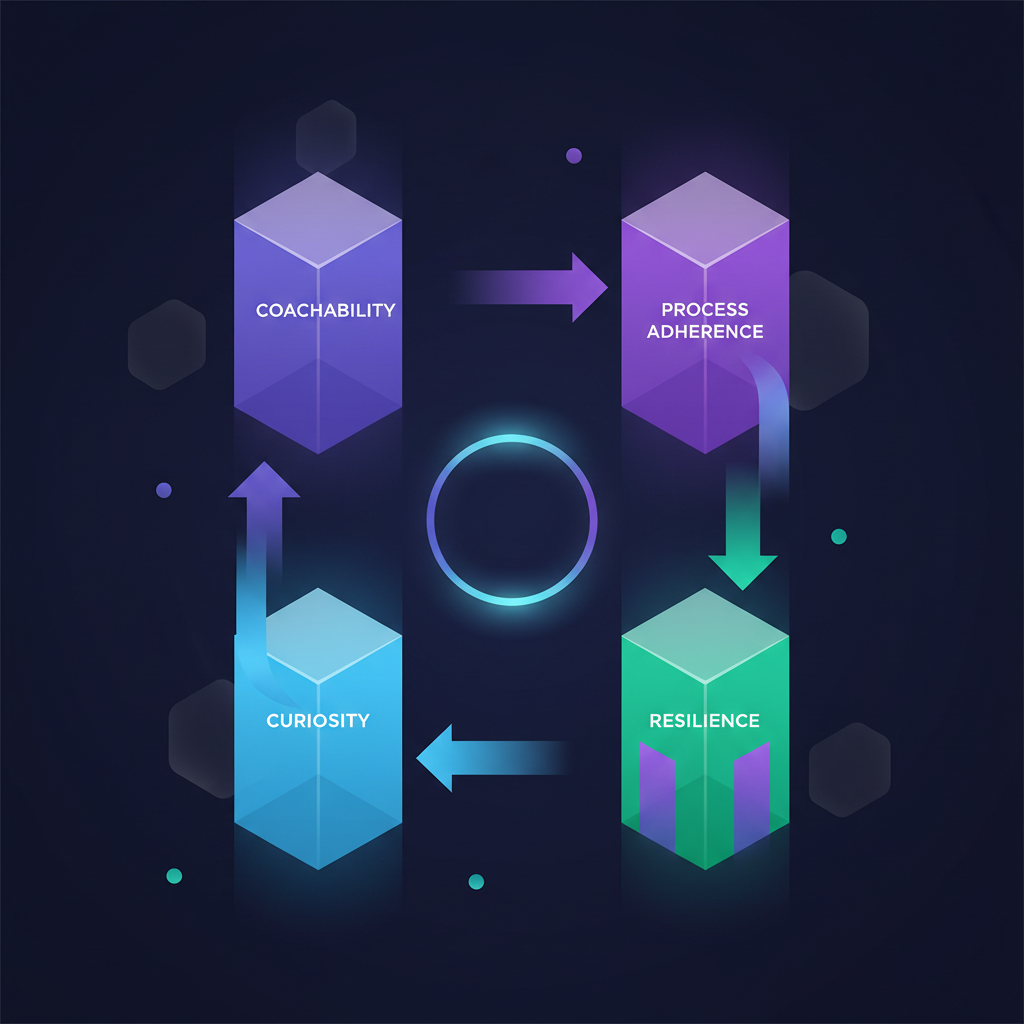
Here's what separates quota-crushers from chronic underperformers:
1. Coachability
Can the rep accept feedback, adapt their approach, and improve in real time?
A Harvard Business Review study found that the best sales managers are coaches, and the best reps are coachable. Coachability is the single strongest predictor of ramp speed and long-term quota attainment.
How to test it: Run a live role-play scenario (cold call or objection handling). Give one piece of specific feedback. Run the scenario again. If the rep adjusts their tonality, pacing, or script structure, they're coachable. If they defend their original approach or ignore the input, they won't scale.
We cover exactly how to structure this in role-play under pressure.
2. Process adherence
Does the rep follow a structured approach, or do they wing it?
Reps who follow a call framework (opening, discovery, objection handling, close) hit quota 40% more often than those who "go with the flow." Process adherence is trainable, but only if the candidate respects structure in the first place.
How to test it: Ask, "Walk me through your last discovery call, step by step." Listen for:
- Did they prepare? (Research, hypothesis, questions pre-written)
- Did they follow a sequence? (Intro → permission → questions → recap)
- Did they document outcomes and next steps?
Vague answers ("I just asked what they needed") signal a rep who will ignore your playbook.
3. Curiosity
Does the rep ask follow-up questions, or do they pitch?
Curious reps uncover pain. Pitchers get ghosted. In our AI role-play scenarios, reps who ask "Why is that a priority now?" or "What happens if you don't solve this?" book 2x more meetings than reps who jump straight to features.
How to test it: In your role-play, play a prospect who gives a surface-level answer ("We're looking to improve efficiency"). See if the rep digs deeper or pivots to a demo. Curiosity can't be taught—either they care about the buyer's world, or they don't.
4. Resilience
How does the rep respond to rejection, pushback, or a bad week?
Sales is rejection at scale. Reps who internalise "no" as personal failure burn out in six months. Reps who treat "no" as data ("What could I have done differently?") improve every quarter.
How to test it: Ask, "Tell me about a quarter where you missed quota. What happened, and what did you change?" Listen for accountability vs. blame. If they finger-point (bad leads, bad territory, bad manager), they'll do it again on your team.
The interview structure: What to ask and when

A structured interview eliminates bias and surfaces the four traits above. Here's the exact sequence:
Stage 1: Screening call (15 minutes)
Goal: Confirm baseline qualifications and filter out obvious mis-fits.
Questions:
- "Walk me through your current sales process, from prospecting to close."
- "What's your quota, and where are you tracking this quarter?"
- "Why are you looking to leave your current role?"
What you're listening for: Process fluency (do they know their own numbers?), accountability (do they own their results?), and alignment (are they running from a problem or toward an opportunity?).
Stage 2: Role-play interview (45 minutes)
Goal: Observe coachability, process adherence, and curiosity under live conditions.
Structure:
- Cold call scenario (10 minutes): You play a prospect. The rep cold-calls you. Use a realistic objection ("We're happy with our current vendor").
- Feedback + re-run (10 minutes): Give one specific piece of coaching (e.g., "Slow your pacing by 20% and pause after your opening question"). Run the scenario again. Did they adapt?
- Discovery scenario (10 minutes): You play a prospect with a hidden pain point. See if the rep digs deep enough to uncover it.
- Debrief (15 minutes): Ask, "What would you do differently?" and "What did you notice about my tonality/body language?"
This is the highest-signal hour of the entire hiring process. If you skip it, you're hiring blind.
For teams hiring at scale, we recommend using an AI role-play platform to run these scenarios asynchronously, then review recordings with a scorecard. It cuts interview time by 60% and eliminates scheduling friction.
Stage 3: Values + situational interview (30 minutes)
Goal: Assess resilience, culture alignment, and situational judgment.
Questions:
- "Tell me about a time you lost a deal you thought you'd win. What did you learn?"
- "Describe a situation where you disagreed with your manager's coaching. How did you handle it?"
- "You're at 60% of quota with two weeks left in the quarter. Walk me through your plan."
What you're listening for: Ownership, adaptability, and whether they problem-solve or panic.
Stage 4: Reference checks (don't skip this)
Ask former managers:
- "On a scale of 1–10, how coachable was [candidate]?"
- "Would you hire them again?"
- "What's one area where they struggled, and how did they respond to feedback?"
References rarely tank a hire, but they often confirm a red flag you saw in the interview.
The onboarding plan that compresses ramp time
Hiring is half the equation. Onboarding determines whether your new rep hits 100% quota in 90 days or limps along at 40% for six months.
Here's the structure we see working:
Days 1–30: Product + process certification
Goal: Rep can explain your product, your ICP, and your sales process without hesitation.
Tactics:
- Assign five customer case studies. Rep presents one per week.
- Shadow ten live calls (discovery, demo, objection handling, close).
- Complete 20 AI role-play scenarios covering your top objections and discovery questions.
- Certify on product knowledge (written test or live pitch to the team).
Reps who complete this phase with confidence ramp 40% faster. Reps who skip it and "learn on the job" stay at 50% quota for months.
For a full onboarding framework, see our guide to onboarding new sales managers.
Days 31–60: Shadowing + reverse shadowing
Goal: Rep runs live calls with a safety net.
Tactics:
- Rep shadows five more calls, but this time they take notes and run the debrief ("Here's what I would have done differently").
- Reverse shadow: Rep runs the call, manager observes and coaches immediately after.
- Rep carries 50% quota (smaller accounts, shorter sales cycles).
This is where coaching accountability becomes critical. Weekly 1:1s should focus on one skill per week (e.g., tonality, objection handling, discovery pacing), not vague "how's it going?" check-ins.
Days 61–90: Full quota, full autonomy
Goal: Rep operates independently and hits 80–100% of quota.
Tactics:
- Rep carries 100% quota.
- Manager reviews two calls per week (live or recorded).
- Rep completes one role-play scenario per week to sharpen a specific skill.
By day 90, the rep should be self-sufficient. If they're still struggling, revisit the four hiring traits—did you miss a red flag?
For more on accelerating quota attainment, see our breakdown of quota attainment levers.
Common sales leadership hiring mistakes (and how to avoid them)
Mistake 1: Hiring on "culture fit"
"Culture fit" is code for "I liked them." It introduces bias and screens out diverse candidates who would thrive.
Fix: Replace "culture fit" with "values alignment." Define three core values (e.g., accountability, curiosity, resilience) and score every candidate against them using a structured rubric.
Mistake 2: Skipping role-play because "it feels awkward"
Role-play is awkward. So is missing quota because you hired a rep who can't handle objections.
Fix: Make role-play non-negotiable. If a candidate refuses or performs poorly, that's your answer.
Mistake 3: Over-indexing on industry experience
A rep who sold SaaS in fintech won't automatically crush it selling SaaS in healthcare. Industry knowledge is table stakes; process and coachability are differentiators.
Fix: Hire for skills (discovery, objection handling, follow-up discipline), not résumé keywords.
Mistake 4: Rushing onboarding to "get them dialing"
Reps who start cold-calling on day three without product knowledge or process training build bad habits that take months to unlearn.
Fix: Invest 30 days in structured onboarding. The reps who ramp slowly at first will outperform the "thrown in the deep end" hires by quarter two.
How AI role-play accelerates sales leadership hiring and onboarding
Traditional hiring and onboarding are slow, subjective, and hard to scale. AI changes that.
Here's how we see sales leaders using AI role-play to compress timelines and improve consistency:
In hiring: Async role-play assessments
Instead of scheduling five 45-minute role-play interviews, send candidates a link to complete three scenarios on their own time (cold call, objection handling, discovery). Review the recordings with a scorecard. This cuts scheduling friction by 80% and gives you a comparable performance sample across all candidates.
In onboarding: Unlimited practice reps
New hires can run 50 role-play scenarios in their first 30 days—more reps than they'd get in six months of live calls. They build muscle memory for tonality, pacing, objection handling, and discovery frameworks before they ever talk to a real prospect.
For a deeper look at how this works, see our guide to the sales management framework and how AI fits into it.
In coaching: Objective feedback at scale
Managers can't listen to every call. AI can. It flags objection-handling mistakes, tonality issues, and pacing problems in real time, so your coaching sessions focus on high-leverage fixes instead of vague advice.
Salesforce sales hiring best practices emphasise the importance of data-driven hiring and onboarding. AI role-play gives you that data without the manual overhead.
FAQ
What is the most important trait to assess in sales leadership hiring?
Coachability. A rep's willingness to accept feedback, adapt their approach, and role-play scenarios predicts quota attainment better than years of experience or charisma. Test it with live role-play in the interview process.
How long should sales rep onboarding take?
Plan for 30-60-90 days depending on deal complexity. Reps should complete product certification by day 30, shadow live calls by day 45, and carry 50% quota by day 60. Compress timelines with AI role-play to build muscle memory faster.
Should I hire for experience or potential in sales roles?
Hire for process adherence and coachability first. A rep with two years of disciplined prospecting will outperform a ten-year veteran who wings every call. Use structured interviews and role-play to measure both.
What's the biggest mistake in sales hiring?
Skipping live role-play. Résumés and charm predict nothing. A 15-minute cold-call simulation reveals objection handling, tonality, pacing, and whether the candidate actually listens—skills that determine 80% of quota attainment.
Sources

Stefano Sechi
Co-founder, QUOTA Training
Stefano Sechi is co-founder of QUOTA Training. He works hands-on with B2B sales teams on cold calling, discovery and objection handling, and shaped much of the methodology behind QUOTA’s AI role-play scenarios.
Turn this into reps, not just reading
QUOTA Training lets your team practise these exact scenarios with an AI buyer that reacts like the real thing — then scores every call.
See it in action