Cold Call Pacing: Control Tempo to Win More Meetings
Part of the Cold Calling guide: The Complete Cold Calling Guide for 2026: Master Every CallMaster cold call pacing to book more meetings. Learn how speech tempo, pause placement, and rhythm control buyer engagement and overcome objections.

Key takeaways
- Cold call pacing—your words-per-minute rate and pause placement—directly impacts prospect engagement: reps who rush their opening (170+ WPM) trigger fight-or-flight responses, while those who pace at 140-160 WPM during the first 15 seconds book 34% more meetings in QUOTA role-play sessions.
- Strategic pauses of 1.5-2 seconds after your opening statement and after questions force cognitive engagement: silence creates discomfort that prospects fill by answering rather than deflecting, and prevents you from talking past objections you haven't heard yet.
- Effective cold callers shift between three pacing gears—opening (140-160 WPM), value delivery (120-140 WPM), and objection response (160-180 WPM): monotone tempo signals script-reading, while deliberate tempo shifts communicate confidence and adaptability.
- Rushed pacing correlates with lower trust and higher objection rates: when reps speak faster than 170 WPM, prospects perceive pressure and disengage, but slowing below 110 WPM during key moments sounds uncertain and kills momentum.
- AI role-play provides the only scalable way to train pacing at the rep level: managers can't sit on every call, but AI analyzes words-per-minute, pause frequency, and tempo variance in real time, giving reps instant feedback they can act on in the next practice round.
Cold call pacing is the least discussed and most impactful variable in outbound success. You can have a perfect cold calling script, flawless tonality, and a compelling value prop—but if your tempo is wrong, prospects will disengage before you finish your second sentence.
Pacing isn't about speaking slowly. It's about controlling the rhythm of the conversation so prospects can process, engage, and respond instead of reflexively objecting or hanging up. Most reps either race through their opening out of nervousness or drone at a monotone pace that signals they're reading. Both kill meetings.
In this guide, you'll learn the exact words-per-minute benchmarks that drive engagement, how to shift between pacing gears based on call stage, where to place pauses for maximum impact, and how to train reps to master tempo without relying on manager ride-alongs. This is part of The Complete Cold Calling Guide for 2026, where we cover every lever that separates reps who book meetings from those who get hung up on.
Why cold call pacing determines meeting conversion

Cold calls are cognitively expensive for prospects. They're interrupted by a stranger, asked to process unfamiliar information, and expected to make a decision in seconds. Your pacing determines whether their brain can keep up or shuts down.
Research on speech rate and comprehension shows that listeners retain significantly less information when speakers exceed 160 words per minute in high-stakes or unfamiliar contexts. On a cold call, you're both unfamiliar and high-stakes. When reps rush, prospects hear noise, not value.
But pacing isn't just about comprehension—it's about signaling confidence and control. Rushed speech triggers the prospect's fight-or-flight response. It sounds like you're nervous, unsure, or trying to sneak past their defenses. Slow, deliberate pacing signals that you belong on the call, that you have something worth their time, and that you're not rattled by silence.
In QUOTA's AI role-play sessions, we track words-per-minute and pause frequency across thousands of simulated cold calls. Reps who pace their opening at 140-160 WPM and insert a 1.5-2 second pause after their positioning statement book meetings at a 34% higher rate than those who exceed 170 WPM or drop below 120 WPM. The difference isn't script quality—it's tempo control.
Pacing also determines when and how objections surface. Reps who rush through their pitch don't leave cognitive space for the prospect to object during the pitch—so objections explode at the end, often in the form of "I'm not interested" or a hang-up. Reps who pace deliberately and pause strategically surface objections earlier, when they're easier to address. This is why objection handling timing and pacing are inseparable skills.
The three pacing gears every cold caller needs
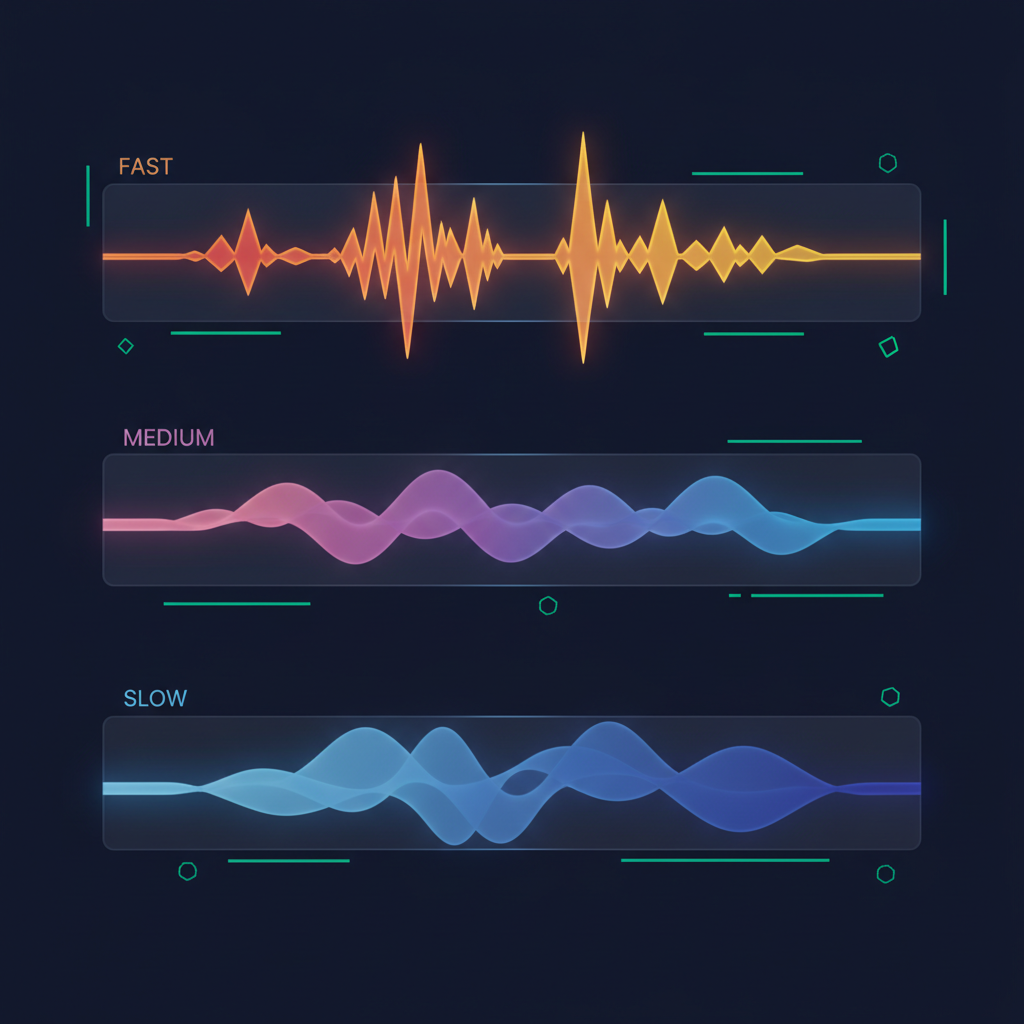
Monotone pacing—speaking at the same tempo for the entire call—is the hallmark of script-reading. Effective cold callers shift deliberately between three pacing gears based on call stage and prospect response.
Gear 1: Opening (140-160 WPM)
Your opening 10-15 seconds set the tone for the entire call. This is where you establish that you're confident, prepared, and worth listening to. Pace at 140-160 words per minute—slightly slower than normal conversation (150-160 WPM)—and insert a 1.5-2 second pause after your positioning statement.
Example:
"Hey Sarah, this is Alex from QUOTA Training. We help SDR teams cut ramp time in half using AI role-play that simulates real objections. [pause 2 seconds] Quick question—are you currently running any formal objection-handling training for your team?"
The pause after your positioning statement forces the prospect to process what you said instead of reflexively objecting. It also gives you a moment to listen for micro-signals—did their tone shift? Did they take a breath to respond?—that tell you whether to proceed or pivot.
Most reps blow through this moment at 180+ WPM because they're nervous. The result: prospects hear a wall of sound and disengage. Your cold call preparation checklist should include a tempo target for your opening.
Gear 2: Value delivery and questions (120-140 WPM)
Once you've earned a few seconds of attention, slow down to 120-140 WPM when delivering your value statement or asking discovery questions. This is where you need the prospect to think, not just hear.
Example:
"Most teams we work with see reps freeze when they hit budget or timing objections—because they've never practiced those scenarios in a safe environment. [pause 1.5 seconds] Does that sound familiar on your team?"
Slowing down here signals that you're asking a real question, not delivering a pitch disguised as a question. It also gives the prospect cognitive space to access their actual experience instead of defaulting to "we're all set."
This is also the gear you use when navigating cold call gatekeepers. Rushing past a gatekeeper signals you're trying to sneak through. Pacing at 130 WPM and pausing after your request signals you're a peer making a reasonable ask.
Gear 3: Objection response (160-180 WPM)
When a prospect objects, many reps slow down out of uncertainty. This kills momentum. Instead, speed up slightly to 160-180 WPM when addressing objections—not to rush past them, but to signal confidence and energy.
Example (responding to "We're all set"):
"Totally understand—most teams we talk to have something in place. The reason I called is that we're seeing a pattern where reps can handle objections on demo calls but freeze on cold calls, because the pressure's different. [pause 1 second] Have you noticed that gap on your team?"
The faster tempo communicates that you've heard this objection before, you're not rattled, and you have a relevant response. Then you slow back down to Gear 2 (120-140 WPM) when you ask your follow-up question, signaling that you're back in discovery mode.
This tempo shift is one of the cold call confidence techniques that separates experienced reps from beginners. Beginners use the same monotone pace regardless of call stage. Experienced reps modulate tempo to control the emotional arc of the conversation.
Where to place pauses for maximum impact
Pauses are the most underutilized tool in cold calling. Most reps are terrified of silence, so they fill every gap with words. But strategic silence is what forces prospects to engage.
After your opening statement (1.5-2 seconds)
This is non-negotiable. After you deliver your positioning statement, stop talking. Count to two in your head. This pause does three things:
- Prevents you from talking past the prospect's cognitive capacity. They need a moment to process who you are and why you're calling.
- Forces them to respond instead of waiting for you to finish. Silence creates discomfort. Prospects fill it by answering or objecting—both of which are better than passively waiting for you to hang up.
- Signals confidence. Only nervous reps are afraid of silence.
In QUOTA role-play sessions, reps who pause for 1.5-2 seconds after their opening get a verbal response 68% of the time, compared to 41% for reps who continue talking immediately.
After asking a question (1.5-2 seconds minimum)
When you ask a discovery question, wait. Most reps ask a question and then immediately rephrase it or add context because they're uncomfortable with silence. This trains the prospect to wait you out—they learn that if they stay quiet, you'll keep talking and eventually answer your own question.
Example of what not to do:
"Are you currently running any objection-handling training? I'm asking because most teams we work with have something informal but nothing structured, and that's usually where we can help—does that resonate?"
You just asked three questions and answered the first one yourself. The prospect has no reason to engage.
Instead:
"Are you currently running any objection-handling training for your team? [pause 2 seconds, wait for response]"
If they don't answer immediately, wait another second. If they still don't answer, then you can add context—but make them fill the silence first.
After delivering a piece of value or insight (1 second)
When you share a relevant insight or pattern, pause briefly to let it land:
"We're seeing a pattern where reps can handle objections on demo calls but freeze on cold calls, because the pressure's different. [pause 1 second] Have you noticed that gap?"
The one-second pause signals "that was important—process it before I move on." Without the pause, insights blur into the rest of your pitch.
When you hear a verbal cue that the prospect is thinking (2-3 seconds)
If the prospect says "Hmm" or "Interesting" or takes a breath, stop talking and let them think. These are signals that they're processing. If you fill the silence, you interrupt their thought process and lose the engagement you just earned.
This is where AI role-play for sales training becomes invaluable. AI can simulate these micro-moments—pauses, verbal cues, tone shifts—and train reps to recognize and respond to them in real time, something that's impossible to practice at scale with human role-play partners.
How to diagnose and fix pacing problems in your team
Most sales managers can hear when a rep's pacing is off, but they struggle to diagnose the specific problem or coach the fix. Here's how to break it down.
Problem 1: Rushed opening (170+ WPM)
Symptom: Prospects say "I'm not interested" or hang up within 10 seconds. The rep sounds nervous or like they're reading.
Root cause: The rep is trying to "get through" the opening instead of delivering it with confidence. This usually stems from call reluctance or lack of preparation.
Fix: Record the rep delivering their opening at three different speeds—fast (170+ WPM), medium (140-160 WPM), and slow (120-130 WPM). Play them back and ask which one sounds most confident. Then have them practice the medium tempo in AI role-play until it feels natural. Most reps are shocked at how slow 150 WPM feels—but that's the target.
Problem 2: Monotone pacing (no tempo shifts)
Symptom: Prospects disengage mid-call. The rep sounds robotic or scripted, even if the script is good.
Root cause: The rep is focused on what to say, not how to say it. They're not modulating tempo based on call stage.
Fix: Teach the three-gear framework (opening, value delivery, objection response) and have the rep mark their script with tempo cues: "OPEN 150 WPM," "SLOW 130 WPM," "SPEED UP 170 WPM." Then drill the same script at different tempos in AI role-play. The goal is to make tempo shifts automatic, not something they have to think about on live calls.
Problem 3: No pauses (filling every silence)
Symptom: The rep asks questions but doesn't get answers. Prospects wait for the rep to finish talking and then object or hang up.
Root cause: Fear of silence. The rep believes that if they stop talking, they'll lose control of the call.
Fix: Run a role-play where the rep is required to pause for two full seconds after every question. Use a timer. This feels excruciating at first, but it rewires their instinct. After five reps, the pause starts to feel natural. Then move to AI role-play, where the platform can flag instances where the rep didn't pause long enough.
Problem 4: Slowing down during objections (110-120 WPM)
Symptom: When prospects object, the rep sounds uncertain or defensive. Objections turn into dead ends instead of pivots.
Root cause: The rep interprets objections as rejection and loses confidence, which manifests as slower, hesitant speech.
Fix: Drill objection responses at 160-170 WPM until the rep can deliver them with energy and certainty. The faster tempo forces them out of "apologizing" mode and into "addressing" mode. Pair this with objection handling timing training so they know when to speed up and when to slow back down.
How AI role-play trains pacing at scale
Pacing is nearly impossible to train with traditional methods. Managers can't sit on every call, and even when they do, they can't give real-time feedback on words-per-minute or pause frequency. Human role-play partners can't simulate the pressure of a real cold call, so reps practice at an artificial tempo that doesn't transfer to live calls.
AI role-play solves this. Platforms like QUOTA Training analyze speech in real time, tracking:
- Words-per-minute by call stage: Is the rep rushing their opening? Droning during discovery? Slowing down during objections?
- Pause frequency and duration: Did the rep pause after their opening statement? After their question? For how long?
- Tempo variance: Is the rep modulating their pace, or speaking at a monotone tempo?
Reps get instant feedback: "Your opening was 178 WPM—target is 140-160. Try again and slow down by 15%." Then they re-run the same scenario immediately, at the correct tempo, until it becomes muscle memory.
This is the same feedback loop that elite athletes use—immediate, specific, repeatable. It's why AI sales training personalization drives faster skill acquisition than manager-led coaching alone. Managers provide strategy and context; AI provides the reps needed to internalize technique.
AI also removes the social cost of practicing pacing. Reps won't ask a manager to sit through 20 reps of the same opening at different tempos—but they'll do it with AI, because there's no judgment and no wasted time.
Pacing mistakes that kill cold calls (and how to avoid them)
Even experienced reps make pacing errors that tank their conversion rates. Here are the most common.
Mistake 1: Matching the prospect's pace too closely
The error: The prospect speaks quickly, so the rep speeds up to match. Or the prospect speaks slowly, so the rep slows down.
Why it fails: Mirroring pace can work in rapport-building contexts, but on cold calls it often backfires. If the prospect is speaking quickly because they're annoyed or busy, matching that pace makes you sound frantic. If they're speaking slowly because they're distracted, matching that pace makes you sound uncertain.
The fix: Mirror the prospect's energy level, not their exact pace. If they're high-energy, increase your tempo by 10-15% but stay within the 140-160 WPM range during key moments. If they're low-energy, slow down slightly but maintain enough tempo to drive momentum.
Mistake 2: Speeding up when you hear skepticism
The error: The prospect says "I'm not sure this is relevant" or "We already have something," and the rep speeds up, trying to cram more value into the call before they get hung up on.
Why it fails: Rushing past skepticism signals desperation. It confirms the prospect's instinct that you don't have anything worth their time.
The fix: When you hear skepticism, slow down. Drop to 120-130 WPM, pause, and ask a clarifying question: "Got it—can I ask what you're currently using?" Slowing down signals that you're listening, not pitching.
Mistake 3: Using the same pacing on every call
The error: The rep finds a tempo that works and uses it on every call, regardless of prospect persona, call stage, or response.
Why it fails: Different prospects require different pacing. A busy VP needs a faster opening (150-160 WPM) to signal you won't waste their time. A director who's engaged in discovery needs a slower pace (120-130 WPM) so they can think through your questions.
The fix: Build pacing flexibility into your cold call preparation checklist. Before each call, decide: Is this a "fast open, slow discovery" call or a "medium open, fast objection response" call? Then adjust your tempo accordingly.
Training exercises to build pacing mastery
Pacing is a motor skill, not a knowledge gap. Reps won't improve by reading about it—they need deliberate practice. Here are three drills that work.
Exercise 1: The metronome drill
Set a metronome to 140 beats per minute (roughly 140 words per minute if you speak one syllable per beat). Have the rep deliver their opening in sync with the metronome. Then move to 160 BPM, then 120 BPM. This trains their internal sense of tempo so they can hit a target pace without thinking about it.
Run this drill for five minutes a day for a week. By day seven, most reps can hit 150 WPM +/- 10 WPM without the metronome.
Exercise 2: The pause timer drill
Record the rep delivering their full cold call script. Then play it back and time every pause. Mark each one: 0.5 seconds, 1 second, 1.5 seconds, etc. Most reps are shocked to discover they're pausing for 0.3 seconds or less—not long enough to create engagement.
Then have them re-record the script with a requirement: every pause must be at least 1.5 seconds. Use a timer. This rewires their instinct to fill silence.
Exercise 3: The gear-shift drill
Mark the rep's script with three colors: green for Gear 1 (opening, 140-160 WPM), blue for Gear 2 (discovery, 120-140 WPM), and red for Gear 3 (objection response, 160-180 WPM). Then have them deliver the script, shifting tempo at each color change.
Record it and play it back. Can you hear the gear shifts? If not, the tempo variance isn't wide enough. Most reps need to exaggerate the shifts at first—slowing down more than feels natural, speeding up more than feels comfortable—before the modulation becomes automatic.
Run this drill in AI role-play so the platform can flag moments where the rep stayed in the wrong gear.
FAQ
What is the ideal words-per-minute rate for cold calls?
The ideal cold call pacing is 140-160 words per minute during your opening, slowing to 120-140 during value delivery and question-asking. This is slightly slower than normal conversation (150-160 WPM) and allows prospects to process unfamiliar information from a stranger.
How do pauses improve cold call outcomes?
Strategic pauses of 1.5-2 seconds after your opening statement and after questions force prospects to engage, prevent them from interrupting with reflexive objections, and signal confidence. Pauses also give you time to listen for micro-signals like tone shifts or breathing changes.
Should I match my prospect's speaking pace on cold calls?
Partial mirroring works best. If your prospect speaks very quickly, increase your pace by 10-15% but stay within the 140-160 WPM range during key moments. Complete matching can feel inauthentic; instead, mirror their energy level while maintaining controlled pacing.
How can AI help reps improve cold call pacing?
AI role-play platforms analyze words-per-minute, pause frequency, and tempo variance in real time, flagging rushed openings or monotone delivery. Reps can practice the same scenario at different pacing levels and receive instant feedback on which tempo drives engagement.
Can pacing alone fix a weak cold call script?
No. Pacing amplifies script quality—it can't compensate for a script that lacks relevance or value. But even a strong script will fail if delivered at the wrong tempo. Focus on both: build a script that resonates, then train your team to deliver it at a pace that allows prospects to engage. Pair your cold calling scripts with deliberate pacing practice for maximum impact.
Cold call pacing isn't a soft skill—it's a measurable, trainable lever that determines whether prospects engage or disengage in the first 15 seconds. Master the three gears, place pauses strategically, and use AI role-play to build the muscle memory that transfers to live calls. When your team controls tempo, they control the conversation—and that's what turns cold calls into meetings.
Sources

Stefano Sechi
Co-founder, QUOTA Training
Stefano Sechi is co-founder of QUOTA Training. He works hands-on with B2B sales teams on cold calling, discovery and objection handling, and shaped much of the methodology behind QUOTA’s AI role-play scenarios.
Turn this into reps, not just reading
QUOTA Training lets your team practise these exact scenarios with an AI buyer that reacts like the real thing — then scores every call.
See it in action