Cold Call Follow-Up Strategy: Turn No-Answers Into Meetings
Part of the Cold Calling guide: The Complete Cold Calling Guide for 2026: Master Every CallMost reps quit after three dials. Learn the exact cold call follow-up strategy that turns no-answers into booked meetings—timing, cadence, and what to say.

Key takeaways
- Most reps quit too early: 44% of salespeople give up after one follow-up, yet 80% of sales require five or more touches—your cold call follow-up strategy determines whether you're in the 44% or the 20% who win.
- No-answers aren't rejections: A prospect who doesn't pick up is simply unavailable; the optimal cold call follow-up cadence includes 8-12 touches over 3-4 weeks, varying time-of-day and channel.
- Strategic voicemail placement: Leave voicemails only on attempts 1, 4, and 8 to maintain presence without creating fatigue, and change your value proposition in each one.
- Multi-channel amplification: Phone-only sequences convert at 3-5%, but adding email and LinkedIn touches to your cold call follow-up strategy increases meeting-set rates by 2-3x.
- Timing windows matter: Call the same prospect at different times (morning, lunch, late afternoon) across different days to maximize connection probability—most reps fail by calling the same time repeatedly.
Why Most Cold Call Follow-Up Strategies Fail
According to Salesforce research on follow-up persistence, 80% of sales require five follow-up calls after the initial contact, yet 44% of salespeople give up after just one attempt. That gap represents millions in lost pipeline.
The problem isn't effort—it's strategy. In our AI role-play sessions at QUOTA, we see three recurring mistakes that kill cold call follow-up effectiveness:
Mistake #1: Treating no-answers as rejection. A prospect who doesn't pick up hasn't said no. They're in a meeting, on another call, or away from their desk. Yet reps internalize each no-answer as a loss and reduce their persistence accordingly.
Mistake #2: Repeating the same pattern. Calling every Tuesday at 10 AM guarantees you'll catch the same weekly team meeting every time. Reps who vary their contact times across different days and dayparts connect 40-60% more often.
Mistake #3: Going phone-only. Gong's cold calling research shows that multi-channel sequences (phone + email + LinkedIn) convert 2-3x better than phone-alone approaches, yet most SDRs still treat cold calling as a siloed activity.
Your cold call follow-up strategy must solve for all three: persistence without desperation, pattern variation, and channel integration.
The 8-12 Touch Cold Call Follow-Up Framework
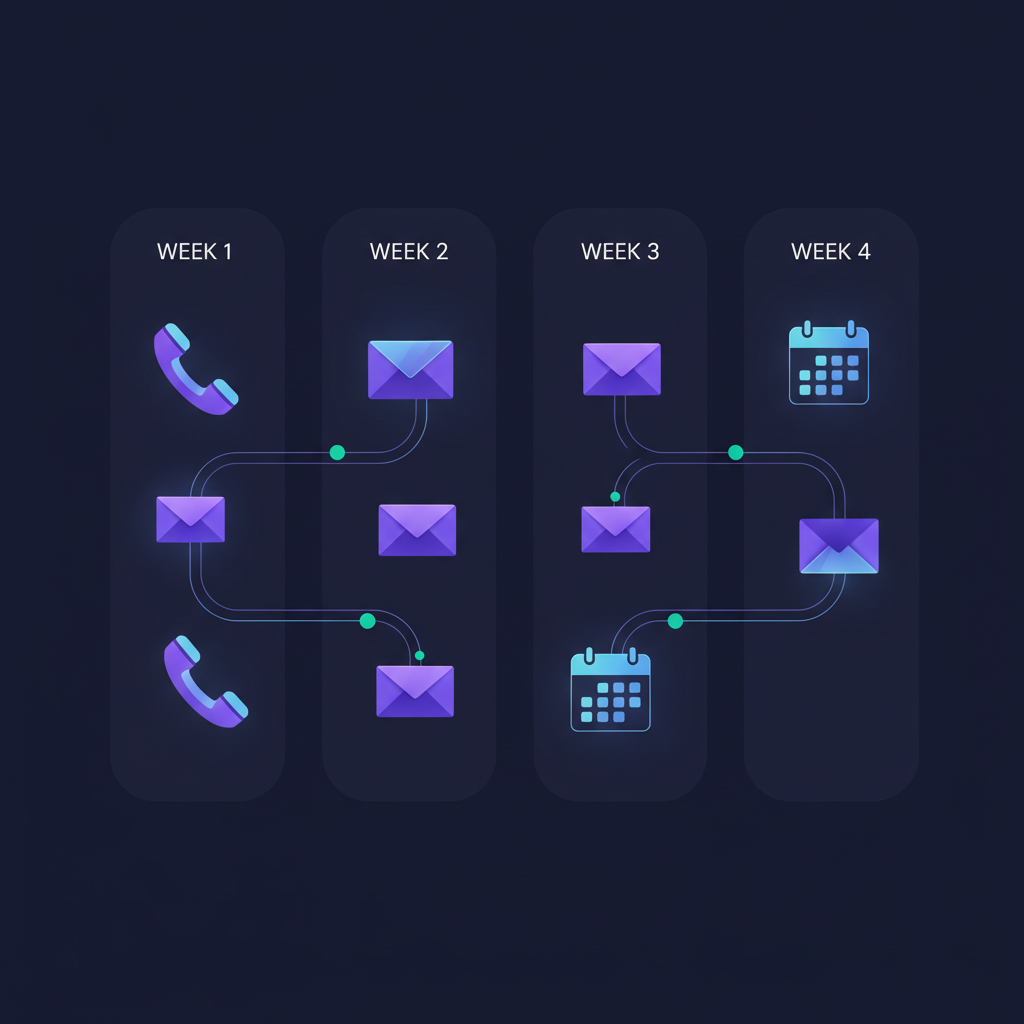
Here's the exact sequence we teach—and test—in QUOTA role-play scenarios. This framework assumes you're working a list of qualified accounts where you have a legitimate reason to reach the prospect.
Touches 1-3: Establish Presence (Days 1-2)
Touch 1 (Day 1, Morning): Initial cold call. If no answer, leave a 20-second voicemail that states who you are, why you're calling (specific to their role or company), and when you'll try again. Example: "Hi [Name], this is [Your Name] from [Company]. I work with [similar companies in their vertical] on [specific outcome]. I'll try you again this afternoon—or call me back at [number]."
Touch 2 (Day 1, 4-6 hours later): Second call attempt, different time of day. No voicemail. If you reach them, reference your earlier message briefly: "I left you a message this morning about [outcome]—do you have two minutes?"
Touch 3 (Day 2, Morning): Email follow-up. Under 75 words. Reference your call attempts, lead with value, ask one question. Tie it to a business trigger if possible (funding, hiring, news). See our guide on email prospecting tactics for templates.
Touches 4-6: Build Multi-Channel Presence (Days 3-7)
Touch 4 (Day 3, Afternoon): Third call attempt. Leave a second voicemail with different value. If your first voicemail mentioned a capability, this one should reference a customer outcome or insight. "Hi [Name], [Your Name] again. I wanted to share something I noticed about [their company]—[specific observation]. Worth a quick conversation. [Number]."
Touch 5 (Day 5, Morning): LinkedIn connection request with a short note (under 200 characters). Don't pitch—offer value or reference a mutual connection or shared interest.
Touch 6 (Day 7, Late Afternoon): Fourth call attempt. No voicemail. Different time window to test availability patterns.
Touches 7-9: Persistence with New Angles (Days 10-17)
Touch 7 (Day 10, Morning): Email #2. Different angle: share a piece of content (case study, benchmark data, insight) relevant to their role. One-sentence setup, link, one-sentence question.
Touch 8 (Day 12, Midday): Fifth call attempt. Leave your third and final voicemail. Make it a "break-up" message with a question: "Hi [Name], I've tried a few times to connect about [outcome]. I don't want to be a pest—if this isn't a priority right now, just let me know. Otherwise, I'd love five minutes to share [specific value]. [Number]."
Touch 9 (Day 14, Afternoon): LinkedIn engagement. Comment meaningfully on one of their posts or share an article and tag them.
Touches 10-12: Final Sequence (Days 18-28)
Touch 10 (Day 18, Morning): Sixth call attempt. No voicemail. If you connect, acknowledge the persistence with humor: "I know I've been trying to reach you—appreciate you picking up."
Touch 11 (Day 21, Morning): Email #3. Ultra-short. "Hi [Name]—still interested in discussing [outcome]? Yes or no is fine—just want to respect your time." A yes/no question lowers friction and often gets a response even if it's "not now."
Touch 12 (Day 28, Afternoon): Final call attempt. Leave it open-ended: "Last time I'll bug you for now, but if [business trigger or outcome] becomes a priority in the next quarter, I'm here."
This is the baseline. For high-value accounts, extend to 15-20 touches over two months. For lower-fit prospects, compress to 6-8 touches over two weeks.
Timing and Cadence: When to Follow Up on Cold Calls
Timing isn't just about speed—it's about variation. Here's what works, based on connection-rate data from thousands of QUOTA role-play sessions and real-world SDR activity:
Same-day follow-up: If you call at 9 AM and get no answer, your second attempt should be 4-6 hours later (early afternoon). This catches prospects returning from lunch or finishing meetings. Don't wait until the next day for touch #2.
Day-of-week variation: If your first call is Tuesday, make your next attempts Thursday and Monday. Avoid calling the same day of the week at the same time—you'll hit the same recurring meetings.
Time-of-day windows: Rotate through these windows across your sequence:
- Early morning (8:00-9:30 AM local time)
- Late morning (11:00 AM-12:00 PM)
- Early afternoon (1:00-2:30 PM)
- Late afternoon (4:00-5:30 PM)
Post-voicemail wait time: After leaving a voicemail, wait 24-48 hours before your next call. This gives them time to respond without feeling hounded.
Email-to-call spacing: Send an email in the morning, call in the afternoon of the same day or the next morning. The email warms them up; the call capitalizes on recognition.
For detailed guidance on controlling tempo during the actual conversation, see our article on cold call pacing.
What to Say on Each Follow-Up Attempt

Your messaging must evolve across the sequence. Repeating the same pitch signals you have nothing new to offer. Here's how to vary your approach:
Follow-Up Calls 2-3: Acknowledge and Compress
When you reach them after previous attempts, acknowledge it briefly without apologizing: "Hi [Name], I tried you yesterday—do you have two minutes to discuss [outcome]?"
Compress your pitch. They're surprised you caught them, so you have less patience budget than on a first call. Lead with the outcome, not your process: "We help [companies like theirs] [achieve specific result]. Worth a quick conversation?"
Follow-Up Calls 4-6: New Value Each Time
Each voicemail and live conversation should introduce a different piece of value:
- Call 1: Your core capability
- Call 4 voicemail: A customer outcome or case study result
- Call 6 (if live): A specific observation about their company or market
- Call 8 voicemail: A question that reframes the conversation
Example of a reframing question: "Hi [Name], most [their role] we work with are trying to solve [common pain]. If that's not you, no worries—but if it is, I have a framework that's worked for [similar company]. Worth five minutes?"
Follow-Up Emails: Shorter and More Specific
Each email should be shorter than the last and more specific:
- Email 1 (Touch 3): 60-75 words, reference your call, state value, ask one question
- Email 2 (Touch 7): 40-50 words, share one piece of content, ask if it's relevant
- Email 3 (Touch 11): 20-30 words, yes/no question
Never write "just checking in" or "circling back." Every message must contain new value or a new angle.
For scripting inspiration, review our library of cold calling scripts that work across different industries and buyer personas.
Multi-Channel Integration: Phone + Email + LinkedIn
A cold call follow-up strategy that lives only in the dialer is half as effective as one that spans channels. Here's how to integrate:
Phone as the primary channel: Your goal is a live conversation, so the phone remains your main tool. Calls should represent 50-60% of your total touches.
Email as the credibility builder: Emails give prospects something to review on their own time and establish that you're a real person with real value. Use email to share content, reference insights, and lower friction with yes/no questions.
LinkedIn as the relationship warmer: A connection request, a comment on their post, or a share of relevant content makes you a familiar name when they finally see your number on caller ID.
Sequencing across channels: A strong pattern is Call → Email (same day) → Call → LinkedIn → Call → Email → Call. This creates multiple impressions without overwhelming any single channel.
In QUOTA simulations, reps who practice multi-channel messaging—not just phone scripts—book 35-40% more meetings because they're prepared for the full conversation arc, including the "I saw your email" moment when a prospect finally picks up.
How to Track and Optimize Your Follow-Up Strategy
You can't improve what you don't measure. Track these metrics for every cold call follow-up sequence:
Connection rate by attempt number: What percentage of prospects pick up on attempt 2, 3, 4, etc.? If your connection rate doesn't improve after attempt 5, your timing or messaging needs work.
Connection rate by time-of-day: Which windows yield the highest pickup rates for your specific buyer persona? A CFO's calendar looks different from a VP of Sales.
Voicemail callback rate: If fewer than 2-3% of your voicemails generate a callback, your voicemail script needs work. Test different hooks and value propositions.
Email response rate: Aim for 5-10% response rate on follow-up emails. Below 5% means your messaging is too generic or your targeting is off.
Meeting-set rate by total touches: What percentage of prospects book a meeting after 6 touches? After 10? This tells you whether your persistence pays off or whether you're working the wrong list.
Most CRMs and sales engagement platforms (Outreach, SalesLoft, Apollo) can surface these metrics. If you're not reviewing them weekly, you're guessing instead of optimizing.
For a broader view of what to measure beyond dials, see our guide on SDR activity tracking.
Objection Handling During Follow-Up Calls
When you finally connect after multiple attempts, prospects often open with objections:
"You've called me five times." Response: "I have—because [specific outcome] is a big priority for most [their role] right now, and I didn't want you to miss it. Do you have two minutes, or should I send you something to review first?"
"I'm not interested." Response: "Totally fair—can I ask what you're currently doing about [the pain you solve]?" This reframes from your product to their situation and often reveals they are interested, just not in being sold to.
"Send me some information." Response: "Happy to—what specifically would be most useful? A case study, a pricing overview, or a one-pager on [specific capability]?" This qualifies whether they're genuinely interested or brushing you off.
For deeper objection frameworks, see The Complete Guide to Sales Objection Handling.
When to Stop Following Up
Persistence is valuable, but there's a line between tenacity and harassment. Stop following up when:
You've completed your planned sequence (8-12 touches over 3-4 weeks) with zero response—no pickup, no email reply, no LinkedIn acceptance. Mark them for re-engagement in 90 days.
They explicitly ask you to stop. Respect it immediately and remove them from your sequence.
You discover they're not a fit. If research reveals they're not in your ICP (wrong company size, wrong tech stack, wrong role), stop and move on.
They've changed roles or left the company. Update your CRM and find the new person in that role.
The goal isn't to annoy prospects into meetings—it's to create enough impressions that when they are ready to engage, you're the first person they think of.
How AI Role-Play Builds Follow-Up Confidence
Most reps struggle with cold call follow-up because they're uncomfortable with the inherent awkwardness: "I've called you four times and you haven't picked up—now I finally have you on the phone."
That discomfort leaks into cold call tonality and pacing, making the rep sound apologetic or desperate. The prospect senses it and disengages.
At QUOTA, we run follow-up scenarios where the AI prospect explicitly says, "You've been calling me a lot." Reps practice responding with confidence instead of defensiveness. They rehearse the reframe: "I have, because this is important—do you have two minutes?"
Repetition builds comfort. Comfort builds confidence. Confidence converts.
If your team struggles with follow-up persistence, the issue isn't motivation—it's skill. And skill is built through practice, not pep talks. Explore how AI role-play can help your team master every stage of the cold call sequence.
FAQ
How many times should you follow up on a cold call?
Most effective cold call follow-up strategies include 8-12 total touches across phone, email, and LinkedIn over 3-4 weeks. Research shows 80% of sales require five or more follow-ups, yet most reps stop after two attempts.
What is the best time to follow up after a cold call?
For no-answers, wait 4-6 hours before your second attempt, then shift to different days and times. For voicemails, wait 24-48 hours before the next call. Always vary your contact times to catch prospects in different situations.
Should you leave a voicemail on every cold call follow-up?
No. Leave voicemails strategically: on attempts 1, 4, and 8 in your sequence. This prevents voicemail fatigue while maintaining presence. Each voicemail should offer different value and give a reason to call back.
How do you write a cold call follow-up email?
Keep it under 75 words, reference your call attempt, lead with specific value for their role, and include one clear question or call-to-action. Avoid generic "just checking in" language and tie your message to a business trigger or insight.
What should you say when a prospect finally answers after multiple calls?
Acknowledge your persistence briefly without apologizing: "I know I've tried a few times—appreciate you picking up. Do you have two minutes to discuss [specific outcome]?" Then compress your pitch and lead with value, not process.
How do you know when to stop following up on a cold call?
Stop after completing your 8-12 touch sequence with zero response, if they explicitly ask you to stop, or if you discover they're not a fit for your solution. Mark them for re-engagement in 90 days rather than deleting entirely.

Stefano Breglia
Co-founder, QUOTA Training
Stefano Breglia is co-founder of QUOTA Training. He focuses on sales methodology, deal progression and how AI simulation accelerates rep ramp time across the SDR, BDR, AE and AM roles.
Turn this into reps, not just reading
QUOTA Training lets your team practise these exact scenarios with an AI buyer that reacts like the real thing — then scores every call.
See it in action