AI SDR vs Human: What Actually Works in 2025
Part of the AI & Sales guide: The Complete Guide to AI in Sales: Transform Your Revenue EngineAI SDR vs human: discover which tasks AI excels at, where humans win, and how to build a hybrid model that maximizes pipeline and conversion rates.

Key takeaways
- AI SDRs excel at high-volume, data-driven tasks like research, list building, initial outreach sequences, and meeting scheduling, delivering 3–5× the output of humans at a fraction of the cost.
- Human SDRs outperform AI in relationship-building, complex discovery, real-time objection handling, and improvisation, especially with high-value accounts where empathy and nuance matter.
- The hybrid model wins: assign AI to automate repetitive, low-touch tasks and free human SDRs to focus on live conversations, personalized outreach, and pipeline acceleration with qualified accounts.
- Cost per meeting is lower with AI, but deal size and conversion rates are typically higher with human SDRs, making the optimal blend dependent on your ICP, deal complexity, and growth stage.
- Successful teams use AI to augment, not replace: AI handles the grunt work, humans handle the relationship work, and both are measured on pipeline contribution, not activity alone.
The debate around AI SDR vs human isn't about choosing one or the other—it's about understanding what each does best and building a system that leverages both. In 2025, the most effective sales teams aren't replacing their human SDRs with AI; they're using AI to multiply their impact.
This article breaks down the tactical realities: where AI SDRs genuinely outperform humans, where they fall short, what a hybrid model looks like in practice, and how to measure success so you can make evidence-based decisions about your SDR stack.
For broader context on how AI is reshaping sales workflows, see The Complete Guide to AI in Sales.
Where AI SDRs outperform humans

AI SDRs shine in tasks that require speed, scale, and consistency—areas where human limitations (time, energy, attention) create bottlenecks.
Research and data enrichment
AI tools can scan thousands of LinkedIn profiles, company websites, earnings calls, and news sources in minutes, extracting job changes, funding events, technology stacks, and intent signals. A human SDR might research 10–15 accounts per day; AI can enrich 500.
Tactical example: Tools like Clay, Apollo, and ZoomInfo integrate with your CRM to auto-populate firmographic data, recent hires, tech stack, and buyer intent scores. Your human SDRs log in to a pre-qualified list with context already loaded.
High-volume email sequences
AI-powered platforms can personalize opening lines at scale using scraped data (recent posts, company news, shared connections) and send thousands of emails per day while maintaining deliverability through smart throttling and domain rotation.
According to Salesforce's sales automation insights, automated email sequences can increase SDR productivity by 40–50% when paired with strong cold email frameworks.
What AI does better: Personalizing the first sentence of 1,000 emails based on LinkedIn activity or recent company news. Humans can't match this speed.
What AI misses: Recognizing when a prospect's tone or recent post suggests they're burned out on outreach, or when a subtle signal (like a competitor mention) warrants a completely different approach.
Meeting scheduling and calendar coordination
AI scheduling assistants (Chili Piper, Calendly with smart routing, Clara) eliminate the 4–6 email back-and-forth that used to burn hours. They check availability, book meetings, send reminders, and reschedule automatically.
Impact: Human SDRs save 5–10 hours per week on calendar Tetris and can focus on conversation prep instead.
CRM hygiene and data entry
AI can auto-log emails, calls, and meeting notes into your CRM, update lead statuses based on engagement signals, and flag records that need human attention. This eliminates the 30–60 minutes per day most SDRs spend on admin work.
Lead scoring and prioritization
AI models can analyze hundreds of signals (engagement history, firmographics, intent data, website behavior) to assign lead scores and route high-fit prospects to human SDRs for immediate follow-up.
Tactical benefit: Your human SDRs spend time on accounts that are 3–5× more likely to convert, rather than working alphabetically through a static list.
Where human SDRs outperform AI
Humans win when the task requires empathy, improvisation, relationship-building, or navigating ambiguity—capabilities AI still can't replicate convincingly.
Live phone conversations
Cold calling and live discovery require real-time listening, tone calibration, and the ability to pivot based on micro-signals (hesitation, enthusiasm, confusion). AI voice agents can handle simple FAQs, but they break down when a prospect asks an unexpected question or raises a nuanced objection.
Why humans win: A skilled SDR can detect when a prospect is genuinely interested but politically constrained, and adjust the conversation to uncover the real blocker. AI follows a script.
For tactical cold calling techniques, see The Complete SDR Playbook for 2026.
Complex discovery and qualification
Sales discovery calls require asking follow-up questions that weren't on your prep sheet, reading between the lines, and building trust in 20 minutes. AI can suggest questions, but it can't feel when a prospect is holding back or when to go deeper.
Example: A prospect says "budget isn't an issue." A human SDR hears the slight hesitation and asks, "Walk me through your approval process—who else needs to sign off?" An AI bot moves to the next question.
Relationship nurturing with high-value accounts
Enterprise deals and strategic accounts require multi-threaded relationships, executive alignment, and long-term trust-building. Humans excel at remembering personal details, sending thoughtful follow-ups, and knowing when to pick up the phone instead of sending another email.
Objection handling and negotiation
Handling objections like "we're already using a competitor" or "we have no budget" requires empathy, creativity, and the ability to reframe value in real time. AI can surface suggested responses, but it can't read the room or adapt tone on the fly.
For objection-handling techniques that require human nuance, explore our guide on sales objection handling.
Personalized video and creative outreach
A 30-second Loom video where an SDR references a prospect's LinkedIn post, mentions a shared connection, or congratulates them on a recent win has a 2–3× higher response rate than a text email. AI can't (yet) create authentic, spontaneous video messages that feel human.
The cost equation: AI SDR vs human SDR
Human SDR fully-loaded cost
- Salary: $50,000–$70,000 (base + variable)
- Benefits, taxes, overhead: +30–40%
- Tools (CRM, sales engagement, data): $3,000–$5,000/year
- Training and ramp time: 2–3 months before full productivity
- Total annual cost: $60,000–$100,000 per SDR
AI SDR tool cost
- Typical SaaS pricing: $200–$2,000/month per seat (depending on volume and features)
- Annual cost: $2,400–$24,000
- Setup and integration time: 1–2 weeks
- Ramp time: Immediate (once configured)
The real comparison
AI is 5–10× cheaper on paper, but it can't replace all human functions. The question isn't "which is cheaper?" but "what's the optimal blend to maximize pipeline per dollar spent?"
Gartner's research on sales development suggests that high-performing teams use AI to handle 60–70% of repetitive tasks, freeing human SDRs to focus on the 30–40% of activities that drive 80% of pipeline value.
AI SDR vs human SDR: performance metrics compared
| Metric | AI SDR | Human SDR | Winner |
|---|---|---|---|
| Emails sent per day | 500–1,000+ | 50–100 | AI |
| Meetings booked per week | 10–20 (volume plays) | 5–10 (quality plays) | AI (volume), Human (quality) |
| Response rate | 1–3% | 5–15% (when personalized) | Human |
| Cost per meeting | $50–$150 | $200–$500 | AI |
| Qualified pipeline per month | Lower (spray-and-pray) | Higher (targeted) | Human |
| Average deal size from booked meetings | Smaller (low-fit leads slip through) | Larger (better qualification) | Human |
| Conversion rate (meeting → opp) | 15–25% | 30–50% | Human |
| Ramp time | Instant | 60–90 days | AI |
Bottom line: AI wins on volume and cost efficiency. Humans win on qualification quality, relationship depth, and deal size. The hybrid model captures both.
The hybrid SDR model: a tactical framework
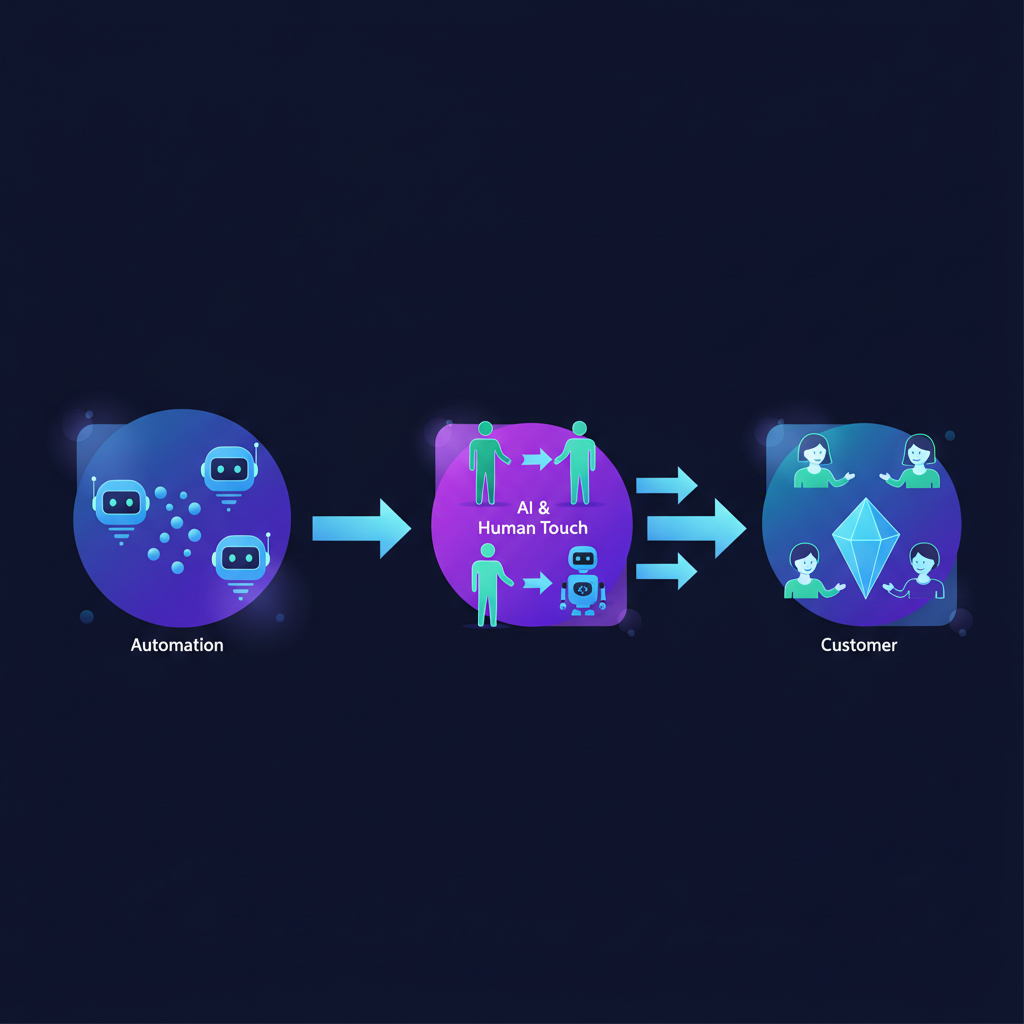
The future isn't AI vs human—it's AI and human, with clear role delineation.
Step 1: Map your SDR workflow by task type
Break your SDR motion into discrete tasks:
- Research & list building → AI
- Initial email sequence (touches 1–3) → AI
- Response handling & qualification questions → Human
- Cold calling → Human
- Meeting scheduling → AI
- Discovery call prep → AI (data aggregation) + Human (strategy)
- Discovery call execution → Human
- Follow-up sequences → AI (templated) + Human (personalized for hot leads)
- CRM updates → AI
Step 2: Define handoff triggers
Set clear rules for when AI passes a lead to a human:
- Email reply received → Route to human SDR within 5 minutes
- Lead score > 80 → Human SDR prioritizes for cold call
- Meeting booked → Human SDR preps and runs discovery
- Objection detected in email → Human SDR crafts custom response
Use AI conversation intelligence to flag high-intent signals (pricing questions, competitor mentions, timeline urgency) and route them to humans immediately.
Step 3: Segment your ICP by complexity
Not all accounts deserve the same treatment:
- Low-touch, high-volume segments (SMB, transactional): AI-led sequences with human intervention only on replies
- Mid-market: AI handles research and initial outreach; humans take over after first response
- Enterprise & strategic accounts: Human-led from day one, with AI supporting research and follow-up
Step 4: Train humans to work with AI
Your human SDRs need to learn how to:
- Review AI-generated research summaries and spot gaps
- Edit AI-drafted emails to add genuine personalization
- Use AI call prep briefs to enter conversations better prepared
- Leverage AI-suggested talk tracks during live calls (real-time battle cards)
AI sales coaching strategies can help reps develop these hybrid skills faster.
Step 5: Measure the blend, not the parts
Track pipeline contribution and cost per qualified opportunity for your entire SDR function, not AI vs human in isolation. The goal is to maximize total output, not to "prove" one is better than the other.
Key metrics:
- Total qualified pipeline generated per month
- Cost per qualified opportunity (total SDR spend ÷ opps created)
- Meeting → Opportunity conversion rate
- Average deal size from SDR-sourced pipeline
Real-world hybrid model example
Scenario: Series B SaaS company, $5M ARR, selling to mid-market (50–500 employees), ACV $25K.
Team structure:
- 2 human SDRs (fully loaded cost: $160K/year)
- AI SDR stack: Clay (research), Instantly.ai (email), Chili Piper (scheduling) (total cost: $15K/year)
Workflow:
- AI (Clay) builds a list of 500 companies per week matching ICP, enriches with tech stack, recent funding, hiring signals.
- AI (Instantly.ai) sends a 4-touch email sequence to all 500, personalized with company-specific data points.
- Human SDRs receive Slack alerts when a prospect replies or clicks a high-intent link (pricing page, case study).
- Human SDRs call all replies within 5 minutes, run discovery, and book demos.
- AI (Chili Piper) handles scheduling; AI logs all activity in HubSpot.
Results (quarterly):
- 6,000 prospects contacted (AI)
- 180 replies (3% response rate)
- 90 meetings booked (50% of replies convert)
- 45 qualified opportunities created (50% meeting → opp conversion)
- 9 closed deals (20% opp → close rate)
- Total pipeline: $1.125M
- Cost per opportunity: $3,889
- Cost per closed deal: $19,444
Before hybrid model (2 human SDRs, no AI):
- 1,200 prospects contacted per quarter (manual research bottleneck)
- 60 meetings booked
- 30 opportunities created
- 6 closed deals
- Total pipeline: $750K
Lift from hybrid: +50% pipeline, +50% closed deals, +15% cost efficiency.
Common mistakes when deploying AI SDRs
Mistake 1: Letting AI run unsupervised
AI email sequences without human review often send tone-deaf messages (congratulating someone on a layoff announcement, referencing outdated news). Always have a human spot-check the first 50 emails in any new sequence.
Mistake 2: Over-rotating to AI and losing the human touch
If every touchpoint is automated, you become indistinguishable from spam. High-value accounts need human creativity and care from the start.
Mistake 3: Measuring AI and humans on the same metrics
AI should be measured on volume, cost efficiency, and top-of-funnel activity. Humans should be measured on qualification quality, pipeline value, and conversion rates. Don't penalize your human SDRs for booking fewer meetings if those meetings convert at 2× the rate.
Mistake 4: Skipping the training investment
Your human SDRs need coaching on how to add value in a world where AI handles the grunt work. Invest in sales coaching frameworks that teach advanced discovery, objection handling, and relationship-building—the skills AI can't replicate.
How to decide: AI, human, or hybrid?
Choose AI-led if:
- You're selling a low-touch, transactional product (ACV < $5K)
- Your ICP is large and homogeneous (thousands of similar prospects)
- Speed and volume matter more than relationship depth
- You have limited budget and need to prove demand before hiring
Choose human-led if:
- You're selling complex, high-ACV deals (> $50K)
- Your ICP is narrow and relationship-driven (enterprise, strategic accounts)
- Discovery and consultative selling are core to your motion
- You have the budget and need to maximize deal size and win rate
Choose hybrid if:
- You're in the middle (mid-market, ACV $10K–$50K)
- You need both volume and quality
- You want to scale without sacrificing personalization
- You're willing to invest in process design and integration
Most B2B companies in 2025 should default to hybrid. The tooling is mature, the ROI is proven, and the competitive advantage comes from execution, not the choice itself.
For a broader view of how to structure your SDR function, see The Complete SDR Playbook for 2026.
What's next: the AI SDR evolution
AI SDRs will continue to improve, but the core limitation—lack of genuine empathy and improvisation—won't disappear in the next 2–3 years. The winning strategy is to treat AI as a force multiplier, not a replacement.
Emerging capabilities to watch:
- AI voice agents that can handle simple discovery questions (still 2–3 years from replacing live SDR calls)
- Hyper-personalized video generation (AI avatars that reference prospect-specific data)
- Real-time coaching during live calls (AI whispering objection-handling scripts in your ear)
According to McKinsey's B2B sales research, the most successful sales organizations will be those that integrate AI deeply into workflows while preserving the human elements that build trust and close complex deals.
The AI SDR vs human debate is over. The hybrid model has won. Your job now is to design the blend that fits your ICP, your deal complexity, and your growth stage—and to measure relentlessly so you can optimize the mix over time.
FAQ
Can AI SDRs fully replace human SDRs?
No. AI SDRs excel at data enrichment, email personalization at scale, and lead scoring, but they lack the empathy, improvisation, and relationship-building skills needed for complex discovery and objection handling. The most effective model is hybrid: AI handles high-volume, low-touch tasks while humans focus on high-value conversations.
What tasks should I assign to AI SDRs vs human SDRs?
Assign AI SDRs to research, list building, initial email sequences, meeting scheduling, and CRM hygiene. Reserve human SDRs for live calls, personalized video messages, complex discovery, objection handling, and relationship nurturing with high-fit accounts.
How much does an AI SDR cost compared to a human SDR?
AI SDR tools typically cost $200–$2,000 per month per seat, while a fully-loaded human SDR costs $60,000–$100,000 annually (salary, benefits, tools, training). However, AI cannot replace all human functions, so the real question is how to optimize the blend.
What metrics prove whether AI SDRs or human SDRs perform better?
Track meetings booked per week, qualified pipeline generated, cost per meeting, response rates, conversion rates from meeting to opportunity, and average deal size. AI typically wins on volume and cost efficiency; humans win on qualification quality and deal size.
Sources

Stefano Breglia
Co-founder, QUOTA Training
Stefano Breglia is co-founder of QUOTA Training. He focuses on sales methodology, deal progression and how AI simulation accelerates rep ramp time across the SDR, BDR, AE and AM roles.
Turn this into reps, not just reading
QUOTA Training lets your team practise these exact scenarios with an AI buyer that reacts like the real thing — then scores every call.
See it in action