AI Personalised Outbound: Scale 1:1 Messaging Without Losing Quality
Part of the AI & Sales guide: The Complete Guide to AI in Sales: Transform Your Revenue EngineLearn how to use AI personalised outbound to craft hyper-relevant messages at scale. Tactical frameworks, tools, and real examples inside.
Key takeaways
- AI personalised outbound combines machine learning, data enrichment, and natural language generation to craft hyper-relevant messages at scale—research shows personalised emails deliver 2–6× higher reply rates than generic blasts.
- The winning approach is human-AI collaboration: AI handles research, data synthesis, and draft generation; human reps add brand voice, strategic judgment, and emotional intelligence before sending.
- Deploy a four-layer stack—data enrichment, AI processing, message generation, and human review—to balance speed, quality, and compliance while maintaining authentic, consultative outreach.
- Measure success beyond open rates: track reply rate, positive reply rate, meeting-booked rate, and time saved per rep to prove ROI and continuously refine your AI prompts and workflows.
- Start small with a pilot cohort of 500–1,000 prospects, validate messaging quality and conversion lift, then scale across your SDR team with documented playbooks and guardrails.
Outbound sales has always been a volume game. But volume without relevance is noise. In 2025, buyers ignore templated spray-and-pray emails, and your SDRs burn hours researching prospects one by one. AI personalised outbound solves this tension: it scales research and message crafting to hundreds or thousands of prospects while preserving the 1:1 relevance that drives replies.
This guide walks you through the tactical mechanics—what AI personalised outbound actually is, how to build the stack, a six-step deployment framework, real examples, and how to measure success. By the end, you'll know exactly how to implement this in your team without sacrificing authenticity or compliance.
For broader context on how AI is reshaping sales workflows, see The Complete Guide to AI in Sales.
What is AI personalised outbound (and what it's not)
AI personalised outbound uses artificial intelligence—primarily large language models (LLMs) and machine learning—to analyse prospect data and generate contextually relevant messaging at scale. It automates the research, synthesis, and drafting steps that traditionally consume 60–80% of an SDR's day.
What AI personalised outbound does
- Enriches prospect data from dozens of sources: firmographics, technographics, intent signals, funding announcements, job changes, social media activity, and company news.
- Synthesises insights into talking points: identifies pain points, relevant use cases, mutual connections, and timely triggers (e.g., a new hire in ops, a product launch, a competitor mention).
- Generates message drafts that weave these insights into email copy, LinkedIn messages, or call scripts—tailored to persona, industry, and stage.
- Suggests subject lines, CTAs, and follow-up sequences optimised for reply rate based on historical performance data.
What it's not
- Not mail-merge 2.0. Inserting
{{FirstName}}and{{Company}}is static tokenisation. AI personalisation synthesises multiple data points into a unique narrative. - Not fully autonomous. The best implementations use AI to draft and suggest; human reps review, edit, and approve before sending. This preserves brand voice and strategic judgment.
- Not a silver bullet. AI can't fix a weak ideal customer profile, a broken value proposition, or poor list hygiene. Garbage in, garbage out.
According to Gartner's Future of Sales report, 60% of B2B sales organisations will transition from experience- and intuition-based selling to data-driven selling by 2025, with AI-assisted personalisation as a core capability.
Why AI personalised outbound matters now
Three forces converge to make this a must-have, not a nice-to-have:
- Buyer expectations have shifted. Prospects receive 100+ cold emails per week. Generic pitches are deleted in seconds. Relevance is the new table stakes.
- Data availability exploded. Intent data, technographic signals, job-change alerts, and social listening are now accessible via API. AI is the only way to process this volume in real time.
- LLM capability crossed the quality threshold. Models like GPT-4 (OpenAI's GPT-4 research) can draft coherent, contextually appropriate sales copy that passes the "sounds human" test—when prompted correctly.
Teams that adopt AI personalised outbound report 2–4× higher reply rates and 30–50% time savings per SDR, freeing reps to focus on conversations, not research drudgery.
For a comparison of how AI augments versus replaces human SDRs, read AI SDR vs Human: What Actually Works in 2025.
The AI personalised outbound stack: four layers

To deploy this effectively, you need four integrated layers. Each serves a distinct function; together they form a closed-loop system.
Layer 1: Data enrichment and signals
This layer feeds the AI with raw material. Tools pull data from:
- Firmographic sources: company size, revenue, industry, location (Clearbit, ZoomInfo, Apollo).
- Technographic sources: tech stack, tools in use, recent adoptions (BuiltWith, 6sense, Clearbit Reveal).
- Intent signals: content consumption, search behaviour, review site activity (Bombora, G2, TechTarget).
- Trigger events: funding rounds, leadership changes, job postings, product launches (Crunchbase, LinkedIn Sales Navigator, Google Alerts).
- Social and content: LinkedIn posts, Twitter activity, blog articles, podcast appearances (Phantombuster, Apify).
Best practice: Integrate these sources into a single enrichment workflow using a tool like Clay or a custom Zapier/Make pipeline that writes into your CRM.
Layer 2: AI processing and insight generation
This layer takes raw data and transforms it into insights. The AI:
- Identifies patterns (e.g., "This company just adopted Salesforce and posted a RevOps job—likely scaling sales ops").
- Maps prospect pain points to your solution's value props.
- Surfaces conversational hooks (e.g., "I saw your post about pipeline visibility challenges").
- Prioritises prospects by fit and timing.
Tools: Custom prompts in ChatGPT/Claude, or native AI features in Clay, HubSpot, Outreach, and Salesloft.
Layer 3: Message generation
The AI drafts emails, LinkedIn messages, or call talking points. Key capabilities:
- Dynamic tone and length based on persona (CFO = concise, ROI-focused; VP Ops = detailed, process-oriented).
- Multi-variant generation for A/B testing subject lines and CTAs.
- Sequence logic: follow-up messages adapt based on prior engagement (opened but no reply, clicked link, etc.).
Tools: Lavender (email coaching + AI suggestions), Instantly.ai, Smartlead, or native AI in your sales engagement platform.
Layer 4: Human review and approval
This is the guardrail. Before any message sends, a human rep:
- Reviews for factual accuracy (AI can hallucinate details).
- Injects brand voice and strategic nuance.
- Approves or edits the CTA and timing.
- Flags edge cases (e.g., sensitive accounts, legal/compliance concerns).
Why this matters: Authenticity and trust. Prospects can smell a bot. The hybrid model—AI drafts, human refines—preserves the consultative tone that wins deals.
Six-step framework for deploying AI personalised outbound
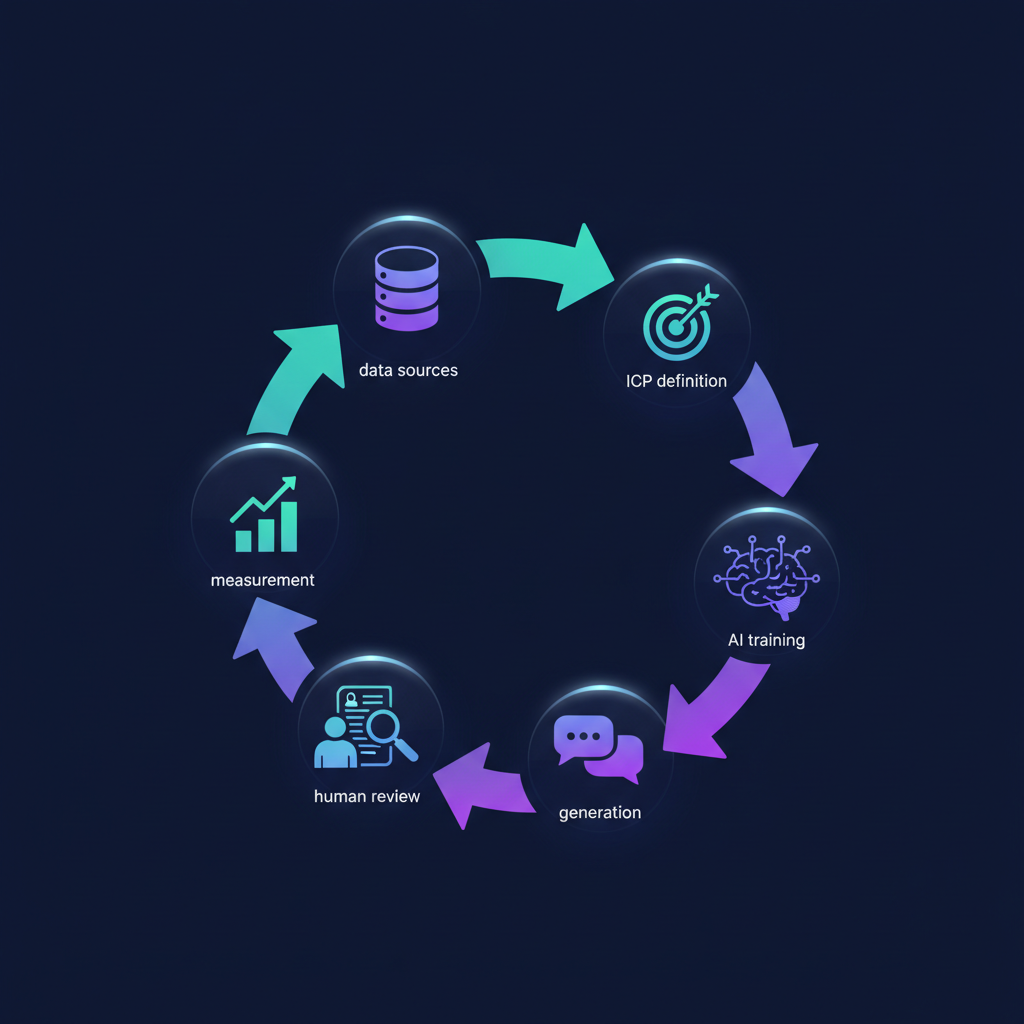
Here's how to roll this out in your team, from pilot to scale.
Step 1: Define your ICP and segment by persona
AI personalisation only works if you feed it a clear target. Start by documenting your ideal customer profile: firmographics, technographics, pain points, and buying triggers.
Then segment by persona:
- Economic buyer (CFO, VP Finance): ROI, cost savings, risk mitigation.
- Technical buyer (CTO, VP Eng): integration, security, scalability.
- End user (Sales Ops, RevOps Manager): usability, workflow efficiency, reporting.
Each persona gets a distinct AI prompt template and value-prop library.
Step 2: Build your data enrichment pipeline
Choose 3–5 data sources that cover firmographics, technographics, intent, and triggers. Integrate them into a single workflow:
- Example workflow (Clay):
- Import prospect list (name, email, company domain).
- Enrich with Clearbit (company size, industry, tech stack).
- Pull LinkedIn profile (recent posts, job tenure, mutual connections).
- Check Crunchbase (funding, recent news).
- Query Bombora (intent topics).
- Write all fields into HubSpot or Salesforce.
Run this pipeline nightly or trigger it when a new lead enters your CRM.
Step 3: Train your AI with prompt templates
Create a library of prompt templates—one per persona and use case. A strong prompt includes:
- Context: "You are a B2B sales rep selling [product] to [persona] in [industry]."
- Inputs: "Here is the prospect's data: [name, title, company, recent news, tech stack, LinkedIn post]."
- Task: "Write a 3-sentence cold email that references [specific trigger], explains how [product] solves [pain point], and asks for a 15-minute call."
- Tone and constraints: "Keep it conversational, under 80 words, no jargon. Do not mention pricing."
Test and iterate these prompts with 20–30 real prospects. Measure reply rate and refine wording, tone, and CTA until you hit 5–10% positive reply rate.
For email structure inspiration, see our cold email framework.
Step 4: Generate drafts and layer in human review
Feed enriched prospect data into your AI tool (ChatGPT API, Clay AI, or your SEP's native AI). The tool outputs a draft email or message.
Human review checklist:
- ✅ Factual accuracy (company name, recent event, tech stack).
- ✅ Relevance (does the hook tie to a real pain point?).
- ✅ Brand voice (does it sound like us?).
- ✅ CTA clarity (is the ask specific and low-friction?).
- ✅ Compliance (no prohibited claims, respects opt-out rules).
Reps should spend 30–60 seconds per message on review and light editing. This is 10× faster than writing from scratch.
Step 5: Deploy in sequences and measure
Integrate AI-drafted messages into your building high-converting outbound sales sequences. A typical sequence:
- Day 1: AI-personalised email (trigger-based hook).
- Day 3: AI-personalised LinkedIn connection request.
- Day 5: Follow-up email (references first email, adds new insight).
- Day 8: Call attempt + voicemail (use AI-generated talking points).
- Day 12: Breakup email (AI-drafted, casual tone).
Track these metrics:
- Reply rate (% of delivered emails that get a reply).
- Positive reply rate (% that express interest or agree to meet).
- Meeting-booked rate (% that convert to a calendar hold).
- Time saved per rep (hours/week freed up by AI research and drafting).
Run A/B tests: AI-personalised vs. traditional manual outreach. Expect 2–4× lift in reply rate if your ICP and prompts are dialled in.
Step 6: Scale with playbooks and continuous learning
Once your pilot cohort (500–1,000 prospects) proves ROI, roll out across the SDR team:
- Document your prompt library in a shared wiki.
- Record training videos showing reps how to review and edit AI drafts.
- Schedule weekly "AI prompt reviews" where the team shares what's working.
- Feed winning message variants back into your AI training data to improve future outputs.
Pro tip: Integrate AI-generated messaging insights into your conversation intelligence platform. When a rep books a meeting from an AI-drafted email, tag the approach and analyse what made it successful. For more on this, see AI Conversation Intelligence: Deploy It to Win More Deals.
Real examples: AI personalised outbound in action
Example 1: Trigger-based email (funding announcement)
Prospect data:
- Name: Sarah Chen, VP Revenue Operations
- Company: Acme SaaS (Series B, $25M raised last month)
- Tech stack: Salesforce, Gong, Outreach
- Trigger: Funding announcement + job posting for "Sales Ops Analyst"
AI-generated draft (edited by rep):
Subject: Congrats on the Series B, Sarah
Hi Sarah,
Saw Acme just closed $25M—congrats! I also noticed you're hiring a Sales Ops Analyst, which usually signals you're scaling the revenue engine fast.
We help Series B teams like yours automate rep coaching and cut ramp time by 30% using AI role-play. Worth a 15-min chat to see if it fits your roadmap?
Best,
[Rep name]
Why it works: Timely trigger, relevant pain point (scaling ops), specific value prop, low-friction CTA.
Example 2: LinkedIn prospecting message (social signal)
Prospect data:
- Name: Raj Patel, Director of Sales
- LinkedIn post: "Our SDR team is struggling with call reluctance—any tips?"
- Company: GrowthCo, 50 employees, uses HubSpot
AI-generated draft (edited by rep):
Hi Raj,
Loved your post on call reluctance—it's the #1 issue we hear from sales leaders. We built an AI role-play platform that lets SDRs practice objection handling in a zero-judgment environment. Teams using it cut call anxiety by 40% in 30 days.
Happy to share a quick demo if you're curious. Sound useful?
Why it works: Direct reference to prospect's own content, empathy, specific outcome, conversational tone.
For more on LinkedIn prospecting, see our full playbook.
Example 3: Multi-touch sequence (intent signal)
Prospect data:
- Name: Emily Torres, CMO
- Company: MarketingTech Inc.
- Intent signal: Visited your pricing page 3× in the last week, downloaded a competitor comparison guide
AI-generated sequence:
- Email 1 (Day 1): "Hi Emily, noticed you've been researching sales coaching platforms. Here's how we compare to [Competitor X]—happy to walk you through it."
- Email 2 (Day 4): "Emily, following up—here's a 2-min video showing our AI role-play in action. [Link]"
- Call script (Day 7): "Hi Emily, [Rep name] here. I saw you checked out our pricing page a few times—wanted to see if you have any questions I can answer live."
Why it works: Intent signals show high buying interest; sequence escalates touch types (email → video → call) and urgency without being pushy.
Common pitfalls (and how to avoid them)
Pitfall 1: Over-automation (the "robot voice" problem)
Symptom: Prospects reply, "This sounds like a bot."
Fix: Always layer in human review. Edit for brand voice, add a personal sentence, use contractions and casual phrasing.
Pitfall 2: Hallucinated facts
Symptom: AI invents a funding round, misspells a company name, or references a competitor the prospect doesn't use.
Fix: Validate every factual claim in the draft. Use structured data fields (not free-text) as AI inputs when possible.
Pitfall 3: Generic "personalisation"
Symptom: AI inserts a data point but doesn't tie it to value. Example: "I saw you use Salesforce. Want to chat?"
Fix: Train your prompts to connect the insight to a pain point and your solution. "I saw you use Salesforce—most teams we work with struggle to get reps to log calls consistently. We automate that with AI call transcription. Worth a look?"
Pitfall 4: Ignoring compliance and opt-out
Symptom: Sending to unsubscribed contacts, violating GDPR/CAN-SPAM, or bypassing internal approval workflows.
Fix: Integrate AI workflows with your CRM's suppression lists and compliance rules. Never bypass human approval for high-risk accounts (e.g., existing customers, partners, legal/regulated industries).
Tools and platforms to consider
Here's a snapshot of leading AI personalised outbound tools in 2025:
| Tool | Primary function | Best for |
|---|---|---|
| Clay | Data enrichment + AI workflow automation | Building custom multi-source pipelines |
| Lavender | Email coaching + AI-generated personalisation suggestions | SDRs writing emails in Gmail/Outlook |
| Instantly.ai | AI-assisted cold email sequences | High-volume outbound, A/B testing |
| Smartlead | AI email personalisation + deliverability optimisation | Agencies and high-scale teams |
| HubSpot AI | Native AI content assistant in sequences | Teams already on HubSpot CRM |
| Outreach / Salesloft | AI-powered message suggestions in sales engagement platform | Enterprise sales teams with existing SEP |
Integration tip: Most of these tools offer API access or native Zapier/Make connectors. Build a single source of truth in your CRM and let AI tools pull from it, rather than creating data silos.
Measuring ROI: metrics that matter
Track these KPIs to prove (and improve) your AI personalised outbound program:
1. Reply rate
Formula: (Replies received / Emails delivered) × 100
Benchmark: 5–10% for well-targeted, AI-personalised outbound; 1–3% for generic blasts.
2. Positive reply rate
Formula: (Positive replies / Total replies) × 100
What counts as positive: Interest, agreement to meet, request for more info. Exclude "not interested" and "remove me."
Benchmark: 40–60% of replies should be positive if your targeting and messaging are tight.
3. Meeting-booked rate
Formula: (Meetings booked / Emails delivered) × 100
Benchmark: 1–3% for cold outbound; 5–8% for warm or intent-based lists.
4. Time saved per rep
Measure: Hours per week spent on manual research and drafting before vs. after AI.
Benchmark: 10–15 hours/week saved per SDR, reallocated to calling, discovery, and deal support.
5. Cost per meeting
Formula: (Total cost of tools + rep time) / Meetings booked
Goal: Lower cost per meeting than traditional methods while maintaining or improving meeting quality (measured by show rate and conversion to opp).
Pro tip: Tie these metrics back to revenue. If AI personalised outbound increases meetings booked by 50% and those meetings convert at the same rate, you've just scaled pipeline without hiring more headcount.
How QUOTA Training fits into your AI personalised outbound strategy
AI can draft the perfect email, but it can't teach your reps how to run the meeting once they book it. That's where QUOTA Training comes in.
Our AI-powered role-play platform lets reps practice discovery, objection handling, and closing in realistic, voice-simulated scenarios. They get instant feedback on talk time, filler words, question quality, and objection responses—so when your AI-personalised outbound books a meeting, your rep is ready to convert it.
The full-stack approach:
- AI personalised outbound books the meeting.
- QUOTA role-play trains the rep to run it flawlessly.
- Conversation intelligence (like Gong or Chorus) scores the live call.
- AI coaching delivers personalised feedback and assigns the next role-play scenario.
This closed loop turns your outbound engine into a revenue engine. Learn more about our gamified sales training platform.
FAQ
What is AI personalised outbound?
AI personalised outbound uses artificial intelligence to analyse prospect data—firmographics, technographics, intent signals, and public content—and generate hyper-relevant messaging at scale. It automates research and drafting while preserving the authentic, human touch that drives replies.
How does AI personalisation differ from mail-merge?
Mail-merge inserts static fields like {{FirstName}} or {{Company}}. AI personalisation synthesises multiple data points—recent news, job changes, tech stack, social posts—to craft contextually relevant hooks and value propositions unique to each prospect.
Can AI personalised outbound maintain authenticity?
Yes, when configured correctly. The best AI tools generate research-backed talking points and suggest messaging frameworks, but human reps review, edit, and inject brand voice before sending. This hybrid approach preserves authenticity while scaling reach.
What tools enable AI personalised outbound?
Leading platforms include Clay (data enrichment and workflow automation), Lavender (email coaching and personalisation suggestions), Instantly.ai and Smartlead (AI-assisted sequencing), and native AI features in HubSpot, Outreach, and Salesloft. Choose tools that integrate with your CRM and conversation intelligence stack.
How do I get started with AI personalised outbound?
Start with a pilot: define your ICP, build a data enrichment pipeline for 500–1,000 prospects, create prompt templates for your top persona, generate AI drafts, layer in human review, and measure reply rate and meeting-booked rate. Once you prove ROI, document playbooks and scale across your SDR team.
What's the biggest risk of AI personalised outbound?
The biggest risk is over-automation leading to robotic, inauthentic messaging. Mitigate this by always including human review, training your AI prompts with real examples, and validating factual claims before sending. Balance speed with quality.
Sources

Stefano Breglia
Co-founder, QUOTA Training
Stefano Breglia is co-founder of QUOTA Training. He focuses on sales methodology, deal progression and how AI simulation accelerates rep ramp time across the SDR, BDR, AE and AM roles.
Turn this into reps, not just reading
QUOTA Training lets your team practise these exact scenarios with an AI buyer that reacts like the real thing — then scores every call.
See it in action