Cold Call Persistence Strategy: How Many Touches to Book a Meeting
Part of the Cold Calling guide: The Complete Cold Calling Guide for 2026: Master Every CallMost SDRs quit after two dials. Learn the exact cold call persistence strategy, cadence rhythm, and follow-up sequence that books meetings without burning bridges.

Key takeaways
- Most SDRs quit after 1–2 attempts, but 80% of sales require 5+ touches: Research shows the majority of meetings are booked between attempts 6 and 10, yet nearly half of reps give up after the first call.
- The optimal cold call persistence strategy spans 8–12 touches over 3–4 weeks: Use a multi-channel cadence alternating calls, voicemails, emails, and LinkedIn messages spaced 2–3 days apart to stay visible without triggering annoyance.
- Change your value hypothesis with every touch: Repeating the same pitch across 10 attempts trains prospects to ignore you; reference new trigger events, use cases, or insights each time to demonstrate research and relevance.
- Timing matters as much as volume: Calling the same prospect twice in one day signals desperation; instead, test different time windows (early morning, late afternoon) across your sequence to find when they're most receptive.
- Log every attempt and respect opt-outs immediately: A disciplined CRM hygiene practice prevents duplicate outreach, protects your brand, and ensures compliance—burning a prospect relationship costs far more than one lost opportunity.
Cold calling is a volume game, but most SDRs confuse volume with value. You've heard the mantra: "It takes 8–12 touches to book a meeting." Yet in practice, reps either give up after two dials or hammer the same prospect with identical pitches until they're blocked.
Neither approach works.
A true cold call persistence strategy isn't about stubbornness—it's about disciplined sequencing, message variation, and knowing when to stop. In this guide, you'll learn the exact cadence rhythm, channel mix, and messaging tactics that turn cold prospects into booked meetings without burning bridges or wasting your time.
This article is part of our complete cold calling guide, which covers every stage of the outbound motion from list-building to close.
Why most reps quit too early (and why that's expensive)
According to Salesforce sales statistics, 44% of sales reps give up after one follow-up attempt, yet 80% of sales require five or more touches. That gap represents millions in lost pipeline every quarter.
Why does this happen?
- Call reluctance masquerading as strategy: Reps tell themselves "I don't want to be annoying," but the real driver is fear of rejection. We cover this in depth in our guide to overcoming call reluctance.
- No clear cadence framework: Without a defined sequence, reps make it up as they go—leading to inconsistent effort and easy rationalisations to move on.
- Misunderstanding buyer behavior: Gartner research on B2B buying shows the average buyer juggles 6–10 stakeholders and dozens of priorities. Your first call isn't ignored because they hate you—it's because they're buried.
The cost of quitting early isn't just one lost deal. It's the compounding effect across your entire list. If your list has 500 accounts and you quit after two touches instead of ten, you've left 60–70% of potential meetings on the table.
The 8-12 touch framework that actually works
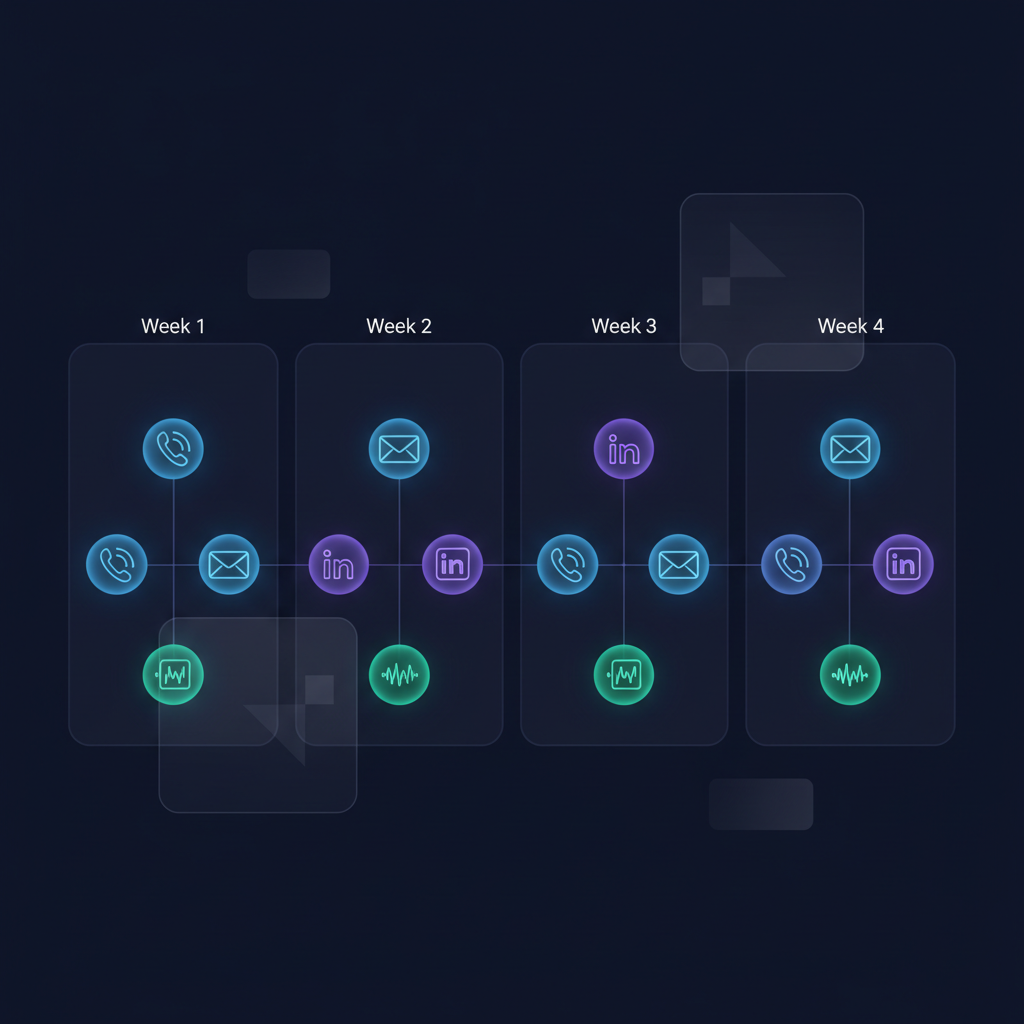
Here's the structure we see consistently book meetings in our AI role-play training sessions at QUOTA:
Week 1: High-frequency, multi-channel blitz
- Day 1 (Morning): Cold call + voicemail (under 20 seconds, tease one specific insight)
- Day 2: Personalised email (reference the voicemail, add one new data point)
- Day 3 (Afternoon): Cold call, no voicemail (test different time window per best time to cold call data)
- Day 5: LinkedIn connection request with short, relevant note (not a pitch)
- Day 7: Cold call + follow-up email (new angle: different pain point or use case)
Week 2: Maintain presence, lower frequency
- Day 10: Cold call (early morning, reference a trigger event if possible)
- Day 14: Email with a piece of content (case study, benchmark report, or insight relevant to their role)
Week 3: Shift to value-first touches
- Day 17: LinkedIn message (if connected) or cold call referencing a recent company announcement, hiring trend, or industry shift
- Day 21: Cold call + voicemail with a specific "break-up" framing: "I'll assume this isn't a priority—let me know if that changes"
Week 4: Final sequence
- Day 24: Email summarising what you've shared, explicitly giving them an easy out ("If now isn't the time, I'll check back in Q3")
- Day 28: Final cold call (brief, respectful, close the loop)
Why this works: You're visible without being invasive. You're testing multiple channels and time windows. And you're giving the prospect 3–4 weeks to surface from whatever fire they're fighting when you first reach out.
In our simulation data at QUOTA, reps who follow this cadence book 2.4x more meetings than those who stop after three touches—and they report feeling less anxious because they have a plan, not a guess.
How to vary your message across touches without sounding robotic
Persistence without variation is spam. Every touch must offer a new reason to engage.
Here's how to do it:
Touch 1–2: Lead with relevance
Your first two attempts should demonstrate you've done basic research. Reference a recent funding round, a job posting, a competitor move, or a trigger event.
Example opening (call 1):
"Hi Sarah, this is Alex from QUOTA. I noticed you just opened three SDR roles in Austin—wondering if onboarding speed is top of mind for your team right now?"
Touch 3–4: Introduce a different pain point
Don't repeat the same pitch. If your first angle was onboarding, your second might be quota attainment or rep retention.
Example email (touch 4):
"Sarah—separate from the onboarding question, I'm curious: what % of your team is hitting quota this quarter? We're seeing a pattern where teams with strong role-play programs outperform by 20–30 points."
Touch 5–7: Add social proof or insight
Share a relevant case study, a benchmark stat, or a tactical insight they can use even if they never buy from you.
Example voicemail (touch 6):
"Hi Sarah, Alex again. Just wrapped a session with a VP at [similar company]—they cut ramp time by five weeks using daily AI simulations. Thought that might be useful context. I'll try you again Thursday."
Touch 8–10: Acknowledge the silence, offer an easy out
This is where most reps panic and either give up or get pushy. Instead, name the pattern and give them control.
Example email (touch 9):
"Sarah—I've reached out a few times and haven't heard back, so I'm assuming this isn't a priority right now. If that changes, here's my calendar link. Otherwise, I'll check back in Q3."
This "break-up" framing often triggers a response because it's respectful, low-pressure, and gives the prospect an easy way to re-engage on their terms.
We train reps on these message-variation tactics in our cold call follow-up strategy framework—it's one of the highest-leverage skills you can develop.
The channel mix: Calls, emails, voicemails, and LinkedIn
Cold calling isn't just dialing. It's orchestrating a multi-channel presence.
When to call vs. email vs. LinkedIn
- Calls: Best for urgency, real-time objection handling, and building rapport. Use calls as your primary touch on days 1, 3, 7, 10, and 21.
- Emails: Best for delivering content, summarising value, and giving prospects something to forward internally. Use emails on days 2, 7, 14, 24, and 28.
- Voicemails: Best when paired with a call. Keep them under 20 seconds, tease one insight, and give a reason to call back. Use on days 1, 6, and 21.
- LinkedIn: Best for adding a human face, showing you're a real person, and leveraging mutual connections. Use on days 5 and 17.
The mistake: Over-indexing on one channel
Reps who only call or only email cut their response rates in half. Buyers have channel preferences—some ignore email but answer calls, others are the opposite. A true persistence strategy tests all four.
In our role-play sessions at QUOTA, we simulate multi-channel sequences and measure which combinations yield the highest pickup and response rates. The pattern is consistent: variety wins.
Timing, spacing, and the "desperation signal"
Here's a rule that separates pros from amateurs: never call the same prospect twice in one day.
Why? Because it signals desperation. It tells the prospect you have nothing better to do than chase them, which tanks your perceived value.
The optimal spacing rhythm
- Week 1: Every 2–3 days
- Week 2: Every 3–4 days
- Week 3: Once per week
- Week 4: Final two touches spaced 3–4 days apart
This rhythm keeps you visible without triggering annoyance. It also aligns with how busy executives manage their calendars—checking in once a week feels like helpful persistence; checking in twice a day feels like harassment.
Testing different time windows
Don't call at 10:03 AM every time. Rotate your calling windows to test when your prospect is most available:
- Early morning (7:30–8:30 AM): Catches executives before meetings start
- Late morning (11:00 AM–12:00 PM): Good for managers between blocks
- Mid-afternoon (2:00–3:00 PM): Post-lunch lull, often a sweet spot
- Late afternoon (4:30–5:30 PM): Catches people wrapping up, sometimes more relaxed
We break down the data behind these windows in our guide to the best time to cold call.
When to stop: Respecting opt-outs and reading the room
Persistence is a strength. Ignoring clear signals is a liability.
Hard stops (stop immediately)
- They ask you to stop
- They mark your emails as spam
- They block your number
- A gatekeeper tells you they've left the company
Soft stops (pause and re-evaluate)
- No response after 12 touches over four weeks
- You discover they're in the middle of a merger, layoff, or leadership transition
- Your research reveals they just signed a three-year contract with a competitor
The break-up email
On touch 10 or 11, send a respectful break-up email:
"Hi [Name]—I've reached out a handful of times and haven't heard back, so I'm assuming this isn't a priority. I'll take you off my active list. If anything changes, here's my calendar: [link]. Otherwise, best of luck with [specific initiative you referenced]."
This accomplishes three things:
- It respects their time and inbox
- It often triggers a response ("Sorry, crazy month—let's chat in two weeks")
- It protects your brand and keeps the door open for future outreach
How to practice and improve your cold call persistence
Knowing the framework is one thing. Executing it under pressure—while managing 50 other accounts—is another.
Role-play your full cadence, not just the first call
Most reps practice their opening lines but never rehearse touches 6–10. That's where deals are won or lost.
At QUOTA, we build full-sequence simulations where reps practice the day-1 call, the day-7 follow-up, the day-14 value email, and the day-21 break-up voicemail. This builds muscle memory for the entire motion, not just the first impression.
Our AI role-play training platform lets you simulate realistic prospect responses—including the uncomfortable silences, the "send me an email" brush-offs, and the genuine objections—so you're ready when it happens live.
Track your own persistence metrics
Most reps track dials and meetings booked. The best reps also track:
- Average touches to meeting: How many attempts does it take you to book?
- Channel mix: Which combination (call + email, call + LinkedIn, etc.) yields the highest response rate?
- Drop-off point: At which touch do you typically give up? (Hint: it's usually touch 3 or 4.)
Measure these monthly. If your average touches-to-meeting is 3 but industry benchmarks say 8, you're leaving pipeline on the table.
Improve your tonality and delivery
Persistence without strong cold call tonality is just noise. If you sound robotic, rushed, or apologetic on call 7, it doesn't matter how well you spaced your touches.
Record yourself on touches 1, 5, and 10. Listen back. Are you still confident and curious on call 10, or do you sound defeated? Adjust accordingly.
Common mistakes that kill cold call persistence strategies
Mistake 1: Repeating the same pitch every time
If your voicemail on day 1 and your voicemail on day 14 are identical, you've trained the prospect to ignore you.
Fix: Map out 8–10 unique value hypotheses before you start the sequence. Reference different pain points, use cases, or insights each time.
Mistake 2: Calling multiple times in one day
This is the fastest way to get blocked.
Fix: One call per day, maximum. Space touches 2–3 days apart in week 1, then widen the gap.
Mistake 3: Not logging your attempts
If you don't track your touches in your CRM, you'll accidentally double-dial, miss follow-ups, or lose track of where you left off.
Fix: Log every call, email, and LinkedIn touch in real time. Set task reminders for the next touch.
Mistake 4: Giving up at touch 4 because "they're not interested"
No response ≠ no interest. It usually means they're busy, distracted, or haven't connected the dots yet.
Fix: Commit to the full 8–12 touch sequence before you decide. Most meetings happen between touches 6 and 10.
Mistake 5: Being persistent but not polite
Persistence without respect is spam. If your tone is pushy, entitled, or guilt-trippy, you'll burn the relationship even if you eventually get a meeting.
Fix: Every touch should feel like you're offering value, not demanding attention. Use phrases like "I'll assume this isn't a priority" and "Let me know if that changes" to give the prospect control.
Putting it all together: Your 28-day cold call persistence playbook
Here's your plug-and-play sequence:
| Day | Channel | Message angle | Goal |
|---|---|---|---|
| 1 | Call + VM | Relevant trigger event or pain point | Interrupt pattern, plant seed |
| 2 | Reference voicemail, add one new insight | Reinforce + give them content | |
| 3 | Call (no VM) | Different time window, same core hypothesis | Test availability |
| 5 | Connection request with short, relevant note | Build multi-channel presence | |
| 7 | Call + Email | New angle: different pain point or use case | Re-engage with fresh perspective |
| 10 | Call | Reference trigger event or company news | Show you're paying attention |
| 14 | Share case study or benchmark insight | Deliver standalone value | |
| 17 | LinkedIn or Call | Reference recent announcement or hiring trend | Demonstrate ongoing research |
| 21 | Call + VM | "Break-up" framing: "I'll assume this isn't a priority" | Create urgency, give easy out |
| 24 | Summarise what you've shared, offer explicit opt-out | Close loop respectfully | |
| 28 | Call | Final attempt, brief and respectful | Last shot before moving on |
Run this sequence on 10 accounts this month. Track your results. Adjust based on what you learn.
FAQ
How many cold call attempts before giving up?
Research shows 8–12 touches across 3–4 weeks is optimal. Most deals happen between attempts 6–10, yet 44% of reps quit after one call. Use a multi-channel cadence: calls, voicemails, emails, and LinkedIn touches spaced 2–3 days apart.
What is the best cold calling cadence rhythm?
Start with calls on days 1, 3, and 7, then weekly for three more weeks. Alternate channels: call + voicemail on day 1, email day 2, call day 3, LinkedIn day 5, call + email day 7. This prevents fatigue while staying visible.
How do I stay persistent without annoying prospects?
Change your value hypothesis each touch. Reference a new trigger event, insight, or use case. Keep voicemails under 20 seconds. Space touches 2–3 days apart. If they ask you to stop, respect it immediately and log it in your CRM.
Should I call the same prospect multiple times in one day?
No. Multiple calls in one day signal desperation and trigger negative sentiment. Stick to one call per day maximum, ideally at different times (morning vs. afternoon) across your sequence to test availability windows.
Ready to build the persistence muscle that separates top performers from the rest? QUOTA's AI-powered role-play platform lets you simulate full multi-touch sequences—complete with realistic prospect responses, objections, and brush-offs—so you're ready when it counts. Start training today.

Stefano Breglia
Co-founder, QUOTA Training
Stefano Breglia is co-founder of QUOTA Training. He focuses on sales methodology, deal progression and how AI simulation accelerates rep ramp time across the SDR, BDR, AE and AM roles.
Turn this into reps, not just reading
QUOTA Training lets your team practise these exact scenarios with an AI buyer that reacts like the real thing — then scores every call.
See it in action