Cold Call Tonality: Master Vocal Delivery That Wins Meetings
Part of the Cold Calling guide: The Complete Cold Calling Guide for 2026: Master Every CallCold call tonality matters more than your script. Learn the exact vocal techniques—pitch, pace, pauses—that turn skeptical prospects into booked meetings.

Key takeaways
- Cold call tonality drives first-impression decisions faster than your script. Prospects decide whether to stay on the line within 3–5 seconds based on how you sound—pitch, pace, and inflection signal confidence, peer status, and intent before your value proposition even lands.
- Upward inflection at the end of statements is the #1 tonality killer. When you make statements sound like questions, you signal uncertainty and low status. Declarative sentences need downward inflection to convey authority and conviction.
- The ideal cold call pace is 150–170 words per minute, with strategic pauses after questions and value statements. Speaking faster signals nervousness; slower risks losing attention. Pauses give prospects processing time and make your questions feel genuine, not scripted.
- Monotone delivery kills engagement, even with a great script. Vocal variety—shifting pitch across your natural range and emphasizing key words—keeps prospects engaged and signals enthusiasm without sounding fake or salesy.
- Tonality is trainable through deliberate practice, not innate talent. Recording calls, scoring yourself on five vocal levers (pitch, pace, volume, inflection, pause), and drilling with role-play simulations produce measurable improvement in 7–10 days.
Your script is tight. Your cold call opening lines are sharp. You've nailed your targeting and you're dialing at the optimal times to cold call. Yet prospects still hang up in the first ten seconds—or worse, stay on the line but mentally check out.
The missing variable isn't what you say. It's how you say it.
Cold call tonality—the combination of pitch, pace, volume, inflection, and pause patterns—determines whether a prospect perceives you as a peer, a pest, or a junior rep reading a script. In our AI role-play simulations at QUOTA, we've analyzed thousands of cold call recordings. Reps with identical scripts but different tonality see conversion-to-meeting rates that vary by 40% or more.
This guide breaks down the exact vocal techniques that separate reps who book meetings from reps who get dismissed—and gives you a repeatable training system to master cold call tonality in days, not months.
For broader cold calling fundamentals, see our complete cold calling guide.
Why cold call tonality matters more than your script
Prospects don't evaluate your cold call rationally. They evaluate it emotionally, and they do it fast. Research from Harvard Business Review's study on vocal authority shows that listeners form competence judgments within seconds based on vocal cues—pitch, tempo, and confidence markers—before processing the content of your message.
On a cold call, this window is even tighter: 3–5 seconds. By the time you finish your opener, the prospect has already decided whether you sound like someone worth listening to.
Here's what tonality signals in those first seconds:
- Confidence vs. uncertainty: Downward inflection at the end of statements signals certainty. Upward inflection (making statements sound like questions) signals you're seeking approval or unsure of your own message.
- Peer status vs. subordinate status: A steady, moderate pace with natural pauses signals you're a peer. Rushed, breathless delivery signals you're nervous and lower-status.
- Curiosity vs. agenda: Genuine vocal variety—pitch shifts that match the emotional arc of your message—signals interest in the conversation. Monotone delivery signals you're reading a script and don't care about the answer.
Tonality isn't about sounding "enthusiastic" or "energetic" in a generic sense. It's about sounding congruent—like someone who believes what they're saying, expects to be taken seriously, and is genuinely curious about the prospect's world.
When tonality and content align, prospects stay on the line. When they clash—great script, weak tonality—you lose them before your value prop lands.
The anatomy of cold call tonality: five levers you control
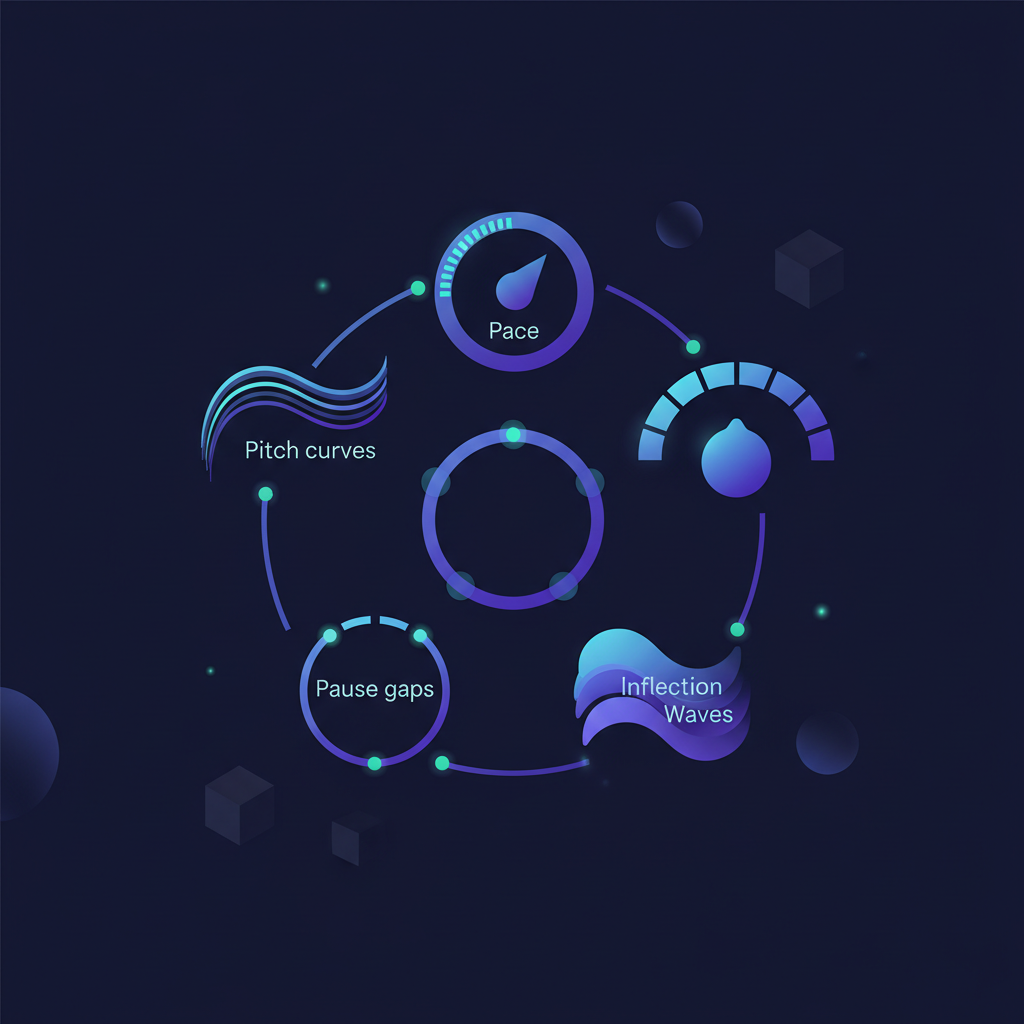
Cold call tonality isn't a vague "vibe." It's a set of discrete, trainable variables. Here are the five levers you can measure, practice, and improve:
1. Pitch (vocal frequency)
Pitch is how high or low your voice sounds. On cold calls, two pitch mistakes dominate:
- Monotone (no pitch variation): Sounds robotic, disengaged, scripted. Prospects tune out because there's no emotional signal to track.
- Upward inflection on statements: When you end declarative sentences with rising pitch—"I'm calling from QUOTA Training?"—you sound uncertain, as if you're asking permission to exist. This is the single most common tonality error we hear in role-play sessions.
What works: Use your full natural pitch range. Emphasize key words (the prospect's name, their company, the pain point, the meeting ask) with slight upward movement, then bring pitch down at the end of statements to signal confidence and closure.
Example (wrong tonality):
"Hi Sarah? This is Alex from QUOTA? We help sales teams reduce ramp time?" (Every sentence sounds like a question.)
Example (correct tonality):
"Hi Sarah—this is Alex from QUOTA. We help sales teams reduce ramp time, and I'm calling because I noticed your team just opened three SDR roles." (Statements end with downward inflection; emphasis on "Sarah," "QUOTA," and "three SDR roles.")
2. Pace (words per minute)
According to Gong's research on talk-to-listen ratios, top-performing sales reps speak at 150–170 words per minute during discovery and pitching. Cold calls demand the same range, but most reps skew too fast (anxiety) or too slow (over-rehearsed).
- Too fast (180+ WPM): Signals nervousness, desperation, or lack of confidence. Prospects can't process your message and perceive you as pushy.
- Too slow (< 140 WPM): Risks losing attention. Prospects assume you're wasting their time or unsure of your point.
What works: Aim for 150–170 WPM during your opener and value statement, then slow down slightly (140–150 WPM) when you ask your first question. The pace shift signals you're moving from "telling" to "asking" and makes the question feel more genuine.
Drill: Record yourself reading your cold call script aloud. Use a free online word-count tool and a timer. Adjust your natural pace until you hit the 150–170 range, then practice until it feels automatic.
3. Volume (vocal projection)
Volume isn't about being loud—it's about sounding present and in control of the conversation.
- Too quiet: Signals low confidence, fear of rejection, or discomfort. Prospects subconsciously dismiss you.
- Too loud: Sounds aggressive, salesy, or desperate. Works in some high-energy environments but backfires in B2B cold calling.
What works: Speak at a volume that would carry clearly across a conference table—loud enough to sound authoritative, soft enough to feel conversational. If you're struggling with volume control, stand up during calls; it naturally opens your diaphragm and increases projection without strain.
4. Inflection (emphasis and vocal variety)
Inflection is where you place emphasis within sentences. It's the difference between sounding like a human and sounding like a text-to-speech bot.
What works: Emphasize nouns and verbs that carry meaning—prospect's name, company name, pain points, outcomes, and the call-to-action. De-emphasize filler words ("just," "quickly," "actually") by dropping pitch and volume slightly.
Example:
"Sarah, I'm calling because QUOTA helps sales teams cut ramp time by 30%, and I saw you're hiring three SDRs—does it make sense to spend 15 minutes next week exploring whether we can help you get them productive faster?"
Bolded words get slight pitch lift and emphasis. Everything else is conversational baseline.
5. Pauses (strategic silence)
Pauses are the most underutilized tonality tool. Most reps rush through cold calls because silence feels uncomfortable. But pauses serve three critical functions:
- After your opener: Gives the prospect a beat to process who you are and why you're calling.
- After a question: Signals the question is genuine, not rhetorical, and invites a real response.
- After a value statement: Lets the value land before you pile on more information.
What works: Insert a 1–2 second pause after your opening sentence, after every question, and after stating a concrete benefit or metric. The silence feels longer to you than it does to the prospect—resist the urge to fill it.
Example (with pauses marked):
"Hi Sarah, this is Alex from QUOTA. [pause] We help sales teams reduce ramp time by 30%. [pause] I'm calling because I saw you just posted three SDR roles—[pause]—does reducing time-to-productivity matter for this hiring wave?"
The tonality mistakes that kill cold calls in the first ten seconds
Here are the exact patterns we see (and hear) in role-play sessions that trigger immediate hang-ups or disengagement:
Mistake #1: Question inflection on statements
When every sentence ends with upward pitch, you sound like you're asking permission to speak. Prospects interpret this as low status and tune out.
Fix: Practice reading your script aloud and force yourself to drop pitch at the end of every statement. Over-exaggerate at first, then dial it back 20%. Record it and listen—does it sound confident and declarative? If not, repeat.
Mistake #2: No vocal variety (monotone)
Even a great script sounds terrible in monotone. Prospects perceive monotone as disinterest, robotic delivery, or a mass-dialed recording.
Fix: Identify the three most important words in each sentence (usually nouns, verbs, or numbers) and practice emphasizing them with slight pitch lifts. Your goal isn't to sound theatrical—just human.
Mistake #3: Speaking too fast when nervous
Anxiety makes reps speed up. Fast delivery signals nervousness, and nervousness signals you don't belong on the call.
Fix: Slow your opener to 140–150 WPM deliberately. It will feel painfully slow to you, but it sounds confident and controlled to the prospect. Use the first sentence as a "speed check"—if you nail the pace there, the rest of the call follows.
Mistake #4: Filling every silence
Reps who fear rejection fill pauses with filler words ("so, um, just, actually") or rush to the next sentence. This destroys the impact of questions and value statements.
Fix: Practice inserting a 2-second pause after every question in your script. Count "one-Mississippi, two-Mississippi" silently. It feels eternal to you; it feels natural to the prospect. For more on managing the psychological side of cold calling, see our guide on overcoming call reluctance.
Mistake #5: Mismatched tonality and message
If your script is confident and direct but your tonality is tentative and apologetic, prospects trust the tonality, not the words. Incongruence kills credibility.
Fix: Record a call, then listen back and ask: "Does my voice match the confidence of my script?" If not, the issue is usually upward inflection, low volume, or pace. Fix one lever at a time.
How to train cold call tonality: drills that work

Tonality isn't innate talent—it's a skill you build through deliberate practice. Here's the training system we use with SDRs at QUOTA:
Step 1: Record and self-score (baseline assessment)
Record five cold calls (live or role-play). Listen back and score yourself 1–5 on each of the five levers:
- Pitch variation (1 = monotone, 5 = natural range with emphasis)
- Pace (1 = too fast/slow, 5 = 150–170 WPM)
- Volume (1 = too quiet, 5 = clear and projected)
- Inflection (1 = no emphasis, 5 = key words emphasized)
- Pauses (1 = none, 5 = strategic pauses after questions/value)
Identify your weakest lever. That's your starting point.
Step 2: Isolated lever drills (15 minutes/day)
Pick one lever and drill it in isolation for a week:
- Pitch drill: Read your script aloud five times, exaggerating pitch variation. Then record it at 80% exaggeration. Listen back—does it sound natural but engaged?
- Pace drill: Use a metronome app set to 150 BPM (roughly 150 words/minute). Read your script in rhythm. Adjust until you hit the target range without the metronome.
- Pause drill: Record your script with forced 2-second pauses after every question and value statement. Listen back. Do the pauses feel natural or awkward? Adjust duration.
- Inflection drill: Highlight the three most important words in each sentence of your script. Practice emphasizing only those words. Record and compare.
Step 3: Role-play with feedback (live simulation)
Tonality training doesn't transfer from solo practice to live calls unless you simulate pressure. Use peer role-play or AI role-play simulations that score tonality in real time.
At QUOTA, our AI listens for pitch patterns, pace, filler words, and pause placement, then gives reps instant feedback: "You used upward inflection on 60% of your statements—practice declarative delivery." This feedback loop compresses learning from weeks to days.
Step 4: Live call review and iteration
After every block of ten live calls, pull one recording and score it on the five levers. Compare it to your baseline. Are you improving? If not, return to isolated drills for the weakest lever.
Tonality improvement is nonlinear—you'll see sudden jumps after 7–10 days of focused practice, then plateau. When you plateau, layer in a second lever (e.g., if you've mastered pace, add pitch variation).
Advanced tonality tactics: matching prospect energy and context
Once you've mastered baseline tonality, you can adapt dynamically based on prospect cues:
Tactic #1: Mirror pace (subtly)
If your prospect sounds rushed or clipped, tighten your pace to 160–170 WPM and get to your ask faster. If they sound relaxed and conversational, you can afford a warmer, slightly slower delivery (145–155 WPM). Don't force it—match within 10–15% of their speed.
Tactic #2: Lower pitch under pressure
When a prospect challenges you ("Why are you calling me?"), resist the urge to speed up or raise pitch. Instead, slow down slightly and drop your pitch a half-step. This signals calm confidence and de-escalates tension.
Tactic #3: Use pauses to regain control
If a prospect interrupts or derails the call, pause for a full two seconds before responding. The silence resets the dynamic and signals you're not rattled. Then respond at a deliberate, controlled pace.
Tactic #4: Vary tonality across the call arc
Your opener should be crisp and declarative (confident pitch, moderate pace). Your first question should slow slightly and end with a genuine, open inflection (not upward on statements, but a natural questioning tone on the actual question). Your close should return to declarative, confident tonality with a clear call-to-action.
How gamification accelerates tonality mastery
Tonality is hard to self-correct because you can't hear yourself the way prospects hear you. This is where gamified training and AI scoring create step-change improvement.
At QUOTA, reps practice cold calls in simulation, and the platform scores tonality in real time—flagging upward inflection, measuring pace, and tracking pause placement. Reps see their score, adjust, and re-run the scenario immediately. The feedback loop is seconds, not days.
Gamification adds a motivational layer: reps compete on tonality scores, unlock new scenarios as they improve, and see their progress visualized on a dashboard. This turns a traditionally subjective skill (tonality) into a measurable, improvable game stat.
The result: reps who would take 4–6 weeks to internalize tonality improvements through live-call trial-and-error do it in 7–10 days with deliberate simulation practice.
FAQ
What is cold call tonality and why does it matter?
Cold call tonality is the combination of pitch, pace, volume, inflection, and pause patterns you use during a cold call. It matters because prospects decide whether to stay on the line within 3–5 seconds based on how you sound, not just what you say. The right tonality signals confidence, curiosity, and peer status—the wrong tonality triggers immediate dismissal.
How can I improve my cold call tonality quickly?
Record five cold calls, then listen back and score yourself on pitch variation (avoid monotone), pace (aim for 150–170 words per minute), and pause placement (after questions and value statements). Practice reading your script aloud with exaggerated tonality shifts, then dial it back 20%. Role-play with a colleague or AI simulation tool to get real-time feedback before live calls.
What tonality mistakes do SDRs make most often?
The three most common mistakes are upward inflection at the end of statements (making everything sound like a question), speaking too fast when nervous (170+ words per minute), and failing to pause after asking a question. These patterns signal low status, desperation, or lack of confidence—all deal-killers in the first ten seconds.
Should I match my prospect's tonality on cold calls?
Subtle mirroring can build rapport, but don't force it. If your prospect sounds rushed, tighten your pace slightly and get to the point faster. If they sound relaxed, you can afford a warmer, slightly slower delivery. The key is staying authentic—forced mirroring sounds manipulative and breaks trust.

Stefano Sechi
Co-founder, QUOTA Training
Stefano Sechi is co-founder of QUOTA Training. He works hands-on with B2B sales teams on cold calling, discovery and objection handling, and shaped much of the methodology behind QUOTA’s AI role-play scenarios.
Turn this into reps, not just reading
QUOTA Training lets your team practise these exact scenarios with an AI buyer that reacts like the real thing — then scores every call.
See it in action