How to Handle Price Objections Without Discounting
Part of the Objection Handling guide: The Complete Guide to Sales Objection HandlingMaster price objection handling with seven tactical frameworks that protect margin, build value, and close deals without resorting to discounts.

Key takeaways

- Price objections are rarely about price alone—they signal insufficient value articulation, misalignment with budget timing, lack of urgency, or that you're speaking to someone without authority. Diagnose the root cause before responding.
- Reframe the conversation around cost of inaction—quantify what the prospect loses by not solving the problem now, using their own numbers from discovery to make your price look small relative to the problem's cost.
- Reconfigure before you discount—unbundle features, adjust scope, change service levels, or modify contract terms to hit their number while protecting your margin and setting up expansion opportunities.
- Use strategic trades, not unilateral concessions—if you do adjust pricing, always secure something valuable in return: longer terms, expanded scope, annual payment, removal of competitors, or reference-customer status.
- Practice these frameworks through repetition—price objection handling is a learned skill that requires muscle memory; the best reps drill these conversations until responses become instinctive under pressure.
Price objections feel personal. A prospect tells you "that's too expensive," and every rep's first instinct is to justify the number, defend the value, or—worst of all—offer a discount to keep the deal alive.
But here's the reality: discounting trains your market to negotiate, erodes your margin, and rarely addresses the actual concern behind the objection. The best B2B sellers handle price resistance without touching their pricing at all.
This guide gives you seven tactical frameworks for price objection handling that protect margin, build value, and close deals. These aren't theory—they're battle-tested approaches used by top-performing account executives who consistently hit quota without giving away margin.
This article sits within our broader The Complete Guide to Sales Objection Handling, where we cover the full spectrum of resistance patterns you'll encounter in B2B sales.
Why discounting is almost always the wrong move
Before we dive into what to do, let's be clear about why reflexive discounting damages your business:
It trains buyers to negotiate. Once a prospect learns you'll drop your price under pressure, they'll apply that pressure every time—and they'll tell their network to do the same.
It signals weak value. When you discount quickly, you communicate that your original price was arbitrary or inflated. Prospects wonder what else you're hiding or exaggerating.
It kills margin without killing objections. According to Gartner research on B2B buying, price is rarely the real blocker—it's a proxy for uncertainty, lack of urgency, or misalignment with the buying committee. A 15% discount doesn't solve those problems.
It creates expansion headwinds. Customers who beat you up on price in year one will expect the same treatment at renewal and for every upsell. You're building a low-margin account from day one.
It shortens sales cycles for the wrong reasons. Yes, a discount might accelerate a signature—but often from a buyer who wasn't truly committed, leading to implementation delays, low adoption, and early churn.
The goal isn't to never adjust pricing. It's to exhaust value-building and reconfiguration options first, and to make any pricing concession a strategic trade rather than a unilateral give.
The seven-framework approach to price objection handling
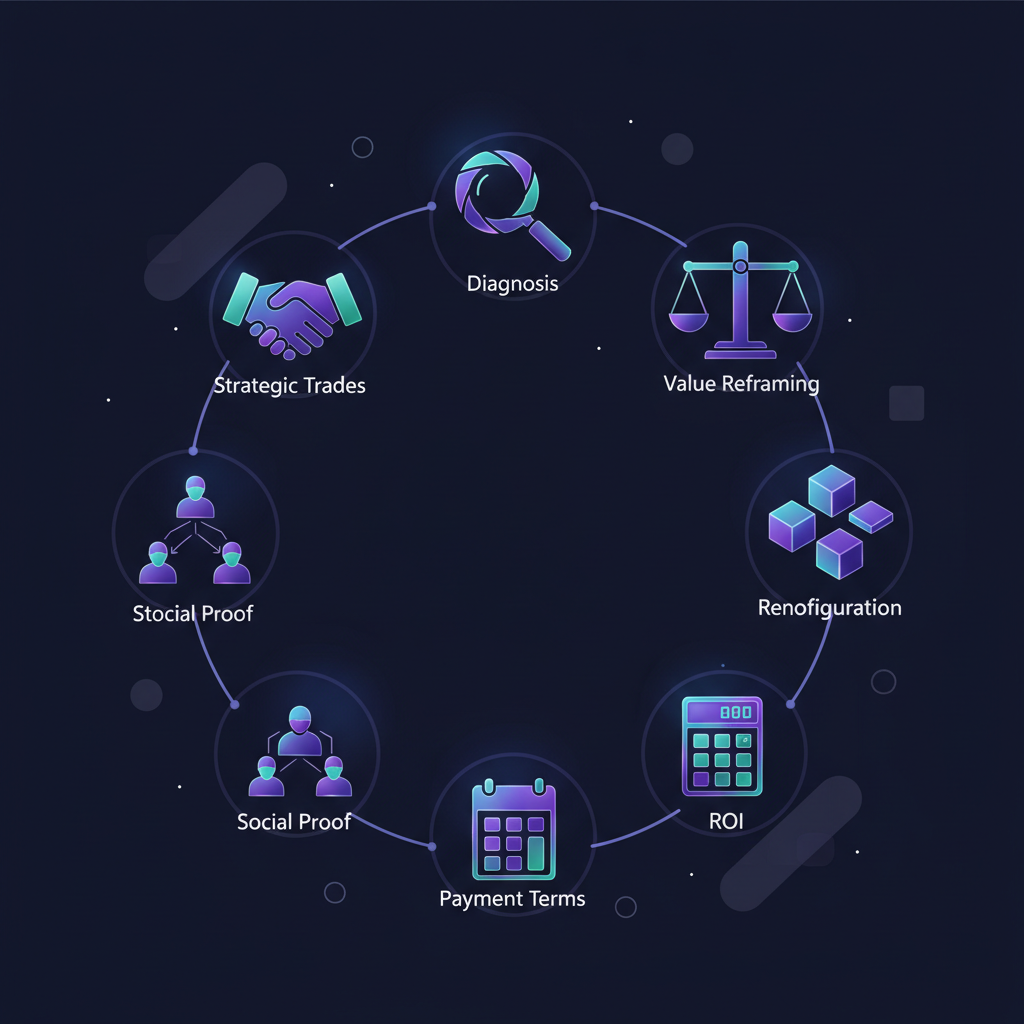
These frameworks are sequenced intentionally. Start at the top and work down—each one gives you more room to maneuver without eroding margin.
Framework 1: Isolate and diagnose the real objection
When a prospect says "it's too expensive," that's almost never the complete picture. Your first job is to figure out what's actually happening.
Tactical script:
"I appreciate you being direct about the price. Can I ask—when you say it's too expensive, what are you comparing it to? Is it the budget you had in mind, a competitor's quote, or something else?"
Then go silent. Let them fill the space.
What you're listening for:
- Budget timing mismatch: "We only have $X allocated this quarter." (Solution: adjust payment terms or start date, not price.)
- Sticker shock without context: "I just wasn't expecting that number." (Solution: rebuild ROI and cost of inaction.)
- Competitive anchor: "Competitor X quoted us 30% less." (Solution: differentiate on value, not price—see our guide on handling competitor objections.)
- Lack of authority: "I'll need to get this approved." (Solution: navigate to economic buyer or coach your champion.)
- No compelling event: "We're just not sure we need to move now." (Solution: uncover a compelling event during discovery or create urgency.)
Why this works: You're refusing to accept the surface objection and forcing the prospect to articulate the real concern. Half the time, this alone changes the conversation—they realize price isn't actually the blocker.
Framework 2: Reframe value against cost of inaction
If the objection is rooted in perceived value, your job is to make the cost of not buying far more painful than your price.
This only works if you did a thorough discovery process. You need their numbers—current cost of the problem, revenue at risk, time wasted, inefficiency losses.
Tactical approach:
- Recap the pain in their words: "You mentioned your team is spending 20 hours a week on manual data entry, and that's causing a two-day delay in your quote-to-cash cycle."
- Quantify the cost: "At your average deal size of $50K and a close rate of 30%, that two-day delay is costing you roughly $X in delayed cash flow per quarter—and that's before we factor in the labor cost of those 20 hours."
- Position your price as a fraction: "Our solution eliminates that delay and saves your team 18 of those 20 hours. The ROI is 4× in year one, and the payback period is under 90 days. So the real question isn't whether you can afford $Y—it's whether you can afford not to fix this now."
Script example:
"I hear you on the price. Let me ask you this: you told me this problem is costing you $200K a year in lost productivity. Our annual fee is $60K. If we solve even half of that problem, you're still netting $40K. What's the cost of waiting another quarter to fix this?"
Why this works: You're flipping the frame. The prospect is no longer evaluating your price in isolation—they're weighing it against the quantified cost of their status quo.
Framework 3: Unbundle and reconfigure your offer
Often, the prospect doesn't need everything in your standard package—or they need it sequenced differently. Instead of discounting, reconfigure.
Tactical options:
- Remove features they don't value: "If we pull out the advanced reporting module you mentioned you wouldn't use in year one, we can bring this down to $X. You can add it back when you're ready."
- Adjust service levels: "Our premium tier includes white-glove onboarding and a dedicated CSM. If you're comfortable with self-serve onboarding and pooled support, we have a mid-tier option at $Y."
- Phase the implementation: "What if we start with your sales team in Q1, prove ROI, then expand to marketing in Q2? That cuts your upfront investment in half."
- Reduce user count or scope: "You mentioned 100 seats, but only 60 are active daily. Let's start with 60 licenses and scale up as adoption grows."
Why this works: You're hitting their budget constraint without giving away margin on the full solution. You're also creating a natural expansion path—once they see value, they'll come back for the rest.
Important caveat: Only unbundle if it doesn't sabotage their success. Don't remove something critical just to hit a number. You'll end up with a failed implementation and a churned logo.
Framework 4: Introduce payment flexibility (not discounts)
Prospects often conflate "total cost" with "cash outlay today." You can solve their budget problem without changing your price by adjusting when and how they pay.
Tactical options:
- Quarterly or monthly payments: "Our annual price is $60K. If cash flow is the concern, we can structure this as $5,500/month. The total is slightly higher to account for payment processing, but it spreads the cost across your fiscal year."
- Delayed start date: "If budget opens up in Q2, we can sign the contract now and start billing April 1. That gives you time to allocate funds and gets us moving on implementation."
- Milestone-based payments: "We can tie payments to implementation milestones—one-third at kickoff, one-third at go-live, one-third at 90-day review. You're only paying as you see progress."
- Pilot or proof-of-concept: "Let's run a 60-day pilot with a smaller team at $X. If you hit the success metrics we agree on, you roll it out company-wide at the full price."
Script example:
"I understand the $60K annual commitment feels like a big number right now. What if we structured this as $16K per quarter? You get the full platform, we get predictable revenue, and your finance team can manage it within existing budget allocations."
Why this works: You're solving their cash flow problem, not their value problem. And you're doing it without eroding margin—in fact, monthly/quarterly terms often carry a small premium.
Framework 5: Build ROI with their numbers, not yours
Generic ROI claims ("Our customers see 3× ROI!") don't move deals. Specific ROI models built with the prospect's own data do.
Tactical approach:
- Use discovery data: Pull the metrics they gave you—current cost, time spent, revenue impact, error rates, whatever's relevant.
- Build a simple model together: Don't email them a spreadsheet. Walk through it live on a call or in person. Make them input the numbers.
- Show payback period and annualized return: "Based on your numbers, you'll break even in 4 months. Over 12 months, the net benefit is $X. Over three years—your contract term—it's $Y."
- Contrast with cost of delay: "If you wait six months to implement, you're leaving $Z on the table. That's more than the cost of our solution."
Script example:
"Let's build this ROI model together using your numbers, not ours. You said you're processing 500 quotes a month, and each one takes your team 45 minutes. That's 375 hours a month. At a blended labor rate of $50/hour, that's $18,750 in monthly labor cost. Our platform cuts that time by 70%. So you're saving roughly $13K a month, or $156K a year. Our annual fee is $60K. That's a 2.6× ROI in year one, and you break even in under five months. Does that math make sense to you?"
Why this works: You're making the prospect do the math with you. They're no longer arguing against your price—they're defending their own ROI calculation.
Framework 6: Leverage social proof and de-risk the decision
Sometimes price resistance is actually risk resistance. The prospect isn't sure your solution will work for them, so the price feels dangerous.
Tactical approaches:
- Case studies from similar buyers: "I hear the concern. Let me share how [Company X]—same industry, similar size—approached this. They had the same budget hesitation. They started with a pilot, hit 4× ROI in 90 days, and expanded company-wide. Here's their CFO on a recorded call talking about the decision."
- Offer a performance guarantee: "If you don't see [specific outcome] within [timeframe], we'll refund [percentage] of your investment. We're that confident."
- Trial or pilot: "Let's de-risk this. Run a 60-day pilot with your highest-impact team. If it works, roll it out. If it doesn't, you're only out $X."
- Reference calls with economic buyers: "I'd love to connect you with our customer [Name], who's your peer at [Company]. They can walk you through their business case and what the ROI looked like in practice."
Script example:
"I get that this feels like a big investment. Three months ago, [Customer Name] felt the same way. They were comparing us to a cheaper competitor. They chose us because of [differentiator], and within 90 days they saw [specific result]. I can connect you with their VP of Sales if it would help to hear their experience firsthand."
Why this works: You're shifting the conversation from "Can we afford this?" to "Can we afford not to do what our successful peers are doing?"
Framework 7: Trade strategically—never discount unilaterally
If you've exhausted the frameworks above and the deal is still stuck on price, you can adjust pricing—but only as a strategic trade. Never give a concession without getting something valuable in return.
What to trade for:
- Longer contract term: "I can get you to $X if you commit to a three-year term instead of one year. That gives us both predictability and lowers your effective annual cost."
- Expanded scope or user count: "If you bring in your marketing team now instead of waiting for year two, I can offer a bundled rate that brings your per-seat cost down."
- Annual payment upfront: "Our list price is $60K annually. If you pay the full year upfront, I can offer a 10% discount—$54K. That's a one-time concession for cash flow certainty on our side."
- Remove competitors from evaluation: "If you're willing to move forward this week and stop the RFP process, I can take this to my VP and ask for approval to match [competitor's] pricing. But I need a committed decision, not another round of evaluation."
- Reference customer commitment: "I can get you a 15% discount if you agree to be a case study customer—recorded testimonial, logo on our website, and a reference call once a quarter for the first year."
Script example:
"I appreciate you being transparent about the budget. Here's what I can do: if you're willing to commit to a two-year term and serve as a reference customer—which means a case study and two reference calls in year one—I can bring this down to $X. That's a meaningful concession on our side, but it's worth it because we get a long-term partnership and a strong reference in your industry. Does that work?"
Why this works: You're not giving away margin for nothing. You're making a trade that benefits both sides. And you're training the buyer that concessions aren't free—they require commitment.
What to do when the deal is truly unqualified
Sometimes, after working through these frameworks, you realize the deal just isn't there. The prospect doesn't have budget, doesn't have urgency, or doesn't have authority. That's okay. Walking away is a form of objection handling.
Script for disqualifying gracefully:
"I appreciate the time we've spent on this. Based on what you've shared, it sounds like the timing isn't right—and I don't want to push you into something that doesn't make sense for your business right now. Let's stay in touch. If your priorities shift or budget opens up in [Q2/next fiscal year], I'd love to revisit this. In the meantime, I'll send over some resources that might help you build the internal business case when you're ready."
Why this works: You're protecting your time, maintaining your margin, and leaving the door open. Prospects respect sellers who don't chase bad deals. And often, they'll come back when the timing is right—because you treated them like a partner, not a quota number.
How to practice price objection handling until it's instinctive
Reading frameworks is one thing. Executing them under pressure—when a prospect is pushing back and your quota is on the line—is another.
The best reps drill these conversations until they become muscle memory. Here's how:
Role-play with your manager or peers. Run through each framework with someone playing a skeptical buyer. Record it, review it, iterate. Do this until you can execute each script without hesitation. Our AI role-play platform lets you practice price objection scenarios on-demand, with real-time feedback on your positioning and tonality.
Debrief every real price objection. After a call where price came up, prepare thoroughly for every sales conversation by reviewing what you said, what worked, and what you'd change. Build a personal library of responses that feel natural to you.
Study your top performers. Shadow AEs who consistently close without discounting. Listen to how they reframe value, how they pause, how they trade concessions. Steal what works.
Get coached on real recordings. If your team uses conversation intelligence, flag price objection moments and ask your manager to coach you on them. Specific feedback on real situations beats generic advice every time.
Bringing it all together: a price objection handling checklist
When a prospect says "it's too expensive," here's your playbook:
- Pause. Don't react defensively or rush to justify. Take a breath.
- Isolate the real objection. Ask what they're comparing to, what's driving the concern.
- Reframe against cost of inaction. Use their numbers to show what they lose by waiting.
- Reconfigure before discounting. Unbundle, phase, or adjust scope to hit their number without killing margin.
- Offer payment flexibility. Solve their cash flow problem, not their value problem.
- Build ROI together. Use their data to create a model they can defend internally.
- Leverage social proof. Show them how peers made the same decision successfully.
- Trade strategically if needed. Never give a concession without getting something valuable in return.
- Disqualify gracefully if the deal isn't real. Protect your time and maintain your positioning.
FAQ
How do you handle a price objection without giving a discount?
Handle price objections by first isolating whether price is the real issue, then reframing value against the cost of inaction, unbundling or reconfiguring your offer, introducing payment flexibility, quantifying ROI with the prospect's own numbers, or bringing in social proof from similar buyers. Only discount strategically when tied to concessions that benefit you.
What are the most common mistakes when handling price objections?
The biggest mistakes are discounting immediately without diagnosing the real objection, defending your price emotionally, talking more instead of asking questions, failing to quantify ROI in the prospect's context, and giving discounts without securing anything in return such as longer contract terms or expanded scope.
When should you actually offer a discount in B2B sales?
Offer discounts strategically only when the buyer commits to something valuable in return: a longer contract term, a larger user count, an annual payment, removing competitors from evaluation, or agreeing to serve as a reference customer. Never discount unilaterally—always trade concessions.
How do you quantify ROI during a price objection conversation?
Use the prospect's own numbers from discovery: current cost of the problem, time wasted, revenue at risk, or efficiency lost. Build a simple ROI model together showing payback period and annualized return. Make them articulate the cost of doing nothing, then position your price as a fraction of that cost.
Price objection handling isn't about having the perfect script—it's about having the discipline to diagnose, reframe, and trade strategically instead of reflexively discounting. The frameworks in this guide give you a repeatable system for protecting margin while still closing deals. Practice them, adapt them to your product and market, and watch your average deal size and margin both climb.
For more on mastering the full spectrum of objections you'll face in B2B sales, explore our The Complete Guide to Sales Objection Handling. And if you're ready to drill these skills until they're instinctive, see how AI role-play can accelerate your team's objection-handling performance.

Stefano Sechi
Co-founder, QUOTA Training
Stefano Sechi is co-founder of QUOTA Training. He works hands-on with B2B sales teams on cold calling, discovery and objection handling, and shaped much of the methodology behind QUOTA’s AI role-play scenarios.
Turn this into reps, not just reading
QUOTA Training lets your team practise these exact scenarios with an AI buyer that reacts like the real thing — then scores every call.
See it in action