Multithreading Sales: How to Reach Every Deal Stakeholder
Part of the Discovery guide: The Complete Guide to Sales Discovery Calls (2025)Multithreading sales means engaging multiple stakeholders in parallel. Learn tactical frameworks, scripts, and mapping strategies to de-risk deals.

Key takeaways

- Multithreading sales means building parallel relationships with multiple stakeholders in a deal, reducing single-point-of-failure risk by 60–80% according to Gartner research on B2B buying committees.
- Start multithreading during early discovery—not late-stage—by mapping the buying committee, identifying each stakeholder's role, priorities, and influence level before requesting introductions.
- Use a champion-centric script that positions additional conversations as de-risking their project, not satisfying your process, to earn warm introductions across departments and levels.
- Track each stakeholder's engagement, sentiment, and blockers in your CRM; deals with 3+ engaged stakeholders close 2.3× faster than single-threaded opportunities.
- Practice multithreading conversations using an AI role-play platform to refine your ask, handle pushback, and build confidence before high-stakes calls.
Why multithreading sales is non-negotiable in complex B2B deals
If your deal lives or dies with one contact, you don't have a deal—you have a dependency.
Multithreading sales is the practice of building genuine, value-driven relationships with multiple stakeholders across an account in parallel. It's not about "going around" your champion; it's about collaborating with them to ensure the entire buying committee is aligned, informed, and advocating for your solution.
Here's why it matters:
- Champion risk: Your single contact gets promoted, leaves the company, or loses budget authority. Without other threads, your deal evaporates.
- Hidden blockers: A procurement lead, a technical gatekeeper, or a silent executive can kill your deal in the eleventh hour if you've never spoken to them.
- Consensus buying: Gartner research on B2B buying committees shows the average enterprise deal involves 6–10 stakeholders. If you're only talking to one, you're missing 80% of the conversation.
Multithreading isn't a late-stage rescue tactic. It's a discovery discipline that should start the moment you qualify an opportunity. This guide will show you how to map stakeholders, earn introductions, tailor your messaging, and track engagement—so you never lose a deal to a single point of failure again.
For a broader view of discovery best practices, see our comprehensive discovery call framework.
The stakeholder mapping framework: who to engage and why
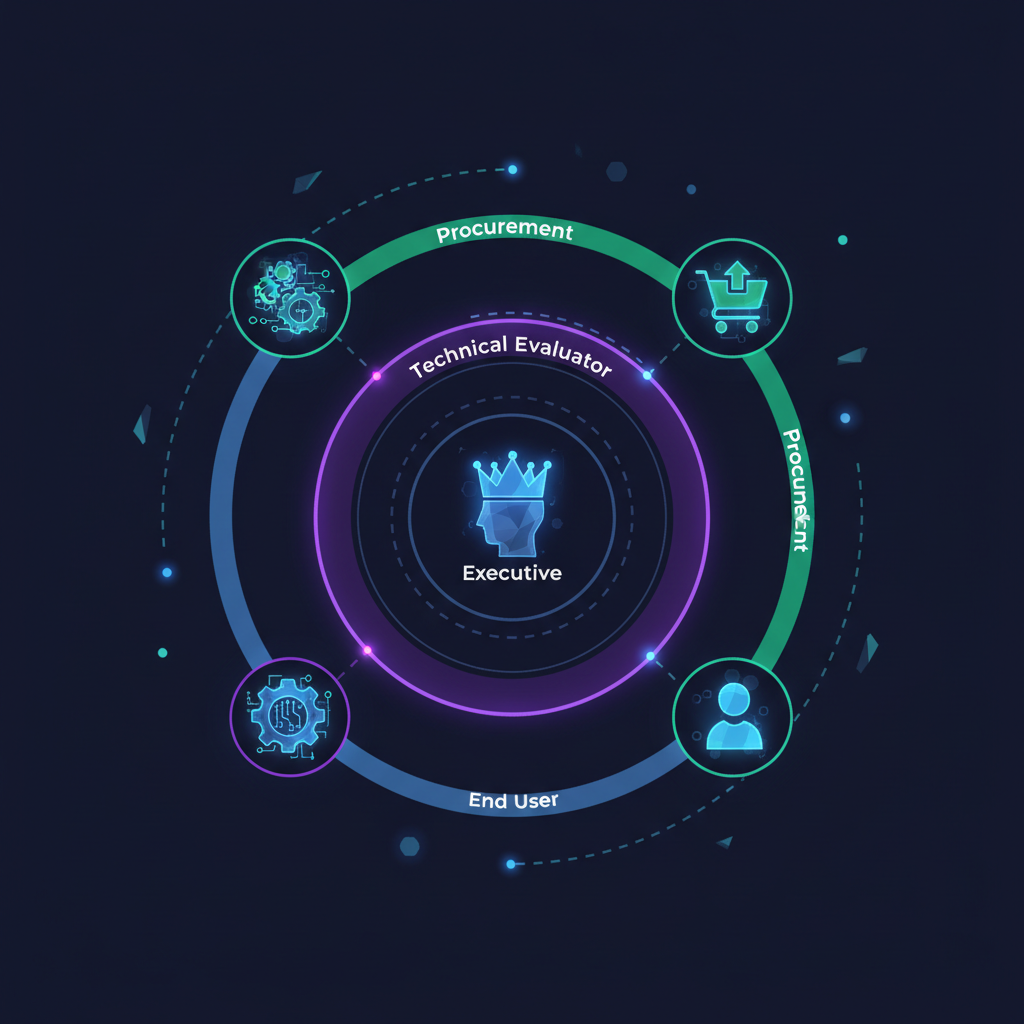
Before you can multithread, you need a map. Not every stakeholder matters equally, and not every conversation should happen in the same order.
Step 1: Identify the core buying roles
In most B2B deals, you'll encounter these archetypes:
| Role | What they care about | When to engage |
|---|---|---|
| Economic Buyer | ROI, budget, strategic alignment | Mid-to-late discovery |
| Technical Evaluator | Integration, security, scalability, risk | Early-to-mid discovery |
| End User / Champion | Ease of use, day-to-day impact, personal win | First contact (usually) |
| Procurement / Legal | Compliance, terms, vendor risk, pricing | Late-stage (but brief early) |
| Executive Sponsor | Business outcomes, competitive advantage | Mid-to-late (via champion) |
Your goal is to engage at least three of these roles before moving to proposal. The MEDDIC qualification methodology calls this "identifying the Economic Buyer and Champion"—but true multithreading goes deeper.
Step 2: Map influence and decision authority
Not all stakeholders have equal power. Use this simple 2×2:
- High influence, high authority: Economic Buyer, Executive Sponsor. Must be aligned.
- High influence, low authority: Champion, Senior End User. Your coaches and internal advocates.
- Low influence, high authority: Procurement, Legal. Can block but rarely champion.
- Low influence, low authority: Junior users. Valuable for adoption insights, not deal progression.
Document this in your CRM. If you're using Salesforce insights on account management, create a "Stakeholder" custom object or use Opportunity Contact Roles with influence scores.
Step 3: Understand each stakeholder's "job to be done"
Multithreading fails when reps treat every conversation the same. A CFO doesn't care about your UI; a product manager doesn't care about your enterprise SLA.
For each stakeholder, answer:
- What metric or outcome is their performance measured on?
- What problem does your solution solve for them specifically?
- What objection or concern are they most likely to raise?
This research should happen during discovery, often by asking your champion directly: "Who else will be involved in evaluating this? What does success look like for them?" These are core SPIN selling questions that unlock the org chart.
How to earn warm introductions without alienating your champion
The #1 fear reps have about multithreading: "My champion will think I don't trust them."
The solution? Frame every request as helping them succeed, not satisfying your process.
The psychology of the ask
Your champion wants this deal to work. But they also fear:
- Looking like they didn't do their homework if the deal gets blocked later.
- Losing control of the narrative if you go rogue.
- Being bypassed or undermined.
Your job is to position multithreading as de-risking their project, not doubting their authority.
Tactical scripts for requesting introductions
Scenario 1: Asking to meet the Economic Buyer
"[Champion], you've made it clear this solves [specific pain]. To make sure we can move quickly and get you live by [compelling event], I'd love a short conversation with [Economic Buyer] to align on ROI and timing. Would you be comfortable making that introduction? I want to make sure we're set up to get their buy-in early."
Why this works:
- You anchor to their pain and timeline (see our guide on uncovering a compelling event).
- You position the ask as accelerating the deal, not slowing it down.
- You explicitly request their help, reinforcing their role.
Scenario 2: Asking to meet the Technical Evaluator
"I want to make sure our solution integrates smoothly with [their stack]. Could you introduce me to your technical lead so we can walk through architecture and security requirements? I'd hate for us to get to contracting and hit a surprise blocker."
Why this works:
- You're solving a problem for them (avoiding late-stage surprises).
- You're asking for help, not permission.
Scenario 3: Asking to meet End Users
"To make sure this drives adoption across your team, I'd love to hear from a couple of end users about their day-to-day workflow. Would you be open to setting up a 20-minute session with [role]? It'll help us tailor the onboarding and ensure a smooth rollout."
Why this works:
- You frame it as improving their adoption and success.
- You're specific about time (20 minutes) and purpose.
When your champion says no
If they resist, probe gently:
"No problem—help me understand: is there a concern about involving [stakeholder] at this stage, or is it more about timing?"
Often, resistance signals:
- Political risk: They don't have the relationship capital to make the intro. (You may need to help them build it.)
- Control: They fear losing ownership. (Reassure them you'll keep them in the loop and position them as the hero.)
- Lack of urgency: They don't see the deal as real yet. (Go back to discovery and re-establish the compelling event.)
If they still refuse to introduce you to the Economic Buyer or key technical stakeholders, that's a red flag. You may not have a real champion—or a real deal.
Tailoring your message for each stakeholder
Once you've earned the introduction, don't waste it with a generic pitch.
Messaging matrix: same solution, different angles
| Stakeholder | Lead with | Avoid |
|---|---|---|
| Economic Buyer | ROI, payback period, strategic outcomes | Feature walkthroughs, technical jargon |
| Technical Evaluator | Architecture, security, integration, scalability | Business outcomes, fluff |
| End User / Champion | Day-to-day impact, ease of use, quick wins | High-level strategy, pricing |
| Procurement / Legal | Compliance, terms flexibility, vendor stability | Product features, competitive comparisons |
| Executive Sponsor | Competitive advantage, market positioning, risk mitigation | Tactical details, implementation steps |
Example: same discovery question, three stakeholders
To the Champion (End User):
"Walk me through your current process for [task]. Where does it break down?"
To the Technical Evaluator:
"What's your current stack for [function]? What integration or security requirements do we need to meet?"
To the Economic Buyer:
"What's the cost—financial and operational—of the current state? What does success look like in 12 months?"
Each question uncovers the same deal intelligence, but the framing matches the stakeholder's lens.
Tracking and managing multithreaded engagement
Multithreading creates complexity. Without a system, you'll lose track of who said what, who's aligned, and who's ghosting you.
CRM hygiene for multithreaded deals
- Log every stakeholder as a Contact Role on the Opportunity (or equivalent in your CRM).
- Assign an influence score (1–5) and a sentiment tag (Champion, Neutral, Blocker).
- Track last touch date and next action for each stakeholder.
- Use a shared doc or CRM notes field to maintain a "stakeholder narrative"—what each person cares about, what they've committed to, and what objections they've raised.
The multithreading scorecard
Before moving a deal to the next stage, ask:
- Have I spoken to at least three stakeholders across different roles?
- Do I know who the Economic Buyer is, and have I had a conversation with them (or have a path to one)?
- Have I identified at least one coach or champion who will advocate internally?
- Do I understand each stakeholder's top priority and how we solve it?
- Have I uncovered any blockers or objections from non-champion stakeholders?
If you can't check at least four of these boxes, your deal is single-threaded and at risk.
For ongoing deal hygiene, integrate this checklist into your call debrief practices and pipeline reviews.
Common multithreading mistakes (and how to avoid them)
Mistake 1: Waiting until late-stage to multithread
Why it fails: By the time you're at proposal or negotiation, requesting new introductions signals panic or distrust. Stakeholders feel ambushed.
Fix: Start mapping and engaging stakeholders during discovery. Make it a natural part of your qualification process.
Mistake 2: Going around your champion without warning
Why it fails: Your champion feels undermined, loses trust, and may actively block you.
Fix: Always request introductions through your champion first. If you must go direct (e.g., via LinkedIn), give them a heads-up and frame it as exploratory.
Mistake 3: Treating every stakeholder the same
Why it fails: A CFO doesn't care about your Slack integration; an IT lead doesn't care about your ROI calculator.
Fix: Tailor your discovery questions, talk tracks, and follow-up materials to each stakeholder's role and priorities (see messaging matrix above).
Mistake 4: Forgetting to keep your champion in the loop
Why it fails: Once you've multithreaded, your original champion can feel sidelined. They stop advocating for you.
Fix: After every new stakeholder conversation, send a brief update to your champion: "Just wrapped with [name]—here's what we covered and next steps. Let me know if you'd like to sync before [next milestone]."
Multithreading in action: a real-world example
Scenario: You're selling a revenue intelligence platform to a Series B SaaS company. Your initial contact is the VP of Sales (your champion).
Week 1–2: Discovery and initial mapping
- Call 1 with VP of Sales: Uncover pain (forecast accuracy, rep ramp time), identify compelling event (new CRO starting in 60 days), and map the buying committee.
- Ask: "Who else will need to weigh in—RevOps, your CRO, IT?"
- Result: You learn the CRO is the Economic Buyer, the RevOps Manager is the Technical Evaluator, and IT has to approve any new data integrations.
Week 3: Secure introductions
- Email to VP of Sales: "To make sure we're aligned on ROI and can move quickly for [CRO's] start date, would you introduce me to [CRO] for a 20-minute strategy conversation?"
- Result: VP of Sales makes the intro. You schedule a call with the CRO.
Week 4: Engage the Economic Buyer
- Call with CRO: Focus on business outcomes (forecast accuracy, rep productivity), tie to their 90-day plan, and confirm budget authority.
- Ask: "What does success look like in your first quarter? How does improving forecast accuracy ladder up to that?"
- Result: CRO confirms this is a priority and asks you to align with RevOps on implementation.
Week 5: Engage the Technical Evaluator
- Call with RevOps Manager: Walk through data model, integration with Salesforce and Gong, and security requirements.
- Ask: "What's your current process for syncing call data? What integration or compliance requirements do we need to meet?"
- Result: RevOps Manager becomes a secondary champion—they see this solving their manual reporting pain.
Week 6: Close the loop with IT
- Brief call with IT: Confirm SSO, data residency, and SOC 2 compliance.
- Result: IT gives the green light.
Outcome
You've now spoken to four stakeholders across three levels of the org. You have:
- An Economic Buyer (CRO) who confirmed budget and timeline.
- A Champion (VP of Sales) who introduced you and is advocating internally.
- A Technical Evaluator (RevOps) who is aligned and excited.
- A Compliance gatekeeper (IT) who has no blockers.
Your deal is multithreaded, de-risked, and forecast-able. Even if the VP of Sales leaves tomorrow, you have three other threads.
How to practice multithreading with AI role-play
Multithreading requires nuance: reading political dynamics, tailoring your message, and asking for introductions without sounding needy.
The best reps practice these conversations before they're on a live call.
Use an AI role-play platform to simulate:
- Asking your champion for an introduction to the Economic Buyer (and handling pushback).
- Running a discovery call with a skeptical CFO who only cares about ROI.
- Navigating a technical deep-dive with an IT lead who's risk-averse.
Record your reps' role-play sessions, review them using call debrief practices, and track improvement over time. Multithreading is a skill—and like any skill, it improves with deliberate practice.
FAQ
What does multithreading mean in sales?
Multithreading in sales means building relationships with multiple stakeholders across different levels and departments within a target account, rather than relying on a single point of contact. It de-risks deals by ensuring your opportunity doesn't die if one champion leaves or loses influence.
How many stakeholders should I engage in a complex deal?
For enterprise deals, aim to engage at least 3-5 stakeholders across different roles: an economic buyer, a technical evaluator, a day-to-day user, and ideally a coach or internal champion. The complexity of your solution and deal size will dictate the exact number.
When should I start multithreading a deal?
Start multithreading during early discovery. Once you've established rapport with your initial contact, ask them to introduce you to other stakeholders involved in the decision. Waiting until late-stage to multithread often signals distrust and can backfire.
How do I ask my champion to introduce me to other stakeholders?
Frame it as helping them succeed: "To make sure this delivers value across your team, I'd love to understand [role]'s priorities. Would you be comfortable introducing us?" Position additional conversations as reducing their risk and ensuring adoption.
What if my champion refuses to introduce me to the Economic Buyer?
Probe gently to understand why: "Is there a concern about involving [stakeholder] at this stage, or is it more about timing?" If they consistently refuse access to key decision-makers, it may signal you don't have a real champion—or a real deal. Reassess your qualification and consider whether this opportunity is truly viable.

Stefano Breglia
Co-founder, QUOTA Training
Stefano Breglia is co-founder of QUOTA Training. He focuses on sales methodology, deal progression and how AI simulation accelerates rep ramp time across the SDR, BDR, AE and AM roles.
Turn this into reps, not just reading
QUOTA Training lets your team practise these exact scenarios with an AI buyer that reacts like the real thing — then scores every call.
See it in action