Discovery Call Agenda: Build a Structure That Uncovers Pain
Part of the Discovery guide: The Complete Guide to Sales Discovery Calls (2025)A proven discovery call agenda framework that guides reps through buyer conversations, uncovers real pain, and builds pipeline that closes.

Key takeaways
- A discovery call agenda should follow a five-phase structure: rapport (2-3 min), context-setting (5 min), questioning (20-30 min), qualification confirmation (5 min), and next steps (3-5 min).
- Reps who share a simplified version of their agenda at the call's start ("Here's how I'd like to use our time…") increase buyer engagement by creating transparency and reducing prospect anxiety about being "sold to."
- The best discovery call agendas are guides, not scripts—high performers deviate from the agenda 40-60% of the time based on buyer cues, while weak reps treat it as a checklist and miss critical signals.
- Pre-loading your agenda with three anchor questions (current state, desired state, and blockers) ensures you capture minimum viable qualification data even if the call goes off-track.
- Discovery call agendas fail when reps skip context-setting and jump straight to questions, causing buyers to give surface-level answers because they don't understand why the information matters.
Most discovery calls fail before the rep asks the first question.
Not because the questions are wrong. Not because the rep lacks product knowledge. But because there's no discovery call agenda—no shared structure that guides both parties through the conversation.
Without an agenda, discovery calls become interrogations. Reps fire questions. Buyers give short answers. Nobody knows where the conversation is going or why it matters. The call ends with "I'll send over some information" instead of a qualified next step.
A strong discovery call agenda solves this. It's not a rigid script. It's a flexible framework that helps reps navigate buyer conversations, uncover real pain, and qualify deals that actually close. This guide shows you how to build one that works.
For a broader overview of discovery fundamentals, see our complete guide to sales discovery calls.
Why most discovery call agendas don't work
The typical discovery call agenda looks like this:
- Introduction
- Ask discovery questions
- Present solution
- Schedule demo
It's linear. It's logical. And it completely ignores how buyers actually communicate.
Real discovery calls don't follow a straight line. Buyers mention a problem in minute three, circle back to budget in minute twelve, and reveal the real blocker in minute twenty-eight. If your agenda can't flex with that reality, you'll miss the insights that matter.
Here's what breaks:
Agendas built around rep goals, not buyer needs. Most agendas are designed to extract information ("I need to qualify BANT"). The buyer feels interrogated. They give surface answers and disengage.
No context-setting. Reps skip the step where they explain why they're asking questions. Buyers don't understand the relevance, so they default to generic responses that don't reveal pain.
Treating the agenda as a checklist. Reps march through questions in order, even when the buyer signals something important. They prioritize "finishing" the agenda over following the conversation.
No built-in adaptation points. The agenda assumes everything goes as planned. When a buyer says "Actually, we're not the decision-maker," the rep has no framework for pivoting.
In our AI role-play sessions at QUOTA, we see this pattern constantly: reps who rigidly follow their agenda score lower on qualification accuracy than reps who use the agenda as a guide and adapt in real-time. The difference isn't preparation—it's flexibility.
The anatomy of a high-performing discovery call agenda
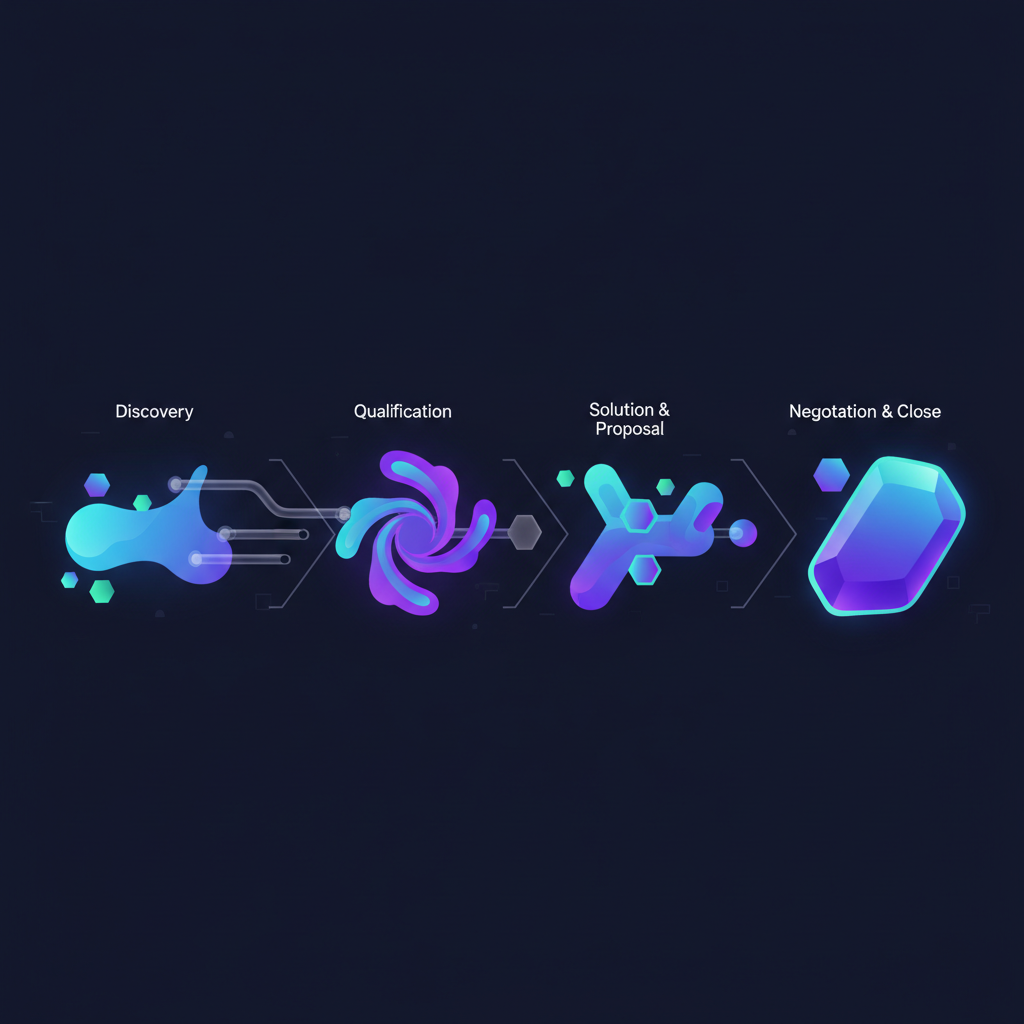
A strong discovery call agenda has five phases. Each phase has a purpose, a time allocation, and decision points that tell you when to move forward or dig deeper.
Phase 1: Rapport and permission (2-3 minutes)
Purpose: Establish credibility and get explicit permission to ask questions.
What it looks like:
"Thanks for taking the time. I know you're busy, so here's how I'd like to use the next 30 minutes. I'd like to spend most of our time understanding your current process and the challenges you're facing. Then, if it looks like there's a fit, we can talk about next steps. Does that work for you?"
This does three things:
- Sets expectations (the call is about them, not your pitch)
- Gets explicit permission (they agree to the structure)
- Reduces sales anxiety (you're not going to ambush them with a demo)
Common mistake: Skipping this entirely and diving straight into "So, tell me about your current process." The buyer doesn't know why you're asking or where the conversation is going. They stay guarded.
Phase 2: Context-setting (5 minutes)
Purpose: Share why you're asking questions and what you'll do with the information.
What it looks like:
"Before I ask about your process, let me give you quick context. We work with [similar companies] who typically struggle with [common pain]. Some of them find that [specific outcome] makes a big difference. I want to understand whether that's relevant to you, or if you're dealing with something completely different. Fair?"
This is the step most reps skip—and it's the reason buyers give shallow answers.
When you explain why the questions matter, buyers understand the relevance. They stop giving generic responses and start sharing real challenges. According to Gong's analysis of discovery calls, top performers spend 2-3 minutes on context-setting, while average reps spend less than 30 seconds.
Context-setting also establishes credibility. You're not fishing for information—you have a hypothesis based on working with similar buyers. That signals expertise.
Phase 3: Questioning and active listening (20-30 minutes)
Purpose: Uncover current state, desired state, and blockers. Qualify fit.
This is the core of your discovery call agenda. But instead of a linear list of 20 questions, structure it around three anchor questions:
Anchor question 1: Current state
"Walk me through how you handle [process] today. What does that look like day-to-day?"
Anchor question 2: Desired state
"If you could wave a magic wand, what would change? What would that unlock for you?"
Anchor question 3: Blockers
"What's stopped you from making that change so far?"
These three questions give you minimum viable qualification data. Everything else is follow-up.
The key is spending 70% of this phase listening, not talking. Use the active listening techniques we cover in depth elsewhere: paraphrase what you hear, label emotions, and ask clarifying questions before moving on.
Decision point: If the buyer reveals a blocker you can't solve, acknowledge it and pivot: "That's helpful to know. It sounds like [X] might not be the right fit right now. Would it make sense to explore [alternative path]?"
For a deeper dive into qualification mechanics, see our guide to the BANT-MEDDIC qualification framework.
Phase 4: Qualification confirmation (5 minutes)
Purpose: Summarize what you heard and confirm next steps are worth both parties' time.
What it looks like:
"Let me make sure I captured this correctly. You're currently [current state], which is causing [pain]. Ideally, you'd [desired state], but [blocker] has been in the way. Does that sound right?"
Pause. Let them correct you.
"Based on what you've shared, I think there's a fit here. The next step would be [demo/technical call/proposal], where we'd focus specifically on [solving X]. Does that feel like the right next step to you?"
This is where weak discovery calls fall apart. Reps assume the buyer is qualified and jump straight to "Let's schedule a demo." The buyer agrees because it's easier than saying no. Then they ghost.
Qualification confirmation forces the buyer to explicitly agree that the next step is worth their time. If they hesitate, you surface the objection now instead of in a no-show.
Phase 5: Next steps and logistics (3-5 minutes)
Purpose: Lock in the next meeting and clarify who else needs to be involved.
What it looks like:
"Great. For that [demo/call], who else should be in the room? Anyone who'd have a strong opinion on [solving the pain you discussed]?"
Then schedule the meeting while you're still on the call. Don't rely on a follow-up email. Buyers who verbally commit to a time show up 60-70% more often than buyers who say "send me some times."
Common mistake: Ending with "I'll send over a calendar invite." The buyer agrees, the call ends, and the deal stalls because you never locked in a time.
How to adapt your discovery call agenda in real-time

The agenda above is your baseline. But real discovery calls require real-time adaptation.
Here's how high performers do it:
When the buyer reveals unexpected pain: Pause your agenda. Go deep on that pain. Ask three follow-up questions before moving on. The agenda can wait—this is the signal that matters.
When the buyer says "I'm not the decision-maker": Pivot immediately. Ask: "Got it. Who typically makes the call on something like this? And what role do you play in that decision?" Then adjust your qualification criteria. You're now qualifying the buyer's influence, not their authority.
When the buyer asks to see a demo early: Acknowledge the request, then reframe: "I'd love to show you what's relevant. To make sure I don't waste your time on features you don't need, can I ask three quick questions about your current process?" This respects their request while protecting your qualification.
When you're running out of time: Cut phase 2 (context-setting) and phase 4 (confirmation). Prioritize phase 3 (questioning) and phase 5 (next steps). You can always add context in a follow-up email. You can't recover a deal that stalls because you didn't lock in the next meeting.
In our AI role-play scenarios, we train reps on exactly these pivots. The goal isn't to memorize a script—it's to recognize the signal and adapt the agenda in the moment.
Discovery call agenda templates by deal type
Not all discovery calls are the same. Here's how to adapt your agenda based on deal complexity:
Template 1: Transactional deals (<$10K ACV, single decision-maker)
- Rapport: 1-2 minutes
- Context-setting: 2-3 minutes (brief, focus on common pain)
- Questioning: 10-15 minutes (focus on current state and urgency)
- Qualification confirmation: 3 minutes
- Next steps: 2 minutes (schedule demo immediately)
Key difference: Speed matters. These buyers expect a faster process. Spend less time on rapport, more time on urgency and timeline.
Template 2: Mid-market deals ($10K–$100K ACV, 2-4 stakeholders)
- Rapport: 2-3 minutes
- Context-setting: 5 minutes (include social proof from similar companies)
- Questioning: 20-25 minutes (cover current state, desired state, blockers, and buying process)
- Qualification confirmation: 5 minutes (confirm next step and who else needs to be involved)
- Next steps: 3-5 minutes (multi-thread: schedule follow-up with additional stakeholders)
Key difference: You're qualifying the buying process, not just the pain. Ask: "Walk me through how decisions like this typically get made at [company]."
Template 3: Enterprise deals (>$100K ACV, 5+ stakeholders)
- Rapport: 3-5 minutes (relationship matters more at this level)
- Context-setting: 5-7 minutes (demonstrate deep understanding of their industry and challenges)
- Questioning: 25-30 minutes (cover pain, process, politics, and success criteria)
- Qualification confirmation: 5-7 minutes (confirm champion, budget, and internal alignment)
- Next steps: 5 minutes (map out multi-step process, identify next three meetings)
Key difference: Discovery is multi-call. This first conversation qualifies whether to invest in a longer sales cycle. Focus on identifying a champion who can guide you through internal politics.
For more on structuring discovery across different frameworks, explore our breakdown of discovery call frameworks.
Common discovery call agenda mistakes (and how to fix them)
Mistake 1: Using the same agenda for every buyer
Why it fails: A CFO cares about ROI and risk. An operations manager cares about workflow and adoption. If your agenda doesn't flex based on persona, you'll ask irrelevant questions and lose credibility.
Fix: Build persona-specific agendas. Adjust your anchor questions and context-setting based on who you're talking to. For a CFO, lead with financial impact. For an ops manager, lead with process efficiency.
Mistake 2: Asking questions you could have answered with research
Why it fails: Buyers expect you to have done basic homework. If you ask "What does your company do?" or "How many employees do you have?", you signal that you didn't prepare. They disengage.
Fix: Front-load your pre-call research process and reference it in your context-setting: "I saw on LinkedIn that you recently expanded into [market]. I'm curious how that's affecting [process]…" This shows you did the work.
Mistake 3: Ending discovery without a clear next step
Why it fails: Buyers are busy. If you end with "I'll follow up next week," the deal stalls. There's no commitment, no urgency, and no accountability.
Fix: Always end phase 5 with a locked-in meeting. "Let's get 30 minutes on the calendar for [specific next step]. I'm looking at [date/time]—does that work?" Don't leave the call without a confirmed time.
Mistake 4: Treating objections as roadblocks instead of signals
Why it fails: When a buyer says "We're not sure about budget" or "We need to talk to the team," weak reps panic and rush to close. Strong reps recognize it as a qualification signal and dig deeper.
Fix: Build objection-handling into your agenda. When a buyer raises a concern, pause and explore it: "Help me understand that. When you say budget is tight, what does that mean for a project like this?" Treat objections as discovery opportunities, not deal-killers.
How to train reps to execute a discovery call agenda
Giving reps an agenda template isn't enough. They need reps to practice adapting it under pressure.
Here's how to build that skill:
Step 1: Role-play the baseline agenda. Have reps practice the five-phase structure with a manager or peer playing the buyer. Focus on smooth transitions between phases and natural delivery (not robotic question-reading).
Step 2: Introduce curveballs. In the next role-play, have the "buyer" throw a curveball: they're not the decision-maker, they want to skip to a demo, or they reveal an unexpected pain. Train reps to recognize the signal and adapt the agenda in real-time.
Step 3: Record and review. Use conversation intelligence tools or manual call recording to capture real discovery calls. In your next coaching session, review where the rep followed the agenda, where they adapted, and where they missed signals. For more on what to track, see our guide to AI conversation intelligence.
Step 4: Use AI role-play for scale. Once reps understand the framework, use AI role-play to give them unlimited reps. At QUOTA, our AI role-play scenarios let reps practice discovery calls with AI buyers who surface realistic objections, curveballs, and qualification challenges. Reps get real-time feedback on whether they followed the agenda, adapted appropriately, and uncovered the right pain.
This is how you move from "here's the template" to "reps who can execute it under pressure."
FAQ
How long should a discovery call agenda be?
A discovery call agenda should allocate 30-45 minutes for most B2B sales conversations. Spend 2-3 minutes on rapport, 5 minutes on context-setting, 20-30 minutes on questioning and active listening, 5 minutes on next steps, and 3-5 minutes buffer for objections or detours.
Should you share your discovery call agenda with the prospect?
Yes. Share a simplified version at the start of the call: "I'd like to spend the first half understanding your current process and challenges, then explore whether we might be a fit. Does that work?" This builds trust and sets expectations without reading a rigid script.
What's the biggest mistake reps make with discovery call agendas?
Treating the agenda as a checklist to complete rather than a guide to navigate. Reps rush through questions to "finish" the agenda instead of following the buyer's cues. The best discovery calls feel conversational because the rep adapts the agenda in real-time based on what the buyer reveals.
How do you handle a prospect who wants to skip discovery and see a demo?
Acknowledge the request, then reframe: "I'd love to show you what's relevant. To make sure I don't waste your time on features you don't need, can I ask three quick questions about your current process?" This positions discovery as respecting their time, not delaying the sale.

Stefano Breglia
Co-founder, QUOTA Training
Stefano Breglia is co-founder of QUOTA Training. He focuses on sales methodology, deal progression and how AI simulation accelerates rep ramp time across the SDR, BDR, AE and AM roles.
Turn this into reps, not just reading
QUOTA Training lets your team practise these exact scenarios with an AI buyer that reacts like the real thing — then scores every call.
See it in action