Discovery Call Preparation: 9 Steps to Win Before You Dial
Part of the Discovery guide: The Complete Guide to Sales Discovery Calls (2025)Discovery call preparation separates top performers from average reps. Follow this 9-step pre-call system to uncover pain, build trust, and close faster.

Key takeaways
- Discovery call preparation separates quota-breakers from quota-missers: in QUOTA role-play sessions, reps who invest 15+ minutes in pre-call research uncover pain 68% more often than those who "wing it."
- A pain hypothesis before the call transforms discovery from interrogation into conversation: prepare what you believe the prospect struggles with, then design questions to validate or challenge that belief.
- Research the buyer's world, not just their company: role, recent changes, tech stack signals, and industry trends matter more than generic firmographics.
- Question maps beat scripts: prepare 8-12 questions organized by theme, but follow the prospect's answers—rigidity kills discovery.
- Pre-call preparation includes emotional and logistical readiness: confirm the agenda, test your tech, and prime yourself mentally so you show up present and curious.
Most sales reps treat discovery call preparation like packing for a trip: they know they should do it, but they throw things together five minutes before departure and hope for the best. Then they wonder why prospects give surface-level answers, why deals stall in qualification, and why better-prepared competitors win the business.
Discovery call preparation isn't about memorizing a script or filling out a checklist for your manager. It's about building the context, hypotheses, and question architecture that let you uncover real pain, earn trust, and move deals forward faster. The Complete Guide to Sales Discovery Calls (2025) covers the full discovery framework; this article zeroes in on what you do before the call—the system that determines whether you waste 30 minutes or accelerate a six-figure deal.
In our AI role-play sessions at QUOTA, we see the delta every day: reps who prepare systematically ask sharper questions, pivot naturally when they hear unexpected answers, and close at rates 2–3× higher than peers who show up cold. Here's the exact 9-step system they follow.
Review the context: who, why now, and what's at stake
Start with the basics, but go deeper than name and title. Pull up your CRM, the meeting invite, and any prior touchpoints. Answer three questions before you do anything else:
- Who is this person? Title, tenure, reporting structure, LinkedIn activity. If they're a VP of Sales, have they been in the role six months or six years? New leaders have different pain than entrenched ones.
- Why are they talking to you now? Inbound demo request? Outbound sequence? Referral? The origin story shapes their intent and urgency.
- What's at stake for them personally? Quota pressure? A new initiative they own? Budget they need to deploy? Gartner's research on B2B buying shows that individual risk and reward drive decisions more than company-level ROI.
If you're in a multi-threading deal, map who else is involved and what each stakeholder cares about. Discovery with a frontline manager is different from discovery with a C-level buyer.
QUOTA observation: Reps who write a one-sentence "context summary" before the call ("Sarah, VP Sales, 9 months in role, team missing quota, inbound from LinkedIn ad") stay grounded when the conversation veers off-plan.
Research the company and recent changes
You're not looking for trivia to name-drop. You're hunting for change—because change creates pain, and pain creates urgency.
Check:
- Funding and growth signals: Recent Series B? Hiring spike on LinkedIn? They're scaling, which means process gaps and tool sprawl.
- Leadership changes: New CRO, new board member, new go-to-market strategy. Leadership transitions destabilize the status quo.
- Public content: Blog posts, press releases, earnings calls (if public), LinkedIn posts from execs. What are they talking about? What are they not talking about?
- Tech stack signals: Tools listed on their careers page, integrations mentioned in help docs, technologies referenced in job descriptions. If they're hiring Salesforce admins, they're invested in that ecosystem.
Spend 5–7 minutes here. You're not writing a research report; you're building a mental model of what's probably true.
Build a pain hypothesis from available intel
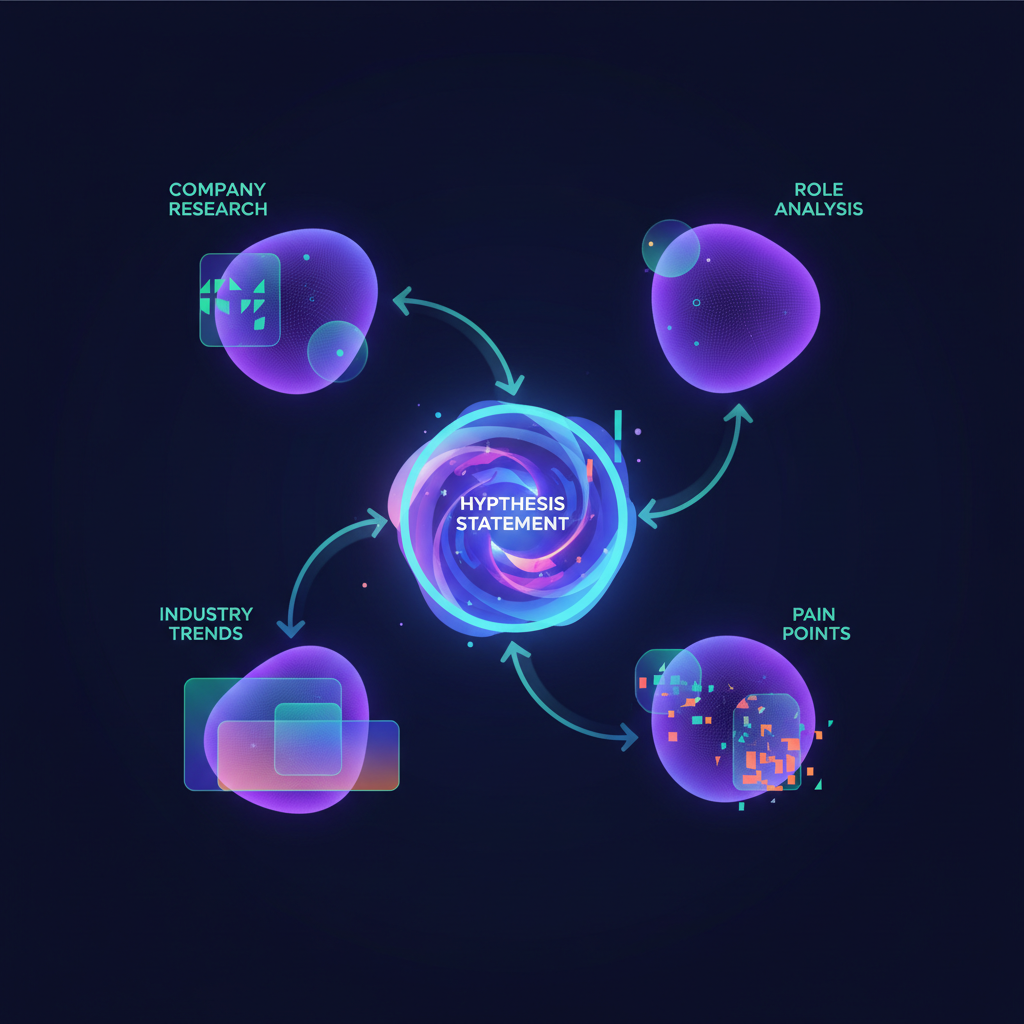
This is where average reps stop and top performers accelerate. Don't go into discovery hoping the prospect will tell you their pain. Go in with a hypothesis about what they likely struggle with, then use the call to validate, refine, or discard it.
Your hypothesis should be specific:
- ❌ Weak: "They probably have sales challenges."
- ✅ Strong: "If they're scaling from 10 to 30 reps in six months, onboarding speed and rep ramp time are likely bottlenecks. New hires probably take 4–6 months to hit quota, and coaching bandwidth is stretched."
Build your hypothesis from:
- Role-based pain: What does every VP of Sales struggle with? Forecast accuracy, rep turnover, pipeline coverage.
- Industry-based pain: SaaS companies face different challenges than manufacturing. Vertical-specific regulations, buyer behavior, and sales cycles shape what hurts.
- Stage-based pain: Early-stage startups lack process; growth-stage companies lack scalability; enterprise orgs lack agility.
Write it down. One or two sentences. This hypothesis becomes the lens through which you listen during the call. When you hear something that contradicts it, you've learned something valuable.
Why this matters: Salesforce's discovery call research found that reps who enter calls with a hypothesis ask 40% fewer generic questions and uncover business impact twice as fast.
Design your question map (not a script)
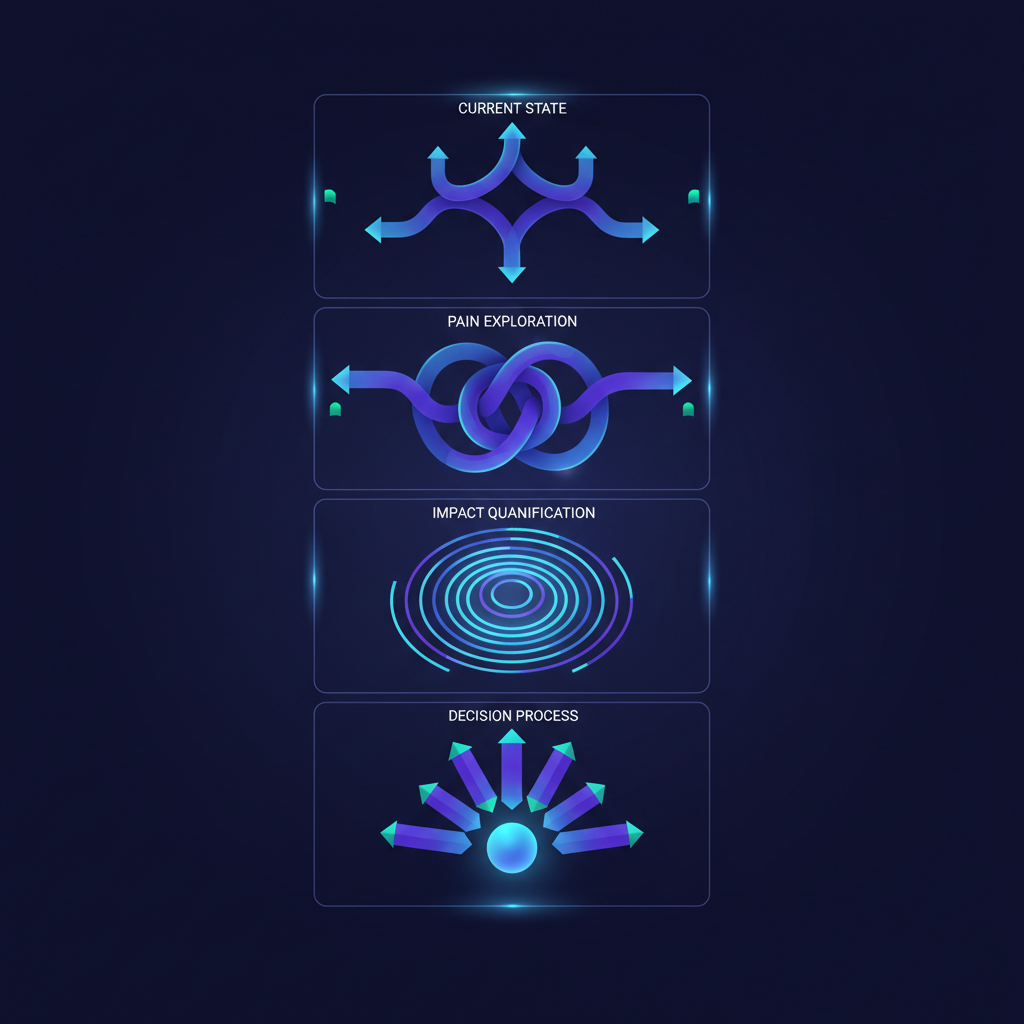
Scripts make you sound robotic. Question maps make you sound prepared and curious.
A question map is a flexible structure: 8–12 questions organized by theme, with branches based on how the prospect answers. You're not reading them in order; you're using them as a guide to explore what matters.
Organize your map into four zones:
Current state questions
Understand how they operate today. "Walk me through how your team handles X right now." "What does your process look like from lead to close?"
Pain exploration questions
Validate or challenge your hypothesis. "You mentioned ramp time—how long does it typically take a new rep to hit quota?" "What's the biggest gap you see between top and bottom performers?"
For a full library of high-impact questions, see our guide to discovery call questions that uncover real pain.
Impact and cost questions
Quantify the pain. "What does an extra month of ramp time cost you in revenue?" "If you could cut onboarding time in half, what would that unlock?"
Decision process questions
Understand how they buy. "Who else needs to be part of this decision?" "What does your typical evaluation process look like?" "Have you solved a problem like this before?"
Write these questions in your own words. If you sound like a chatbot, the prospect will treat you like one.
Pro tip: In AI role-play sessions, reps practice pivoting when a prospect gives an unexpected answer. Prepare follow-up branches: if they say X, ask Y; if they say Z, go deeper on W.
Prepare your agenda and confirm logistics
You're not running a mystery call. Send a short agenda 24 hours before the meeting so the prospect knows what to expect and can prepare on their end.
Your agenda should include:
- Purpose: "Understand your current sales process and challenges."
- Topics: "We'll cover how your team trains reps today, what's working, and where you see gaps."
- Time allocation: "I'll ask questions for 20 minutes, share how we've helped similar teams for 5 minutes, and leave 5 minutes for next steps."
- What you need from them: "If possible, have examples ready of recent onboarding challenges or rep performance gaps."
Confirm logistics the morning of the call: Zoom link works, they're still available, no conflicts. A 10-second Slack or email check prevents no-shows.
Identify your success criteria for the call
What does "good" look like when you hang up? Define it before you dial.
Success criteria might include:
- Validate or refute your pain hypothesis
- Quantify the cost of the problem (dollars, time, deals lost)
- Identify at least one additional stakeholder to involve
- Understand their timeline and decision process
- Secure a clear next step with a date
Write 2–3 success criteria in your notes. This keeps you focused when the conversation wanders and gives you a concrete way to self-assess afterward.
QUOTA observation: Reps who define success criteria before the call are 3× more likely to walk away with a concrete next step than those who "see where it goes."
Prime yourself: mental and emotional preparation
Discovery call preparation isn't just intellectual—it's emotional. You need to show up curious, present, and genuinely interested in the prospect's world. If you're distracted, rushing, or thinking about the last call, they'll feel it.
Spend two minutes before the call:
- Clear your head: Close Slack, silence notifications, take three deep breaths.
- Review your hypothesis and questions: Glance at your notes so the structure is top of mind.
- Set your intent: Remind yourself that your job is to learn, not to pitch. Discovery is about them, not you.
In our role-play sessions, we track how often reps interrupt prospects or jump to features before understanding pain. Almost always, it's because they didn't take 60 seconds to center themselves before the call.
Pacing matters, too—if you rush through discovery, you miss the nuance that separates real pain from polite conversation. Our guide to discovery call pacing breaks down how to control tempo without feeling slow.
Test your tech and environment
Nothing kills credibility faster than "Can you hear me?" five times in the first two minutes.
Before the call:
- Test your audio and video: Join the meeting two minutes early, confirm your mic and camera work.
- Check your background: Clean, professional, no distractions.
- Have your tools ready: CRM open, notes doc ready, question map visible, prospect's LinkedIn and company page in separate tabs.
- Mute everything else: Slack, email, phone. You're off the grid for 30 minutes.
If you're screen-sharing (demo, mutual action plan, etc.), have that content loaded and tested. Technical fumbling signals you're unprepared.
Prepare your follow-up in advance
Discovery doesn't end when the call ends. Top performers plan their follow-up before the call so they can execute immediately afterward while the conversation is fresh.
Set up:
- A note-taking system: Use a template that captures pain, impact, stakeholders, timeline, objections, and next steps. The faster you can document, the faster you can act.
- A follow-up email draft: Pre-write the structure—"Great talking today, here's what I heard, here's what we agreed on, here's the next step"—so you only need to fill in specifics.
- A calendar hold: Block 10 minutes after the call to write notes and send follow-up. If you wait, you'll forget the nuance.
For a full system on what to do after discovery, see our guide to discovery call follow-up.
Practice the call (yes, actually practice)
Reading your question map isn't the same as using it under pressure. If you want to sound natural, confident, and adaptable, you need to practice.
Run a mock discovery call with a peer, a manager, or an AI role-play tool. Simulate the scenario: "You're talking to a VP of Sales at a 50-person SaaS company that just raised Series B. They're struggling with rep ramp time. Go."
Practice:
- Asking your questions naturally (not reading them)
- Pivoting when you get an unexpected answer
- Digging deeper when you hear a vague response
- Staying curious instead of jumping to pitch mode
In QUOTA's platform, reps run discovery simulations against AI buyers who mirror real prospect behavior—evasive answers, budget objections, multi-stakeholder complexity. Reps who practice discovery 3–4 times before a real call uncover pain faster and close at higher rates than those who "learn on the job."
FAQ
How long should discovery call preparation take?
Plan 15-20 minutes for a mid-market prospect, 30-45 minutes for enterprise accounts. The complexity of the buyer's org structure and your hypothesis depth determine prep time. Reps who skip this step waste the prospect's time and lose deals to better-prepared competitors.
What's the most important part of discovery call preparation?
Building a pain hypothesis before the call. Research what problems the prospect's role, industry, and company likely face, then design questions to validate or refute that hypothesis. This transforms discovery from interrogation into insight-led conversation.
Should I prepare questions or a script for discovery calls?
Prepare a question map, not a script. List 8-12 questions organized by theme (current state, pain, impact, decision process), but stay flexible. The best discovery calls follow the prospect's answers, not a rigid sequence.
How do I prepare for discovery when I have limited information about the prospect?
Start with role-based and industry-based assumptions. Research common pain points for that title, review the company's public content (blog, press releases, LinkedIn), and look for recent changes (funding, leadership, tech stack signals). Even sparse intel beats zero preparation.
Can I over-prepare for a discovery call?
Yes, if preparation turns into procrastination or makes you rigid. The goal is to build context and hypotheses, not to script every word. Spend 15–20 minutes preparing, then trust yourself to adapt in the moment.
How do I balance preparation with staying present during the call?
Use your question map as a guide, not a checklist. Glance at it between answers, but keep your focus on the prospect. If they say something unexpected, follow that thread—your preparation gives you the confidence to improvise.
Discovery call preparation isn't a nice-to-have. It's the difference between extracting surface-level answers and uncovering the pain that drives deals forward. The reps who win consistently are the ones who show up with context, hypotheses, and a question map that adapts to what they hear.
If you want to build discovery skills that translate to quota attainment, practice matters as much as preparation. AI role-play lets your team run discovery simulations at scale, so every rep gets the reps they need without pulling managers off the floor.
Start with these nine steps. Refine them based on what works in your market. And remember: the best discovery calls don't feel like interrogations—they feel like conversations between two people solving a problem together. That only happens when you've done the work before you dial.

Stefano Sechi
Co-founder, QUOTA Training
Stefano Sechi is co-founder of QUOTA Training. He works hands-on with B2B sales teams on cold calling, discovery and objection handling, and shaped much of the methodology behind QUOTA’s AI role-play scenarios.
Turn this into reps, not just reading
QUOTA Training lets your team practise these exact scenarios with an AI buyer that reacts like the real thing — then scores every call.
See it in action