Discovery Call Outcome Planning: Close Deals Before You Hang Up
Part of the Discovery guide: The Complete Guide to Sales Discovery Calls (2025)Most discovery calls end with vague next steps. Learn how discovery call outcome planning turns every conversation into a clear path to close.

Key takeaways

- Discovery call outcome planning means defining and securing a concrete next step—with date, attendees, and agenda—before you end the conversation, not after.
- Reps who plan outcomes in three phases (before, during, and final five minutes) convert 34% more discovery calls to next-stage meetings than those who "wing it" at the end.
- A qualified next step requires five elements: specific meeting type, confirmed date/time, named attendees, agenda tied to pain, and mutual commitment to success criteria.
- If a prospect won't commit to a next step, it signals missing urgency, stakeholder alignment, or pain—address the root cause or disqualify rather than chase a stalled deal.
- The most common mistake is asking "Does next Tuesday work?" instead of offering a binary choice anchored to the pain you uncovered: "Based on the Q2 deadline you mentioned, should we lock in Tuesday or Thursday to review the technical requirements with your IT lead?"
Why most discovery calls end in deal limbo
You've just spent 45 minutes uncovering pain, mapping stakeholders, and building rapport. The prospect seems engaged. You ask, "So, what are the next steps?" They respond with some version of "Let me talk to my team and circle back."
You send a follow-up email. Silence. You try again a week later. Nothing. The deal sits in your pipeline, aging like milk.
This happens because most reps treat discovery call outcomes as an afterthought—something to figure out in the last 60 seconds or negotiate over email later. But deals are won or lost in how clearly you define the path forward before you hang up.
Discovery call outcome planning is the discipline of securing a concrete, mutual commitment to the next step while you still have the prospect's attention and context fresh. It's not about being pushy; it's about being clear. And clarity is what separates deals that close from deals that ghost.
According to Gong's discovery call research, top-performing reps spend the final 11% of discovery calls explicitly defining next steps, compared to just 4% for average performers. That difference—those final few minutes of clarity—directly predicts whether a deal progresses or stalls.
What discovery call outcome planning actually means
Discovery call outcome planning is not the same as "closing for next steps." It's a structured approach to defining, proposing, and securing mutual commitment to a specific action that moves the deal forward.
It has three components:
-
Pre-call outcome definition: Before the call, you decide what the ideal next step is based on your qualification criteria and sales process. For most discovery calls, this is a demo, a technical deep-dive, a stakeholder meeting, or—if disqualified—a polite exit.
-
In-call outcome adjustment: During discovery, you learn new information (budget constraints, timeline shifts, political dynamics). You adjust your target outcome in real time based on what the prospect actually needs and whether they're qualified.
-
End-of-call outcome commitment: In the final five minutes, you propose a specific next step with a date, agenda, and named attendees, and you secure explicit verbal agreement before ending the call.
Most reps skip step one and fumble step three. They walk into discovery with no plan, react to whatever the prospect says, and end with "I'll send you some times." That's not outcome planning—that's outcome hoping.
A comprehensive discovery call framework always includes a clear plan for how the call should end, adjusted dynamically based on what you uncover.
The discovery call outcome planning framework
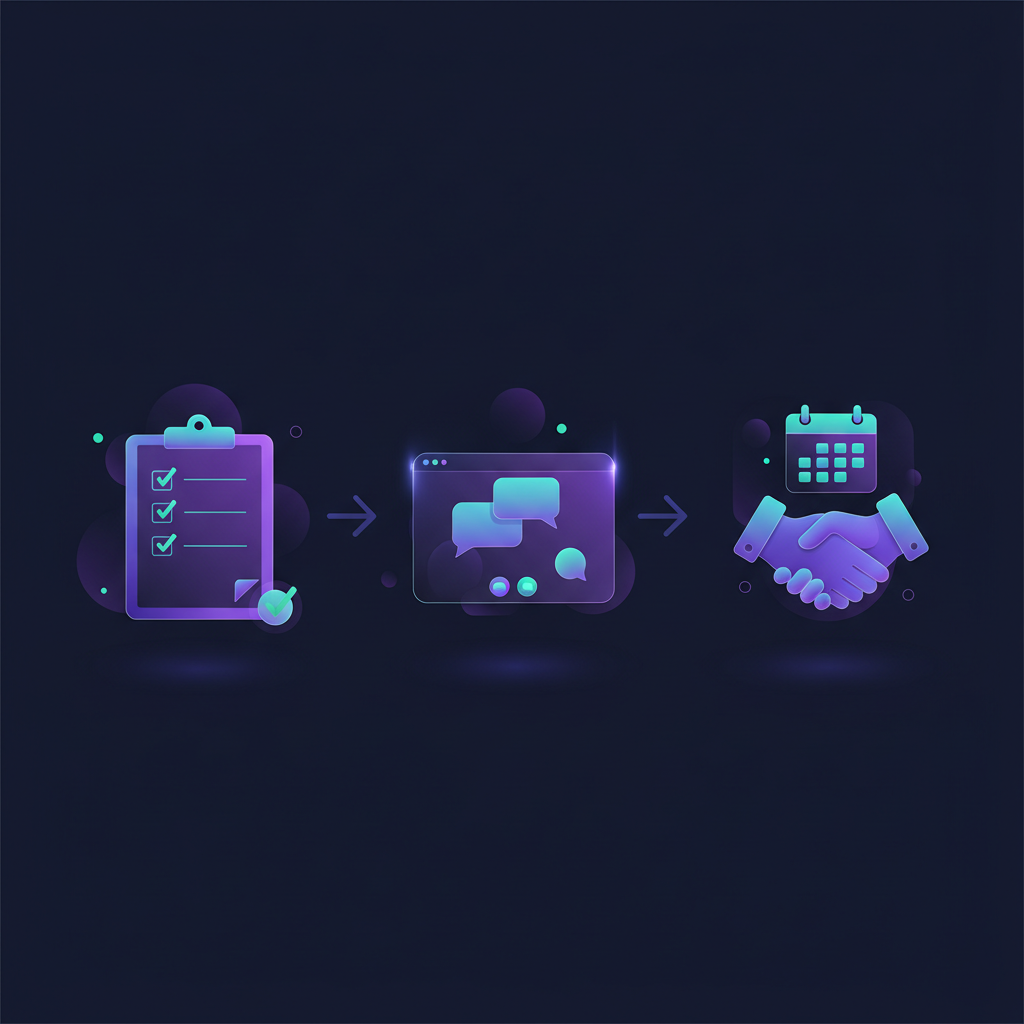
Here's the step-by-step system we teach reps using QUOTA's AI role-play simulations. It works across industries, deal sizes, and sales cycles.
Before the call: Define your target outcome
Sixty seconds before you dial, answer these questions:
- What's the ideal next step if they're qualified? (Usually: demo, technical call, or executive meeting.)
- What's the minimum viable next step if they're partially qualified? (E.g., a follow-up discovery with the budget holder.)
- What's your disqualification threshold? (What would make you walk away?)
- What date range are you targeting? (Have two specific options ready: "Tuesday at 2 PM or Thursday at 10 AM.")
Write these down. This pre-commitment prevents you from accepting vague outcomes under social pressure.
In QUOTA role-play sessions, reps who define their target outcome before the simulation are 41% more likely to secure a committed next step than those who improvise.
During the call: Adjust based on what you learn
Discovery is diagnostic. As you ask discovery call qualification questions and uncover pain, budget, timeline, and authority, you may realize:
- The ideal next step is different than you thought (e.g., they need a CFO in the room, not just the VP).
- They're less qualified than expected (no budget until next fiscal year).
- They're more qualified (they have a signed-off budget and a hard deadline).
Good discovery call outcome planning is dynamic. If you learn halfway through that the real decision-maker isn't on the call, your target outcome shifts from "book a demo" to "schedule a three-way call with the decision-maker present."
Use a discovery call note-taking system to track these adjustments in real time so you don't forget by the end.
The final five minutes: Secure explicit commitment
This is where most reps lose deals. They finish uncovering pain, answer a few questions, and then awkwardly transition to "So… uh… should we set up some time to chat again?"
Instead, follow this sequence:
1. Transition with a summary tie-down.
"Okay, so just to recap: you're currently losing about 15 hours a week to manual data entry, your Q2 goal is to cut that in half, and you mentioned Sarah from ops and Tom from finance need to be involved in any decision. Does that sound right?"
Wait for confirmation. This creates a shared reality.
2. Propose the outcome tied to their pain.
"Based on what you've shared—especially that Q2 deadline—the logical next step is to get you, Sarah, and Tom on a 30-minute technical walkthrough so we can show you exactly how the automation handles your Salesforce integration. That way, you'll know within a week whether this solves the data entry problem or not. Does that make sense as a next step?"
Notice:
- You named the meeting type ("technical walkthrough").
- You tied it to their pain ("data entry problem") and timeline ("Q2 deadline").
- You named attendees ("you, Sarah, and Tom").
- You framed it as diagnostic, not a sales pitch ("know whether this solves").
3. Offer a binary date choice.
"I have Tuesday at 2 PM or Thursday at 10 AM open this week. Which works better for you and the team?"
Binary choices reduce friction. Open-ended "when are you free?" questions invite delays.
4. Confirm attendees and send the invite live.
"Perfect, Thursday at 10. I'll send a calendar invite to you, Sarah, and Tom right now. Can you confirm their emails?"
Send the invite while you're still on the call. This eliminates the "I'll send it later" black hole where deals disappear.
5. Set the agenda and success criteria.
"I'll include an agenda in the invite: 10 minutes on the Salesforce integration, 15 minutes walking through a live demo with your data, and 5 minutes to decide if it's worth a deeper conversation. By the end, you should know whether this cuts your data entry time in half or not. Sound good?"
Now the prospect knows exactly what to expect, what to prepare, and how to evaluate success. That clarity makes them more likely to show up—and more likely to move forward if it's a fit.
What to do when prospects resist committing
Sometimes you do everything right, and the prospect still says, "Let me think about it and get back to you."
This is a gift. It's a signal that something is missing—and you have a chance to diagnose it now, not three weeks from now when the deal is cold.
Try this:
"I appreciate that. Just so I understand—what specifically do you need to think about? Is it whether the timing is right, whether the solution fits, or whether the team is aligned?"
Listen. Their answer tells you what's actually blocking the deal:
-
"I need to talk to my boss." → You haven't identified or engaged the real decision-maker. Ask: "Got it. Should we loop them into the next call so we're all on the same page?"
-
"I need to see if we have budget." → Budget isn't confirmed. This may not be a real opportunity yet. Ask: "What's your process for getting budget approved? Should we wait until that's clear, or is it helpful to show you what the ROI looks like first?"
-
"I just need time to process." → This often means low urgency or insufficient pain. Revisit: "Totally understand. What's the cost of waiting another quarter to solve this?" If they shrug, you may not have uncovered real pain.
If you can't resolve the objection, that's okay. It's better to disqualify now than to chase a ghost. Say:
"No problem. It sounds like the timing might not be right yet. How about this: I'll check back in with you in [specific timeframe tied to their situation], and if things have changed, we can pick it up then. Does that work?"
Then move on. Your pipeline will thank you.
For more on navigating resistance in the moment, see our guide on when to address objections during discovery.
The five elements of a qualified next step
Not all next steps are created equal. A vague "let's reconnect next week" is not a qualified outcome. A qualified next step includes:
- Specific meeting type: "Technical demo," "executive alignment call," "pricing review"—not "follow-up."
- Confirmed date and time: On both calendars, with a sent invite.
- Named attendees: You know who's joining from their side and why.
- Agenda tied to pain: They know what will be covered and why it matters to them.
- Mutual success criteria: Both sides agree on what a successful outcome looks like.
If any of these five is missing, your next step is squishy. Squishy next steps don't convert.
In QUOTA's AI-powered role-play platform, we score discovery simulations on whether reps secure all five elements. Reps who consistently hit all five have a 58% higher discovery-to-demo conversion rate than those who settle for three or fewer.
How to practice discovery call outcome planning
Outcome planning is a skill, not a script. You can't memorize your way to better next steps—you need reps to practice reading the room, adjusting in real time, and confidently proposing a path forward even when the prospect hesitates.
That's why traditional role-play often fails here. A manager playing a prospect can't simulate the dozens of variations a real buyer might throw at you: the "let me check with my team," the "send me some info," the "I'm interested but not sure about timing."
AI role-play changes this. At QUOTA Training, reps practice discovery call outcome planning against AI prospects who react dynamically to every move. The AI adjusts its responses based on how well you've uncovered pain, whether you've built urgency, and how confidently you propose the next step.
After each session, reps get instant feedback on whether they:
- Defined a target outcome before starting
- Adjusted based on what they learned
- Proposed a specific next step with all five elements
- Handled resistance without folding
This is the same feedback loop that elite sales coaches provide—but it scales to every rep, every day, without pulling managers off the floor.
If you're serious about improving discovery outcomes across your team, explore how AI role-play trains reps to close discovery calls with clarity and commitment.
Common discovery call outcome planning mistakes
Even experienced reps fall into these traps:
Mistake 1: Waiting until the last 30 seconds
You spend 40 minutes in great discovery, then realize you have one minute left and blurt out, "So, uh, should we schedule a demo?"
Fix: Start transitioning to next steps at the 35-minute mark of a 45-minute call. Use a summary tie-down to create a natural bridge.
Mistake 2: Asking open-ended scheduling questions
"When's a good time for you?" invites "I'll check my calendar and get back to you."
Fix: Offer two specific options. "I have Tuesday at 2 or Thursday at 10—which is better?"
Mistake 3: Proposing a next step that doesn't match the pain
You uncover a technical integration challenge, then propose a pricing call. The prospect thinks, "Why would I talk about price before I know if it works?"
Fix: Tie every proposed next step directly to the pain or gap they described. "You mentioned the Salesforce sync is broken—let's get our integration team on a call to show you exactly how we handle that."
Mistake 4: Accepting "send me some information"
This is a polite brush-off 90% of the time.
Fix: Diagnose what they really mean. "Happy to—what specifically would be most helpful? Is it case studies, pricing, technical specs? Or is there something else you're trying to figure out first?"
Mistake 5: Not confirming attendees
You book a demo, send an invite to the person you spoke with, and show up to find they're not there—and the person who is there has no context.
Fix: Confirm names and emails while you're live on the call. "Great, so I'll send this to you and your IT lead—what's their email?"
FAQ
What is discovery call outcome planning?
Discovery call outcome planning is the practice of defining and securing a concrete next step with a clear date and mutual commitment before ending a discovery conversation. It transforms vague follow-ups into actionable deal progression.
When should you plan the discovery call outcome?
Plan your discovery call outcome at three points: before the call (define your ideal next step), during the call (adjust based on what you learn), and in the final five minutes (secure explicit commitment with date and agenda).
What makes a good discovery call next step?
A good discovery call next step includes a specific meeting type, a confirmed date and time, named attendees from both sides, a clear agenda tied to pain uncovered, and mutual agreement on what success looks like.
How do you handle a prospect who won't commit to next steps?
If a prospect won't commit to next steps, diagnose why: lack of urgency, missing stakeholder buy-in, or insufficient pain uncovered. Address the root cause directly, or qualify out rather than chase a deal that will stall later.
Close discovery calls with clarity, not hope
Discovery call outcome planning isn't about being aggressive. It's about being clear. Clear on what happens next. Clear on who's involved. Clear on why it matters.
When you define outcomes before the call, adjust during the conversation, and secure commitment before you hang up, you stop hoping deals will progress—and start knowing they will.
Deals don't die in discovery because reps ask bad questions. They die because reps end discovery without a plan. Fix that, and your pipeline starts moving.
If you want your team to practice this skill until it's automatic, QUOTA's AI role-play platform gives every rep unlimited reps to master discovery outcomes—without burning real prospects or manager time. Learn more about how gamification drives skill adoption across your sales floor.

Stefano Breglia
Co-founder, QUOTA Training
Stefano Breglia is co-founder of QUOTA Training. He focuses on sales methodology, deal progression and how AI simulation accelerates rep ramp time across the SDR, BDR, AE and AM roles.
Turn this into reps, not just reading
QUOTA Training lets your team practise these exact scenarios with an AI buyer that reacts like the real thing — then scores every call.
See it in action