Sales Leadership Performance Reviews That Drive Results
Part of the Sales Leadership guide: The Complete Sales Management Guide: Build a High-Performing TeamMaster sales leadership performance reviews with frameworks, scripts, and examples that motivate reps, align goals, and improve win rates every quarter.

Key takeaways
- Run formal sales leadership performance reviews quarterly, aligned with your sales cycle, supported by monthly 1:1s and weekly pipeline reviews to maintain coaching continuity without overwhelming reps.
- Structure every review around four pillars: quantitative results (quota, pipeline, win rate), qualitative skills (discovery, objection handling, stakeholder management), specific behavioural examples from real calls or deals, and a concrete development plan with clear next actions.
- Separate performance reviews from compensation conversations to keep the focus on growth, not defensiveness—handle comp changes in a distinct meeting tied to pre-agreed criteria.
- Anchor all feedback in the SBI framework (Situation, Behaviour, Impact) to make coaching specific, observable, and tied to outcomes, avoiding vague advice that reps can't action.
- Use AI role-play between reviews to practise the exact skills you've identified as development priorities, turning feedback into measurable skill improvement before the next review cycle.
Sales leadership performance reviews are where strategy meets execution. Done well, they align your team to revenue goals, surface skill gaps before they tank deals, and give every rep a clear path to quota. Done poorly, they become box-ticking exercises that demotivate top performers and fail to move the middle.
Most sales leaders inherit a performance review process built for HR compliance, not revenue growth. The result? Reviews that focus on activity metrics ("you made 200 dials") instead of outcomes, deliver feedback too late to change behaviour, and leave reps unclear on what to improve or how.
This guide shows you how to build sales leadership performance reviews that drive results: a quarterly framework that balances quantitative and qualitative assessment, scripts for delivering difficult feedback without crushing morale, and a system for turning every review into a launchpad for skill development.
If you're responsible for a sales team's performance, this is how you make reviews a competitive advantage instead of a calendar obligation.
Why most sales performance reviews fail
The typical sales performance review suffers from three structural problems.
First, they're backward-looking scorecards, not forward-looking coaching tools. Leaders present a summary of quota attainment, pipeline coverage, and activity metrics, then ask the rep to sign off. There's no diagnosis of why the numbers look the way they do, no joint problem-solving, and no plan to change trajectory. The rep leaves knowing they missed quota but not knowing how to hit it next quarter.
Second, they conflate performance assessment with compensation decisions. When a review doubles as a pay conversation, reps become defensive. They justify every lost deal, downplay skill gaps, and focus on protecting their comp plan instead of honestly discussing what's holding them back. Development conversations require psychological safety; comp conversations require advocacy. Mixing them poisons both.
Third, they rely on lagging indicators and manager memory. By the time you sit down for a quarterly review, the deals that defined the quarter are long closed. You're reconstructing what happened from CRM notes and hazy recollection, not from real call recordings or live observation. Feedback becomes generic ("you need to handle objections better") because you lack the specifics to make it actionable.
The fix isn't to abandon performance reviews—it's to redesign them as a structured coaching conversation that connects results to behaviours, behaviours to skills, and skills to a concrete development plan. That's what the rest of this guide delivers.
For a broader view of how performance reviews fit into your overall sales management best practices, start with the foundation and build from there.
The quarterly performance review framework
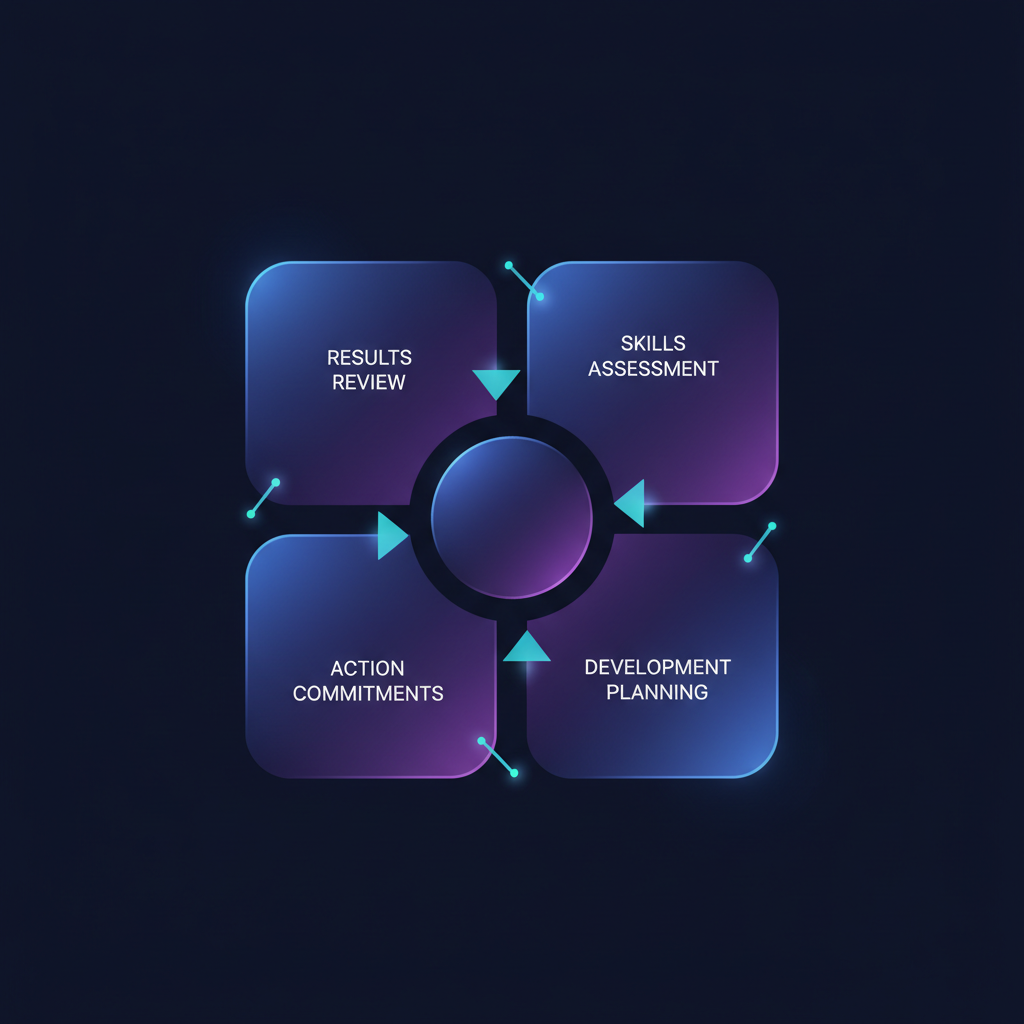
A high-impact sales leadership performance review has four distinct sections, each with a clear purpose and a set of questions that drive the conversation forward.
1. Results review: What happened?
Start with the numbers, but go deeper than quota attainment. Look at the full picture of pipeline health, deal velocity, and win rate.
Metrics to review:
- Quota attainment (closed-won revenue vs. target)
- Pipeline coverage (pipeline value divided by quota, typically 3-5x for healthy coverage)
- Win rate (deals won divided by opportunities created)
- Average deal size and sales cycle length
- Activity leading indicators: meetings booked, discovery calls completed, demos delivered (see metrics that predict revenue for SDR-focused indicators)
Questions to ask:
- "Which deals did you win this quarter, and what was the common thread?"
- "Which deals stalled or were lost, and what was the pattern?"
- "Where did pipeline come from—inbound, outbound, referrals?"
- "What's your current pipeline coverage for next quarter?"
This section establishes a shared understanding of reality. Don't rush it. If a rep missed quota by 30%, you need to know whether it was due to a thin pipeline, long sales cycles, poor close rates, or something else entirely.
2. Skills assessment: Why did it happen?
Now connect the results to the behaviours and skills that drove them. This is where call recordings, CRM notes, and live observation become invaluable.
Skills to assess:
- Discovery and qualification: Did they uncover compelling events, budget, authority, and decision criteria? (Review your discovery call framework if this is a gap.)
- Objection handling: How did they respond to pushback on price, timing, competition, or authority?
- Stakeholder engagement: Did they multithread and build consensus across the buying committee?
- Tonality and presence: Did they sound confident, consultative, and credible on calls?
How to assess:
Pull 3-5 representative calls or emails from the quarter—wins, losses, and stalls. Listen together (or review ahead and bring specific clips). Look for patterns, not one-offs.
Questions to ask:
- "When you lost the deal to [competitor], what objection did they raise, and how did you respond?"
- "In your best discovery call this quarter, what question unlocked the real pain?"
- "When a prospect says 'we need to think about it,' what's your go-to response?"
Anchor every observation in a specific example. Instead of "you need to be more assertive," say: "In the Acme call on March 12th, when the VP said 'send me a proposal,' you agreed without confirming next steps. That's where we lost control of the deal."
This is also where strong sales leadership communication skills come into play—your goal is insight, not blame.
3. Development priorities: What will we improve?
Choose 1-3 skills to focus on for the next quarter. More than three dilutes effort; fewer than one suggests you're not being honest about gaps.
How to choose priorities:
- Impact: Which skill, if improved, would most directly increase win rate or deal size?
- Frequency: Which skill comes up in every deal cycle (e.g., discovery, objection handling)?
- Coachability: Which skill can realistically improve in 90 days with focused practice?
Example priorities:
- "Improve discovery question sequencing to uncover budget and authority in the first call."
- "Handle the 'we're already using [competitor]' objection confidently without discounting."
- "Reduce average sales cycle from 87 to 60 days by confirming next steps and compelling events in every call."
Each priority should be specific, measurable, and tied to a revenue outcome. Avoid vague goals like "be more confident" or "improve communication."
4. Action plan: How will we get there?
Turn each development priority into a concrete plan with owners, timelines, and checkpoints.
Components of a strong action plan:
- Practice method: Role-play, call shadowing, peer review, or AI role-play for on-demand reps can complete between 1:1s.
- Checkpoint cadence: Weekly or bi-weekly check-ins to review progress (separate from your regular pipeline review).
- Success criteria: What does "good" look like? (e.g., "In the next five discovery calls, confirm budget and authority before moving to demo.")
- Manager commitment: What will you do to support the rep? (e.g., "I'll join your next two discovery calls live to give real-time feedback.")
Example action plan:
Priority: Improve discovery question sequencing.
Practice method: Complete three AI role-play scenarios per week focused on MEDDIC qualification.
Checkpoint: Review call recordings together every Friday at 2 PM.
Success criteria: Uncover compelling event, budget, and decision criteria in 80% of discovery calls by end of quarter.
Manager support: I'll shadow your next two calls and give inline feedback via Slack after each one.
This structure ensures accountability on both sides. The rep knows exactly what to practise; you know exactly what to coach.
For more on how to balance coaching intensity with rep autonomy, see our guide to delegation frameworks.
The quarterly performance review framework
Run the review as a 60-90 minute conversation, not a monologue. Share the results summary ahead of time so the rep arrives prepared to discuss, not defend.
Suggested agenda:
- 0-15 min: Results review (you present the numbers, rep adds context)
- 15-40 min: Skills assessment (review calls together, identify patterns)
- 40-60 min: Development priorities (jointly choose 1-3 focus areas)
- 60-75 min: Action plan (document practice methods, checkpoints, success criteria)
- 75-90 min: Wrap-up (confirm next steps, schedule first checkpoint)
Take notes in a shared doc so both of you leave with the same action plan. Schedule the first checkpoint before you end the meeting.
How to deliver difficult feedback without demotivating reps

Delivering tough feedback is the highest-leverage skill in sales leadership. Do it well, and reps lean in and improve. Do it poorly, and they disengage or leave.
Use the SBI framework (Situation, Behaviour, Impact) to make feedback specific and non-judgmental:
- Situation: "In the discovery call with Acme on March 12th..."
- Behaviour: "...when the prospect mentioned budget concerns, you moved directly to pricing without exploring the underlying constraint..."
- Impact: "...which meant we never learned whether budget was a real blocker or a negotiation tactic, and we lost the deal to a lower-cost competitor."
This approach removes subjectivity. You're not saying "you're bad at discovery." You're saying "in this specific instance, here's what you did, and here's what happened as a result."
Pair every critique with a concrete next step:
- "Next time a prospect raises budget, try asking: 'Help me understand—is this a budget priority issue or a budget availability issue?' Then pause and let them talk."
Offer to role-play the skill immediately:
- "Want to practise that objection response right now? I'll play the prospect, you handle the pushback, and we'll iterate until it feels natural."
This turns feedback from a verdict into a coaching session. The rep leaves with a new tool, not just a new awareness of a gap.
For reps who need ongoing practice between your 1:1s, point them toward AI role-play so they can drill the exact scenario you've identified without waiting for the next live call.
Separating performance reviews from compensation conversations
One of the biggest mistakes sales leaders make is bundling performance feedback with pay decisions. It's efficient, but it destroys trust.
Why separation matters:
When a rep walks into a performance review knowing their comp is on the line, they shift into self-preservation mode. They'll justify every loss, minimize every gap, and resist feedback that might threaten their variable pay. You lose the honesty required for real development.
How to separate them:
- Run performance reviews quarterly, focused purely on skill development and goal alignment.
- Run compensation reviews annually (or semi-annually), tied to clear, pre-agreed criteria documented in your comp plan.
- In the performance review, say explicitly: "This conversation is about growth and development. Your comp is determined by the criteria we agreed on in January, and we'll discuss that separately in December."
This gives reps permission to be vulnerable about what they don't know, which is the only way they'll improve.
According to Harvard Business Review research on performance management, companies that separate development feedback from pay decisions see higher engagement and faster skill growth, because employees trust the process enough to admit gaps.
Using call recordings and AI to make reviews objective
Memory is unreliable. By the time you sit down for a quarterly review, you've forgotten the details of most calls. You remember the big win and the catastrophic loss, but not the 40 calls in between that reveal the real patterns.
Call recordings solve this. Pull a sample of calls from the quarter—wins, losses, and stalls—and review them together during the performance review. Listen for:
- Discovery depth: Did they ask second- and third-level questions, or accept surface answers?
- Objection handling: Did they acknowledge, explore, and reframe, or did they get defensive?
- Tonality: Did they sound confident and consultative, or rushed and transactional?
- Next-step clarity: Did they confirm a specific next action with a date and attendee list, or leave it vague?
AI conversation intelligence platforms can surface these patterns automatically, tagging calls by skill area (discovery, objection handling, stakeholder engagement) and flagging coaching opportunities in real time. Gartner's B2B sales performance research shows that teams using conversation intelligence improve win rates by 15-20% because coaching becomes specific and timely instead of generic and delayed.
At QUOTA, we see this in our role-play data: reps who review their own AI-scored role-play sessions before a performance review arrive with self-awareness about their gaps, which makes the conversation faster and more productive.
What to do after the performance review
The review itself is just the start. The real work happens in the 90 days that follow.
Weekly checkpoints (15-20 minutes) keep development priorities top of mind:
- "Show me a call where you practised the new objection handling framework."
- "What's one discovery question you tried this week that worked?"
- "Where are you stuck, and how can I help?"
Monthly deep dives (30-45 minutes) assess progress against the action plan:
- Review success criteria: Are they hitting the targets you set?
- Adjust the plan if needed: If a skill isn't improving, change the practice method or simplify the goal.
- Celebrate wins: When a rep nails a new skill in a live call, recognize it immediately.
Quarterly cycle: Repeat the full performance review process, using the previous quarter's action plan as the baseline for progress.
This cadence ensures that performance reviews aren't isolated events—they're part of a continuous coaching system that compounds over time.
For leaders managing multiple reps and struggling to maintain this cadence, our guide to sales leadership delegation offers frameworks for scaling coaching without becoming a bottleneck.
Common performance review mistakes to avoid
Even well-intentioned sales leaders fall into predictable traps. Here are the most common, and how to avoid them.
Mistake 1: Focusing only on quota attainment
Quota is the outcome, not the diagnosis. A rep who hit 95% of quota with a 40% win rate has a very different problem than one who hit 95% with a 10% pipeline coverage. Dig into the leading indicators.
Mistake 2: Delivering feedback without examples
"You need to improve your discovery skills" is not actionable. "In the March 18th call with Beta Corp, you accepted 'we need to reduce costs' as the pain without asking why costs matter now or what happens if they don't act—here's how to dig deeper" is actionable.
Mistake 3: Setting too many development priorities
Three is the maximum. More than that, and the rep improves nothing because they're trying to improve everything. Choose the highest-impact skill and go deep.
Mistake 4: Running the review as a monologue
If you're talking for 80% of the meeting, you're doing it wrong. Ask questions, listen, and co-create the action plan. The rep should leave feeling ownership, not dictation.
Mistake 5: Skipping follow-up
The action plan is worthless if you don't check in. Schedule the first checkpoint before you end the performance review, and protect that time every week.
How AI role-play accelerates performance review outcomes
One of the biggest gaps between performance reviews and performance improvement is practice volume. You identify a skill gap in March, but the rep only gets 10-15 live opportunities to practise it before the June review. That's not enough reps to build fluency.
AI role-play solves this by giving reps unlimited, on-demand practice between your coaching sessions. After a performance review, assign specific scenarios tied to the development priorities you've set:
- "Complete five discovery role-plays focused on uncovering compelling events."
- "Practise handling the 'we're already using [competitor]' objection until you can reframe it in under 30 seconds."
- "Run three objection-handling scenarios and get your confidence score above 80%."
The rep practises at their own pace, gets instant feedback on tonality, pacing, and message clarity, and arrives at your next checkpoint with the skill already improved. You're coaching refinement, not teaching from scratch.
At QUOTA, reps who complete 10+ role-play sessions between performance reviews improve win rates 22% faster than those who rely solely on live-call learning, because they're compressing the learning curve through deliberate, high-volume practice.
Learn more about how AI role-play fits into a modern coaching stack.
Performance reviews for new hires vs. tenured reps
Not all performance reviews should follow the same structure. A rep in their first 90 days needs a different conversation than a tenured AE who's been with you for two years.
For new hires (first 90 days):
Focus the review on onboarding milestones and foundational skills:
- Have they completed product training and can they deliver a clean demo?
- Can they articulate your ICP and disqualify poor-fit prospects?
- Are they hitting activity targets (calls, meetings booked)?
- What's their ramp trajectory compared to plan?
Use the review to surface blockers early—CRM confusion, unclear messaging, lack of manager support—and fix them before they become ingrained habits. For a full onboarding structure, see our guide to accelerating ramp time.
For tenured reps:
Shift the focus to strategic skill development and career growth:
- What advanced skills (negotiation, executive presence, deal strategy) will unlock the next level of performance?
- Are they ready to mentor newer reps or take on team leadership responsibilities?
- What's their long-term career goal, and how does this quarter's development plan support it?
Tenured reps often plateau not because they lack motivation, but because they've mastered the basics and need a new challenge. Use the performance review to co-create that challenge.
FAQ
How often should sales leaders conduct performance reviews?
Conduct formal quarterly reviews aligned with sales cycles, supported by monthly 1:1 check-ins and weekly pipeline reviews. Quarterly cadence balances depth with recency, allowing time to assess trends without losing momentum on coaching opportunities.
What should be included in a sales performance review?
Include quantitative metrics (quota attainment, pipeline coverage, win rate), qualitative skill assessment (discovery, objection handling, stakeholder engagement), specific behaviour examples from calls or deals, agreed development priorities, and a clear action plan with ownership and timelines.
How do you give constructive feedback in a sales performance review?
Anchor feedback in specific, observable behaviours tied to outcomes. Use the SBI framework: describe the Situation, the Behaviour you observed, and the Impact it had. Pair every development area with a concrete next step and offer to role-play or shadow to build the skill.
Should performance reviews be tied to compensation changes?
Separate development conversations from comp discussions. Run performance reviews focused on growth and skill-building; handle compensation in a distinct conversation tied to clear, pre-agreed criteria. This prevents reps from becoming defensive and allows honest dialogue about improvement.
Sales leadership performance reviews are one of the highest-leverage activities you own. Done right, they align your team to revenue goals, surface skill gaps before they cost you deals, and give every rep a clear, actionable path to quota.
The framework in this guide—results review, skills assessment, development priorities, and action plan—turns performance reviews from compliance exercises into coaching conversations that compound quarter over quarter. Pair it with weekly checkpoints, call recording review, and AI role-play for deliberate practice, and you'll build a team that doesn't just hit quota—they raise the bar every quarter.
Ready to turn feedback into skill improvement at scale? Explore how QUOTA Training uses AI role-play and gamification to help sales leaders coach more reps, more often, without pulling them off the phones.
Sources

Stefano Breglia
Co-founder, QUOTA Training
Stefano Breglia is co-founder of QUOTA Training. He focuses on sales methodology, deal progression and how AI simulation accelerates rep ramp time across the SDR, BDR, AE and AM roles.
Turn this into reps, not just reading
QUOTA Training lets your team practise these exact scenarios with an AI buyer that reacts like the real thing — then scores every call.
See it in action