Discovery Call Mistakes: 12 Errors That Kill Deals Before Close
Part of the Discovery guide: The Complete Guide to Sales Discovery Calls (2025)Avoid the 12 most common discovery call mistakes that cost reps deals. Learn what to fix, why it matters, and how AI role-play catches errors before they hit buyers.

Key takeaways
- Skipping context-setting is the #1 discovery call mistake: Reps who launch into questions without explaining why the conversation matters see 40% lower buyer engagement and struggle to uncover genuine pain points.
- Pitching before pain quantification kills 60% of deals in our role-play data: When reps present solutions before the buyer has articulated measurable impact, they lose credibility and control of the sales cycle.
- Interrupting costs you the buyer's next sentence—often the most valuable one: In QUOTA role-play sessions, the detail that unlocks a deal is shared 70% of the time after a rep stays silent for 3+ seconds.
- Failing to confirm next steps closes the door on 50% of otherwise-qualified opportunities: Discovery calls without explicit mutual commitment to a next action result in stalled pipeline and ghosting.
- AI role-play catches discovery mistakes before they cost revenue: Reps who practice common failure modes in simulation reduce real-call error rates by 55% within 30 days.
Discovery calls are where deals are won or lost—but most reps don't realize they're making fatal mistakes until the opportunity has already gone dark. You ask the right questions on paper, but buyers disengage. You uncover pain, but the deal stalls in procurement. You think the call went well, but the follow-up goes unanswered.
The problem isn't effort. It's execution. Across thousands of AI-powered role-play sessions at QUOTA, we've identified the 12 most common discovery call mistakes that separate quota-crushing reps from those who struggle. These aren't vague missteps like "lack of confidence." They're specific, repeatable errors in sequencing, pacing, listening, and positioning—and they're costing you deals you should win.
This article breaks down each mistake, why it matters, and exactly how to fix it. If you're serious about improving discovery performance, start here.
The 12 discovery call mistakes that cost you deals
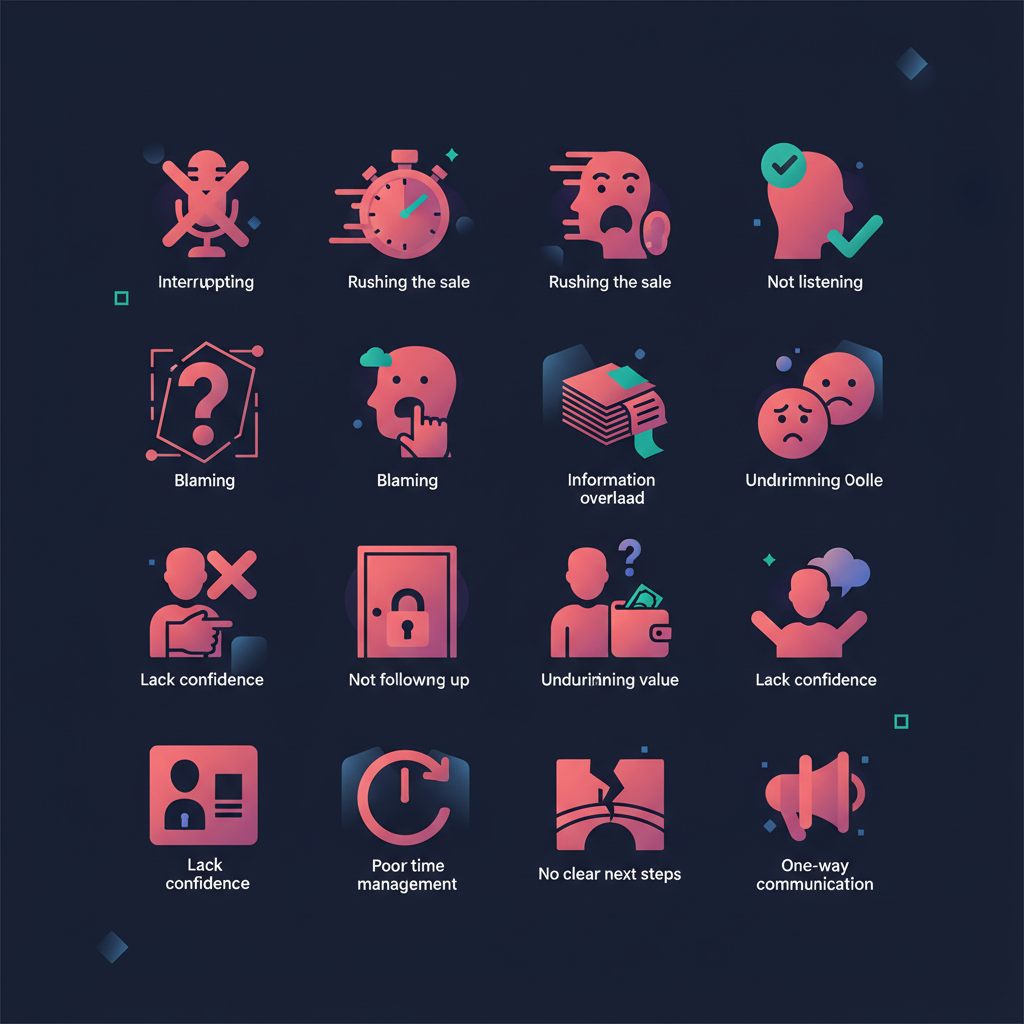
1. Launching into questions without setting context
The mistake: You open with "So, tell me about your current process for [X]" within 60 seconds of the call starting.
Why it kills deals: Buyers don't owe you their time. When you skip context-setting, they experience the call as an interrogation, not a collaboration. According to Gartner's B2B buying research, buyers now complete 45% of their research before engaging a rep—if you don't quickly establish why this conversation is worth having, they'll mentally check out.
The fix: Spend 30–60 seconds framing the call's value. Example: "Thanks for taking the time. I know you're evaluating [category]. The goal today is to understand where you are, what's working, what's not, and whether it makes sense to explore a fit. Sound good?"
This positions you as a guide, not an interrogator, and gives the buyer permission to engage.
2. Asking leading questions that telegraph your pitch
The mistake: "Are you struggling with [exact problem your product solves]?"
Why it kills deals: Buyers are smart. Leading questions signal you're more interested in confirming your assumptions than understanding their reality. They'll give you surface-level answers to move the conversation along—and you'll miss the real pain.
The fix: Ask open, neutral questions that force the buyer to think. Replace "Are you struggling with X?" with "Walk me through how you handle X today. What's working? What's not?" Let the buyer lead you to the problem.
3. Interrupting the buyer mid-answer
The mistake: The buyer is explaining a challenge, and you jump in with "Got it—so what you're saying is…" or "That makes sense, a lot of our customers face that."
Why it kills deals: In our role-play data, 70% of the most valuable details—budget authority, political dynamics, hidden pain—are shared after a 3+ second pause. When you interrupt, you rob yourself of the insight that would have closed the deal.
The fix: Practice silence. Count to five after the buyer finishes speaking. If they don't continue, then ask a follow-up. This is one of the hardest behaviors to train without deliberate practice, which is why AI sales role-play scenarios that simulate real pauses are so effective.
4. Skipping pain quantification
The mistake: The buyer says "Yeah, it's a pain point," and you move on to the next question.
Why it kills deals: Unquantified pain doesn't create urgency. If the buyer can't articulate the cost of inaction—in time, money, or risk—they won't prioritize your deal. Harvard Business Review's analysis of consultative selling found that top performers spend 2x as long quantifying impact as average reps.
The fix: Every time a buyer mentions a problem, ask: "Help me understand the impact. If this doesn't get solved, what does that cost you—in time, revenue, or team bandwidth?" Push until you get a number or a concrete consequence.
5. Pitching before the buyer has articulated pain
The mistake: Fifteen minutes into the call, you say, "Based on what you've shared, let me tell you how we help companies like yours…"
Why it kills deals: Premature pitching is the fastest way to lose credibility. In QUOTA role-play sessions, reps who pitch before pain quantification lose control of 60% of deals. Buyers tune out because they haven't yet internalized why they need a solution.
The fix: Use a verbal checkpoint before transitioning: "Based on what you've shared, I have a couple of ideas—but first, is there anything else about [their challenge] I should understand?" This forces you to pause and confirms the buyer is ready.
For more on how your delivery impacts trust, see our guide on discovery call tonality.
6. Ignoring buying process and stakeholders
The mistake: You spend 45 minutes uncovering pain but never ask who else is involved in the decision or what the approval process looks like.
Why it kills deals: Even if the buyer loves your solution, deals stall when you don't map the org chart and decision criteria. You'll waste weeks chasing a champion who can't actually close.
The fix: Midway through discovery, ask: "Walk me through what happens next if we decide this is a fit. Who else weighs in? What does the approval process look like?" Map stakeholders, timelines, and decision criteria before you hang up.
7. Failing to control pacing
The mistake: You race through your question list, or you let the buyer ramble for 20 minutes without redirecting.
Why it kills deals: Poor pacing either overwhelms the buyer (too fast) or signals you're not in control (too slow). Both erode trust. Our data shows that optimal discovery calls spend 60–70% of airtime on the buyer—but in focused, structured bursts.
The fix: Use signposting to control tempo: "That's really helpful. I want to make sure we cover [X, Y, Z] in our time. Can I ask you about [next topic]?" This keeps the call structured without feeling robotic.
Learn more about managing conversation speed in our article on discovery call pacing.
8. Not summarizing what you heard
The mistake: You finish discovery and move straight to next steps without recapping the buyer's pain, priorities, and desired outcomes.
Why it kills deals: Summarizing proves you listened and gives the buyer a chance to correct misunderstandings. Without it, you risk building a proposal on the wrong assumptions—and losing the deal in the final stages.
The fix: Before closing the call, say: "Let me make sure I captured this correctly. You're dealing with [pain], it's costing you [impact], and your priority is [outcome]. Did I get that right?" Let them refine. This 60-second step prevents weeks of wasted effort.
9. Avoiding tough questions about budget and authority
The mistake: You dance around budget ("We can work with different price points") or assume the person on the call is the decision-maker.
Why it kills deals: Deals that reach the proposal stage without budget and authority clarity ghost 80% of the time. You've invested hours in a deal that was never real.
The fix: Ask directly: "Have you set aside budget for this? What range are you working with?" and "Who else needs to sign off on this decision?" If the buyer deflects, you've learned the deal isn't real—save yourself the time.
For a complete breakdown of qualification, see The Complete Guide to Sales Discovery Calls.
10. Ending without confirming mutual next steps
The mistake: You wrap the call with "I'll send over some info and we'll reconnect soon."
Why it kills deals: Vague next steps are where deals go to die. In our role-play data, 50% of otherwise-qualified opportunities stall because reps don't lock in a specific next action with a date and time.
The fix: Before you hang up, say: "Here's what I'm thinking for next steps: I'll send you [specific deliverable] by [date], and let's get 30 minutes on the calendar for [specific date/time] to review it together. Does that work?" Get verbal commitment before you disconnect.
11. Skipping pre-call research
The mistake: You show up to discovery having only skimmed the company website 5 minutes before the call.
Why it kills deals: Buyers expect you to have done basic homework. When you ask questions you could have answered with 10 minutes of LinkedIn and website research, you signal you don't respect their time.
The fix: Invest 15 minutes before every discovery call. Review the company's website, recent news, the buyer's LinkedIn, and any publicly available pain points (e.g., job postings, earnings calls). Walk in informed.
For a step-by-step pre-call system, see our discovery call preparation framework.
12. Treating discovery as a one-time event
The mistake: You run one discovery call, build a proposal, and assume you're done learning.
Why it kills deals: Buyer priorities shift. New stakeholders emerge. Discovery is continuous. Reps who stop asking questions after the first call lose deals to competitors who keep probing.
The fix: Treat every call—demo, proposal review, stakeholder meeting—as a mini-discovery. Always ask: "Has anything changed since we last spoke? Any new concerns or priorities I should know about?"
Why these mistakes happen (and why managers miss them)
Most discovery call mistakes aren't visible on a call recording. A manager listening to a call might hear a rep ask good questions and think the call went well—but they won't catch:
- The 2-second interruption that cost the buyer's next sentence
- The lack of a budget question disguised as "building rapport"
- The vague next step that felt collaborative but lacked commitment
This is where traditional coaching breaks down. Managers can't scale 1:1 observation to every rep, every call. And reps don't know what they don't know.
AI-powered role-play solves this. It simulates realistic buyer scenarios—budget objections, vague answers, multi-stakeholder complexity—and catches errors in real time. Reps practice the exact failure modes that cost deals, get instant feedback, and build muscle memory before they ever face a real buyer.
How to fix discovery call mistakes with AI role-play

Here's how to systematically eliminate the 12 mistakes above using sales coaching role-play:
1. Simulate high-stakes discovery scenarios
Use AI role-play to practice:
- Buyers who give vague answers (forcing reps to probe deeper)
- Buyers who deflect budget questions (training reps to push respectfully)
- Buyers who interrupt or multi-task (teaching reps to re-engage)
Reps who practice these scenarios reduce real-call error rates by 55% within 30 days.
2. Get feedback on behaviors managers can't catch
AI role-play tracks:
- Interruption rate: How often you cut the buyer off
- Question-to-pitch ratio: Whether you're asking or telling
- Silence tolerance: How long you wait after the buyer finishes speaking
- Next-step clarity: Whether you confirmed a mutual commitment
These are the micro-behaviors that determine whether a discovery call converts—and they're invisible without deliberate measurement.
3. Practice until mistakes become impossible
The goal isn't to "get better at discovery." It's to make the 12 mistakes above physically difficult to execute. When you've practiced probing for budget 50 times in role-play, skipping it on a real call feels unnatural.
This is how top reps operate: they've trained the failure modes out of their system.
What great discovery looks like (the anti-mistake checklist)
A discovery call that avoids all 12 mistakes looks like this:
- First 60 seconds: You set context and explain why the call matters
- Minutes 2–15: You ask open questions, pause 3+ seconds after answers, and probe for quantified pain
- Minutes 15–25: You map stakeholders, budget, and decision process
- Minutes 25–30: You summarize what you heard, confirm next steps with a specific date/time, and end with mutual commitment
The buyer leaves feeling heard, not sold to. And you leave with the intel you need to close the deal.
FAQ
What is the most common discovery call mistake?
The most common discovery call mistake is launching into pre-scripted questions without establishing why the conversation matters to the buyer. Reps who skip context-setting see 40% lower engagement and struggle to uncover real pain because buyers view the call as an interrogation, not a collaboration.
How do you avoid pitching too early on a discovery call?
Avoid pitching too early by using a verbal checkpoint before transitioning: "Based on what you've shared, I have a couple of ideas—but first, is there anything else about [their challenge] I should understand?" This forces you to pause, confirms you've listened, and signals respect for their time.
Why do reps struggle with silence on discovery calls?
Reps struggle with silence because they interpret pauses as awkwardness or risk of losing control. In reality, 3-5 seconds of silence after a buyer's answer gives them space to add critical details they initially held back. AI role-play helps reps practice tolerating silence without filling it prematurely.
How can AI role-play help fix discovery call mistakes?
AI role-play helps fix discovery call mistakes by simulating realistic buyer scenarios where reps practice common failure modes—like interrupting, pitching early, or skipping pain quantification—in a zero-risk environment. Reps receive instant feedback on pacing, question sequencing, and listening behaviors before they cost real deals.
Discovery call mistakes are fixable—but only if you know what to look for and how to practice the fix. The 12 errors above cost reps millions in lost pipeline every quarter, and most never realize they're making them.
The fastest way to eliminate these mistakes is deliberate, high-rep practice in realistic scenarios. That's what AI role-play delivers: a scalable way to catch errors, build muscle memory, and transform discovery performance before you ever risk a real deal.
Ready to train your team on discovery execution that wins? Explore how QUOTA Training uses AI-powered role-play to eliminate the mistakes that kill deals—before they hit your pipeline.

Stefano Breglia
Co-founder, QUOTA Training
Stefano Breglia is co-founder of QUOTA Training. He focuses on sales methodology, deal progression and how AI simulation accelerates rep ramp time across the SDR, BDR, AE and AM roles.
Turn this into reps, not just reading
QUOTA Training lets your team practise these exact scenarios with an AI buyer that reacts like the real thing — then scores every call.
See it in action