AI Sales Training Data: What to Capture & Why It Matters
Part of the AI & Sales guide: The Complete Guide to AI in Sales: Transform Your Revenue EngineAI sales training data powers personalized coaching at scale. Learn what conversation signals to capture, how to structure feedback loops, and why data quality beats volume.
Key takeaways
- AI sales training data captures practice sessions, not customer calls — it measures skill development through role-play repetitions, objection scenarios, and framework adherence before reps engage real prospects.
- Seven conversation signals predict performance better than activity volume — talk-to-listen ratio, objection response patterns, question sequencing, tonality shifts, pause placement, filler word frequency, and framework adherence reveal competency gaps activity metrics miss.
- Data quality beats data volume for personalized coaching — three well-structured role-plays per skill area (objection handling, discovery, cold calling) generate more actionable insights than dozens of untagged practice calls.
- Training data must refresh weekly during onboarding, bi-weekly for tenured reps — skills decay without reinforcement, and buyer objections evolve; stale data produces generic coaching that doesn't address current performance gaps.
- The feedback loop determines ROI, not the capture technology — AI sales training data only drives results when it triggers specific, immediate practice recommendations that reps act on within 24 hours.
What AI sales training data actually means
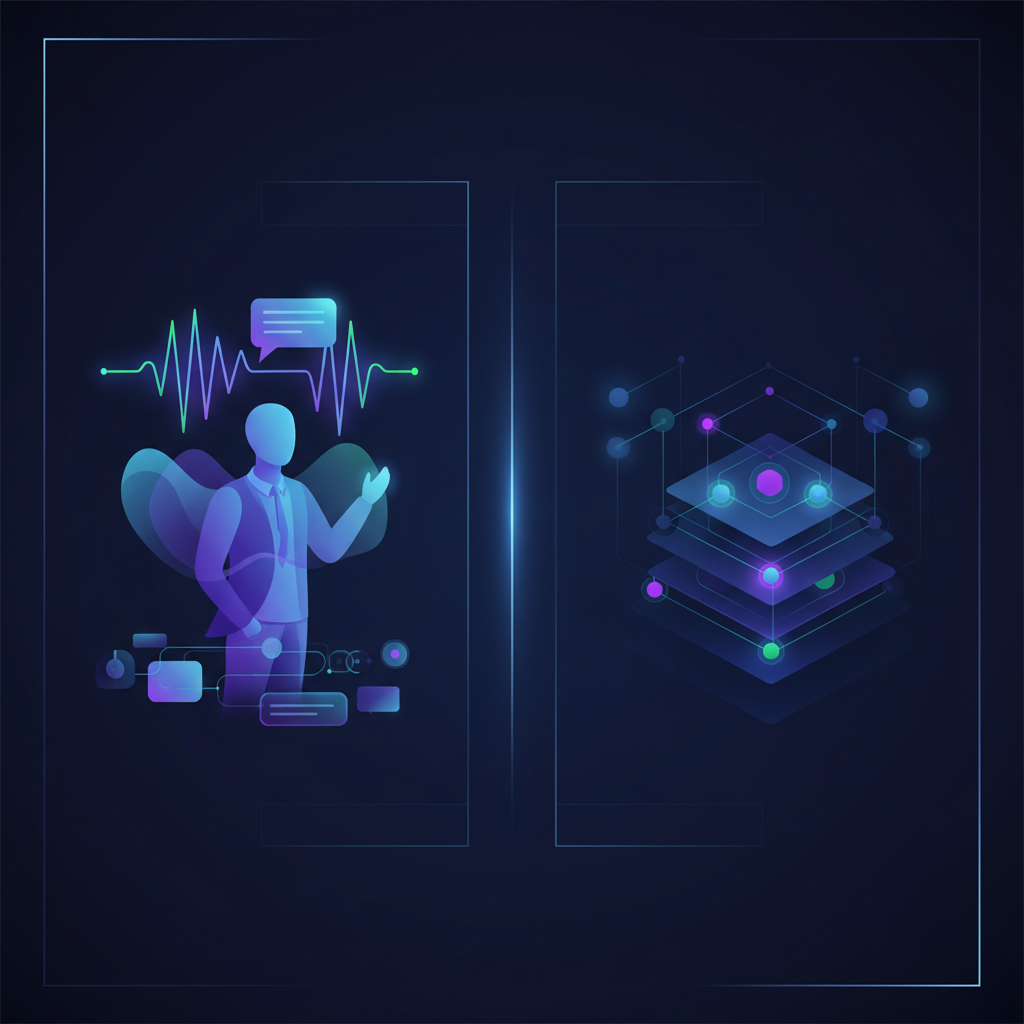
AI sales training data is the structured record of how your reps practice selling before they talk to prospects. It's not the same as conversation intelligence, which analyzes real customer calls after they happen. Training data captures simulated scenarios — AI role-play for sales training sessions, objection drills, discovery rehearsals — and measures whether reps demonstrate the skills you're trying to build.
Most sales leaders confuse activity data (dials, emails sent, meetings booked) with training data. Activity tells you what happened. Training data tells you why a rep succeeds or struggles, and how to fix specific gaps before they cost you deals.
According to Gartner's research on AI in sales, organizations that separate training measurement from activity tracking see 23% faster ramp times because coaching becomes diagnostic rather than reactive.
Here's the distinction that matters: when a rep bombs an objection on a real call, conversation intelligence flags it. When a rep practices handling that objection in AI role-play, training data reveals which part of their response pattern breaks down — the framework, the tonality, the pause placement, the question sequencing — so you can coach the precise skill deficit.
At QUOTA, we see this play out daily. A rep might log 50 practice dials, but if the platform only tracks completion ("Did they finish the scenario?"), you learn nothing. If it captures objection response accuracy, talk ratio during pushback, and framework adherence, you know exactly where to intervene.
The value isn't in the technology that records the session. The value is in what signals you choose to measure and how quickly those signals trigger personalized coaching. That's what AI sales training personalization delivers at scale.
Why most sales training data is useless
The majority of training data collected by sales organizations sits in dashboards no one checks. The problem isn't capture — it's structure.
Unstructured data (raw call recordings, untagged practice sessions, free-text manager notes) requires a human to listen, interpret, and decide what matters. That doesn't scale. By the time a manager reviews last week's practice calls, the rep has already moved on to new accounts and reinforced bad habits.
Structured data (talk ratio, objection response time, framework step completion, tonality variance) feeds directly into coaching workflows. The AI can compare a rep's discovery question sequencing against top performers, flag the gap, and recommend a specific drill — all within seconds of the practice session ending.
Here's what we observe in our platform: reps who receive coaching within 24 hours of a practice session are 3.2 times more likely to apply the feedback in their next live call than reps who get feedback a week later. Speed matters because skill development is a reinforcement loop, not a one-time event.
Most training platforms capture too much of the wrong data:
- Session duration — tells you nothing about skill quality
- Completion rate — measures compliance, not competency
- Self-reported confidence scores — don't correlate with actual performance
- Manager subjective ratings — vary wildly and lack consistency
The data that actually predicts quota attainment:
- Objection response accuracy — did the rep use the taught framework?
- Talk-to-listen ratio during discovery — are they asking or pitching?
- Question sequencing adherence — do they follow the qualification model?
- Tonality consistency under pressure — does their voice confidence hold when challenged?
If your training data doesn't measure these signals, you're collecting noise, not insight. And noise doesn't drive behavior change.
The seven conversation signals that predict performance
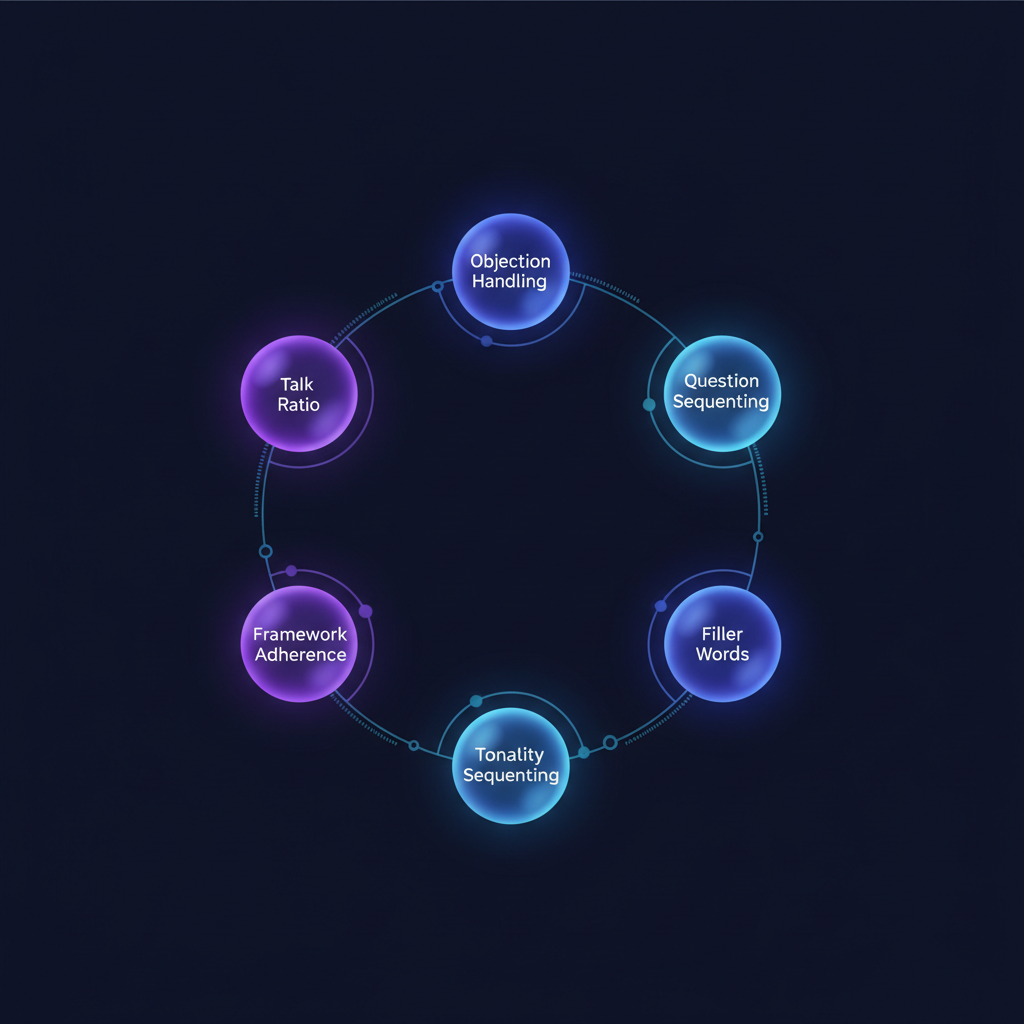
After analyzing thousands of role-play sessions, we've identified seven conversation signals that consistently separate top-performing reps from the middle of the pack. These aren't subjective "soft skills" — they're measurable patterns AI can track in real time.
1. Talk-to-listen ratio
Top performers maintain a 40:60 talk-to-listen ratio during discovery and a 60:40 ratio during objection handling. Reps who talk more than 70% of the time in discovery rarely uncover real pain. Those who talk less than 50% during objections sound defensive.
AI training platforms can measure this per conversation turn, not just overall call time. A rep might hit 50:50 for the full call but dominate the first five minutes (when rapport matters most) and go silent during objection pushback (when confidence matters most). Segment-level data reveals these patterns.
2. Objection response patterns
When a prospect says "We don't have budget," does your rep:
- Immediately pivot to ROI (framework adherence)?
- Ask a clarifying question first (discovery instinct)?
- Offer a discount (panic response)?
Training data should tag the type of response, not just whether the rep said something. We map responses to taught objection handling frameworks and flag deviations. A rep who improvises might occasionally win, but they can't replicate success or teach it to others.
3. Question sequencing
Discovery isn't about asking good questions — it's about asking them in the right order. A rep who jumps to solution questions before establishing current-state pain will trigger buyer defensiveness.
AI can track whether reps follow your qualification methodology (MEDDIC, SPIN, etc.) and identify where they skip steps. In our data, reps who ask situation and problem questions before implication questions book 34% more second calls than those who jump straight to need-payoff.
4. Tonality shifts during pushback
Voice stress analysis reveals confidence gaps that transcripts miss. When a prospect challenges pricing, does the rep's pitch rise? Do they speed up? Do they insert more filler words?
Tonality consistency under pressure is the clearest predictor of objection-handling success. Reps who maintain steady pace, pitch, and volume when challenged close at higher rates — not because they have better scripts, but because buyers interpret vocal steadiness as product confidence.
5. Pause placement
Top performers pause before answering objections, not during. A two-second pause after "We're already working with [competitor]" signals thoughtfulness. A two-second pause mid-sentence signals uncertainty.
Training data should measure pause frequency, duration, and placement. Reps who pause before objection responses convert 22% more objections into discovery conversations than those who respond immediately or hesitate mid-answer.
6. Filler word frequency
"Um," "like," "you know," "sort of" — these aren't just verbal tics. They're credibility killers. Buyers unconsciously interpret filler words as uncertainty about the product or the claim being made.
AI can count filler words per minute and flag spikes during specific conversation phases. A rep might sound polished during their opener but fall apart when asked about implementation timelines. That's a knowledge gap disguised as a communication issue.
7. Framework adherence
If you teach a cold-calling structure (permission-based opener, pattern interrupt, value hypothesis, ask), does the rep actually use it? Or do they improvise based on how they feel that day?
Consistency beats creativity in early-stage selling. Training data should track step completion: Did the rep ask for permission? Did they state the problem before the solution? Did they end with a clear ask?
In our role-play sessions, reps who follow the taught framework in at least 80% of practice calls book 41% more meetings in their first 30 days than reps who "personalize" too early.
How to structure a feedback loop that drives behavior change
Capturing the right data is step one. Converting it into behavior change is step two — and where most training programs fail.
Harvard Business Review on AI coaching effectiveness found that feedback loops longer than 48 hours produce negligible skill improvement. Reps forget the context of their practice session, rationalize their mistakes, and don't connect the feedback to their current performance gaps.
Here's the feedback loop structure that works:
Immediate (within 60 seconds of practice session ending):
- Flag the top two skill gaps (not ten — two)
- Show the exact moment in the recording where the gap appeared
- Provide a model example of the correct behavior (clip from a top performer or the taught framework)
Within 24 hours:
- Assign a targeted drill that isolates the flagged skill (if the issue is objection response timing, don't make them practice a full discovery call — drill objection responses only)
- Require one rep-submitted practice attempt before they can move on
- Auto-escalate to a manager if the rep doesn't complete the drill
Weekly:
- Surface trend data: "Your objection-handling accuracy improved from 62% to 78% this week"
- Compare against cohort benchmarks: "You're in the top 30% for question sequencing"
- Recommend the next skill to focus on based on performance data, not a predetermined curriculum
This loop only works if your training data feeds directly into your coaching workflow. If a manager has to manually review sessions, extract insights, write feedback, and assign drills, the loop breaks. The delay kills urgency, and the rep moves on.
At QUOTA, the platform does this automatically. A rep finishes an objection-handling scenario, and within 60 seconds they see their talk ratio, framework adherence score, and a side-by-side comparison of their response versus the model. They can immediately re-record and improve. No waiting for manager review. No scheduling a coaching call three days later when the context is gone.
That's why AI sales training personalization scales where traditional coaching doesn't. The feedback loop runs continuously, not on a manager's calendar.
What to capture during onboarding versus ongoing training
The data you need from a new SDR in week two is different from what you need from a tenured AE in month six. Training data strategy should evolve with rep tenure.
Onboarding (weeks 1-12): Measure foundational skill acquisition
During ramp, you're teaching frameworks, not refinement. Capture:
- Framework step completion — can they execute the taught structure?
- Script adherence — are they using approved language, or improvising too early?
- Objection response accuracy — do they recognize the objection type and apply the correct framework?
- Tonality baseline — what's their natural confidence level under pressure?
Onboarding data should answer: "Is this rep ready to talk to prospects, or do they need more practice?" You're looking for competency thresholds, not optimization.
In our 30-60-90 day onboarding framework, we recommend reps complete at least 15 AI role-plays per skill area (cold calling, objection handling, discovery) before they touch real leads. The training data from those sessions determines certification readiness, not manager intuition.
Ongoing training (post-ramp): Measure skill retention and adaptation
Once a rep is quota-carrying, training data shifts from "Can they do it?" to "Are they still doing it?" and "Are they adapting to new objections?"
Capture:
- Skill decay signals — are their talk ratios drifting back to old habits?
- New objection handling — when market conditions change (new competitor, pricing shift, economic downturn), can they adapt their responses?
- Advanced technique adoption — are they using the new discovery framework you rolled out last quarter, or reverting to the old one?
- Peer benchmarking trends — is their performance improving relative to cohort, or falling behind?
Ongoing data should answer: "What's the highest-leverage coaching intervention for this rep right now?" You're looking for performance optimization, not foundational gaps.
We see this distinction ignored constantly. Sales leaders use the same training curriculum and data capture for a rep in week three and a rep in month eighteen. That's why training feels like a compliance exercise instead of a performance driver.
The minimum viable data set for personalized AI coaching
You don't need to capture everything to get value from AI sales training. You need to capture the right things with enough frequency to spot patterns.
Here's the minimum viable data set:
Three role-play sessions per rep, per skill area, per month:
- One cold-calling scenario (gatekeeper + decision-maker)
- One objection-handling scenario (budget, timing, or competitor)
- One discovery scenario (qualification + pain exploration)
Seven signals per session (the ones outlined earlier):
- Talk-to-listen ratio
- Objection response pattern
- Question sequencing adherence
- Tonality consistency
- Pause placement
- Filler word frequency
- Framework step completion
One comparison benchmark:
- Rep's current session versus their own 30-day average (am I improving?)
- Rep's current session versus top-quartile performers (what's possible?)
That's it. Three sessions, seven signals, one benchmark. If your AI training platform captures this consistently, you have enough data to:
- Identify individual skill gaps
- Recommend targeted practice drills
- Measure skill improvement over time
- Predict which reps will hit quota in 90 days
Anything beyond this is optimization, not necessity. Most platforms over-capture and under-analyze. They record 40 data points per session but never convert them into a coaching action.
Start with the minimum viable data set. Once your feedback loop is working and reps are actually changing behavior, then add more signals.
How AI sales training data integrates with your existing stack
Training data doesn't live in isolation. It should feed into your CRM, your conversation intelligence platform, and your sales performance dashboards so you can connect skill development to revenue outcomes.
Here's how the integration should work:
CRM (Salesforce, HubSpot):
- Push training completion milestones into rep profiles so managers see certification status during pipeline reviews
- Tag opportunities with the rep's current skill scores (objection-handling proficiency, discovery competency) so you can forecast risk
- Trigger automated training assignments when a rep loses three deals in a row to the same objection
Conversation intelligence (Gong, Chorus):
- Compare real customer call data (what happened) with training data (what they practiced) to identify skill transfer gaps
- Surface objections that appear frequently in live calls but rarely in practice sessions — those are blind spots your training curriculum isn't addressing
- Benchmark a rep's live call performance against their practice session performance to measure confidence decay
Sales performance dashboards:
- Correlate training activity (number of role-plays completed, skill scores) with lagging indicators (quota attainment, win rate, deal velocity)
- Identify which skills drive the most revenue impact so you can prioritize coaching focus
- Segment underperformers by root cause: activity problem (not enough dials) versus skill problem (low objection-handling scores)
Salesforce on sales AI adoption reports that organizations integrating training data with CRM see 19% higher win rates because managers can coach proactively (before deals are lost) instead of reactively (after the post-mortem).
At QUOTA, our integrations push training milestones, skill scores, and drill completion directly into Salesforce and Slack so coaching happens in the tools managers already use. Training data that lives in a separate platform gets ignored. Training data that surfaces in your daily workflow drives action.
Common mistakes that make AI sales training data worthless
Even when organizations capture the right signals, they often render the data useless through poor implementation. Here are the four mistakes we see most often:
Mistake 1: Measuring activity instead of skill quality
"Our reps completed 500 practice calls this month!" Great. How many of them demonstrated competency? How many applied the taught framework? How many improved their objection-handling accuracy?
Volume metrics make executives feel good but don't predict performance. One high-quality role-play with structured feedback beats ten casual practice calls with no measurement.
Mistake 2: Waiting for manager review before delivering feedback
If your AI captures training data but a human has to review it before the rep gets coaching, you've eliminated the speed advantage. The rep will have already moved on to live calls and reinforced their bad habits.
Automate the feedback loop. Managers should review trends (which reps are stuck, which skills are improving), not individual sessions.
Mistake 3: Treating all reps the same
A new SDR needs different data and different coaching than a tenured AE. A rep who struggles with tonality needs different drills than a rep who struggles with framework adherence.
Personalization is the entire point of AI training data. If your platform delivers the same coaching to everyone, you're not using the data — you're just collecting it.
Mistake 4: Ignoring the feedback loop
Data without action is noise. If a rep sees their talk ratio is 75:25 but you don't tell them what to practice to fix it, the insight is worthless.
Every data point should trigger a specific, actionable next step: "Your talk ratio is too high during discovery. Complete this 5-minute drill where you practice asking follow-up questions instead of explaining features."
The feedback loop is what converts data into behavior change. Without it, you're just building a more sophisticated reporting dashboard that no one acts on.
FAQ
What data should AI sales training platforms capture?
AI sales training platforms should capture objection response patterns, talk-to-listen ratios, filler word frequency, question sequencing, tonality shifts during pushback, pause placement, and framework adherence. These signals predict performance better than call volume or duration alone.
How is AI sales training data different from conversation intelligence?
Conversation intelligence captures real customer calls to analyze what happened. AI sales training data captures practice sessions to identify skill gaps before reps talk to prospects. Training data focuses on competency development; conversation intelligence focuses on deal insights.
What's the minimum data set needed to personalize AI sales coaching?
You need at least three role-play sessions per rep covering objection handling, discovery, and cold calling. Track response accuracy, framework usage, and tonality consistency. This baseline lets AI identify individual weak spots and recommend targeted practice scenarios.
How often should sales training data be refreshed?
Capture new training data weekly for onboarding reps and bi-weekly for tenured sellers. Skills decay without reinforcement, and buyer objections evolve. Fresh data ensures AI coaching adapts to current market conditions and individual performance trends.
Can AI sales training data predict quota attainment?
Yes. Objection-handling accuracy, question sequencing adherence, and tonality consistency in practice sessions correlate strongly with quota attainment 90 days later. Reps who score in the top quartile across these signals during onboarding hit quota 2.3 times more often than bottom-quartile performers.
How do you prevent reps from gaming AI training metrics?
Measure skill quality, not completion. Instead of "Did you finish the scenario?" track "Did you use the taught framework?" and "Did your tonality stay consistent under pressure?" Reps can't fake framework adherence or vocal confidence — the AI detects pattern deviations instantly.
AI sales training data is only as valuable as the feedback loop it powers. Capture the right signals, deliver coaching within 24 hours, and connect training activity to revenue outcomes. That's how you turn practice into performance.
For a deeper look at how AI transforms sales training, explore The Complete Guide to AI in Sales. To see how QUOTA's platform captures and acts on training data in real time, visit our product page.
Sources

Stefano Sechi
Co-founder, QUOTA Training
Stefano Sechi is co-founder of QUOTA Training. He works hands-on with B2B sales teams on cold calling, discovery and objection handling, and shaped much of the methodology behind QUOTA’s AI role-play scenarios.
Turn this into reps, not just reading
QUOTA Training lets your team practise these exact scenarios with an AI buyer that reacts like the real thing — then scores every call.
See it in action