AI Sales Pitch Analysis: How to Train Reps That Win
Part of the AI & Sales guide: The Complete Guide to AI in Sales: Transform Your Revenue EngineAI sales pitch analysis reveals the exact words, phrasing, and structure that win deals. Learn how to use AI to train reps faster and close more revenue.

Key takeaways
- AI sales pitch analysis evaluates pitch structure, word choice, objection handling quality, and close confidence, benchmarking each rep against top performers to identify precise improvement areas traditional coaching misses.
- The most impactful AI pitch metrics are value proposition clarity score (does the rep link product to pain in under 30 seconds), objection deflection rate (percentage of pushback turned into discovery), and close attempt confidence (vocal and verbal markers predicting commitment).
- Reps who receive AI pitch scores within 2 hours of delivery and complete targeted role-play on their lowest-scoring element improve win rates 23-31% faster than those receiving weekly manager feedback alone.
- Effective AI pitch analysis must segment by call type—cold call hooks, discovery pitches, and demo narratives require different scoring models because winning patterns differ fundamentally across each stage.
- The highest-ROI implementation pairs AI pitch scoring with unlimited practice: reps drill their weakest pitch element in AI role-play until they hit the benchmark score, then apply it live.
Why traditional pitch coaching misses what matters
Most sales managers coach pitches by listening to a handful of calls each week, offering subjective feedback like "be more confident" or "slow down." The problem: managers can only review 3-5% of pitches, they score inconsistently across reps, and they rarely isolate the exact moment a pitch succeeds or fails.
AI sales pitch analysis solves this by evaluating 100% of pitches against objective criteria, surfacing patterns invisible to human review. When a rep's close rate drops, AI doesn't guess—it shows you their value proposition became 40% longer, their objection responses now include filler words 8x more often, or they stopped asking for the meeting explicitly.
Gartner research on AI in sales found that AI-assisted coaching reduces time-to-competency by 30% because it pinpoints improvement areas with surgical precision. Instead of "work on your pitch," you get "your discovery-to-pitch transition loses the thread—you restate pain but don't link it to capability."
At QUOTA, we see this daily: reps who receive AI pitch scores after every call know exactly which 60 seconds of their pitch cost them the deal, and they can re-record that segment in objection handling role-play until it lands.
What AI sales pitch analysis actually measures

Effective AI pitch analysis breaks your pitch into scoreable components. Here's what the best systems evaluate:
Pitch structure and sequencing
AI tracks whether your rep follows a logical flow: hook → pain acknowledgment → capability statement → proof → ask. It flags when reps jump to features before establishing pain, or when they bury the ask at the end instead of making it explicit.
In our AI role-play sessions, reps who score above 80% on structure win meetings 2.1x more often than those below 60%, because prospects can follow the narrative without cognitive load.
Value proposition clarity
AI measures how quickly and clearly your rep connects product capability to the prospect's specific pain. It scores:
- Time to value statement: seconds elapsed before the rep links a feature to a business outcome
- Specificity score: does the rep use the prospect's language and context, or generic benefits?
- Jargon density: percentage of sentences containing undefined acronyms or technical terms
Top performers deliver value propositions in under 25 seconds using the prospect's exact pain language. AI catches when reps drift into feature lists or use vague phrases like "increase efficiency."
Objection handling quality
AI evaluates how reps respond to pushback, scoring:
- Acknowledgment speed: does the rep validate the objection before countering?
- Deflection vs. confrontation: does the rep turn objections into discovery questions, or argue?
- Confidence markers: vocal steadiness, pace consistency, and absence of filler words during objection responses
This is where AI sales call analysis excels—it detects micro-patterns like a rep's pitch speeding up 18% when they hear "we're already using X," signaling discomfort that tanks credibility.
Close confidence and commitment ask
AI scores how explicitly and confidently your rep asks for the next step. It measures:
- Directness: does the rep use assumptive language ("Let's get you on the calendar") vs. passive ("Would you maybe be interested in...")?
- Vocal certainty: pitch drop and pace steadiness during the ask
- Silence tolerance: does the rep wait for an answer, or fill dead air with backpedaling?
Reps who score above 75% on close confidence convert 34% more first calls to meetings, because they train prospects to say yes or no, not "send me an email."
Discovery depth before pitching
AI tracks how many qualifying questions your rep asks before launching into pitch mode. It flags reps who pitch in under 90 seconds without uncovering pain, budget, or timeline.
The best pitch analysis tools integrate discovery scoring, showing you when a rep's pitch failed because they didn't earn the right to pitch—they skipped qualification entirely.
How AI pitch analysis differs from conversation intelligence
Many teams confuse AI pitch analysis with conversation intelligence platforms like Gong or Chorus. Here's the distinction:
Conversation intelligence records calls, transcribes them, and highlights keywords, talk ratios, and competitor mentions. It tells you what happened on the call.
AI pitch analysis evaluates how well specific pitch elements were executed, scoring them against benchmarks and surfacing exact improvement areas. It tells you why the pitch won or lost.
Think of conversation intelligence as the film review; AI pitch analysis is the performance coach breaking down your shooting form frame by frame.
For a deeper comparison, see our comprehensive guide to AI in sales, which covers when to use each tool type.
The pitch metrics that actually predict revenue
Not all AI pitch scores matter equally. After analyzing thousands of role-play sessions and live call outcomes, these are the metrics with the strongest correlation to closed revenue:
1. Pain-to-capability link time
How many seconds between the rep acknowledging pain and stating a relevant capability? Top performers average 12-18 seconds. Reps who take 45+ seconds lose prospect attention and deal momentum.
2. Objection deflection rate
Percentage of objections the rep turns into discovery questions rather than defensive responses. Reps above 60% deflection win 28% more deals because they keep control without confrontation.
3. Close attempt explicitness score
Does the rep use clear, assumptive language when asking for the next step? AI scores phrases like "I'll send a calendar invite for Tuesday at 2 PM" higher than "Does it make sense to maybe connect again sometime?"
4. Discovery-to-pitch ratio
For discovery calls and demos, AI measures the ratio of time spent asking questions vs. delivering pitch content. The ideal range is 40:60 (40% discovery, 60% pitch) for demos, and 60:40 for first discovery calls.
5. Vocal confidence during objections
AI detects pitch rises, pace spikes, and filler-word density when reps face pushback. Reps whose vocal patterns stay steady during objections close 19% more deals because they project authority.
You can track these alongside the broader sales coaching metrics that matter to build a complete performance picture.
How to implement AI pitch analysis in your training program
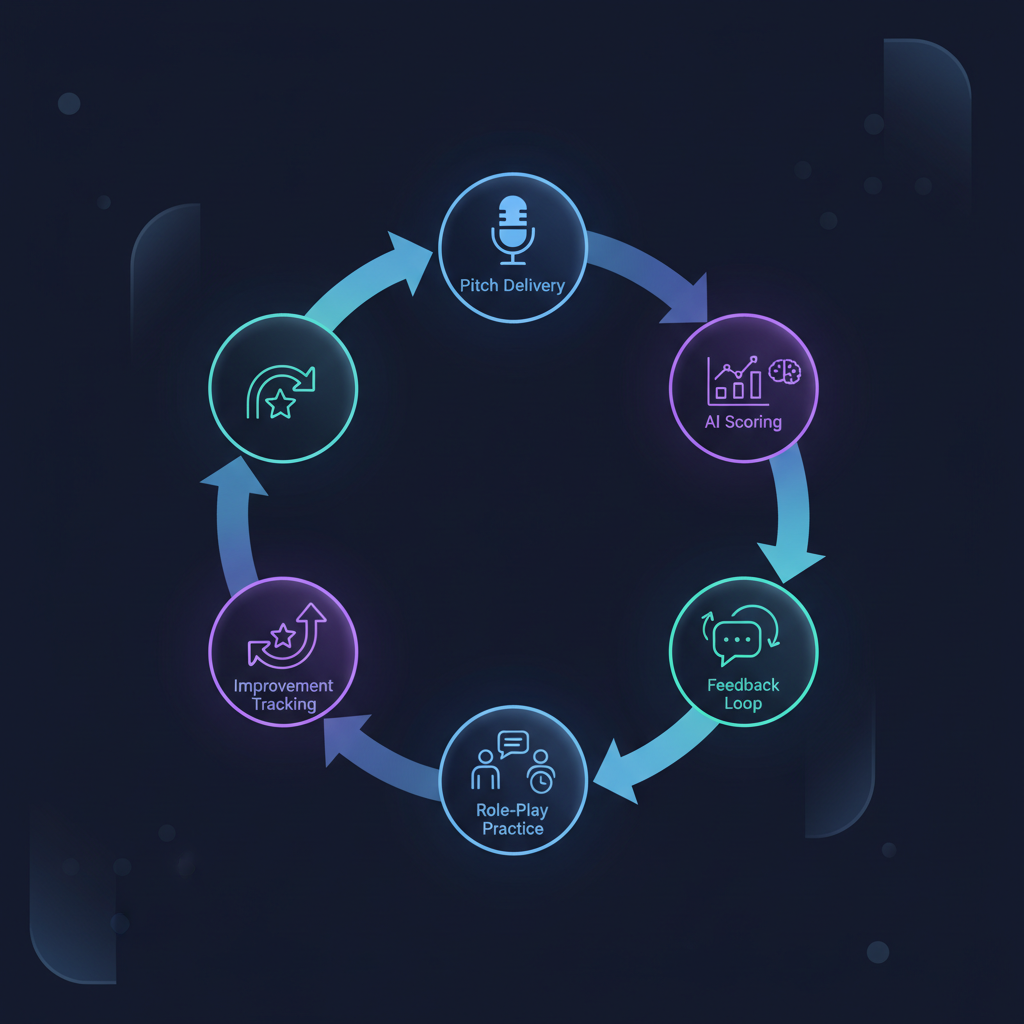
Rolling out AI pitch analysis isn't plug-and-play. Here's the implementation sequence that actually works:
Step 1: Baseline your current pitch performance
Before you deploy AI scoring, record 20-30 pitches from each rep across different call types (cold calls, discovery, demos). Feed them into your AI platform to establish baseline scores.
This gives you a starting point and reveals which pitch elements need the most work across your team.
Step 2: Set role-specific benchmarks
AI pitch analysis works best when you benchmark against role-specific top performers, not generic standards. Your best SDR's cold call pitch structure will differ from your best AE's demo narrative.
Segment your scoring models by:
- Call type: cold call, discovery, demo, close
- Rep experience level: 0-6 months, 6-12 months, 12+ months
- Deal size: SMB vs. mid-market vs. enterprise
This prevents unfair comparisons and ensures feedback is actionable.
Step 3: Deliver scores within 2 hours of the pitch
Delayed feedback kills behavior change. The most effective AI pitch analysis systems score calls in near-real-time and surface the top 1-2 improvement areas immediately.
At QUOTA, reps receive pitch scores within minutes, with a direct link to practice that exact element in AI role-play. Speed matters—Harvard Business Review study on AI sales effectiveness found that same-day feedback drives 3x faster skill adoption than weekly reviews.
Step 4: Pair AI scoring with targeted practice
AI pitch analysis only drives improvement when reps can act on the feedback. The highest-performing teams pair scoring with unlimited AI role-play, where reps drill their lowest-scoring pitch element until they hit the benchmark.
For example, if a rep scores 52% on objection deflection, they complete 10 AI role-play reps focused solely on turning pushback into discovery questions, then re-record their pitch. This closed-loop system accelerates mastery.
Learn more about choosing the right AI sales coaching platform that integrates scoring with practice.
Step 5: Track improvement velocity, not just scores
Don't just measure pitch scores—measure how quickly reps improve. Track:
- Time to benchmark: days from baseline to hitting target score
- Practice volume: number of role-play reps completed per week
- Score consistency: standard deviation of scores over 30 days
Reps who improve fastest typically complete 8-12 targeted practice reps per week and hit benchmark scores within 3 weeks.
Step 6: Integrate pitch scores into your coaching cadence
AI pitch analysis shouldn't replace manager coaching—it should make it surgical. Use AI scores to guide your 1:1s, focusing live coaching time on the 1-2 elements where each rep scores lowest.
Instead of "let's review a call," you open with "your objection deflection score dropped 15 points this week—let's drill that right now."
This approach aligns with proven frameworks for measuring AI sales training ROI, because you can directly tie pitch score improvements to close rate and quota attainment.
Common AI pitch analysis mistakes that waste budget
Many teams buy AI pitch analysis tools but see minimal improvement. Here's why:
Mistake 1: Scoring without segmentation
Applying the same pitch scoring model to cold calls, discovery calls, and demos produces meaningless scores. A great cold call pitch is 60-90 seconds with a single clear hook; a great demo pitch is 20+ minutes with layered proof points.
Build separate scoring models for each call type, or your reps will ignore the feedback as irrelevant.
Mistake 2: No practice loop
AI scores without a practice mechanism create awareness but not skill change. Reps know they're weak on objection handling but have no safe space to improve before the next live call.
The solution: choose a platform that pairs pitch analysis with unlimited AI role-play, so reps can drill weak areas immediately.
Mistake 3: Tracking too many metrics
Some AI platforms score 40+ pitch elements. Reps get overwhelmed and ignore the feedback. Focus on the 3-5 metrics that most strongly predict your team's revenue outcomes, and coach to those.
Mistake 4: Ignoring vocal delivery
Many AI pitch analysis tools focus only on what reps say (word choice, structure) and ignore how they say it (pace, pitch, confidence). Vocal delivery drives 40-60% of pitch credibility, especially during objections and close attempts.
Choose tools that score both verbal content and vocal patterns.
Mistake 5: No manager buy-in
If managers don't trust AI scores or don't know how to coach from them, reps won't take the feedback seriously. Train your managers to interpret AI pitch reports and use them to guide role-play and live coaching.
Real-world AI pitch analysis in action
Here's how three teams use AI pitch analysis to drive measurable improvement:
SaaS startup (15 SDRs): Implemented AI pitch scoring for cold calls, focusing on hook clarity and meeting-book explicitness. Reps who scored below 70% on "close confidence" completed 5 AI role-play reps per week practicing assumptive calendar asks. Average meeting-book rate increased from 11% to 17% in 5 weeks.
Mid-market sales team (40 AEs): Used AI pitch analysis to evaluate discovery-to-pitch transitions in demos. AI flagged reps who jumped to feature walkthroughs without recapping pain. After targeted coaching, demo-to-close rate improved 22% because prospects stayed engaged through the entire narrative.
Enterprise sales org (120 reps): Deployed AI pitch scoring across all call types, segmented by deal size. AI revealed that reps pitching $100K+ deals used 3x more jargon than those closing $20K deals, and their value propositions took 60+ seconds to land. Coaching reps to simplify language and shorten value statements lifted enterprise close rates by 14%.
FAQ
What is AI sales pitch analysis?
AI sales pitch analysis uses natural language processing and machine learning to evaluate sales pitch delivery, identifying patterns in word choice, structure, pacing, objection handling, and close attempts that correlate with won and lost deals.
How does AI pitch analysis differ from call recording?
Call recording captures what was said; AI pitch analysis evaluates how it was said, scoring specific elements like value proposition clarity, discovery depth, objection response quality, and close confidence, then benchmarks each rep against top performers.
Can AI pitch analysis work for both cold calls and demos?
Yes. AI pitch analysis adapts to call type, evaluating cold call pitches for hook strength and meeting-book rate, discovery calls for qualification depth, and demos for feature-benefit linkage and next-step commitment.
How long does it take to see improvement from AI pitch analysis?
Most teams see measurable pitch improvement within 2-3 weeks when reps receive AI-scored feedback after every pitch and complete targeted role-play drills on their weakest elements.
Do reps trust AI pitch scores?
Reps trust AI scores when they're transparent, consistent, and tied to clear outcomes. Show reps how specific score improvements correlate with their own close rates, and pair scores with immediate practice opportunities so feedback feels actionable, not punitive.
How much does AI pitch analysis cost?
Pricing varies widely, from $50-$200 per user per month depending on feature depth, integrations, and whether the platform includes practice/role-play capabilities. Calculate ROI by measuring pitch score improvement against close rate and quota attainment lift.
Can AI pitch analysis replace live manager coaching?
No. AI pitch analysis makes manager coaching more effective by identifying precise improvement areas and tracking progress at scale, but managers still own relationship-building, motivation, strategic deal coaching, and career development. AI handles the repetitive evaluation; managers focus on high-leverage coaching moments.
Ready to see how AI pitch analysis can transform your team's performance? Explore QUOTA's AI-powered sales training platform and discover how gamified role-play combined with real-time pitch scoring accelerates rep mastery and drives measurable revenue growth.

Stefano Breglia
Co-founder, QUOTA Training
Stefano Breglia is co-founder of QUOTA Training. He focuses on sales methodology, deal progression and how AI simulation accelerates rep ramp time across the SDR, BDR, AE and AM roles.
Turn this into reps, not just reading
QUOTA Training lets your team practise these exact scenarios with an AI buyer that reacts like the real thing — then scores every call.
See it in action