AI Sales Training ROI: How to Measure and Prove the Impact
Part of the AI & Sales guide: The Complete Guide to AI in Sales: Transform Your Revenue EngineLearn how to calculate AI sales training ROI with concrete metrics, benchmarks, and frameworks that prove impact to leadership and justify budget.

Key takeaways
- AI sales training ROI is calculated by dividing net revenue gain (from improved win rates, reduced ramp time, and saved coaching hours) by total training investment, then multiplying by 100 for a percentage return.
- Leading indicators like objection handling win rates and call quality scores show impact within 30-45 days, while lagging revenue metrics require 60-90 days to reflect behavioral improvements.
- High-performing AI training programs deliver 3:1 to 5:1 ROI within the first year by compressing ramp time by 20-40% and improving win rates by 8-15 percentage points.
- To prove ROI to leadership, establish baseline metrics for 90 days pre-implementation, track the same metrics post-rollout, and report monthly on both leading indicators and revenue impact.
- The most defensible ROI case combines hard revenue metrics with soft cost savings: reduced manager coaching hours, eliminated external training costs, and improved rep retention.
Why AI sales training ROI is hard to measure (and why it matters)
Most sales leaders know their training isn't working. Reps sit through hours of onboarding, shadow a few calls, get thrown into the deep end, and either sink or swim. When you ask what the return was on that investment, you get shrugs.
The challenge with measuring AI sales training ROI isn't the math—it's isolating the signal from the noise. Sales performance moves for a dozen reasons: market conditions, product changes, territory shifts, seasonality. If you roll out an AI training platform and win rates tick up two months later, was it the training? Or was it the new pricing model, the competitor stumbling, or the fact that your best rep finally closed that whale deal?
This ambiguity is why AI in sales adoption stalls at the executive level. CFOs and CROs want proof, not promises. They've been burned by sales enablement tools that delivered vanity metrics—"10,000 role-plays completed!"—but no change in quota attainment.
Here's the truth: AI sales training ROI is measurable, but only if you define the right inputs, track the right metrics, and build a measurement framework before you roll out the tool. This guide walks you through exactly how to do that, using the methods we've refined at QUOTA Training after coaching thousands of reps and reporting results to dozens of revenue leaders.
For a broader view of how AI transforms sales organizations, see our comprehensive guide to AI in sales.
The AI sales training ROI formula that actually works
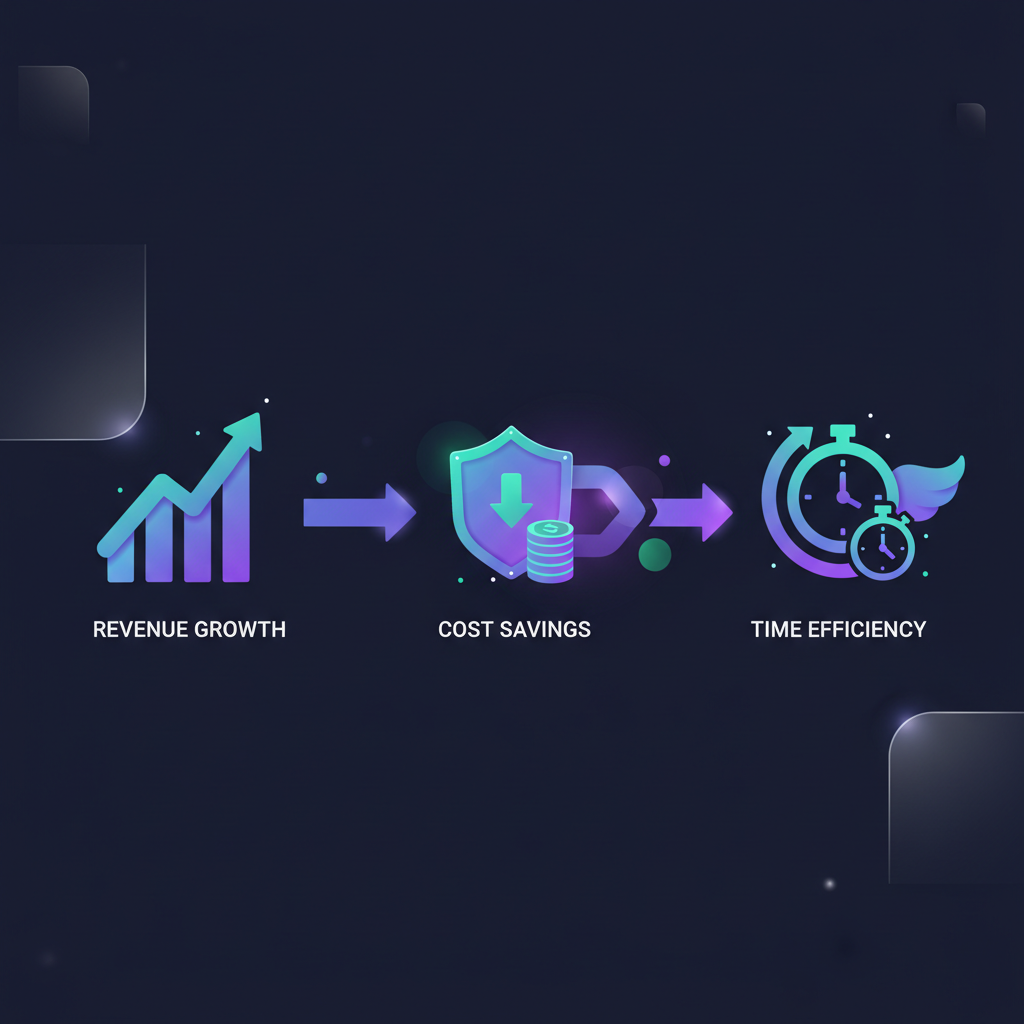
Start with a simple formula:
AI Sales Training ROI (%) = [(Net Revenue Gain - Total Training Investment) / Total Training Investment] × 100
The hard part is defining "net revenue gain." You need to isolate the incremental revenue your team generated because of improved skills, not revenue they would have closed anyway.
Here's how to calculate net revenue gain:
1. Baseline your key metrics (90 days pre-AI)
Before you implement AI training, capture baseline performance across:
- Average ramp time (days from hire to first closed deal)
- Win rate (percentage of qualified opps that close)
- Quota attainment (percentage of reps hitting 100%+)
- Average deal size
- Sales cycle length (days from opp creation to close)
Track these for your entire team for 90 days. This is your control group.
2. Measure the same metrics post-implementation (90+ days)
Roll out your AI training platform. After 90 days, measure the same five metrics. The difference is your performance delta.
For example:
- Ramp time drops from 120 days to 85 days (29% improvement)
- Win rate increases from 22% to 28% (6 percentage points, 27% relative improvement)
- Quota attainment improves from 58% to 71% of reps
3. Translate performance improvements into revenue
Now convert those deltas into dollars:
Faster ramp time: If you hired 10 reps this year and cut ramp by 35 days, each rep produces revenue 35 days earlier. If your average rep closes $20K/month, that's ~$23K per rep × 10 reps = $230K incremental revenue.
Higher win rate: If your team created 400 qualified opps this year at an average deal size of $15K, a 6-point win rate improvement means 24 additional deals closed = $360K incremental revenue.
Improved quota attainment: If 13% more reps hit quota (from 58% to 71% of a 30-person team), that's ~4 additional reps performing at target. At $500K annual quota, that's $2M incremental pipeline contribution (though not all converts to closed revenue in year one).
Add up your incremental revenue, subtract any revenue you would have earned anyway (use conservative assumptions), and you have your net revenue gain.
4. Calculate total training investment
Include:
- AI platform subscription cost (annual)
- Implementation and onboarding time (internal hours × loaded hourly rate)
- Ongoing admin and content management time
- Any displaced costs from legacy training tools you retired
For most mid-market teams (20-50 reps), total annual investment ranges from $30K to $80K depending on platform and internal effort.
5. Run the formula
If your net revenue gain is $400K and your total investment is $60K:
ROI = [($400K - $60K) / $60K] × 100 = 567%
That's a 5.7:1 return. Defensible, reportable, and enough to justify expansion.
Leading indicators: Track these metrics in weeks 1-8
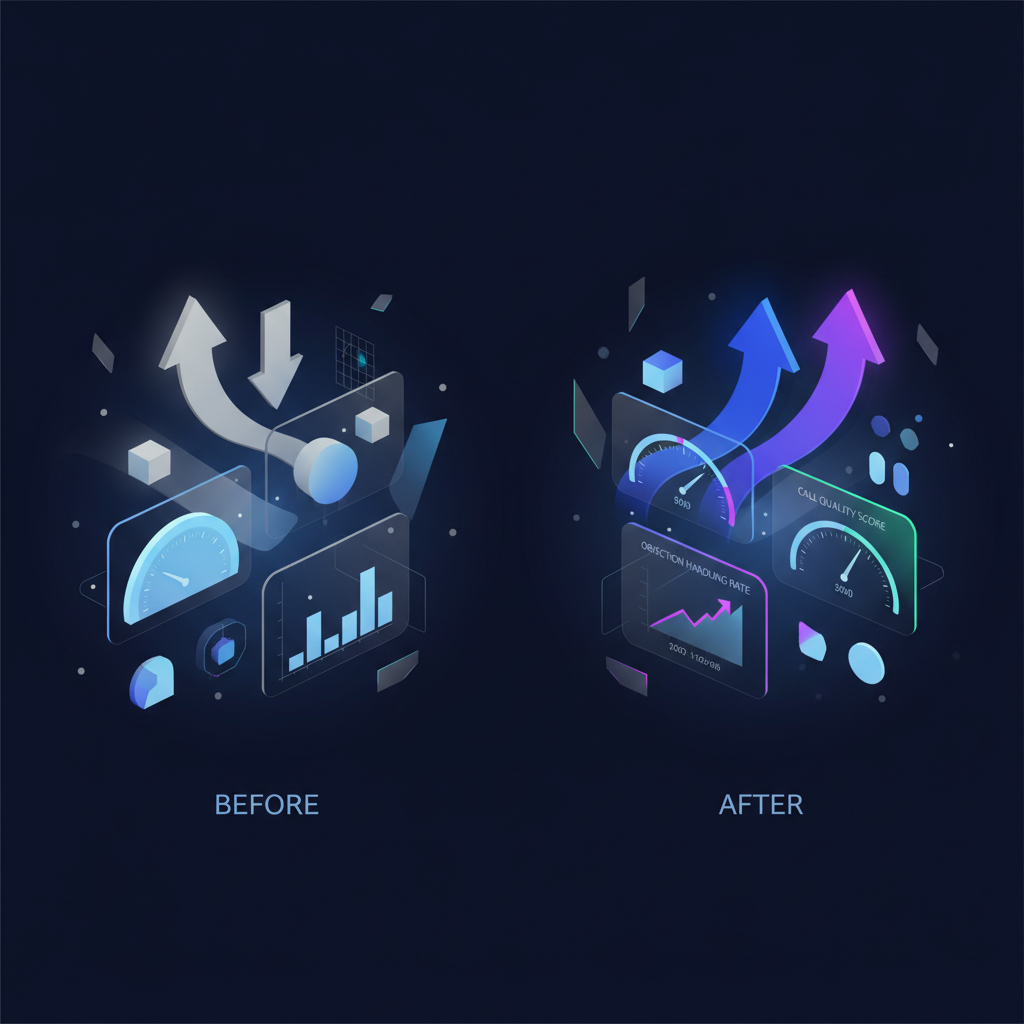
Revenue impact lags behavior change by 60-90 days because of sales cycle length. If you wait that long to know whether your AI training is working, you've lost two quarters.
Instead, track leading indicators that predict revenue outcomes. These move fast—often within 2-4 weeks of reps starting to train.
Objection handling win rate
In our AI role-play sessions, we measure how often a rep successfully navigates an objection and keeps the conversation moving forward. Baseline this metric before training, then track it weekly.
A rep who handles price objections successfully 40% of the time pre-training and 62% post-training has a 22-point improvement. That improvement shows up in discovery-to-demo conversion rates within 30 days and in closed-won rates within 60-90 days.
For tactical approaches to improving this metric, see our guide on AI sales objection handling.
Call quality scores
If your AI training platform includes conversation analysis (as QUOTA does), it can score calls on specific behaviors: Did the rep ask a pain question? Did they confirm next steps? Did they mirror prospect language?
Track the average quality score across your team weekly. A 15-20% improvement in quality score within the first month is a strong predictor of pipeline health 60 days out.
Role-play volume and consistency
Reps who complete 3+ AI role-play sessions per week improve faster than reps who do one every two weeks. Track participation rates as a proxy for engagement and skill development.
In our experience, teams where 80%+ of reps complete weekly role-plays see measurable win rate improvements within 60 days. Teams below 50% participation see no ROI.
Manager coaching hours saved
One of the most underappreciated ROI drivers is time. Before AI training, how many hours per week did each manager spend doing live role-play, listening to call recordings, and giving feedback?
If your five managers each spent 8 hours/week on coaching and AI training reduces that to 4 hours/week (because reps get instant feedback from AI), you've saved 20 manager-hours per week = ~1,000 hours/year.
At a loaded manager cost of $100/hour, that's $100K in saved capacity your managers can redirect to deal coaching, pipeline reviews, and strategic work.
Ramp time compression
Track time-to-first-meeting, time-to-first-opp, and time-to-first-deal for every new hire cohort. Compare cohorts trained with AI vs. cohorts trained the old way.
We consistently see ramp time reductions of 20-40% when AI role-play is integrated into onboarding. A rep who would have taken 120 days to close their first deal now does it in 85 days. That's 35 days of productive selling time you didn't have before—and it compounds across every hire.
Lagging indicators: Revenue metrics that prove long-term ROI
Leading indicators give you confidence in weeks. Lagging indicators give you budget authority in quarters.
Win rate improvement
This is the cleanest revenue signal. If your team's win rate improves by 5-10 percentage points and holds steady for two quarters, you can confidently attribute a portion of that lift to training.
Calculate incremental revenue by multiplying the win rate delta by your total qualified pipeline. A 7-point win rate improvement on $5M in annual pipeline = $350K in incremental closed revenue.
Quota attainment distribution
Don't just track average attainment—track the distribution. AI training should compress the performance gap between your top and bottom performers.
If 60% of reps hit quota pre-training and 78% hit quota post-training, you've added 18% more productive capacity without hiring. That's a massive ROI multiplier.
Average deal size and sales cycle length
Better discovery and qualification (skills AI training reinforces) lead to larger deals and faster cycles. Track both.
If your average deal size grows from $18K to $21K and your sales cycle shortens from 67 days to 58 days, you're closing bigger deals faster—a compounding revenue gain that shows up in annual quota attainment and team capacity.
Rep retention and rehire costs
Reps who feel competent stay longer. If AI training improves confidence and performance, you should see a reduction in voluntary attrition.
Replacing a sales rep costs 1.5-2× their annual salary when you account for recruiting, onboarding, lost productivity, and ramp time. If you reduce attrition from 30% to 20% on a 40-person team, you avoid replacing 4 reps = $200K-$400K in saved costs (depending on comp structure).
How to build a reporting dashboard that leadership trusts
Revenue leaders don't want a 40-slide deck. They want a single-page dashboard they can glance at in a QBR and know whether the investment is working.
Here's the structure we recommend:
Section 1: Investment summary (top left)
- Annual platform cost
- Internal hours invested (onboarding, admin)
- Total investment YTD
Section 2: Leading indicators (top right, updated monthly)
- Objection handling win rate (team average, % change vs. baseline)
- Call quality score (team average, % change vs. baseline)
- Role-play participation rate (% of reps completing 3+/week)
- Manager coaching hours saved per week
Section 3: Lagging indicators (bottom left, updated quarterly)
- Win rate (% and percentage-point change vs. baseline)
- Quota attainment (% of reps at 100%+, change vs. baseline)
- Average ramp time (days, % reduction vs. baseline)
- Rep retention rate (%, change vs. prior year)
Section 4: ROI summary (bottom right, updated quarterly)
- Incremental revenue attributed to training (calculated using the formula above)
- Total cost savings (manager time, avoided rehires, retired tools)
- Net revenue gain
- ROI percentage (the headline number)
Update leading indicators monthly. Update lagging indicators and ROI quarterly. Present this dashboard in every QBR, and tie ROI improvements to specific training initiatives (e.g., "We rolled out negotiation role-plays in Q2; win rate improved 4 points in Q3").
For broader context on how these metrics fit into sales management practices, see our complete guide.
Common mistakes that tank AI sales training ROI
1. Deploying AI training without executive buy-in
If your CRO doesn't understand what you're measuring or why it matters, the program will get defunded the moment budgets tighten. Socialize your measurement framework before you buy the tool.
2. Tracking vanity metrics instead of revenue impact
"Reps completed 5,000 role-plays!" is not ROI. It's activity. Leadership cares about outcomes: Did win rates improve? Did ramp time shrink? Did we close more revenue?
3. Not establishing a baseline
If you don't know your win rate, ramp time, and quota attainment before you start, you can't prove the AI training caused the improvement. Spend 90 days capturing baseline data before you roll out.
4. Ignoring adoption
The best AI training platform in the world delivers zero ROI if reps don't use it. Track participation rates weekly and address drop-offs immediately. Gamification, manager accountability, and tying usage to performance reviews all help.
For more on how gamification drives engagement, explore QUOTA's gamification features.
5. Expecting instant revenue impact
Behavior change takes 30-45 days to show up in leading indicators and 60-90 days to show up in revenue. If you measure ROI after 30 days and see nothing, you're measuring too early. Be patient and trust the leading indicators.
Real-world AI sales training ROI benchmarks
While every team is different, here are the ranges we see across QUOTA customers (20-200 rep teams, B2B SaaS, 30-90 day sales cycles):
- Ramp time reduction: 20-40% (e.g., 120 days → 85 days)
- Win rate improvement: 5-12 percentage points (e.g., 22% → 28%)
- Quota attainment improvement: 10-20% more reps hitting 100%+
- Manager coaching time saved: 3-6 hours per manager per week
- Overall ROI: 3:1 to 6:1 within the first 12 months
High-performing teams that integrate AI sales role-play into onboarding, run weekly practice sessions, and tie usage to performance reviews consistently hit the upper end of these ranges.
Teams that treat AI training as optional or fail to track metrics land at the lower end—or see no ROI at all.
According to McKinsey research on sales performance, organizations that invest in structured, technology-enabled training see 10-20% improvements in sales productivity. AI-powered training accelerates this by delivering personalized, scalable coaching that traditional methods can't match.
How to report AI sales training ROI to your CFO
When you present ROI to finance, lead with the formula and the assumptions. CFOs respect transparency.
Slide 1: The headline "Our AI sales training investment delivered a 4.7:1 ROI in the first 12 months, generating $420K in incremental revenue against a $90K investment."
Slide 2: The calculation Show the formula. Walk through each component:
- Baseline metrics (90 days pre-AI)
- Post-implementation metrics (90 days post-AI)
- Revenue impact of each improvement (ramp time, win rate, retention)
- Total investment (platform + internal hours)
- Net revenue gain and ROI percentage
Slide 3: The assumptions Be explicit about what you're attributing to training vs. other factors. If you improved win rate by 8 points but launched a new product mid-year, attribute only 5 points to training and note the conservatism.
Slide 4: The leading indicators Show that ROI isn't a one-time fluke. Present the monthly trends in objection handling win rates, call quality scores, and role-play participation. These prove the behavior change is real and sustainable.
Slide 5: The ask "Based on this ROI, we're requesting budget to expand AI training from the SDR team to the full AE team in Q2, with a projected incremental ROI of $650K."
CFOs fund what they can measure. If you build a defensible ROI case, you'll get the budget.
What to do if your AI sales training ROI is low (or negative)
If you're 90 days in and seeing no improvement in leading indicators, you have a problem. Here's the diagnostic checklist:
Is adoption below 60%?
If fewer than 60% of reps are using the platform weekly, the issue is adoption, not the tool. Address this with manager accountability, gamification, or tying usage to comp.
Are you training the wrong skills?
If you're running role-plays on closing techniques but your team's real problem is discovery, you're training the wrong thing. Audit your pipeline to identify where deals are actually dying, then train those skills.
Are managers reinforcing the training?
AI training works best when managers reinforce it in live coaching. If reps practice objection handling in AI role-play but never hear their manager reference it in a deal review, the behavior won't stick.
Is your baseline data accurate?
If your baseline win rate was artificially low (e.g., measured during a slow quarter), your post-training improvement might look smaller than it really is. Re-baseline using a full quarter of data.
Are you measuring too early?
Revenue impact lags behavior change. If you're measuring ROI at 45 days, you're too early. Trust the leading indicators and give it 90 days.
For a deeper look at the metrics that matter beyond activity counts, see our guide to SDR metrics that matter.
FAQ
How do you calculate ROI for AI sales training?
Calculate AI sales training ROI by dividing net revenue gain by total training investment. Net gain includes increased win rates, reduced ramp time, higher quota attainment, and saved manager hours. Multiply by 100 for percentage ROI. Track baseline metrics for 90 days pre-implementation, then measure the same metrics 90 days post-rollout to isolate impact.
What metrics prove AI sales training is working?
Key metrics include reduction in ramp time (days to first deal), improvement in win rate percentage, increase in quota attainment, reduction in manager coaching hours per rep, improvement in objection handling success rate, and increase in discovery call quality scores. Track these monthly and compare to pre-AI baselines.
How long does it take to see ROI from AI sales training?
Most teams see measurable improvements within 30-45 days for activity metrics like objection handling win rates and call quality scores. Revenue impact typically appears within 60-90 days as improved behaviors translate into closed deals. Full ROI clarity requires a 6-month measurement window to account for sales cycle length.
What's a good ROI benchmark for sales training investment?
High-performing sales training programs deliver 3:1 to 5:1 ROI within the first year. AI-powered training often exceeds this because it scales without adding headcount. If your AI training costs $50,000 annually and generates $200,000 in incremental revenue through faster ramp and higher win rates, that's a 4:1 ROI.
Can you measure AI sales training ROI without a long baseline period?
While a 90-day baseline is ideal, you can use historical data if it's clean and comparable. Pull win rates, ramp time, and quota attainment from your CRM for the prior two quarters, then measure the same metrics post-implementation. The key is ensuring the comparison period is apples-to-apples—same market conditions, same product, same team structure.
How do you isolate AI training impact from other variables?
Use a control group if possible: roll out AI training to half your team and compare their performance to the other half over 90 days. If a full control isn't feasible, document every other major change (new product launch, pricing update, territory realignment) and adjust your attribution accordingly. Conservative assumptions are better than aggressive ones when reporting to finance.

Stefano Sechi
Co-founder, QUOTA Training
Stefano Sechi is co-founder of QUOTA Training. He works hands-on with B2B sales teams on cold calling, discovery and objection handling, and shaped much of the methodology behind QUOTA’s AI role-play scenarios.
Turn this into reps, not just reading
QUOTA Training lets your team practise these exact scenarios with an AI buyer that reacts like the real thing — then scores every call.
See it in action