AI Sales Coaching ROI: Measure What Training Actually Delivers
Part of the AI & Sales guide: The Complete Guide to AI in Sales: Transform Your Revenue EngineLearn how to calculate AI sales coaching ROI with precision. Track the metrics that prove training impact, justify budget, and scale performance improvements.

Key takeaways
- AI sales coaching ROI is calculated by dividing net revenue gain by total training investment: (improved win rate × average deal size × number of reps - platform and implementation costs) ÷ total investment × 100
- Leading indicators appear in 2-4 weeks (practice frequency, objection handling scores, manager time saved) while lagging indicators (quota attainment, revenue lift) surface in 60-90 days
- The highest-ROI AI coaching programs achieve 5:1 returns by focusing on three levers: reducing ramp time by 30-40%, improving conversion rates by 15-25%, and cutting manager coaching hours by 50%
- Track six core metrics to prove impact: days to first deal, conversion rate by stage, average deal size, quota attainment percentage, manager hours per rep, and training completion rates
- Organizations that measure AI sales coaching ROI weekly (not quarterly) adjust faster, justify budget expansions more easily, and scale training across teams with executive confidence
Why most sales leaders can't prove training ROI
You've invested in an AI sales coaching platform. Your reps are running role-plays. Managers are reviewing fewer calls manually. But when your CFO asks, "What's the return on this?" you're stuck pointing at activity metrics—sessions completed, scenarios practiced—instead of revenue impact.
The problem isn't that AI sales coaching doesn't deliver ROI. It's that most organizations measure the wrong things, track them too late, or never connect training activity to pipeline outcomes. According to Harvard Business Review on training effectiveness, 75% of managers are dissatisfied with their organization's learning function, largely because they can't tie training to business results.
AI sales coaching is different. Unlike traditional training, AI platforms generate granular, timestamped data on every practice session, every objection handled, every tonality shift. That data makes ROI measurable—if you know what to track and how to calculate it.
This guide shows you exactly how to measure AI sales coaching ROI, which metrics matter at each stage, and how to build a business case that justifies expanding your investment. For a broader view of how AI transforms sales performance, start with The Complete Guide to AI in Sales.
The AI sales coaching ROI formula that actually works
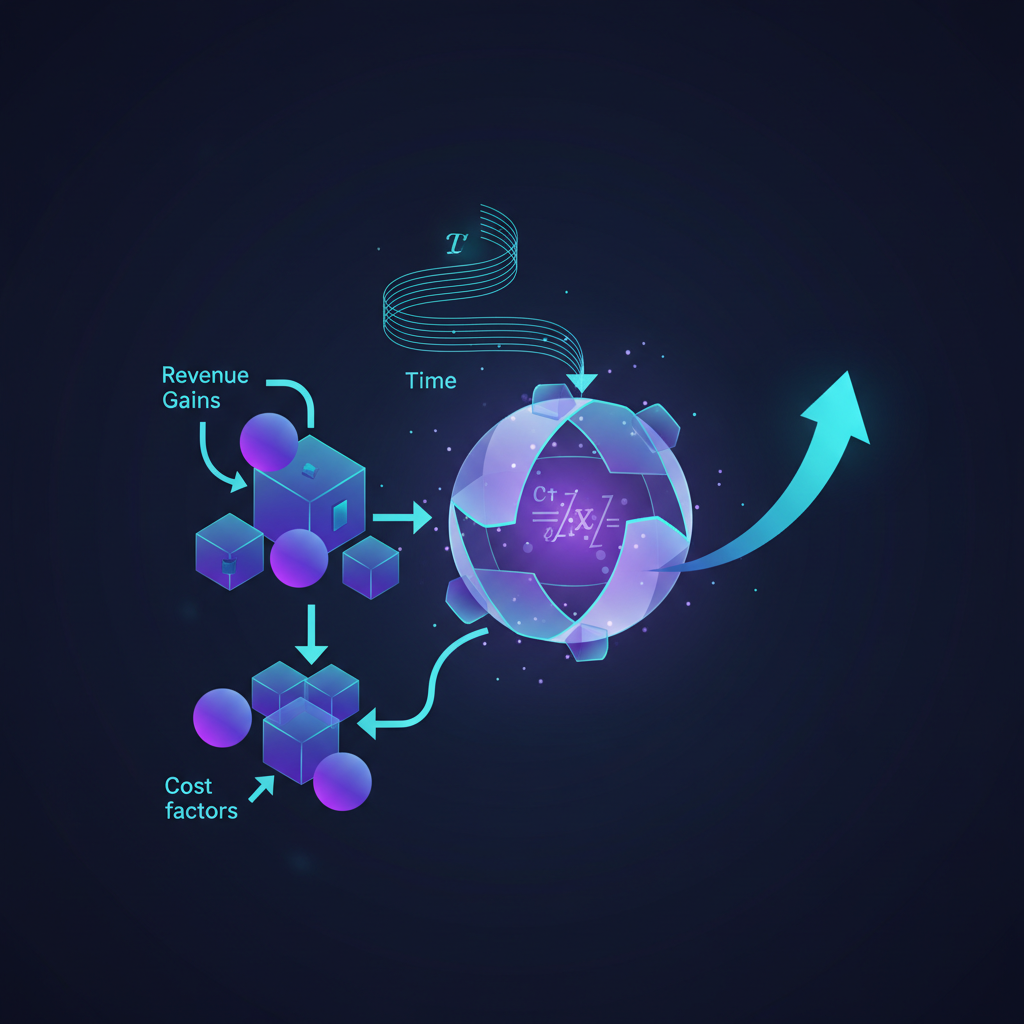
Here's the formula that connects training investment to revenue outcomes:
AI Sales Coaching ROI (%) = [(Net Revenue Gain) ÷ (Total Training Investment)] × 100
Where:
Net Revenue Gain = (Incremental Revenue from Improved Performance) - (Cost of AI Platform + Implementation + Time Invested)
Incremental Revenue from Improved Performance = (Improved Win Rate × Average Deal Size × Number of Reps Trained × Sales Cycle Count in Measurement Period) - (Baseline Revenue Over Same Period)
Total Training Investment = Platform subscription + implementation fees + internal time cost (manager hours × hourly rate) + rep time cost (practice hours × hourly rate)
Example calculation
Let's say you're training a team of 20 SDRs and 10 AEs over six months:
- Baseline performance: 15% meeting-to-opportunity conversion, $50K average deal size, 40% quota attainment
- Post-training performance: 20% meeting-to-opportunity conversion, $52K average deal size, 55% quota attainment
- Platform cost: $30K annually ($15K for six months)
- Implementation cost: $5K (onboarding, integration)
- Manager time: 40 hours saved per month × 6 months × $75/hour = $18K saved (negative cost)
- Rep practice time: 2 hours/week × 30 reps × 24 weeks × $50/hour = $72K
Incremental revenue: The 5-point conversion lift and 15-point quota lift generated an additional $420K in closed revenue over six months (calculated from pipeline data).
Net revenue gain: $420K - ($15K platform + $5K implementation + $72K rep time - $18K manager time saved) = $420K - $74K = $346K
ROI: ($346K ÷ $74K) × 100 = 467% ROI
This formula works because it accounts for both hard costs (platform fees) and soft costs (time), while crediting the revenue lift directly attributable to improved performance metrics.
The six metrics that prove AI coaching impact
To calculate ROI accurately, you need to track both leading indicators (what changes first) and lagging indicators (what changes in revenue). Here are the six metrics that matter most.
1. Days to first deal (ramp time)
This is the number of calendar days from a rep's start date to their first closed deal. AI coaching compresses ramp time by giving new hires unlimited practice in realistic scenarios before they touch a real prospect.
Why it matters for ROI: Every day a rep isn't producing costs you their fully-loaded salary without revenue return. Cutting ramp from 90 days to 60 days means one extra month of quota contribution per rep.
How to track it: Measure cohort-by-cohort. Compare the average days-to-first-deal for reps onboarded before AI coaching versus those onboarded after. In our role-play data, organizations typically see 30-40% ramp reduction within two onboarding cohorts.
2. Conversion rate by funnel stage
Track conversion rates at each stage: cold call to meeting, meeting to opportunity, opportunity to close. AI coaching improves each micro-skill (tonality, objection handling, discovery pacing) that drives these conversions.
Why it matters for ROI: A 5-point lift in meeting-to-opportunity conversion (from 15% to 20%) means 33% more pipeline from the same activity. That's pure efficiency gain.
How to track it: Pull stage-by-stage conversion data from your CRM. Segment by rep, by cohort, and by time period (before/after AI coaching launch). If you're also tracking SDR quota attainment, you'll see how conversion lifts translate to quota performance.
3. Average deal size
AI coaching improves discovery rigor and value articulation, which often leads to larger deal sizes. Reps who practice multi-threading, executive conversations, and upsell scenarios close bigger opportunities.
Why it matters for ROI: A $5K increase in average deal size across 50 deals per year = $250K in incremental revenue with zero additional pipeline required.
How to track it: Compare average closed deal size quarter-over-quarter, segmented by reps who have completed AI coaching modules versus those who haven't.
4. Quota attainment percentage
This is the ultimate lagging indicator. What percentage of reps hit or exceed quota? AI coaching should move the entire distribution curve to the right—fewer reps at 0-50%, more at 80-120%.
Why it matters for ROI: Moving five reps from 60% to 100% attainment is a direct, measurable revenue gain. If quota is $500K, that's $200K per rep, or $1M total.
How to track it: Run a cohort analysis. Compare quota attainment for reps trained in Q1 versus untrained reps in Q1. Control for territory, product, and tenure.
5. Manager coaching hours per rep
AI coaching platforms handle repetitive practice and feedback, freeing managers to focus on strategic coaching. This is both a cost saving (manager time is expensive) and a quality improvement (managers coach higher-value skills).
Why it matters for ROI: If each manager saves 10 hours per month and manages 8 reps, that's 80 hours/month freed up. At a $100/hour fully-loaded cost, that's $8K/month saved—or redirected to higher-leverage activities like deal strategy. This is central to sales coaching scalability.
How to track it: Survey managers monthly. Ask: "How many hours did you spend on live role-play, script review, and call breakdowns this month?" Compare pre- and post-AI coaching.
6. Training completion and engagement rates
If reps don't use the AI coaching platform, ROI is zero. Track weekly active users, scenarios completed per rep, and average practice minutes per week.
Why it matters for ROI: Engagement is the leading indicator of all other metrics. Reps who complete 3+ scenarios per week show measurably higher conversion rates than those who complete fewer than one.
How to track it: Your AI coaching platform should surface this in a dashboard. Set a threshold (e.g., 2 scenarios/week) and measure what percentage of reps hit it. For deeper insight into what practice data to capture, see our guide on AI sales training data.
Leading indicators: What to track in weeks 1-4
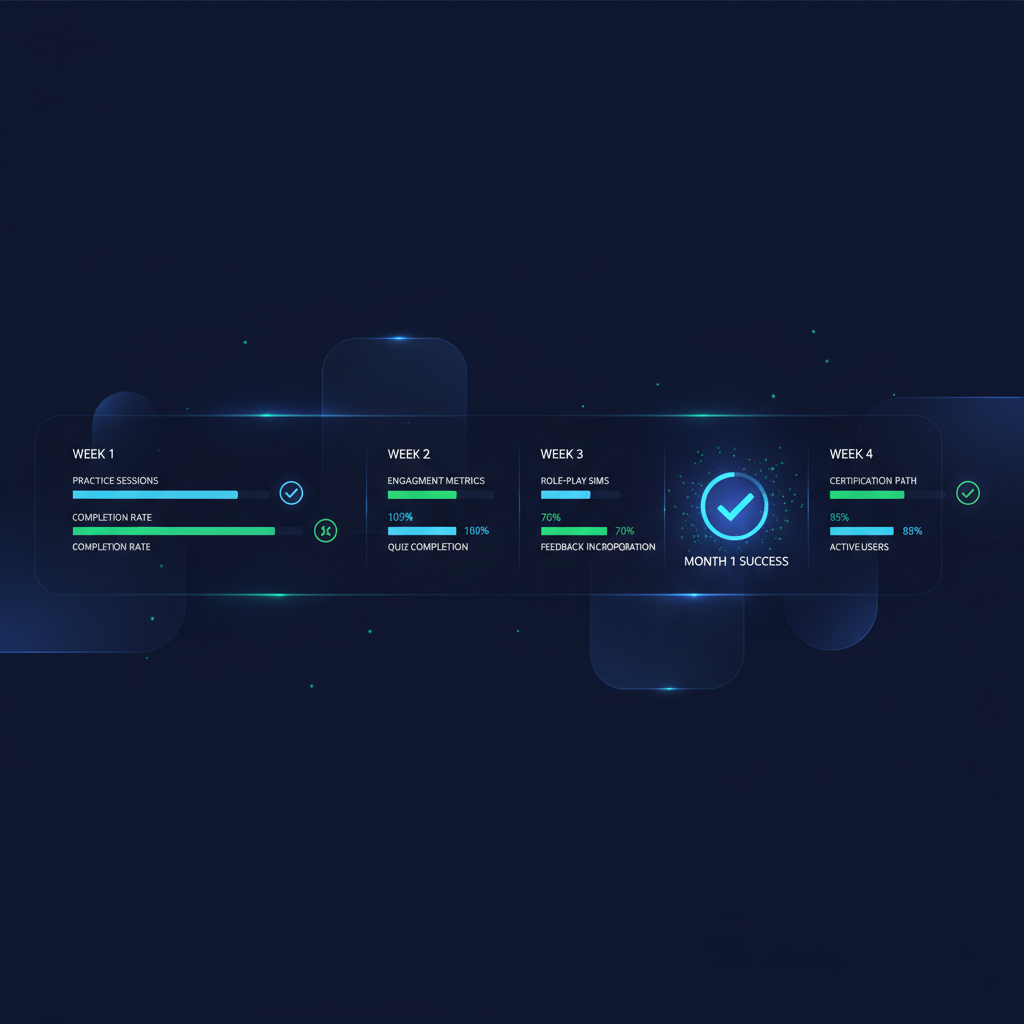
Leading indicators predict future performance. They change before revenue does, giving you early proof that your AI coaching investment is working—and giving you time to course-correct if it's not.
Practice frequency and scenario completion
In the first month, track how many scenarios each rep completes and how often they practice. Reps who engage 3+ times per week in weeks 1-4 consistently outperform those who don't.
What good looks like: 80%+ of reps complete at least 2 scenarios per week. If you're below 50%, investigate adoption barriers (time, manager buy-in, platform UX).
Objection handling scores
AI platforms score how well reps handle objections in simulated calls. Track the average score across your team week-over-week. You should see steady improvement as reps internalize frameworks and practice responses.
What good looks like: A 15-20 point score increase (on a 100-point scale) within the first month. If scores plateau, reps may need more advanced scenarios or manager-led debriefs.
Tonality and pacing metrics
Voice AI analyzes tonality (confident vs. hesitant) and pacing (words per minute, pause length). These are micro-skills that correlate strongly with meeting conversion. For more on this, explore how AI sales coaching feedback captures these nuances at scale.
What good looks like: Reps move from "hesitant" or "rushed" tonality classifications to "confident" and "controlled" within 3-4 weeks of consistent practice.
Manager time saved
Ask managers to log their coaching hours weekly. You should see a 30-50% reduction in time spent on basic skill-building (script practice, objection drills) within the first month.
What good looks like: A manager who spent 15 hours/week on role-play and call review now spends 7-8 hours, freeing up time for strategic deal coaching and pipeline review.
Lagging indicators: What to track in months 2-6
Lagging indicators measure revenue impact. They take longer to surface but are the metrics that justify continued—and expanded—investment.
Conversion rate lift by stage
By month two, you should see measurable conversion rate improvements. Track cold-call-to-meeting, meeting-to-opportunity, and opportunity-to-close separately.
What good looks like: A 10-15% relative improvement in at least one stage by month two, and improvements across all stages by month four. For example, if meeting-to-opportunity was 20%, you're now at 22-23%.
Ramp time reduction
Compare the ramp time (days to first deal) for cohorts onboarded after AI coaching versus before. This metric typically shows impact by month three, once a full cohort has closed their first deals.
What good looks like: A 20-30 day reduction in ramp time for new hires. If your baseline was 90 days, you're now seeing first deals at 60-70 days.
Quota attainment distribution
By the end of a full quarter (month three), analyze what percentage of your team hit quota. Compare this to the previous quarter and to a control group (if you have one).
What good looks like: A 10-15 percentage point increase in reps hitting 80%+ of quota. If 40% of reps hit quota last quarter, you're now at 50-55%.
Revenue per rep
Divide total revenue by number of reps. This is a blunt but powerful metric that captures the combined effect of faster ramp, higher conversion, and better deal sizes.
What good looks like: A 15-25% increase in revenue per rep over six months, controlling for territory and market changes.
How to build a business case for AI sales coaching
When you're pitching AI sales coaching to your CFO or board, lead with ROI—but structure the business case around risk mitigation, scalability, and competitive advantage.
Step 1: Baseline your current state
Document your current performance across the six core metrics: ramp time, conversion rates, average deal size, quota attainment, manager coaching hours, and training engagement. This is your "before" snapshot.
Step 2: Project conservative improvements
Based on McKinsey research on training ROI and Gartner's sales enablement research, AI-driven training programs typically deliver:
- 25-35% ramp time reduction
- 10-20% conversion rate lift
- 15-30% improvement in quota attainment
Use the low end of these ranges in your business case. If you project 10% conversion lift and deliver 18%, you're a hero.
Step 3: Calculate net revenue gain
Use the formula from earlier in this guide. Show the incremental revenue from improved performance, subtract all costs (platform, implementation, time), and calculate ROI percentage.
Step 4: Highlight non-revenue benefits
AI coaching also delivers:
- Reduced manager burnout: Managers spend less time on repetitive coaching, more on strategy
- Consistent onboarding: Every new hire gets the same high-quality training, regardless of manager skill
- Data-driven coaching prioritization: Managers know exactly which reps need help and on which skills
- Scalability: You can double your team size without doubling your training headcount
These benefits are harder to quantify but critical for long-term growth.
Step 5: Show a phased rollout plan
Propose a pilot with a single team or region. Measure ROI over 90 days. If it hits your targets, expand. This reduces perceived risk and builds internal champions.
Common AI sales coaching ROI mistakes (and how to avoid them)
Mistake 1: Measuring activity instead of outcomes
Tracking "scenarios completed" or "hours practiced" feels productive, but it doesn't prove ROI. If reps complete 500 scenarios and conversion rates don't move, you've proven the platform doesn't work.
Fix: Always tie activity metrics (leading indicators) to outcome metrics (lagging indicators). Show that reps who complete 3+ scenarios per week have 18% higher conversion rates than those who don't.
Mistake 2: Waiting too long to measure
If you wait six months to pull ROI data, you can't course-correct. You also miss the chance to show early wins that build momentum.
Fix: Measure weekly for the first month (leading indicators), then monthly for months 2-6 (lagging indicators). Share wins with leadership every 30 days.
Mistake 3: Ignoring control groups
If the entire team gets AI coaching at once, you can't isolate its impact from other variables (new comp plan, product updates, market shifts).
Fix: Roll out in phases. Train one team or region first, keep another as a control, then compare. Or compare new cohorts (trained) to historical cohorts (untrained).
Mistake 4: Underestimating time costs
Platform fees are easy to track. Rep practice time and manager implementation time are not—but they're real costs that belong in your ROI calculation.
Fix: Log time spent in the first 90 days. Include manager onboarding hours, rep practice hours, and any internal training you deliver. Multiply by fully-loaded hourly rates.
Mistake 5: Not connecting training to CRM data
If your AI coaching platform and CRM don't talk to each other, you can't tie practice activity to pipeline outcomes.
Fix: Integrate your AI coaching platform with your CRM (Salesforce, HubSpot, etc.) so you can segment conversion and revenue data by training completion. Most modern platforms offer native integrations or Zapier connectors.
How QUOTA Training customers measure ROI
At QUOTA Training, we've seen hundreds of teams calculate AI sales coaching ROI. The highest-performing organizations follow a consistent pattern:
- They set a baseline in week zero: Ramp time, conversion rates, and quota attainment before any AI coaching
- They track leading indicators weekly: Practice frequency, objection scores, tonality improvements
- They pull CRM data monthly: Conversion rates, deal size, and quota attainment segmented by training cohort
- They run quarterly business reviews: Full ROI calculation, lessons learned, and recommendations for expansion
This cadence gives them early proof of impact, continuous improvement feedback, and a bulletproof business case for scaling.
Our platform makes this easier by automatically capturing practice data, scoring performance, and surfacing insights that managers can act on immediately. You can explore how our approach scales across large teams in our solutions overview.
FAQ
How do you calculate AI sales coaching ROI?
Calculate AI sales coaching ROI by dividing net revenue gain by total training investment, then multiplying by 100. Net revenue gain equals (improved win rate × average deal size × number of reps) minus the cost of the AI coaching platform, implementation, and time invested. Track this over 90-180 days for accurate measurement.
What metrics prove AI sales coaching is working?
The metrics that prove AI sales coaching impact are: reduced ramp time (days to first deal), improved conversion rates at each funnel stage, increased average deal size, higher quota attainment percentage, and reduced manager coaching hours per rep. Track these before and after implementation to demonstrate ROI.
How long does it take to see ROI from AI sales coaching?
Most organizations see measurable AI sales coaching ROI within 60-90 days. Leading indicators like increased practice frequency and improved objection handling appear in 2-3 weeks. Lagging indicators like quota attainment and revenue impact typically surface in the second and third months after launch.
What's a good ROI for sales training investment?
A strong sales training ROI is 3:1 or higher—for every dollar invested, you generate three dollars in incremental revenue. Elite AI sales coaching programs achieve 5:1 or better by combining automated practice, real-time feedback, and data-driven coaching prioritization that scales across large teams.
Can you measure AI sales coaching ROI for a small team?
Yes, but small teams (under 10 reps) require longer measurement periods to reach statistical significance. Focus on individual rep performance improvements—ramp time, conversion rates, deal size—rather than team-wide averages. Track over 6-12 months to account for sales cycle length and sample size limitations.
What if AI sales coaching ROI is negative or flat?
If ROI is flat after 90 days, investigate three areas: adoption (are reps actually using the platform?), relevance (do scenarios match real buyer conversations?), and integration (are managers reinforcing AI coaching in live coaching sessions?). Low engagement is the most common culprit. Address it before expanding investment.
Sources

Stefano Breglia
Co-founder, QUOTA Training
Stefano Breglia is co-founder of QUOTA Training. He focuses on sales methodology, deal progression and how AI simulation accelerates rep ramp time across the SDR, BDR, AE and AM roles.
Turn this into reps, not just reading
QUOTA Training lets your team practise these exact scenarios with an AI buyer that reacts like the real thing — then scores every call.
See it in action